On 14 March 2022, the Global Justice Academy hosted a conversation between Mohamedou Ould Salhi, author of the best-seller Guantánamo Diary, and Dr Kasey McCall-Smith,…
Comments closedCategory: Africa
This is the fourth blog in a series written by LLM students on the Human (In)Security course at Edinburgh Law School. This series celebrates…
Comments closedThis post by is by Oskar Granskogen Kjorstad, Alexandra Haider and Tess Gallagher. They are students enrolled in PLIT10063 ‘Human Rights in International Relations’, an honours-level…
Comments closedThe Global Justice Academy (GJA) and Political Settlements Research Programme (PSRP) recently hosted a free Peace Photography Masterclass at the University of Edinburgh. The workshop…
Comments closedThis blog post was written by Micaela Opoku-Mensah, a masters student in Africa and International Development at The University of Edinburgh. Micaela reports from The…
Comments closedBrooks Marmon is a PhD student in the Centre of African Studies at The University of Edinburgh. His thesis examines Zimbabwean responses to the broader…
Comments closedThis guest post is by Michelle Burgis-Kasthala, who is currently a Research Fellow at the Centre for International Governance and Justice, RegNet, ANU. Michelle will be returning to Edinburgh Law School in 2017-18. This post is re-blogged from ‘Regarding Rights: Academic and Activist Perspectives on Human Rights’ and is based on an article published recently in the Journal of International Criminal Justice: ‘Scholarship as Dialogue? TWAIL and the Politics of Methodology’.

ICC in Ivory Coast in 2013. Image: BBC News
Concerns about the International Criminal Court’s (ICC) continuing relevance in Africa following exit announcements by Burundi, South Africa, and Gambia are widespread. But the picture across the continent is more complex. While some African states have clearly rejected the Court, the majority remain members. How can we explain the fracturing of the Court’s support in Africa? More fundamentally – what is the best way of studying international criminal justice and its effects in the Global South – whether in Africa or elsewhere?
Comments closedOn 7 December 2016, the Global Justice and Global Development Academies supported a student-led initiative to follow the elections in Ghana, as part of their Innovative Initiative Fund. In this post, MSc student, Matthew Pflaum, reflects on the evening’s events.
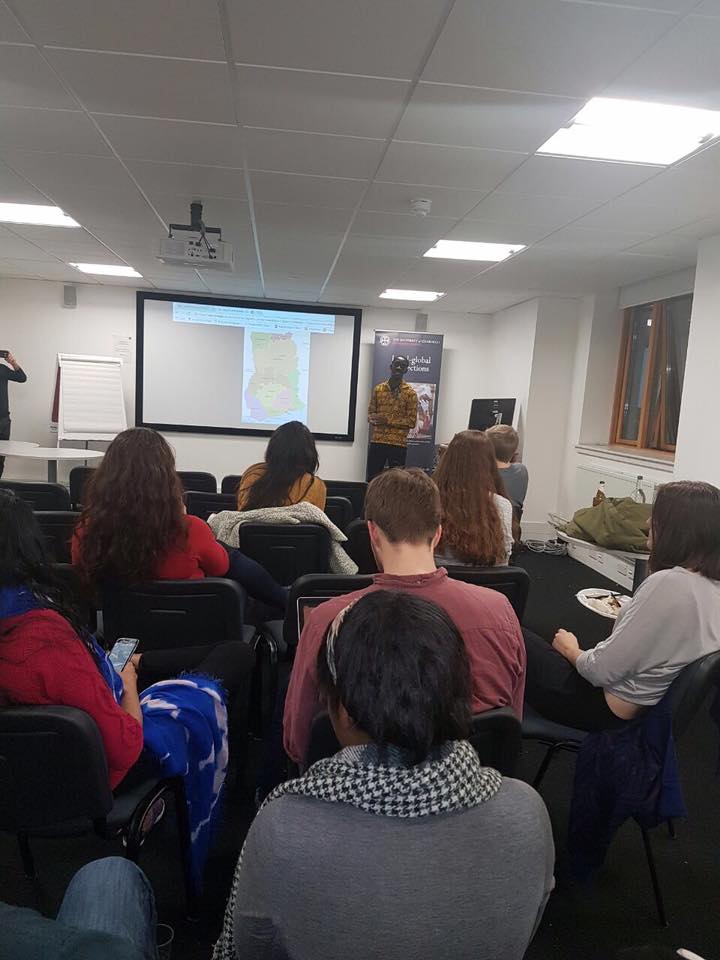 Elections are critical processes for global social and political change, leading to new policies and reforms. Certain elections, referenda, and regions receive widespread attention and coverage – the US election and Brexit, for example – while others are less covered. Elections in the Global South tend to be disregarded by much of the world, and this is a mistake. All elections are significant, principally for local citizens, but also for the rest of the world through geopolitics and trade.
During the US election, crowds gathered in tenebrous bars and sterile classrooms to watch the event unfold, their eyes festooned to the glaring screens with constant updates of results. Americans and non-Americans watched with anticipation, feeling that the event was important to their lives. But aren’t all elections important? Should we not also gather to support elections in Burma and Botswana?
Comments closed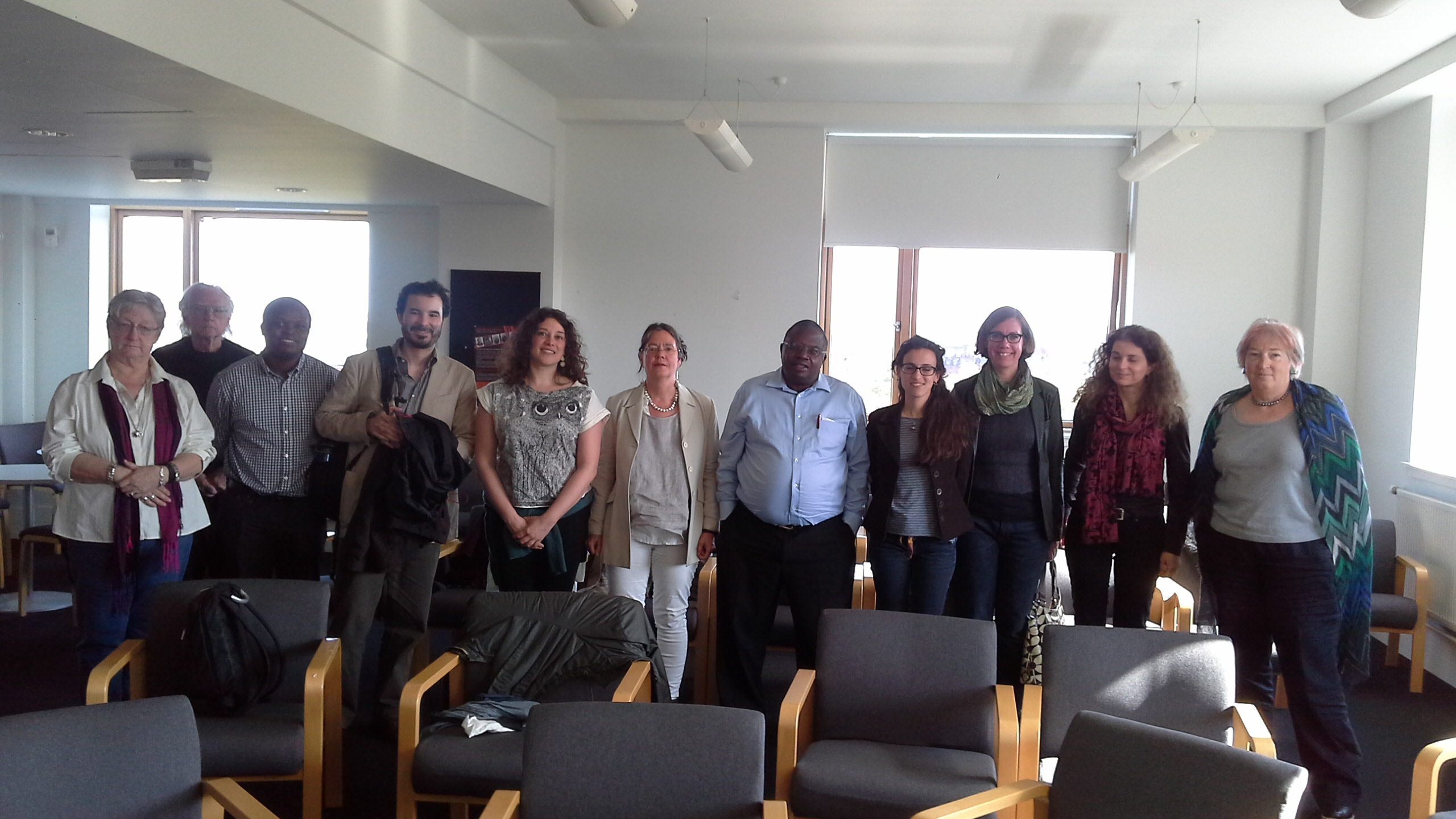 On 16 May 2016 the University of Edinburgh hosted a workshop funded by the British Academy and organised by Professor Anne Griffiths and the Benelex Project Research group, coordinated by Professor Elisa Morgera.
The full-day workshop addressed the issue of access to land as means to realise justice. The workshop intended to discuss four key questions:
- the norms that underpin international and transnational governance regimes regulating access to and use of land and the extent to which they have an impact on individual countries’ jurisdictions on land;
- who are the actors who are engaged in this field and to what extent do their perspectives overlap or conflict with one another when it comes to promoting equitable and sustainable governance over land;
- what impact does globalisation have on the recognition of the legitimacy of plural orders, such as statutory, religious or customary law, and the authority that is accorded to them?; and
- what are the most pressing challenges that counties face in administering land and implementing reform given the global pressures that are brought to bear by international and transnational agencies and institutions.
In this post, two visiting postgraduate students – Marghertia Brunori and Komlan Sangbana – offer some reflections from the day.
Marghertia Brunori
The four presentations of the workshop portrayed the same sensible question of access to land by four different angles, allowing to appreciate the subject in its multifaceted complexity.
Comments closed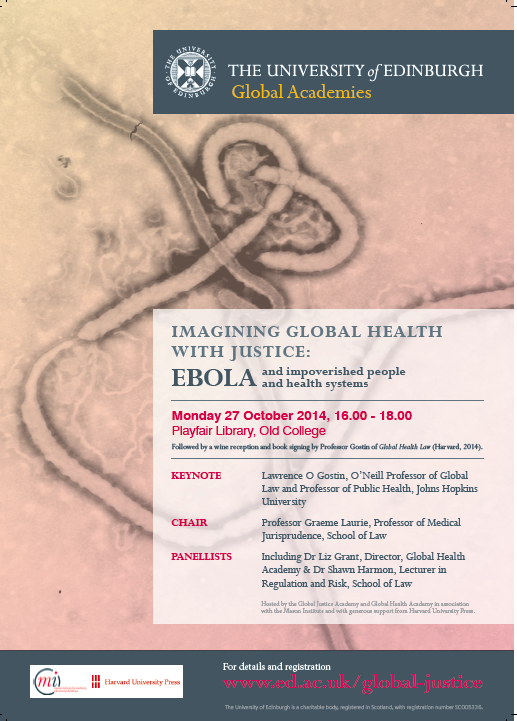
The University of Edinburgh’s Global Academies have announced their Autumn 2014 Ebola Series in response to the current global crisis. In this short post, Dr Harriet Cornell from the Global Justice Academy reflects on how the global response to Ebola has unfolded in the press, and criticisms that have been voiced by experts in the field.
This evening’s Ebola headlines are divided between pleas for world help from Liberia’s President, Ellen Johnson Sirleaf, and blame for the spread and devastation of the outbreak been laid squarely at the doors of the world’s supranational bodies: the World Health Organisation, and the United Nations. Then there is the intersect between the outbreak of the disease in West Africa, and the western media response, with The Guardian running a comment piece entitled ‘The problem with the west’s Ebola response is still fear of a black patient’.
Comments closed