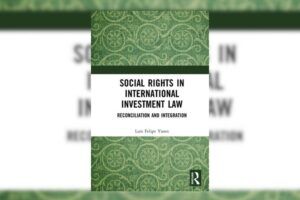
 The Global Justice Academy celebrated Human Rights Day 2025 with the launch of Luis Yanes’ new book, Social Rights in International Investment Law: Reconciliation and Integration. An enthusiastic group of current students, former students, and colleagues gathered at the Old College to celebrate and hear from Dr. Yanes and discussants Professor Katie Boyle, Chair of Human Rights and Social Justice at the University of Strathclyde, and Dr Ana Maria Daza Vargas, Senior Lecturer in International Economic Law at the University of Edinburgh. Dr. Yanes is a guest lecturer in international human rights law at the University of Edinburgh, drawing from his expertise of almost twenty years of involvement in human rights across the globe. He currently serves as the Scottish Human Rights Commission‘ s expert on economic, social, and cultural rights.
Social Rights in International Investment Law discusses privatisation of social rights (water, health, education, housing) and the tense relationship between international investment law and international human rights law. In his new book, Dr. Yanes analyzes their application and interpretation in various sectors, and proposes a novel seven-step method that can be used by tribunals and courts to reconcile the two regulatory systems.
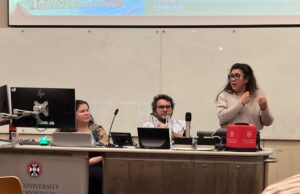
Professor Boyle opened the discussion with her comments on the book from an international human rights law perspective. She praised the grounding of the argument on the general dominance and proliferation in law of neoliberal thought. She pointed out that there states may face limitations in following through with their human rights commitments given the substantial role of private investments. She reflected on the notions of by “progressive realisation” and the “maximum available resources” that permeate and inform the normative content of the rights contained in the International Covenant on Economic, Cultural, and Social Rights (“ICESCR”). States must factor in the ability to secure and deploy those resources, which often cross paths with investment law. The book provides significant insight into this intersection and its relevance to the realisation of social rights.
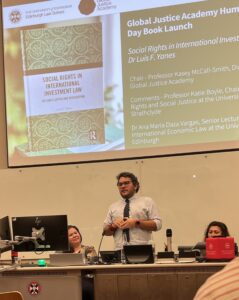 Dr. Daza Vargas drew from her own experience in Bolivia, where the “water wars” have taken place and the tension borne out of the privatisation of utilities is very real. The international investment law system allows investors to bring suit against the state to stop states from using their regulatory authorities in a way that harms investments, whereas the international human rights law system can stop the state from harming citizens’ rights. The two different paths of accountability for the state often work at cross-purposes. While most commentators focus on the incompatibilities between those systems, Dr. Yanes hypothesised a that convergence or integration of those systems is possible. The book focuses on concrete methods for creating that convergence, focusing on the notion of fair and equitable treatment in the context of treaty obligations.
In reflecting on whether the book is an exercise in pragmatism, Dr Yanes reflected that there does not necessarily need to be contradiction on the face of the treaty and legal texts, but the issue is really about how they are interpreted. In order realise social rights it is necessary to address the laws as they exist now, and change the discourse on the interpretation of those laws to support the delivery of social rights. He recalled reading an article that gave him inspiration for the title of one of the book’s chapters: “England’s water can be re-nationalised without compensation.” While the original article did not mention investment law, nor ICESCR, he reinforced how the two bear relevance to this discussion in the UK, but also in every country that aims to deliver the rights enshrined in the ICESCR.
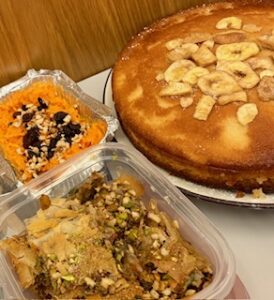
The event concluded with a celebratory reception where two of the current LLM in Human Rights were awarded prizes as part of the Human Rights Day 2025 ‘Bake Your Rights’ competition. Laura Early and Binal Chudasama baked a variety of confections from the Global South reflecting Third World Approaches to International Law (TWAIL) and Article 27(1) of the Universal Declaration of Human Rights. Their ‘Third World Approaches to Dessert’ samplings included Gajar Ka Halwa (Carrot Halwa) from India, Baklava from the Middle East, Meskouta from Morocco, Alfajores from Peru and Caribbean Rum Cake from Jamaica.
Their enthusiasm for celebrating Human Rights Day was shared by all through the joy of their creations. After all, what is a good book without a sweet treat on the side?
Blog Author: Addie Miller, LLM Human Rights Candidate 2026