On 2nd October the Global Justice Academy had the pleasure to co-host a celebratory event to mark the ten-year anniversary of the Platform for Social Rights of the Council of Europe (COE), the European Agency for Fundamental Rights (FRA), the European Network of National Human Rights Institutions (ENNHRI) and the European Network of Equality Bodies. The Platform on Social and Economic Rights was established in October 2015 with the clear aim to strengthen National Human Rights Institutions (NHRIs) and National Equality Bodies in their work for the implementation of social and economic rights. The Platform enhances cooperation across its constituent organisations, facilitates the exchange of good practices across NHRIs and equality bodies, strengthens their capacity to better promote and protect social and economic rights and advances the implementation of European and international standards on social rights at the national level. In particular, the Platform works to advance the effective implementation of the European Social Charter by ensuring its broader institutional acceptance within European states and promoting the Charter’s collective complaint procedure. It does so by hosting annual thematic workshops, issuing reports and publication on topical and relevant issues, providing crucial capacity building and training for stakeholders and generally facilitating institutional dialogue between the COE and stakeholders within the European Union.
Dr Luis Yanes of the Scottish Human Rights Commission (SHRC) and the University of Edinburgh introduced the event, followed by opening remarks from Jan Savage, Executive Director of the SHRC. She highlighted the importance of the occasion which merits celebration, but also presents an opportunity for reflection on the future of the Platform, and how its objectives remain relevant in the current tumultuous times. Mss Savage wondered whether social and economic rights may be the solution to many of the present issues faced by human rights institutions.
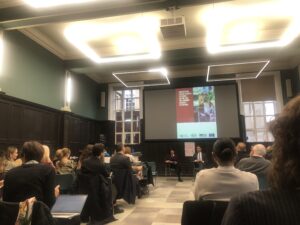
The event consisted of a discussion moderated by Aaliya Seyal, Commissioner with the SHRC, with participants representing the different constituent organisations of the Platform: national equality bodies, NHRIs, civil society and the COE. The discussion [flowed around] three central themes: the lessons learned in the first ten years of the Platform, the challenges faced that were overcome and the Platform’s future trajectory.
Rafael Benitez, Director of Social Rights (Health and Environment) within the COE highlighted central role that the COE plays in coordinating and promoting human rights within signatory states. The flag of the COE acts as unifying symbol for all persons in Europe with a consistent promise of democracy, human rights and the rule of law. He also noted the need in the future to ensure more consistent involvement of Non-Governmental Organisations, who carry significant potential in monitoring human rights practice and who also may play an active role in the enforcement of social and economic rights, as they may submit collective complaints or third-party interventions to the European Committee on Social Rights.
Debbie Khner, Secretrary General, ENNHRIs noted that many of the stakeholders in Europe are not necessarily familiar with the rules and enforcement framework of the European Social Charter, but this status quo ought to change, especially in light of the limited legislative competences of the European Union in terms of recognising and concretising social and economic rights. However, the Platform has played a crucial role so far in drawing attention on social rights. Its very longevity acts as evidence of its continued success, especially given that at the Vienna Conference in October 2015, the Platform of Social and Economic Rights was one of four platforms to be established, but remains now the only one to be active and thriving.
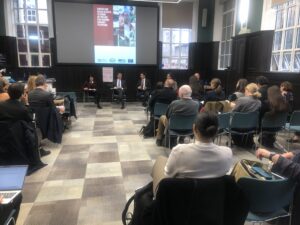
Next, Tamas Kadar, Co-Director of the European Network of Equality Bodies, reflected on the role of the Platform in respect to the contribution by national equality bodies. He noted how such bodies are uniquely well-positioned to ensure better implementation of social and economic rights as they may take practical steps in reducing and removing discrimination in individual enjoyment of social goods, like healthcare, work and housing.
Finally, Piotr Sadowski, Vice-President of the Conference of INGOs of the COE, speaking from the perspective of civil society organisations, focused on the current political moment, and how the Platform presents a unique opportunity to link civil society with national and European governmental organisations, and create a safe space for individuals and groups that are currently suffering as a result of hate speech and marginalisation. Mr Sadowski expressed acute concerns for the threat being posed by the far-right political movements, which presents a significant threat, especially after years in which multiple political actors have been treating human rights, democratic principles and the rule of law as mere political currency. He then concluded with a reflection on the necessity, now more evident than ever, to treat all human rights, including social and economic rights, as indivisible and that going forward solidarity for all communities can only ever be credible if consistently dispensed.
Key reflections on the main presentation focuses on the natural alliance between the various constituent organisations of the Platform, and how through cooperation it is possible for them to further human rights. It was also noted that the traditionally neglected social and economic rights may be central to finding a solution to the current challenges faced by human rights institutions, as opposed to those bad faith actors who provide very simple solutions to very complex problems. These challenges go to the heart of democracy since inequality in social and economic issues may be the root cause of the current mistrust of democratic institutions.
Ultimately, while there may be pressing challenges in the Platform’s immediate future, these may be overcome with better recognition and enforcement of social and economic rights.