As part of my LLM in Human Rights at the University of Edinburgh, I had the unique opportunity to undertake a work placement with the sports company Decathlon. This was a very special experience that enhanced my academic understanding of business and human rights, while offering practical insights into how multinational companies are responding to emerging legal obligations regarding due diligence in their supply chains at EU and domestic levels.
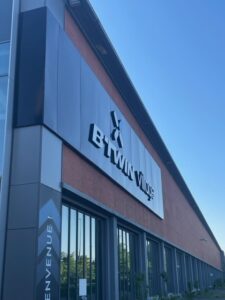
In May, Nonye Ebili (LLM Human Rights) and I were invited to the headquarters of Decathlon in Lille, France, to meet with the company’s Social Responsibility and Impact team. During our three-day visit, we immersed ourselves in the company’s human rights strategy and took part in discussions about implementing the UN Guiding Principles on Business and Human Rights (UNGPs), as well as the potential impact of upcoming EU legislation, such as the Corporate Sustainability Due Diligence Directive (CSDDD) and the Forced Labour Ban.
Our supervisor Jannicke Martin, the Human Rights Manager at Decathlon (and also graduate of our LLM Human Rights programme), gave us a short presentation on business and human rights. She set us the task of developing an action plan to address one of the key human rights risks identified by Decathlon. We were encouraged to benchmark Decathlon against other companies and develop realistic recommendations that could be put into action. Receiving this assignment made me realise that, to be constructive, I needed to shift from an accusatory stance to a more pragmatic, business-focused approach to promoting human rights in supply chains. On our last day, we enjoyed a fun tour of sustainable clothing design and played a round of golf with the team.
Back in Edinburgh, I narrowed down my research. Given my background in Chinese studies, I was particularly interested in the issue of forced labour in the Xinjiang Uyghur Autonomous Region (XUAR) during the cotton harvest. Although this issue has received more international attention recently, I was struck by the lack of legal clarity surrounding state-imposed forced labour (SIFL) as a human rights violation and its potential classification as slavery or enslavement under international criminal law. I therefore attempted to bridge the gap between legal analysis and practical implications for Decathlon, focusing on legal exposure and compliance strategy. Examining documents from various clothing manufacturers, I noted the absence of SIFL-specific language in most supplier codes, highlighting a broader industry gap in engaging with politically sensitive contexts of raw material sourcing.
While the CSDDD and the EU Forced Labour Ban are historic steps towards creating a region-wide human rights due diligence framework, my analysis concluded that many supply-chain issues remain overlooked. Notably, no guidance is provided to companies on how to improve traceability in their supply-chains, which is the most significant challenge in the context of SIFL. It is almost impossible for companies to conduct on-the-ground investigations and take action against non-democratic governments. Furthermore, the EU legislation lacks identification of specific high-risk regions where these types of abuses are occurring, such as the XUAR.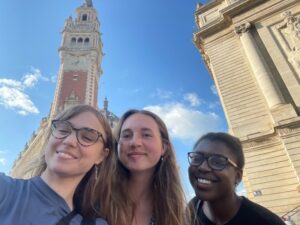
In the final stage of our internship, Nonye and I presented our recommendations to Decathlon’s Social Responsibility and Impact team. For me, this was a very important part of the placement, as it meant that our research would hopefully contribute to internal discussions on advancing human rights due diligence in supply-chains.
I would like to express my sincerest gratitude to Jannicke Martin for dedicating so much of her time and energy to making this work placement as engaging as possible. This placement was a significant period for me personally, as it made me realise how I can contribute to human rights reforms in a business context.

Zsófia van Loo