The Global Justice Academy was pleased to co-host a recent event showcasing the work of Dr Esra Demir-Gürsel, delivered as part of her ongoing project Framing Human Rights. This engaging and thought-provoking session offered an in-depth discussion on her latest paper, which interrogates the often-overlooked role of duties within the European Convention on Human Rights (ECHR). Drawing on social theory, legal case law, and current global challenges, Dr Demir-Gürsel’s presentation invited participants to reflect on how framing choices shape both the interpretation and operation of human rights norms.
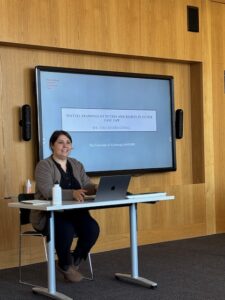
Dr Demir-Gürsel grounds her analysis in framing theory, a concept from the social sciences that explores how individuals and societies perceive, organise, and interpret reality. Frames both illuminate and obscure, determining which aspects of a given issue come into focus and which are left out. This theoretical lens underpins her central argument: that the concept of duties, often treated with caution in human rights discourse, is essential to understanding both the possibilities and the limitations of the human rights framework.
While human rights theory traditionally emphasises entitlements and protections, Dr Demir-Gürsel observes that global challenges such as artificial intelligence, misinformation, and climate change are shifting the conversation. These developments bring questions of responsibility—towards others, institutions, and the environment—to the forefront, compelling a rethinking of what it means to be a rights-holder in an interconnected world.
Turning to the ECHR, Dr Demir-Gürsel notes the Convention’s limited explicit engagement with duties. Article 10, concerning freedom of expression, uniquely acknowledges that this right carries with it “duties and responsibilities.” Yet, as former European Court of Human Rights (ECtHR) President Robert Spano has pointed out, duties also emerge implicitly—particularly in Articles 8 and 11, where the enjoyment of rights is contingent on respect for the rights of others. Spano further identified duties placed on specific actors such as civil servants, military personnel, and legal professionals.
Dr Demir-Gürsel reflects on Spano’s account of a symbiotic relationship between rights and duties—where the fulfilment of obligations enables the exercise of rights. She examines how this argument is deployed in cases involving deportation of settled migrants, vaccination mandates, and environmental protection. Spano put forward both a normative justification (grounded in the individual’s embeddedness within society) and a strategic one (aimed at countering critiques that human rights over-prioritise individual autonomy). Dr Demir-Gürsel, however, critically interrogates both claims, challenging their assumptions through her framing analysis.
Her presentation also engaged with spatial and scalar framing, drawing on the work of Nancy Fraser. Dr Demir-Gürsel argues that the scale at which legal claims are framed—local, national, or international—shapes both their visibility and adjudicative outcomes. Framing, she contends, is inherently political: decisions about scale are not neutral, and misframing can result in the exclusion of certain actors or claims. Rather than treating misframing as error, she proposes that multiple, overlapping frames exist, each characterised by their own priorities, exclusions, and normative assumptions.
Returning to the ECHR, Dr Demir-Gürsel distinguishes between two ways in which duties appear in the Court’s jurisprudence: state obligations to implement and enforce human rights protections; and limitations on individual rights, where duties function as necessary checks on the exercise of freedom.
She highlights two categories of case law to illustrate the second function:
1. Duties as concessions for the common good, seen in the Court’s acceptance of limitations on individual rights in cases such as S.A.S. v. France, where bans on face coverings were justified under the principle of “living together” and the “protection of the rights and freedoms of others”.
2. Duties to obey national law, which arise in cases involving settled migrants (where adherence to national law affects access to rights in relation to deportation) and in Chapman v. UK, where environmental protection laws were upheld even when they conflicted with Article 8 claims from a member of the Roma community in relation to housing.
In her interim conclusions, Dr Demir-Gürsel interrogates the figures of the “dutiful citizen” and the “dutiful guest.” Furthermore, she questions whether the current framing of duties within the ECHR context re-empowers states—contrary to the trajectory outlined by commentators like Moyn and Hoffmann, who highlight the historical shift from citizen rights (vested in state authority) to human rights (intended to constrain it).
She also explores how the ECHR preserves the interface between national and regional legal systems, rooted in the principle of subsidiarity. The Court presumes that member states are functioning democracies governed by the rule of law—an assumption that informs procedural doctrines such as the exhaustion of domestic remedies. She pointed to cases like Köksal v. Turkey, where this presumption is upheld even in contexts of limited domestic redress, revealing the Court’s prioritisation of its relationship with national governments. But what happens when this presumption meets the reality of democratic backsliding?
In her conclusion, Dr Demir-Gürsel emphasises that individuals may be called upon to make sacrifices not only for the preservation of democratic society but also for the integrity of the intergovernmental system to which their state belongs. The Court’s jurisprudence, she suggests, reflects an understanding of the human not as an entirely autonomous rights-bearer, but as a social being embedded in layers of legal, political, and communal obligations. This sociality is spatially framed—first within the nation-state, and then within the broader European context.