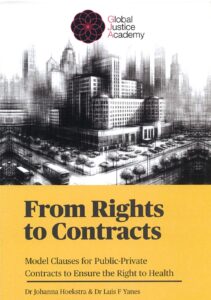
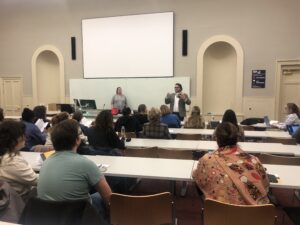
On 23 January, the Global Justice Academy hosted Dr Johanna Hoekstra (Edinburgh Law School) and Dr Luis F Yanes (Guest Lecturer at Edinburgh Law School) for the introduction of their new compendium of “From Rights to Contracts: Model Clauses for Public-Private Contracts to Ensure the Right to Health.” This work explores the critical intersection between economic, social and cultural rights—enshrined in the International Covenant on Economic, Social and Cultural Rights (ICESCR)—and contract law, taking into account business responsibilities under the UN Guiding Principles on Business and Human Rights. Focusing specifically on the right to health, the publication examines how contractual frameworks can safeguard human rights when private actors are engaged in providing health services. By offering model contract clauses, it provides practical tools to ensure that the involvement of private providers in healthcare aligns with human rights obligations.
Context and Inspiration
This work builds on years of research by Dr Hoekstra and Dr Yanes about how to fill the long-running gaps in the state’s human rights obligations when health services are being contracted out to private providers. The presentation offered an overview of the growing reliance on private providers for essential medical services through public-private partnerships (PPPs). These long-term contracts, established between public authorities and private entities, allow private providers to deliver healthcare services without direct payment from those receiving care. Given the expanding role of private actors in healthcare, the authors emphasized the need to structure these agreements in a way that safeguards human rights, particularly the right to health.
While the work remains neutral on the broader debate around privatization, it acknowledges that private sector involvement in healthcare is expected to increase. The authors highlighted concerns that privatization should not inherently undermine the progressive realization of the right to health under ICESCR, but long-term contracts with profit-driven entities can pose challenges, such as cost-cutting measures that may affect service quality or staff qualifications. Additionally, seeking redress in cases of contractual failures can be difficult. To address these issues, this publication offers practical solutions through model contract clauses, ensuring that human rights remain a core consideration in PPP agreements.
Model Clauses and Practical Examples
Recognizing services as essential to protecting and fulfilling human rights was a fundamental message running throughout the presentation. They also took up well recognized issues in the long-standing business and human rights discourse, including human rights due diligence, transparency in contracting, monitoring of contracts, and redress.
Underpinning the discussion of the clauses, both speakers reiterated that though focused on the right to health, these model clauses are capable of being adjusted to accommodate other human rights, including the right to food, right to housing, among many others.
Embedding human rights recognition and protection through contract clauses ensures the gradual culture change that is necessary to pursue a more equitable and just society. It is only by bridging the gap between public and private law, policy and services that this pursuit can be realized.
Their talk finished with some comparative examples of how such clauses could work in different countries. They also emphasized that, for Scotland, this could mark the beginning of implementation efforts related to the UNCRC (Incorporation) (Scotland) Act 2024.
You can explore the model clauses and commentary: [https://blogs.ed.ac.uk/globaljusticeacademy/wp-content/uploads/sites/10170/2025/02/From-Rights-to-Contracts-LFYanes-JHoekstra.pdf].