Any views expressed within media held on this service are those of the contributors, should not be taken as approved or endorsed by the University, and do not necessarily reflect the views of the University in respect of any particular issue.
Press "Enter" to skip to content

Month: July 2018

Why torture? Exploring our Perceptions of Torture, and What Causes It

In this post, our Communications Intern, Jee-Young Song, reports from the second day of the recent GJA-sponsored GREYZONE summer school.
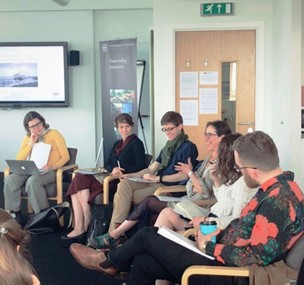
26 June 2018 was the second day of the GREYZONE Summer School, and starting the day’s session was Danielle Celemajer, Professor of Sociology and Social Anthropology at the University of Sydney. Titled ‘The worlds that produce torture’, the main question put to us was:

“What causes torture?”

The straightforward answer to this would of course be obvious: doesn’t torture occur because a malignant perpetrator decided to inflict such an act on the victim?

However, this is an over-simplistic approach, as Professor Celemajer professed her view that there is in fact a complex map of causality for torture, with many contributory factors which extend beyond the scope of the individual perpetrator.

Comments closed
Complicity, Elitism and Storytelling: Exploring Moral Ambiguity in Times of Injustice

In her second post for this blog, GJA Communications Intern, Jee-Young Song, reflects on the recent GJA GREYZONE Summer School keynote session on ‘Conceptual Perspectives’.

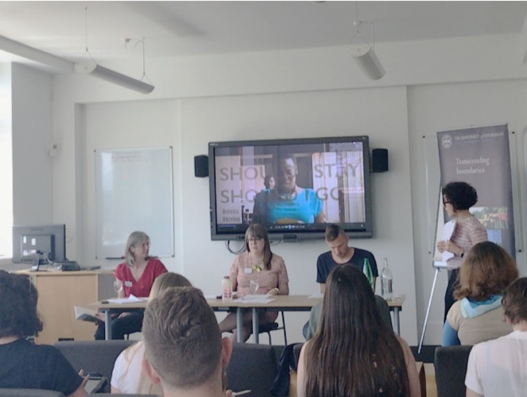
The Summer School kick-started on Monday the 25 June, the theme this year being ‘Navigating the Grey Zone: Complicity, Resistance and Solidarity’.The following is from the ‘Conceptual Perspectives’ talks, where expert speakers from the fields of human rights, philosophy, and political theory (Ruth Kelly, Charlotte Knowles and Lukas Slothuus, pictured above) each gave their unique insight on the key issues.

Storytelling as a way to reinforce human rights

First to speak was Ruth Kelly, who focused on the potential for narrative to help communities articulate approaches to the development of human rights. To give an example of such artistic intervention, she showed footage taken at a poetry workshop in Uganda, where a woman recites a poem about struggling to choose between action and complicity, entitled ‘Should I stay? Should I go?’.

Comments closed
css.php

Report this page

To report inappropriate content on this page, please use the form below. Upon receiving your report, we will be in touch as per the Take Down Policy of the service.

Please note that personal data collected through this form is used and stored for the purposes of processing this report and communication with you.

If you are unable to report a concern about content via this form please contact the Service Owner.

Please enter an email address you wish to be contacted on. Please describe the unacceptable content in sufficient detail to allow us to locate it, and why you consider it to be unacceptable.
By submitting this report, you accept that it is accurate and that fraudulent or nuisance complaints may result in action by the University.

  Cancel