Any views expressed within media held on this service are those of the contributors, should not be taken as approved or endorsed by the University, and do not necessarily reflect the views of the University in respect of any particular issue.
Press "Enter" to skip to content

Month: May 2018

Legacies of Human Rights Violations: Beyond the Legal Paradigm

In this blog, the organisers of this IIF-sponsored film series reflect on the three events and issues raised. The series took place which took place between January and April 2018 at The University of Edinburgh.

The film series ‘Legacies of Human Rights Violations’ addressed the contemporary legacies of human rights violations from an artistic, cinematic perspective. The series involved showing four films: I Am Not Your Negro, My Beautiful Laundrette, REwind: A Cantata for Voice, Tape and Testimony, and Kamchatka. The selected films tackled issues as diverse as racial oppression, gender norms and agency and institutionalised state violence. Specifically, the films focused the experiential reality of human rights issues that stands beyond the grasp of the legalist perspective and its disembodied standards of right and wrong. Indeed, our purpose was to shed light on how the structural, deeply entrenched practices of oppression and discrimination affect people’s everyday lives, intimate domestic spheres and interpersonal relationships, while also unearthing the everyday, relational forms of dissent, solidarity and resistance that arise in response. The film screenings ensued in a fruitful dialogue across the fields of political theory, anthropology, law, film and music studies. They were well attended and engaged students, staff and the broader public in a discussion on the ethical potentials and limitations of cinema as a mode of creative learning and democratic education.

The first film, I Am Not Your Negro, perhaps most explicitly exposed the limits of the Western liberal understanding of democracy and the supposed neutrality of its legal institutions, as revealed by the structural nature of racial oppression. In the film, the director Raoul Peck tells the story of James Baldwin, an American novelist and social critic, based on his unfinished manuscript Remember This House. At the forefront stands Baldwin’s conversations and friendships with prominent figures of the American civil rights movement, such as Medgar Evers, Malcom X and Martin Luther King Jr, bringing forth an emotional insight into the struggles for racial equality in the US.
Comments closed

Incarceration in Scotland: a system with positive evolutions in need of a generalisation of its good practices

In this guest post, Coline Constantin reflects on the recent seminar that tackled issues around incarceration in Scotland. Coline is reading for an LLM in Human Rights at Edinburgh Law School, and applied for funding for this event from the Global Justice and Global Development Academies’ Innovative Initiative Fund.

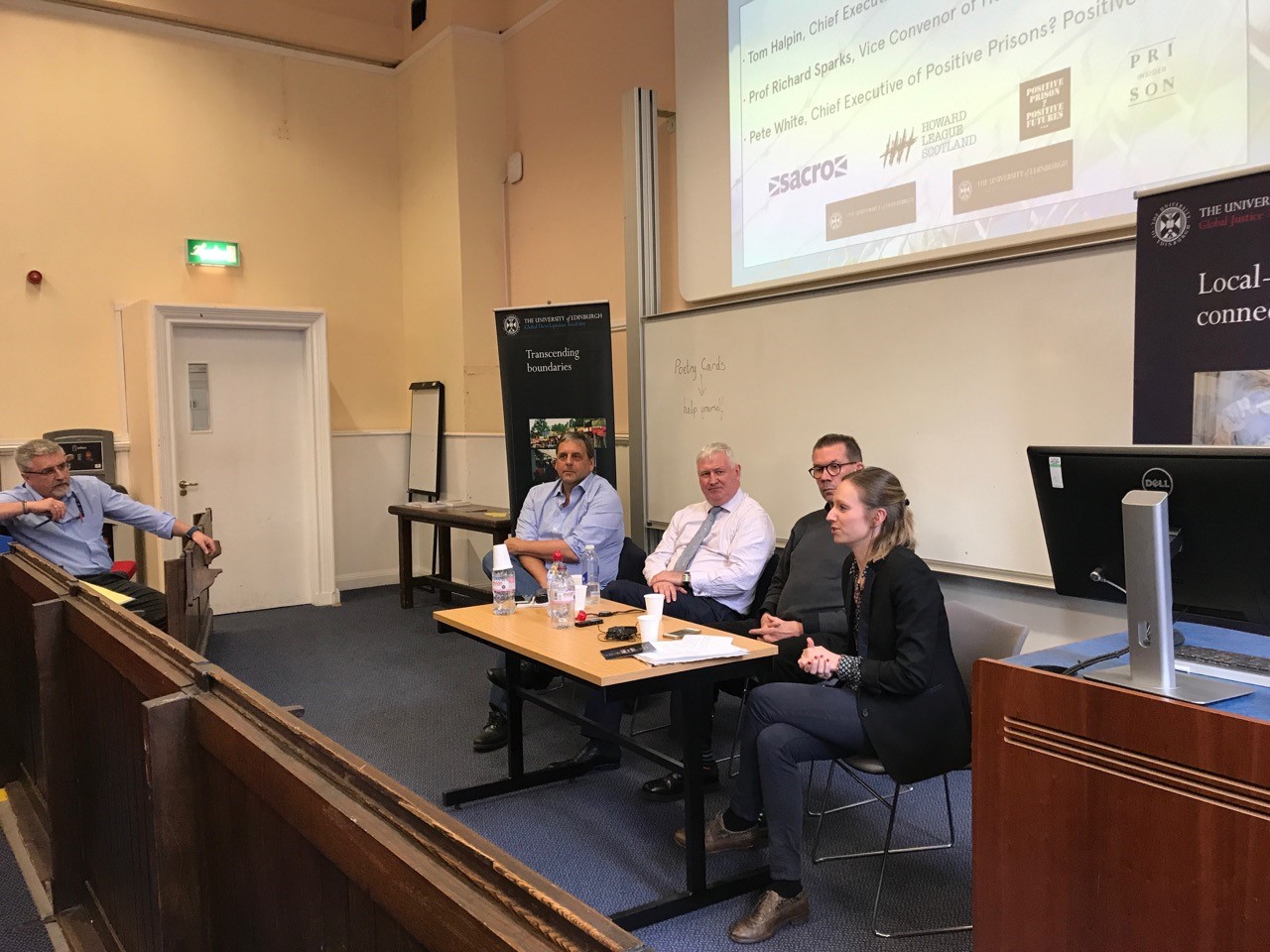
Scotland has the second highest imprisonment rate in Europe. Although English headlines for issues of overcrowding, under staffing, rising rates of self-harming cases do not find an echo north of the border, the statistic still makes it worth taking a closer look at its system. On Thursday 26 April, an engaged audience gathered at the University of Edinburgh to hear more about the positive developments and challenges of the Scottish system of detention.

Three panellists from different fields of expertise and different view angles on the Scottish situation were invited to cover topics from policy-making, to the implementation and analysis of these policies. Professor Richard Sparks, Convenor of Howard League Scotland and criminologist specialised on the different systems of detention in the UK, took us through his analysis of the particularities of the Scottish case within the UK and European context. Tom Halpin, Chief Executive of Sacro and prominent figure in the reduction of inequalities in the Scottish criminal justice system, gave us a sense of the work that is being done with communities and specific groups of people with convictions to go towards better mentoring and guidance throughout the process. Pete White, Chief Executive of Positive Prisons? Positive Future and fascinating storyteller, treated the audience with a story of his personal experience from his time inside and the aftermath of this life-changing event.

Comments closed

The Shadows of Torture: Reporting from Guantánamo

This series of blogs presents a number of the legal issues raised at the April – May 2018 military commission proceedings against the alleged plotters of the 11 September 2001 (9/11) terror attacks against the US in the case of US v. Khalid Shaikh Mohammad, et. al. taking place at Camp Justice, Guantánamo Bay Naval Station, Cuba.

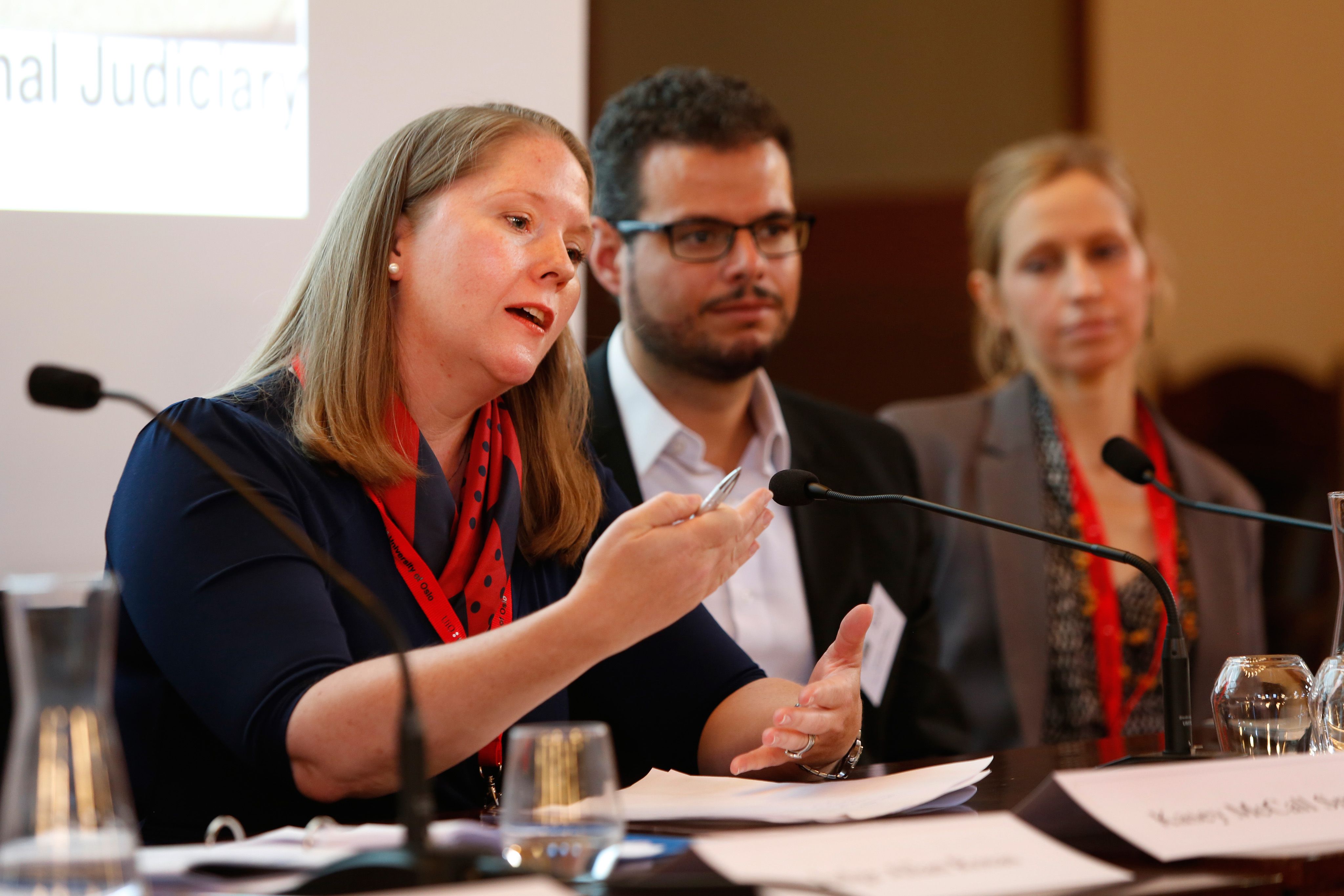
The author, Dr Kasey McCall-Smith, is conducting a research project entitled Torture on Trial, which is funded by the Royal Society of Edinburgh.

1. The Shadows of Torture

When people speak about torture and the war on terror, the most egregious and publicly decried acts generally pop to mind: waterboarding, walling, sleep deprivation, and so on. As the military commission proceedings in case of US v. Khalid Shaikh Mohammad, et. al. (KSM case) unfold, less examined examples aspects of torture reveal the irreversible physical and mental impacts on victims of such abuse.

Comments closed
css.php

Report this page

To report inappropriate content on this page, please use the form below. Upon receiving your report, we will be in touch as per the Take Down Policy of the service.

Please note that personal data collected through this form is used and stored for the purposes of processing this report and communication with you.

If you are unable to report a concern about content via this form please contact the Service Owner.

Please enter an email address you wish to be contacted on. Please describe the unacceptable content in sufficient detail to allow us to locate it, and why you consider it to be unacceptable.
By submitting this report, you accept that it is accurate and that fraudulent or nuisance complaints may result in action by the University.

  Cancel