Any views expressed within media held on this service are those of the contributors, should not be taken as approved or endorsed by the University, and do not necessarily reflect the views of the University in respect of any particular issue.
Harriet Cornell is the Development Officer for the Global Justice Academy. In this guest post, she reports on the botched execution of Clayton Lockett in Oklahoma, and the state of the death penalty in the United States.
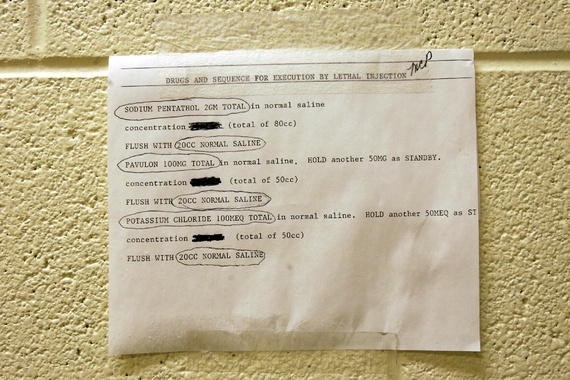
In 2005, this memo was posted next to the death chamber at the Southern Ohio Correctional Facility in Lucasville, Ohio. Credit: AP File Photo
The state of Oklahoma executed Clayton Lockett at 6pm local time on Tuesday 29 April 2014. Or, according to widespread news reports and a statement from Robert Patton (Director of Oklahoma Department of Corrections), the state attempted to execute Lockett but failed, and he died 43 minutes later from a massive heart attack. Charles Warner was due to follow Lockett to the gurney at 8pm, but has been granted a 14-day stay by Governor Mary Fallin, pending an investigation into what happened in that execution chamber.
A guest blog by Akwugo Emejulu, University of Edinburgh and Leah Bassel, University of Leicester, in which they argue that in order to counter the asymmetrical effects of the current economic crisis, intersectional analyses and coalition building are required. They consider how researchers might capture the effects of austerity on representations of minority women’s vulnerability as well as their activism. They do so by drawing on their current empirical project, ‘Minority Women’s Activism in Tough Times’, which explores the impact of the crisis on minority women in Scotland, England and France.
At the time of writing, the UK is undergoing the most extensive reduction and restructuring of its welfare state since its enactment after the Second World War (Taylor-Gooby and Stoeker 2010; Yeates et al 2011). The Conservative-Liberal Democrat Coalition Government is presiding over a 27% cut to local government—the key mechanism for delivery of public services—and a 68% cut to the social housing budget (Taylor-Gooby 2011: 4). Whilst France was not implementing as stringent measures until the January 2014 budget was announced, a key policy aim of the Socialist government is austerity (Clift 2013). The headline of President François Hollande’s 2013 budget, which he described as ‘the biggest budget shock of the past 30 years’ (Guélaud 2012), was a commitment to cutting the deficit to 3% of GDP in 2013 (L’Express 2012). However, the beleaguered Socialist government missed this budget target (BBC 12 March 2013).
A guest blog by Dave Gorman, Edinburgh University’s first Director of Social Responsibility and Sustainability.
“I’ve got principles….and if you don’t like them well I’ve got other principles” Groucho Marx
I love Groucho Marx, but he did once say that he wouldn’t want to be a member of a club that would allow him as a member, so we continue to work to improve our approach to make sure we stick to our principles, and I wanted to share some emerging thoughts on where we are heading.
A guest blog by Dejan Stjepanović of the University of Edinburgh on the Ukraine crisis.
The ongoing Ukrainian crisis raises a number of serious questions about the future of political relations in Europe. Until now, the primary driver of regional integration in post-socialist Europe was the European Union. The return of Russia onto the stage, and its not shying away from using its military power, caught some observers by surprise. Behind the struggle for geopolitical dominance lies a deeper problem which arises from the pervasive influence of the essentialist understanding of nation, state, sovereignty and borders.