
What do I do when I feel torn between identities?
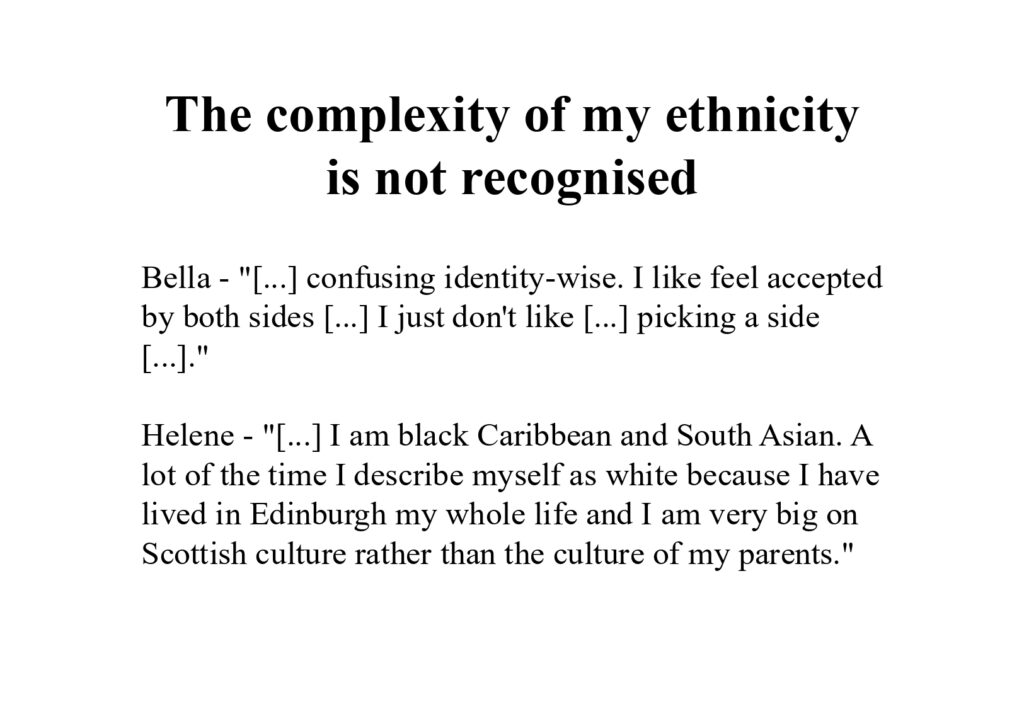
In response to the question “How would you define your ethnicity/race? And how do you feel about it?” we noticed, especially from mixed-race students an experience of feeling torn:
Limit-Situation:
In their discussions in the initial sessions, we noticed the following limit situation:
- Feeling confused or torn between identities, not knowing where one belongs or what to do with our difference. Wanting to align with the dominant identity or a mixture of both in a neutral way while at the same time being aware of the power dynamics involved in this, which leaves one feeling incongruent.
* This limit-situation was especially relevant for people identifying as mixed-race and for people who have grown up in the UK whilst having ancestry coming from the Global South. However, it also becomes relevant for international students who feel torn between the version of themselves that appears in the UK and back home.
Generative Theme: What do I do when I feel torn between identities?
Summary:
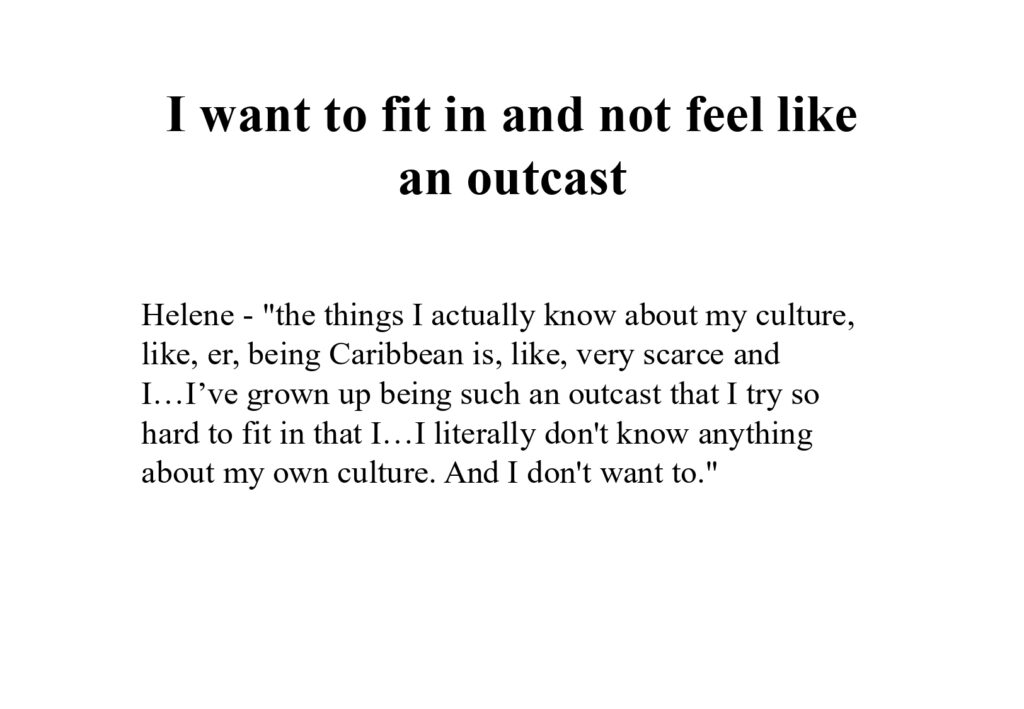
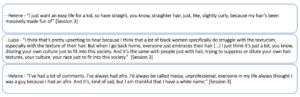
This generative theme was more keenly felt by mixed-race students or students who have close Global South ancestry and have grown up in the UK. In exploring the limiting situation experience, Helene realised the extent to which she ‘accepted’ racialisation because that had been normative growing up in the UK, even to the extent of identifying as ‘white’ (regardless of having black skin) and feeling a lack of interest towards their ethnic roots. Bella often found herself trying hard to say the right things and be accepted by the white people who surrounded them. Yet not all students in this situation shared this approach. A few of them were more vocal about defending and embracing their roots. Thus, dialoguing with one another and hearing each other speak about their own experiences uncovered reflections on diluting oneself and one’s racial or cultural identity, making connections to social realities that reinforce the same. For example, when Helene expressed a desire for her future children to lose her textured hair, Luisa challenged that desire and expressed how upsetting it is to hear this, bringing a reflection on the desire to dilute one’s culture to fit in this society.
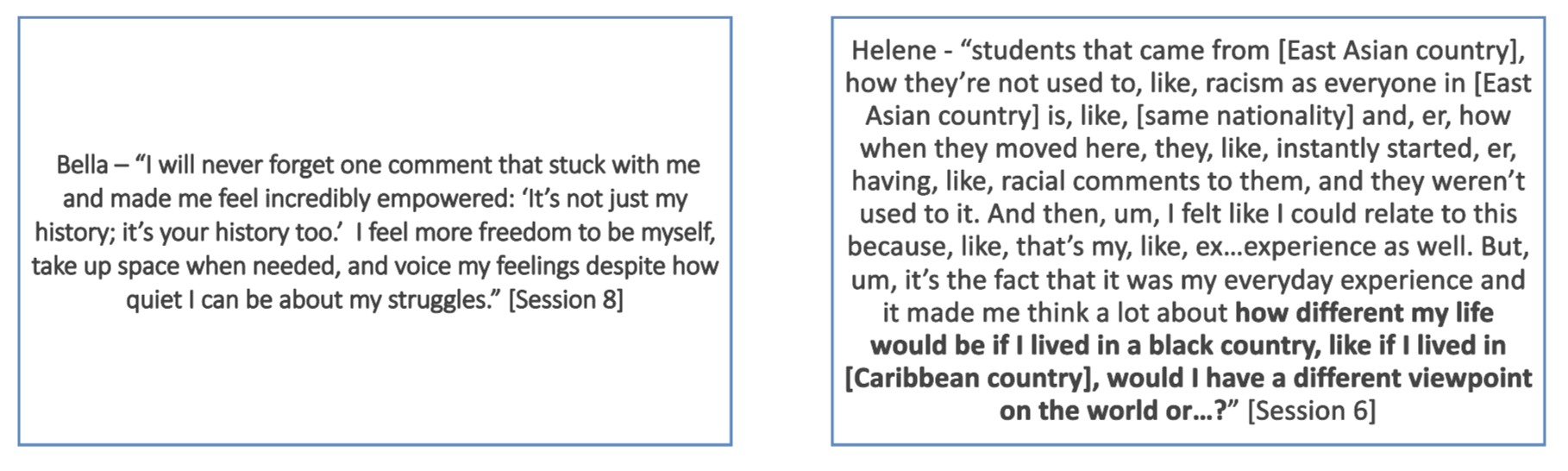
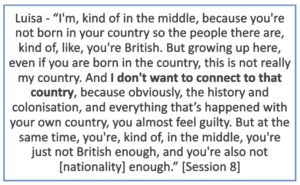
This generative theme thus captures the process of moving from neutrality, confusion or identifying with the dominant identity position to taking a critical position aware of the power dynamics. Bella moved from not taking sides and not wanting to create problems/being worried about how White people would perceive her to showing her disappointment and hurt, feeling connected and seen, and feeling more empowered to speak her truth and name moments of racial discrimination. She seems to have implicitly chosen a side in positioning herself in her Black identity while recognising how quiet she can be in her struggles. Helene troubled her identification as white and wondered whether she would feel the same way if she had grown up in the Caribbean instead of the UK. Luisa clearly expressed not wanting to identify with the UK because it is the colonising country, she instead identifies with the country where she has her ethnic roots. However, she acknowledged the ambiguity and complexity of her position because she does not belong to her chosen country in the same way as someone who has been raised in it.
Reflections:
Reflections on Helene, Bella, and Luisa elucidating the generative theme:
For context, Helene, Bella and Luisa are domestic students. Helene has described her ethnicity as Black Caribbean/South Asian in writing and as White in the first sessions; Bella as Black Caribbean/English; and, Luisa as Black African.
Their processes reflected the movement from confusion and not wanting to pick sides (or explicitly picking the side of the colonising force) to grappling with the impact of colonisation on the psyche to beginning to position themselves closer to their cultural and racial identities, thereby naming the difficulties in doing so and the ways in which structures and socialisations make it an uphill task.
From the second session onwards, we could observe a shift in how much more of herself Helene brought in, even naming how her experience is different. She remained relatively quiet in Session 1, perhaps unsure if she could bring in her ‘different’ experiences. But as the sessions carried on, she started questioning her own position and what she engages with – finding several moments of resonance between hers and others’ experiences, and perhaps recognising that her experiences were not so ‘different’ as she reflected on how she was positioning herself and her identity, and what she was ignoring or pushing away. Even though she joined the project looking for POC spaces, she identified as White in Session 1 and explicitly stated not wanting to know more about her “own culture.” Through the sessions, perhaps through the dialogue the group had on how they felt about being asked ‘where are you from originally’, her dialogue with Luisa (and hearing about Luisa’s relationship with her Black identity), and listening to Asian students in the group, Helene seems to have opened up more about her own experiences with her racial identity – and even tearing up in Session 8 listening to and resonating with other people’s experiences of race.
Bella moved from not taking sides and not wanting to create problems/being worried about how White people would perceive her to showing her disappointment and hurt, feeling connected and seen, and feeling more empowered to speak her truth and name moments of racial discrimination. She seems to have implicitly chosen a side in positioning herself in her Black identity while recognising how quiet she can be in her struggles.
Luisa came in with a strong sense of Black identity and did not seem to resonate with Helene or Bella’s experiences of being torn. She consistently expressed this through comments such as, “you lose a part of yourself by not knowing your history” and “it’s not just your history, it’s theirs too”. By the end of the sessions, she went a layer deeper in the reflections she brought to the group, recognising the disconnect with her culture that she carries due to growing up in the UK while also feeling disconnected from the UK, the country of her colonisers. She expressed with authority that she did not wish to connect with the UK yet she carries this tension of unknowingly conforming and feeling the weight of guilt, thereby complicating this conversation – not only is it about feeling torn internally with one’s identity and having to pick sides but rather the colonial structures in place keep our identities fragmented, even if we consciously put in the effort to pick a side.
Such a recognition of the historical and power structures that influence the way we view our own identities and relate to them was a powerful theme to unpack. The deeper reflections offered by the above Co-Is on their own identities offer insight into the journey of uncovering critical consciousness that took place during these sessions – they reflected on their positionality, questioned how they were feeling about/relating to their own identities, and began to tease out layers that allowed them to have more agency in defining themselves rather than being constrained by their limit-situations of being confused/accepting racialised realities. While Helene and Bella moved towards picking a side and thereby engaging in critical action and questioning, Luisa shed light on another layer – as someone who had entered the group being firmly rooted in her Black identity, she explored the complexity of exercising this critical agency and grappled with her guilt, tension, and worry of unknowingly conforming to the colonial side while simultaneously recognising the disconnect from her own culture even as she seeks to place herself firmly in it.
