
Decoding ME/CFS

Professor Chris Ponting on the study bringing new clarity to ME/CFS research.
For many people living with myalgic encephalomyelitis/chronic fatigue syndrome (ME/CFS), the search for answers why they’re so unwell has been long and often frustrating. Scientific understanding has lagged behind patient need, with research historically underfunded and fragmented.
That landscape is beginning to shift.
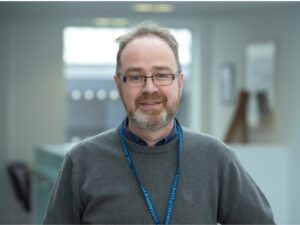
At the Institute of Genetics and Cancer at the University of Edinburgh, Professor Chris Ponting – Chair of Medical Bioinformatics and an Investigator at the MRC Human Genetics Unit – has been leading on DecodeME, the world’s largest genetic study of ME/CFS. By bringing together researchers, charities and thousands of participants, the project has helped to build a clearer picture of the biology underlying the condition.
We spoke with Chris about how the study came together, what it has revealed so far, and why he believes the field is entering a new phase.
Building an evidence base
DecodeME grew out of a long-running collaboration between researchers, charities and people with lived experience, supported by funding from the Medical Research Council (MRC) and the National Institute for Health and Care Research (NIHR).
“The study really came from a researcher-patient-charity collaborative,” Chris explains. “It stemmed from conversations that began about ten years ago, and ultimately led to a funding award for a genetics study.”
For Chris, genetics offered a way to bring clarity to a field where many questions remain open.
“I had not seen a persuasive argument as to why ME/CFS is destroying so many people’s lives,” he says. “The field needed a more evidence-based approach to determining what are the right experiments to do first.”
Genome-wide association studies, which look across the genome to identify genetic differences linked to disease, have transformed understanding in many other conditions. DecodeME set out to apply the same approach to ME/CFS at an unprecedented scale.
Research at scale
More than 25,000 people signed up to take part, with over 18,000 providing DNA samples. After extensive quality control, the team analysed data from over 15,000 participants.
“It’s now quite normal to do big data studies,” Chris says. “Studies of this size provide the power to find things out that smaller studies haven’t been definitive about.”
Large datasets are particularly important in ME/CFS, where smaller studies have often produced findings that proved difficult to replicate.
Listening to what the data and patients are telling us
The study has identified eight regions of the genome associated with risk of ME/CFS, pointing towards biological pathways involving the brain, immune system and chronic pain.
Looking at where the relevant genes are active, Chris says, “The answer is very clearly in the brain, which gives strong evidence that these associations relate to neurological processes.”
For him, one of the most striking aspects was how closely the findings aligned with patient experience.
“The DNA was speaking back to us what we had already been hearing from people with ME,” he says.
He emphasises that these are population-level insights rather than diagnostic tools for individuals. “It’s about changes of risk – not that if you have a variant you will have ME, but that it slightly tilts the odds.”
A field gaining momentum
Chris sees DecodeME as part of a broader shift in the research landscape.
“The evidence base is firming up,” he says. “People who matter – healthcare professionals, family, friends – are becoming more compassionate and understanding.”
He believes the field is now following a trajectory seen in other conditions, where sustained investment and larger studies gradually build a foundation for breakthroughs.
“I think we’re at the beginning of a process that perhaps wasn’t happening a couple of years back.”
What comes next
The team is continuing to refine its analyses, including studying additional genomic regions, improving understanding of which genes are involved, and comparing findings with other diseases.
“Our future work is all about adding to and improving what we’ve already done,” Chris says.
He is also clear about the importance of continued investment. More comprehensive sequencing could reveal rare genetic changes and help attract pharmaceutical interest in developing new treatments.
“What I would want for the ME community is a way of reading out the whole of everyone’s genomes,” he says, noting that this could provide the deeper insights needed to drive therapeutic development.
Hope grounded in progress
Chris recognises that scientific timelines can feel slow, particularly for those living with ME/CFS.
“I understand how hard it is to stay hopeful,” he says. But he believes the direction of travel is positive, with growing recognition and stronger evidence guiding future work.
Genetics, he adds, provides a powerful starting point. “It’s a starting point, not the end of the story.”
Community at the heart of progress
DecodeME’s success reflects the commitment of thousands of participants and the wider ME/CFS community, whose involvement has helped shape and drive the research forward.
That spirit of collective effort extends beyond the laboratory. Across the community, people affected by ME/CFS – alongside families, friends and supporters – continue to organise events and initiatives to raise funds and awareness for research.
In the following case studies, we highlight some of the community fundraisers whose creativity and determination are helping to sustain momentum and support the next steps in understanding ME/CFS.
Meet our community fundraisers

Isaac Greer
Isaac is organising Blue Sunday for ME, an online concert in aid of the University’s ME/CFS research:
I was inspired by my older sister, who has very severe ME and is bedridden. She is funny, caring, clever, determined, hopeful and incredibly brave. Seeing what she lives with has made me determined to do what I can to raise awareness and support research into treatments and a cure. I was also motivated by Anna Redshaw, founder of Blue Sunday – The Tea Party for ME, whose work encouraged me to organise an event that could contribute to both awareness‑raising and fundraising.
The 2026 concert will feature a wide range of musicians and performers who have generously volunteered their time. I will also be performing in the concert again this year. The concert will include closed captions and avoid flashing lights to make it as accessible as possible. It will be available from 10 May at the above link, ahead of this year’s Blue Sunday on 17 May.
ME/CFS affects an estimated 400,000 people in the UK, and research is essential to understand its causes and develop effective treatments. By supporting the University of Edinburgh’s ME/CFS research, led by Professor Chris Ponting, you can contribute to vital scientific progress. Every donation helps advance knowledge and brings us closer to meaningful treatments.
Follow the concert on Instagram
Jo Greer
Isaac’s mother Jo has also fundraised for ME/CFS research. She organised One Red Leaf at a Time:
Our teenage daughter has very severe Myalgic Encephalomyelitis following Covid Pneumonia in 2021 and is bedridden. A DecodeME research participant, she is one of over 400,000 people in the UK affected by ME/CFS (an estimated 25% of whom are housebound or bedridden). The dedication of scientists like Professor Chris Ponting and his team at the University of Edinburgh play a huge role in our being able to hold onto hope for treatments and a cure for this disease that for decades has been underfunded, neglected and misunderstood.
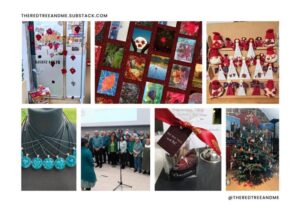
Shaun Tan’s ‘The Red Tree’, inspired a creative advocacy initiative ‘The Red Tree and ME’ and the formation of a creative collaborative of patients, carers and allies. We are currently working towards an international virtual art exhibition displaying red leaf art and lived experience narratives. Other initiatives include a red leaf salon display (thanks to Emma at Studio 57, Ainsdale and Helen Guy-Roberts) a Red Tree and ME installation at the Chester Cathedral Christmas Tree Festival (thanks to Amina Hussain) with messages of hope from leading ME researchers, a red leaf concert (thanks to Helen and Ken Stout and the Wotton Silver Band), the sale of handmade jewellery, and red leaf gonks and angels (thanks to Shirley Kay Mosaics and Jo at AJcrafts4ME), the sale of red leaf greetings cards (thanks to Clare Rayner) and the creation of special bags of chocolate red leaves by a Southport based chocolatier (thanks to Jo and Rob @rsfinechocolate).
Germany has recently pledged a total of 500 million euros for further research into post-infectious diseases including ME/CFS. Serious funding is needed in the UK too. While we wait, we hope our modest red leaf efforts will create some ripples and that others will be inspired to support the ME/CFS research at the University of Edinburgh however they are able.
Karen Hargrave
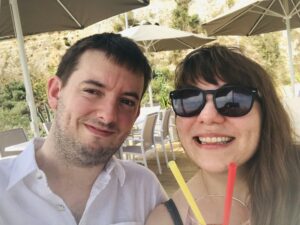
Karen set up a Christmas fundraiser in lieu of gifts for her husband James, who has ME and whose birthday is on Boxing Day:
My husband James developed ME post-Covid in 2022 and is currently very severely affected. He was mid-30s at the time and within the space of a year he went from living a full, normal life to a very limited one. He’s been 100% bed-bound for around 18 months and for a long time now has been dependent on full-time care. He experiences extreme noise and light sensitivity, and spends all of his time in a quiet, dark room (mostly on his own). His birthday is on Boxing Day and every year I get lots of questions from friends and family about what to get him for presents. There isn’t much he can enjoy, so this year he wanted to raise some money for an ME-related cause in lieu of gifts for Christmas and his birthday – and we decided on raising money for ME research because it really is his biggest source of hope for a better future.
I posted our fundraiser on social media and shared it around to friends and family. I think we were both overwhelmed by the donations. Christmas is such a hard time of year for James. He’s not able to enjoy any of the festivities, and I could tell that getting updates on how much he’d raised throughout December made such a difference to what is otherwise a really miserable time. His energy is very scarce but when I gave him the running total on his birthday on December 26th he decided he wanted to dictate a thank you message to everyone who had donated. It took a few days, with James dictating a few words at a time , but we got there in the end! Many of his friends and family haven’t heard from James for years now, so it was lovely to be able to share a message back to them – and it showed how much the money we’d raised meant to him. James did a science PhD back in the day, so he was really pleased to hear that the money we’d raised would help to support the research team’s early career researchers.
The research team at the University of Edinburgh are doing groundbreaking work and I couldn’t think of many better causes to donate to. It’s genuinely a privilege being able to support them in a small way and I’d encourage others to consider doing the same!
Fundraise Your Way – more information and stories about community fundraising for the University’s research
Header image: Xesai via Getty Images
All opinions expressed in this article are those of the individual and do not necessarily reflect those of the University of Edinburgh.

