
A legacy that expands opportunity for medical students
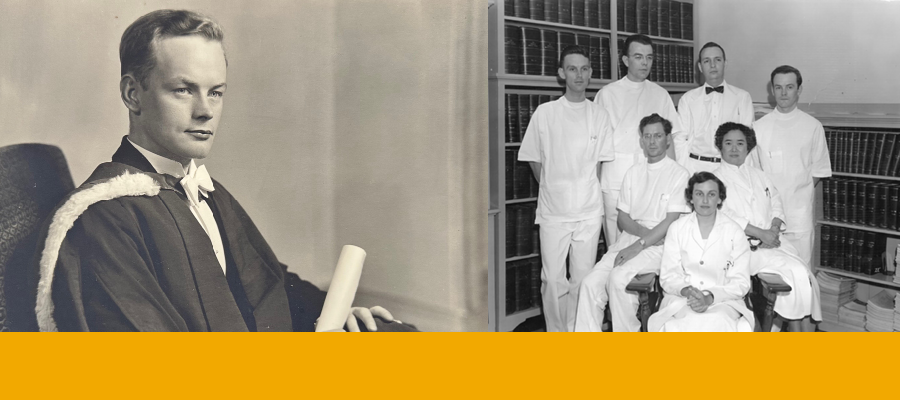
Above: Dr Murray McCallum Bett at graduation and (right) with colleagues during medical training
For many medical students, the final-year elective is a key part of their training. It offers the chance to gain experience in different healthcare settings, often abroad, and to develop skills that will shape their future careers. But the cost of travel, accommodation and placement fees can make these opportunities difficult to access.
The legacy of Dr Murray McCallum Bett and Mrs Hanna Bett is helping to address that.
Dr Bett graduated MBChB in 1951 and went on to build a career in general and paediatric surgery in the United States. His wife, Hanna Bett, a former nurse, shared his belief in the value of medical education and the opportunities it can create.
In 2019, following Dr Bett’s death, Mrs Bett donated a collection of gold coins to Edinburgh Medical School. The coins were used to establish the Murray McCallum Bett Travelling Scholars Fund, which supports final-year students with the cost of their elective placements.
In 2020, she pledged a further legacy gift in her will to support MBChB scholarships, in recognition of the role Edinburgh played in her husband’s life and career.
After her death in February 2025, that gift has now been endowed. It will support around ten students each year for more than 30 years through the Dr and Mrs Bett Scholarship. It also forms the founding gift for the University’s Future Medicine: Clinical Scholarship Fund.
Supporting global experience
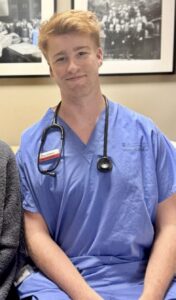
Rob Gilmour
For Rob Gilmour, the scholarship has made it possible to undertake an elective at Sir Lester Bird Medical Centre in Antigua.
“International electives can be expensive once you factor in travel, accommodation and placement fees,” he says. “The scholarship has made the experience possible and given me the chance to work in a healthcare setting I wouldn’t otherwise have considered.”
He hopes the experience will broaden his understanding of how care is delivered in different systems.
“Seeing how surgical care works in a smaller hospital environment will help me develop adaptability and a wider perspective on patient care.”
Alix Davidson is undertaking her elective in Sri Lanka, combining hospital-based learning with community-focused work.
“Without this support, I wouldn’t have been able to pursue an elective of this scope,” she says. “It has allowed me to gain experience in a healthcare system with different resources and challenges.”
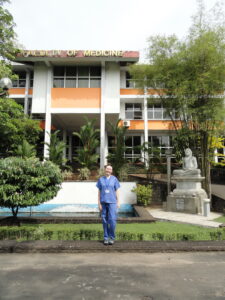
Alix Davidson pictured at the University of Ruhuna Medical School
She highlights the impact this is already having on her development.
“I’m becoming more adaptable and more aware of how clinical decisions are made when resources are limited. It’s also helping me better understand global health inequalities and cultural differences in patient care.”
Both students emphasise the importance of the legacy behind the funding.
“It’s a privilege to benefit from a fund created in memory of Dr Murray and Mrs Hanna Bett,” says Alix. “Their generosity is enabling opportunities that have a lasting impact on students like me.”
Developing skills for future practice
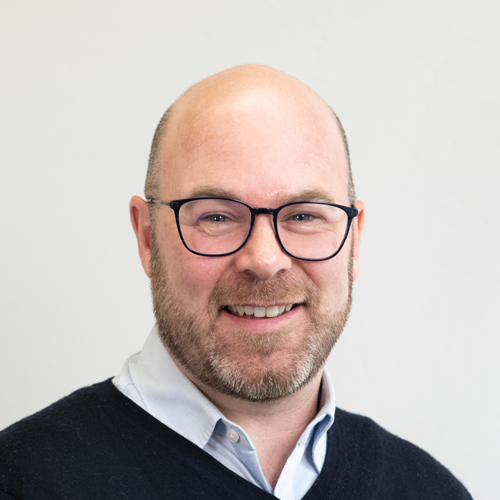
Dr Robin Ramsay
Dr Robin Ramsay, Clinical Programme Director for the Master of Family Medicine, explains why this kind of support is so important.
“All medical students complete a six-week elective in their final year,” he says. “Travel scholarships enable them to undertake placements overseas that they might not otherwise be able to afford.”
He notes that the benefits go beyond clinical exposure.
“Students gain experience in planning and organisation, as well as developing cultural competency and communication skills. They also build qualities such as adaptability, initiative and problem solving.”
These experiences play a role in shaping the kind of doctors students become.
“International electives help students develop confidence, self-awareness and empathy,” Dr Ramsay says. “They often influence career choices and contribute to building well-rounded doctors who can work effectively in a globalised healthcare environment.”
Long-term impact
The Bett legacy will support hundreds of students over the coming decades, creating a growing community of scholars who have benefited from international experience during their training.
Importantly, it ensures that access to these opportunities is not limited by financial circumstances.
“This support can be life-changing for students,” says Dr Ramsay, “and it ultimately benefits the patients and communities they go on to serve.”
By investing in medical education in this way, the Betts’ legacy continues to have a practical and lasting impact — enabling students to expand their experience, develop key skills, and bring those insights back into their future practice.
Related links
For 300 years, Edinburgh has shaped the future of medicine. Now, we’re investing in the next generation. You can support life changing opportunities for students through the Future Medicine: Student Fund:
To find out more about leaving a gift to the University in your will, contact Morag Murison at Morag.Murison@ed.ac.uk

