A new photography exhibition by Guy Neveling provides an insight into Operation BraveHeart and the journeys of children and families as they navigate the diagnosis, treatment, and lifelong effects of a congenital heart disease.
The 300th anniversary of Edinburgh Medical School provides an opportunity to showcase aspects of the rich diversity and history of a connection with the University of Cape Town. Dr Lauraine Vivian and Dr Sean McLaughlin provide an insight and background to Operation Braveheart.
Edinburgh Medical School and the University of Cape Town
In the late 19th century, many medical students from the Cape were trained at Edinburgh and in the early 1900s, the establishment of the Medical School at the University of Cape Town was recognised by Edinburgh and other Scottish Universities.
In 1911 two doctors from Edinburgh took up the inaugural Chairs of Anatomy and of Physiology, Profs R. B. Thomson, and W. T. A. Jolly. The official beginning of the UCT Medical School was marked when a new building was opened on 6 June 1912, and by 1920 students could proceed to clinical years to complete the full course for the M.B. Ch.B. degree, and the 6-year curriculum was modelled on the Edinburgh degree (see Prof J.H. Louw’s article – S. Afr. med. J., 56, 864; 1979).
Operation BraveHeart, paediatric cardiac surgery
Over a century later this historical bridge between these institutions still exists in the work of medical educators and researchers who have worked in both institutions. The shared history of scientific research and medical practice is explored in a new photographic exhibition from Operation BraveHeart, begun as a research collaboration between the UCT Primary Healthcare Directorate and School of Child & Adolescent Health in 2011.
The project was set to a backdrop of post-Apartheid South Africa, where the process of political transformation, given the Constitution of the New South Africa, was driven by the administration of the late President Nelson Mandela and aimed to provide healthcare to all South Africans. Operation BraveHeart follows the journey of children, alongside their families, as they navigated the diagnosis, treatment, and lifelong effects of a congenital heart disease.
At the Red Cross War Memorial Children’s Hospital in Cape Town, specialist services are available for paediatric heart surgery with high rates of success amongst children undergoing the operation, but the burden of after-care currently falls on the parents and families of these children, as the hospital does not have the capacity to follow-up on children into their communities. Challenges remain in resourcing and maintaining specialist services including paediatric cardiac surgery in purpose built surgical theatres, the Paediatric Intensive Care Unit, and general wards where international standards of medical care are carried out by South African trained healthcare professionals. Whilst a heart operation is lifesaving, early identification of heart defects, pre-operative, surgical and aftercare is critical to the ongoing health and recovery of children with congenital heart disease. The project responded to a primary health care need for more extensive support for children undergoing heart surgery as they returned to their homes.
Operation BraveHeart photography exhibition
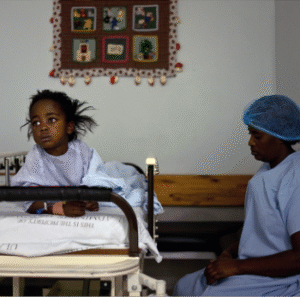
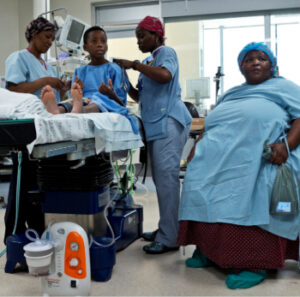
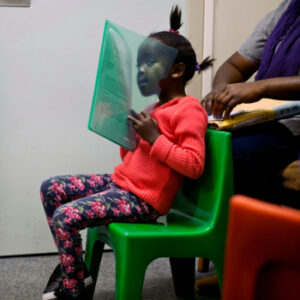
This exhibition showcases photographs by professional photographer Guy Neveling, of children and families involved in Operation Braveheart, from initial outpatient appointments to the surgical theatre itself. His images provide a sensitive and insightful reflection on the bravery of these children and the dedication and compassion of those who cared for and treated them during their admissions for heart surgery. Photographs provide glimpses of the cardiac surgeon Professor John Hewitson, the son of Rodney Hewitson who operated alongside Professor Christiaan Barnard in the first successful heart transplant, operating on a small child; tender moments of a mother with her child in pre-operative care; and the bravery of these children, like the photograph of an isiXhosa-speaking girl holding a folder in the waiting room before she underwent heart surgery.
Making cardiac surgery and specialist health services more accessible
Having worked in Medical Schools in Edinburgh and Cape Town, we have learned how Edinburgh helped to establish the early clinical foundation for medical education at UCT. Since then, generations of health care practitioners have trained to standards of excellence at the UCT Medical School, and today both institutions continue to share a commitment to research and medical practices engaging with the needs of communities in accessing healthcare whilst maintaining international best-practice.
Operation BraveHeart describes how heart disease is a life-long condition and when those children in need receive surgery early in their lives they can thrive into adulthood. In Cape Town these children are from the less advantaged ‘townships’, such as Khayelitsha, Gugulethu or refugee communities. Making cardiac surgery and specialist health services more accessible to all, especially families in less resourced communities so they could be informed about, understand and choose pathways into cardiac care is vital. We hope these photographs create greater understanding of these families’ cultural and social backgrounds, of their children’s pathways in and out of care and of the meaning they give to the operation and care they receive. Through this research and the Edinburgh Medical School 300 exhibition, we hope to ensure that cardiac surgery and aftercare are optimal and that by following these children’s eventful lives we know that they are more likely to lead full lives and get further treatment if they need it.
Acknowledgements
Our sincere gratitude to the children, their parents and the hospital staff who appear in these photographs. The parents of the children provided informed consent for the use of their images. The multi-disciplinary team ensured that results from the project were available to parents and their communities. At the Red Cross War Memorial Children’s Hospital and UCT School of Child & Adolescent Health, Professor John Lawrenson, and Dr George Comitis led the Cardiology arm to identify cases; Professor Andrew Argent, the lead consultant in the Paediatric Intensive Care Unit helped to formulate the project for the researchers to engage children prior to, during and post their cardiac surgery.
Operation BraveHeart is the culmination of combined efforts of Dr Lauraine Vivian, a medical anthropologist and educator, and Dr Sean McLaughlin, a medical educator and qualitative researcher – both formerly in the UCT Medical School and Primary Healthcare Directorate and now based at Edinburgh Medical School – with the assistance of Ms. Claudia Naidu at UCT, and in collaboration with Dr Cynthia Hunter, a medical anthropologist at the University of Sydney. Joseph Barry assisted in producing the Edinburgh Medical School 300 Exhibition. Our logo and media were designed by Mark McLaughlin.
Contact: Dr Lauraine Vivian – lauraine.vivian@ed.ac.uk
Visit the website of Guy Neveling
Visit the LinkedIn page of Mark McLaughlin