Conceptual Foundations: Defining Presence and the Exploration of Grief
The concept for our project developed through an iterative process of group discussions centered on the theme of “presence.” Our initial conversations revolved around the idea that presence goes beyond physical existence. It is a state of full awareness and engagement. From this, we began to discuss the contrast between presence and absence, particularly how the absence of someone or something can heighten the significance of being present. This interplay between presence and absence became a key inspiration for our work.
As we delved deeper into the technical aspects of the project, we explored how emotions manifest through sensory experiences, considering how abstract feelings can be externalized through sound, visuals, and other sensory stimuli. This led us to focus on one particularly profound emotional journey: Grief.
Grief became the central focus of our project as it perfectly captures the tension between presence and absence. Its unpredictable and non-linear nature aligned with our goal to move away from traditional, structured storytelling, while its universal relevance made it something participants could connect with on a personal level. We wanted to represent the emotional weight of grief in a way that allowed visitors to actively engage with the experience, influencing the emotional ‘weather’ of the space rather than simply observing it. The sensory design featuring chaotic visuals and layered audio will reflect the mental turbulence often felt during grief, while the interactive elements highlight how acts of empathy and connection can bring stability. By translating abstract emotions into tangible sensory experiences, the installation will encourage participants to reflect on how being present, even in small moments, can have a meaningful impact on emotional well-being.
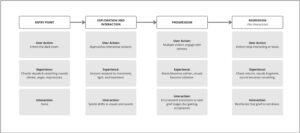
User Interaction Flow
Entry Point: Introduction to the Installation
Action: The user enters the dark, intimate space of Alison House’s Atrium.
Experience: The room is in a chaotic state, representing the early stages of grief (denial, anger, depression). The visuals on the projection are fragmented and erratic, with dark tones and disjointed animations. The surround sound creates an unsettling atmosphere with low-frequency drones, sharp noises, and overlapping audio elements.
Interaction: Initially, no interaction is required. The system reflects a “worst mental state” as it starts in chaos due to minimal activity.
Exploration: Interaction Begins
Action: Visitors approach the center of the room where interactive sensors (heartbeat sensor, buttons, knobs, light sensors, proximity sensors) are placed.
Experience: The sensors pick up on the Presence.
- Heartbeat Sensor: Detects a visitor’s pulse and translates it into rhythmic audio or visual elements (e.g., pulsating light or sound).
- Proximity Sensors: Trigger subtle changes in visuals or sound as visitors move closer or farther from specific areas.
- Visual Sensors: React to changes in ambient light caused by visitors’ shadows or movements, influencing visuals on the projection.
System Response: The more interactions occur, the system begins to transition from chaos to calmer states.
Dynamic Progression Through Stages of Grief
Action: As visitor activity increases (e.g., multiple people interacting simultaneously), the system dynamically evolves toward later stages of grief (bargaining and acceptance).
Experience: The projected visuals become less fragmented and chaotic, shifting toward more cohesive imagery with lighter tones. Soundscapes evolve from dissonant noise to harmonious and soothing ambient music. Visitors feel a sense of collective impact as their interactions contribute to improving the “mental state” of the system.
Interaction Feedback: Real-time feedback ensures users see their impact on the environment (e.g., visuals brighten or calm as more sensors are activated).
Regression if Activity Stops
Action: If visitors stop interacting with the sensors or leave the space entirely, the system begins to regress back into earlier stages (chaos and depression).
Experience: Visuals become darker and more fragmented again. Soundscapes return to unsettling tones, reinforcing a sense of emotional instability. This regression emphasizes that grief is non-linear and requires ongoing engagement for resolution.
Installation Features:
- The installation is non-linear; users can enter at any time during its progression.
- Sensors are designed to be intuitive so that all interactions feel natural and engaging.
- The evolving system reinforces themes of grief as a shared experience that requires active participation for healing.
- This flow ensures an immersive journey where visitors feel both individual agency and collective responsibility in shaping the emotional narrative of grief.
Miro Board: https://miro.com/app/board/uXjVLixa9bM=/
