Any views expressed within media held on this service are those of the contributors, should not be taken as approved or endorsed by the University, and do not necessarily reflect the views of the University in respect of any particular issue.

Personal Blog-Sound Work-Week 10&11 And Project Critical Reflection

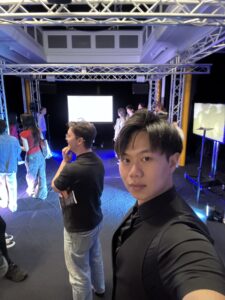
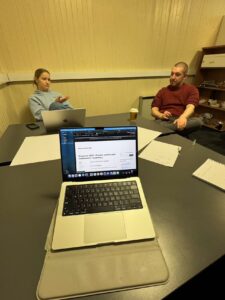
In the last two weeks, I finished all the sound work in the tenth week, so the main work in the last two weeks was to integrate all the work parts and test with other team members. We scheduled three tests, two in Atrium and one in Studio 4. We also found some problems in the Wwise project, for example, the sound playback distance was not set correctly, the attenuation distance was different, etc., but they were all solved smoothly in the end.

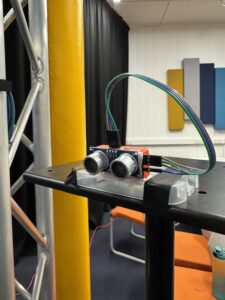
In the first test

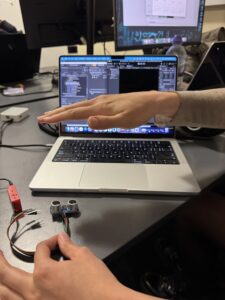
We successfully connected four distance sensors. When participants put their palms close to the distance sensors, they can control the sound volume to attenuate as their palms move. However, when they are completely covered by their palms or other objects, the sound disappears completely. When all four distance sensors are covered for a few seconds, our emotions and vision will automatically jump to the next stage. In each stage, the four speakers will play the same ambience of that stage, and the four sensors also control different ambiences in four directions.
In the second test

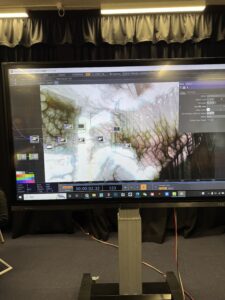
Since my computer was not compatible with Red’s sound card, I spent a lot of time transferring the entire project to Lidia’s laptop. On the same day, I tested it on the speakers in the Atrium room, placed the ambiences in all four directions on the corresponding speakers, and connected the visual and sound parts.
Project Critical Reflection

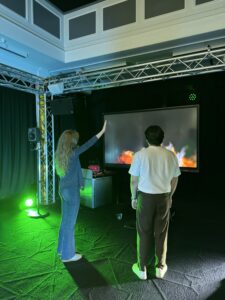
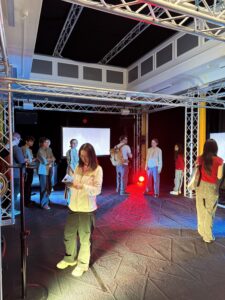
I personally did half of the sound work in this project and encountered many difficult problems, such as how to record the original audio? How to make these original audios into suitable ambience? How to cooperate with other students in the project? But these questions were well answered on the day of the exhibition on April 2, 2025. As a sound design student, I gained very valuable experience in this project. I have mastered the two softwares Wwise and Unity proficiently and understood the working principles. I believe this will be of great help to my future work. If I have more time, I will improve the quality and relevance of all sounds, and add some transition sounds when the emotions are excessive, so that the audience’s auditory immersion and perception of emotions will be enhanced.
Personal Blog-Sound Work-Week 9

The five-stage sound work was basically completed in the ninth week. Lidia and I completed the integration of the two projects on Wwise, and with the help of Leo, I created a Unity project to test our sound part. This was a very important progress, which meant that our sound could work.

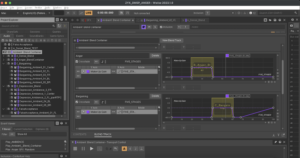
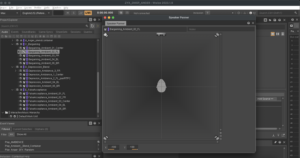
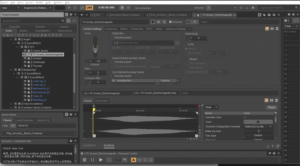
In Wwise, a blend container is set up to control the five stages of sound, and they are staged, with a value of 20 for each stage, and connected to the FIVE_STAGES RTPC.

On Wwise

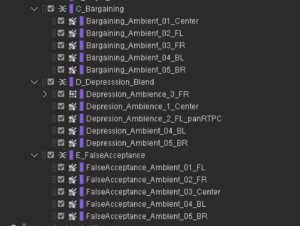
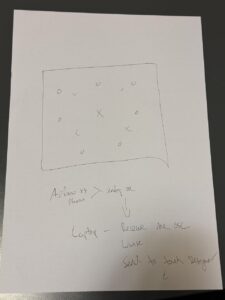
At this week’s meeting, Leo suggested changing the design mode of one ambient sound and five sound effects on each speaker to setting a “Center sound” on four speakers at a certain stage, which is our Main ambience, and adding five Ambiences to the speakers in the four directions of FL, FR, BL, and BR to connect touch designer for interaction, and changing from triggering SFX with distance sensors to triggering Ambience. I think this is a very good suggestion, because for Ambience, it can better reflect the sense of distance and the weakening of sound, which makes our project more playable. In terms of the sound work, Lidia and I shared this work, and I was responsible for “Bargaining”, “Acceptance” and half of “Depression”.

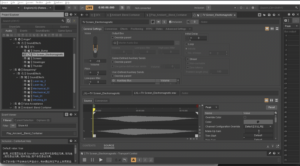
This is one of the Bargaining Ambience

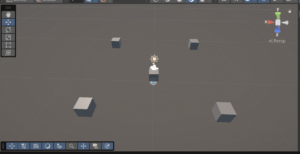
On Unity

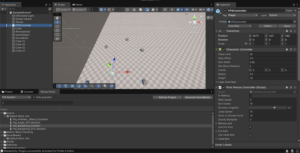
We built a project file with four speakers to simulate the Atrium room in Alison house and used it to test our audio, which was successful. In the next two weeks, we will complete all the sound work and conduct live testing in the Atrium.


Personal Blog-Sound Work-Week 7&8

During these two weeks, with the guidance of Leo and the help of Lidia, I completed all the work on “Anger” and “Bargaining” and the ambient work of “False Acceptance” in Wwise, and created Blend container events to gradually control these ambient sounds. I also created triggers in Unity to test these sounds. After testing, these sounds can run correctly, which is a good preparation for the next stage of assembly work!

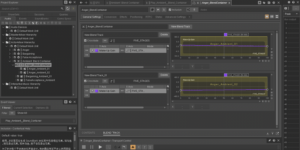
ZYX_ChangedFalseAcceptance_Ambient

Leo gave me a very useful suggestion on the Anger ambient. He asked me to create a blend container under the blend container to control my two anger ambients. This suggestion made my ambient effect even stronger.

This week I have created a test model in Unity and am preparing to assemble Lidia’s Wwise project files and test them. Next week we will conduct the first test of the entire project in Atrium.


Personal Blog-Sound Work-Week 5&6

In the fifth and sixth weeks, my main responsibility is to record the sound, create the sound for the second time, and create the Wwise project.

In the five stages of the wwise project, my work at this stage is to complete all the ambient and SFX work of “Anger” and “Bargaining”. It is expected to complete the ambient construction of “False Acceptance” in week 7-8. This part of the SFX is produced by Lidia.

1.Anger Stage

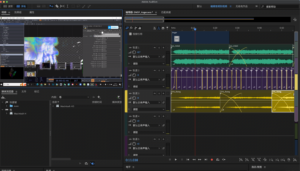
According to Chunyu’s video, I first use the original audio file I recorded on AU to produce ambient sound, and then make sound effects after making ambient sound, and add them to Wwise.

In the ambient construction of Anger, I added the warning sound and the metal tearing sound recorded with an electromagnetic microphone, and added pitch converter, low-pass filter, and smaller reverberation to create a feeling of unease and anger.

In the sound effect part, I chose some high-frequency sounds to enhance the feeling of anger.

2.Bargaining Stage

At this stage, I mixed the sound of rain recorded at submission1 and the sound of knocking on the piano lid to make environmental sounds, and made them standardised and added some effects.

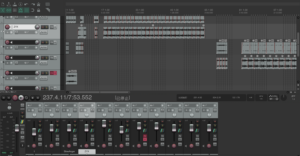
In terms of sound design, I have combined most of the sound effects on Reaper to create a feeling of “bargaining”.

Meeting and Recording on 25 FEB

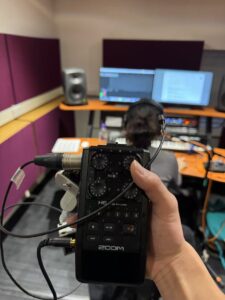
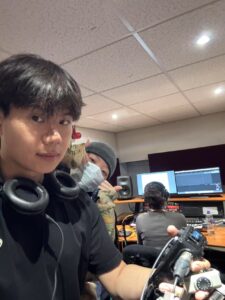
In terms of sound design, Lidia and I have confirmed the audio materials for our first sound design today. We borrowed several different microphones from the music store to record ambient sound and sound effects, and included them in the first stage of sound design. During the recording process, Kyra assisted me in recording a lot of sound materials at Alison House. And Leo gave a lot of useful and valuable advice before recording, which made our recording process very easy. Lyida also worked with Leo in the afternoon to study sensor and technology issues, and Lidia and I also took her advice on sound.

Sound Design

Sound design

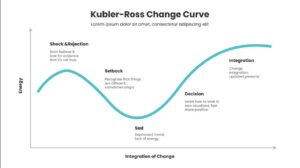
My sound design is centered around the five emotional stages of the Kübler-Ross model, exploring the psychological changes that occur when people face a major loss. Each sound piece is designed to capture the core qualities of a specific emotional stage, bringing the listener into the emotional experience described by the model.

Figure 1: Kübler-Ross model (Source: Visual Paradigm, n.d.)
Figure 2: Psychological numbness (Source: Dame Magazine, 2021)
In the denial stage, individuals often show shock and psychological numbness, trying to protect themselves from emotional shock by avoiding reality. The core of this stage is “unreality”, as if they are in a dream that is detached from reality. The sound creates a vague auditory experience at this stage, making the listener feel as if they are in an isolated environment, symbolizing the individual’s resistance to reality and psychological stagnation. The vague background sound and short sense of blankness in the sound strengthen the stagnant state of emotion. This “unreal” auditory experience is closely linked to the emotions of the denial stage, as if the listener himself is also trying to withdraw from the reality of the outside world.
Figure 3: Anger (Source: Fezra Counseling, n.d.)

Anger is a strong outburst of emotion, with instability and confrontation. At this stage, individuals try to find external outlets to fight against the inner helplessness, and their emotions fluctuate violently. The sound shows a greater dynamic range contrast at this stage, and the sudden volume peak enhances the impact of anger. The inharmonious intervals increase the tense atmosphere, making the audience feel the aggressiveness and instability of anger in hearing.


Figure 4: Individuals are wavering between hope and despair (Source: Cardiff University, n.d.)

The bargaining stage is an attempt to regain lost control, with the individual wandering between hope and despair. This stage reflects an inner contradiction: the inability to accept reality, yet the inability to change it. The sound design of this section symbolizes the repeated attempts and failures in psychology through a looping rhythm and a faint modulated melody. The sound reinforces the slimness and impossibility of hope, immersing the audience in an emotional “self-dialogue”. In this way, the sound expresses the core contradiction of the bargaining stage: the desire for change, but the inability to do anything about it.


Figure 5: Deep sense of despair and helplessness (Source: Vanourek, n.d.)

The depression stage is the despair and helplessness deep in the heart after the individual begins to face reality. This is the lowest point of emotion, full of fear of the future and powerlessness of the current situation. The sound at this stage shows strong emotional oppression, as if an invisible weight is looming over the audience.


Figure 6: Trying to appear “normal,” but internally still
struggling to accept (Source: Psychology Today, 2017.)

The acceptance stage is not simply calm, but a compromise of inner emotions and surrender to reality. This is a complex emotional state, including superficial peace and deep worries. The sound of the work at this stage shows a subtle sense of calm, but this calmness always carries a hint of uneasiness. The subtle fluctuations and potential low frequencies symbolize the emotional residue that has not been completely eliminated in the heart. The audience experiences a complex state of balance in this emotion: no longer struggling, but not completely letting go. This sound experience highlights the emotional core of the acceptance stage – accepting reality, but not forgetting the pain.

Links to all sounds used here:www.youtube.com/@yuxinzhang-og1gg

Reference
  1. Visual Paradigm. n.d. “Kubler-Ross Change Curve.” Visual Paradigm Blog.Accessed February 12, 2025. https://blog.visual-paradigm.com/what-is-the-kubler-ross-change-curve/
  2. Dame Magazine. 2021. “There’s a Reason You Feel Numb Right Now.” Dame Magazine. Accessed February 12, 2025. https://www.damemagazine.com/2021/02/10/theres-a-reason-you-feel-numb-right-now/
  3. Ezra Counseling. n.d. “Anger Management: Understanding and Navigating the Stages of Anger.” Ezra Counseling. Accessed February 12, 2025. https://ezracounseling.com/anger-management-understanding-and-navigating-the-stages-of-anger/
  4. Cardiff University. n.d. “On Hope and Despair, Part I.” Open for Debate Blog. Accessed February 12, 2025. https://blogs.cardiff.ac.uk/openfordebate/on-hope-and-despair-part-i/
  5. Vanourek, Gregg. n.d. “How to Overcome Helplessness.” Gregg Vanourek Blog. Accessed February 12, 2025. https://greggvanourek.com/how-to-overcome-helplessness/
  6. Psychology Today. 2017. “How and Why You Compromise Your Integrity.” Evolution of the Self Blog. Accessed February 12, 2025. https://www.psychologytoday.com/us/blog/evolution-of-the-self/201707/how-and-why-you-compromise-your-integrity
css.php

Report this page

To report inappropriate content on this page, please use the form below. Upon receiving your report, we will be in touch as per the Take Down Policy of the service.

Please note that personal data collected through this form is used and stored for the purposes of processing this report and communication with you.

If you are unable to report a concern about content via this form please contact the Service Owner.

Please enter an email address you wish to be contacted on. Please describe the unacceptable content in sufficient detail to allow us to locate it, and why you consider it to be unacceptable.
By submitting this report, you accept that it is accurate and that fraudulent or nuisance complaints may result in action by the University.

  Cancel