Project Overview
Name: Liu Xiaole
Project Title: Five Stages of Grief – Immersive Interactive Audiovisual Installation
THE DAY LEFT FIELD is an immersive interactive audiovisual installation inspired by Kübler-Ross’s model of the five stages of grief (Denial, Anger, Bargaining, Depression, Acceptance). Through the seamless integration of sound, visuals, and sensor systems, audiences interact with the installation in real-time within a 144-square-meter space, experiencing the flow and transformation of emotions across the environment.
The project team was divided into three main modules: Sound, Visual, and Engineering. My primary responsibilities were centered on the research and development of the sound system, building the sound library, and filming and editing the project documentary. My work spanned the entire process—from concept development to final presentation.
Initial Phase|Establishing the Theoretical and Practical Foundation for the Sound System
At the start of the project, how the sound system would express abstract emotional stages remained an open question. I actively participated in the initial brainstorming for the sound system design and took the initiative to undertake theoretical research on the relationship between sound and emotional perception, aiming to build a solid perceptual foundation for later creative work.
During this phase, I consulted a large volume of psychoacoustic studies on how sound influences the experience of negative emotions, reaching key insights such as:
Low-frequency, continuous sound waves often evoke feelings of oppression and heaviness;
High-frequency, sharp sound effects easily trigger tension or anger;
Noise or irregular rhythms are commonly used to simulate internal conflict and chaos.
These theories provided critical direction for the later sound design of emotional stages such as “Denial,” “Anger,” and “Depression.” For example, the “Depression” stage was constructed as a space filled with low frequencies and blurred echoes, while the “Anger” stage heavily utilized fractured rhythms and sudden, sharp sound effects.
At the same time, I researched and analyzed multiple cases related to interactive emotional installations, including:
TeamLab’s interactive multi-channel art exhibitions

THE DAY LEFT FIELD’s immersive audiovisual projects
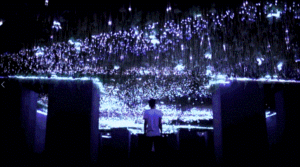
These cases not only inspired our technical strategies for linking sound and visuals but also pushed the team to reconsider how sound in a space could dynamically respond to audience behavior.
Building on this research, I worked with the team to establish an Emotion-to-Sound Mapping Chart that served as a consistent guide throughout the design process:
| Emotional Stage | Sound Characteristics |
| Denial | Blurred, unstable, low-directionality ambient sounds |
| Anger | Sudden, sharp, high-energy fractured rhythms |
| Bargaining | Psychological tension created using nontraditional sound sources like paper, liquids, and water ripples |
| Depression | Low-frequency, blurred, echo-rich spatial ambiance |
| Acceptance | Gentle, progressive, spatially layered soundscapes |
In addition, I continually proposed new ideas for sound expression, such as:
Using wind chimes or soft metallic sounds to convey the gentleness of “Acceptance”;
Introducing “silence” or extreme low-frequency elements at certain stages to create emotional contrast;
Exploring the idea of expressing presence through absence.
These discussions and reflections helped the team establish a clear and in-depth sound design methodology:
“Using psychological models as a framework, combined with the physical properties of sound and audience interaction mechanisms, to construct dynamic emotional soundscapes.”
Although this phase belonged to the early stage of the project, it was undoubtedly one of the periods where I had the deepest involvement and the strongest impact. It laid the theoretical foundation and directional alignment for all subsequent sound collection, editing, and system integration efforts.