Project Lead Professor: Leo Butt
Roles up until now:
Lydia – Arduino- Touch Designer integration, sensor programming
Isha – User interaction flow, storyboards, visual concept
Kyra – Visual design, Touch Designer
Xiaole – Audio aesthetic research
Evan – Sound design
Lidia – Conceptualisation, note taking
Introduction to concept and project aim:
The project is based on two core concepts: using the five stages of grief as a theme and creating an interactive audio-visual installation. Integrating these ideas into a cohesive and meaningful concept was not a straight journey, but we have now established a strong foundation:
Expressing the profound impact of social interactions on individuals experiencing grief and how these interactions, in turn, shape our own self-reflection.
But how did we get here?
In the first week, we focused on defining what the word ‘presence’ means to us: It is not only to be physically present in a space but to be consciously aware of being there, at that moment. Being present requires us to open our senses and pay attention to everything that surrounds us: every change of breeze in the air, every sound, every movement of light, and every change of sight. Moreover, it means to actively concentrate and pay attention to the other beings around us.
As Buddhist monk Thích Nhất Hạnh wrote once, “The greatest gift we can make to others is our true presence” (Hạnh, 2023).
Coping with the loss of someone or something one loves is probably the biggest challenge in everyone’s life (Smith, 2018). It is highly an individual experience, however, what might be the connection in all, is the need for others who can offer support and comfort: a Swedish study based on a survey outlined that participants during such difficult times did report their need for emotional support. Despite mentioning that this is mostly “provided by family and friends”, receiving kind gestures and a positive attitude from a stranger can equally bring a significant change (Benkel et al., 2024).
The project seeks to raise awareness of this topic, leading us to create an audio-visual multisensory installation portraying “The five stages of grief”. The installation will be ‘an exploration of being present in grief’, primarily from the perspective of an imaginary character’s inner mental world. Secondarily, we direct back a rhetorical question: Do they see themselves in it, and are there perhaps any feelings which they have been hiding from themselves?
First introduced as “The Five Stages of Death” by Swiss-American psychiatrist Elisabeth Kübler-Ross in 1969 (Kübler-Ross, 2014), the model says that those who experience sudden grief will most likely go through the following 5 stages and emotions: denial, anger, bargaining, depression, and acceptance. However, these are very strict categorizations of humans’ complex scale of emotions. The lines between these feelings are blurred (Grief is Not Linear: Navigating the Loss of a Loved One, 2023), therefore, in our project as well, we will aim to present the audience with the general impression of grief as we imagine it from a creative point of view.
Our weekly progression to arrive to this concept can be found in our ‘Progress of Meetings” blog:
https://blogs.ed.ac.uk/dmsp-presence25/2025/02/10/progress-of-meetings/
The project in detail:
The installation will be a true sense-stimulating phenomenon, with powerful sound ambiences, low-humming sounds and whispers, and abstract visual design of distorted faces, muted screams, and chaotic shapes and forms: by mixing the technique of real-time processed video footage playback and digital designs.
The showroom location will be in a closed space such as Alison House’s Atrium, to provide the necessary atmosphere of the intimate and dark characteristics of one’s innermost mind. An array of 6-8 speakers placed around the walls of the room will provide a surround sound environment, while a projector on the front will display the designed visuals.
There will be multiple (at least 5) sensors, such as a heartbeat sensor, buttons, knobs, light sensors, and proximity sensors. These will be placed around the centre of the room, for the visitors to interact with. The sensors will be built with Arduino, which will feed the data into Touch Designer to control the main audio ambience, additional SFX and the visual design.
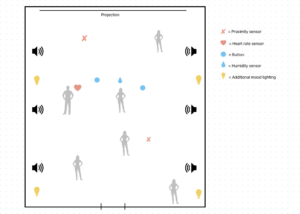
Rather than going through the 5 emotional stages in order, it will be a non-linear journey influenced by the activity of the visitors. The starting scenario is: with no, or only a few visitors, our imaginary grieving person (abstract presentation on the projection) will be in the worst mental state (first stages of the 5). It will be in chaos, darkness and pure depression. As the number of visitors and interactions with the sensors grow, the system will gradually become more and more calmer, and eventually evolves towards the last stage: acceptance.
However, if the interactions come to a halt, the negative emotions will come back once again.
The roles of the sensors:
Humidity sensor: as the crowd grows and reduces, the change in humidity of the air will provide a smooth and slow change over time. The sensor will most likely affect the sound ambience and the amount of distortive processing on the visuals.
Heartbeat sensor: when visitors scan their heartbeat, as a symbol for supporting the other with care and love, it will be presented with a corresponding heartbeat sound and visuals
Buttons/knobs, proximity sensors, light sensors: will trigger SFX and VFX, or change a set of real-time processing parameters.
The knobs/ buttons do not have a fixed direction, such as turning left for sadness, right for improvement in mood. Instead, it would be completely random. The goal is to get the audience involved, representing the true nature of how random emotions can come and go. Of course, if the input difference is significant, the grief gradually becomes more controllable.
More detailed description of technical concept and user interface layout can be found here:
https://blogs.ed.ac.uk/dmsp-presence25/2025/02/10/conceptual-foundations-and-user-interaction-flow/
Audio components:
In order to create relevant sound design aesthetics for the project, Xiaole did a throughout research on audio design techniques on the theme of grief, and related art projects:
https://blogs.ed.ac.uk/dmsp-presence25/2025/02/10/dmps-presence-25-research-for-audio/
Then, Evan created the first samples of short sounds designs: one for the five stages each.
https://blogs.ed.ac.uk/dmsp-presence25/2025/02/09/sound-design/
In the next couple of weeks we will aim to create more ambiances, effects, and effect parameter changes
The audio-system will be built in Wwise for the freedom of triggering and real-time processing multiple events/sound effects/ ambiances at the same time. This will be integrated into Unity, to use the given data (collected from sensors) to trigger the events. Since now we have a strong concept foundation, experienting with and building these systems will be our main goal for the next weeks.
Visual:
The visuals will be designed with Touch Designer, where the various data sources will trigger different layers/ effects
First, Isha created a moodboard to summarize our ideas for used textures, colors, saturations, figures:
Then Kyra developed the first sketches about one of the emotions: ‘anger’
Technology:
After the workshop at week 4, Lydia has taken up the role of computer tech design. The sensors will be built using Arduino, which will send the data bot the Touch Designer for the visuals, and Unity for the audio. In the next week, the workload will be share between her and Isha.
The technical research and progress can be found here:
https://blogs.ed.ac.uk/dmsp-presence25/2025/02/10/arduino-integration-with-touch-designer/
Summary:
By creating a constant connection between the visitor’s input and their result on the art, the project aims to show people the impact they can leave on someone’s mental well-being. Experiencing this through ‘someone else’s eyes, while it reflects the visitors’ bodies, we are hoping to make them ask themselves whether they are truly paying attention to their own, and their loved one’s struggles. And therefore, we aim to foster a deeper awareness of emotional connections, encouraging mindfulness and active presence in their everyday life.
References:
Benkel, I. et al. (2024) ‘Understanding the needs for support and coping strategies in grief following the loss of a significant other: insights from a cross-sectional survey in Sweden’, Palliative Care and Social Practice, 18. Available at: https://doi.org/10.1177/26323524241275699.
Cohen, S. (2004) APA PsycNet, psycnet.apa.org. Available at: https://psycnet.apa.org/buy/2004-20395-002.
Grief is Not Linear: Navigating the Loss of a Loved One (2023) Veritas Psychotherapy. Available at: https://veritaspsychotherapy.ca/blog/grief-is-not-linear/.
Hạnh, T.N. (2023) Dharma Talk: True Presence – The Mindfulness Bell, Parallax Press. Available at: https://www.parallax.org/mindfulnessbell/article/dharma-talk-true-presence-2/ (Accessed: 9 February 2025).
Heaney, C.A. and Israel, B.A. (2008) Health Behaviour and Health Education. Jossey-Bass, pp. 190–193. Available at: https://www.medsab.ac.ir/uploads/HB_&_HE-_Glanz_Book_16089.pdf#page=227.
Kübler-Ross, E. (2014) On Death and Dying, www.simonandschuster.com. Scribner. Available at: https://www.simonandschuster.com/books/On-Death-and-Dying/Elisabeth-Kubler-Ross/9781476775548 (Accessed: 9 February 2025).
Smith, M. (2018) Coping with Grief and Loss: Stages of Grief and How to Heal, HelpGuide.org. Available at: https://www.helpguide.org/mental-health/grief/coping-with-grief-and-loss.
Young, S.N. (2008) ‘The neurobiology of human social behaviour: an important but neglected topic’, Journal of Psychiatry & Neuroscience : JPN, 33(5), p. 391. Available at: https://pmc.ncbi.nlm.nih.gov/articles/PMC2527715/.