Any views expressed within media held on this service are those of the contributors, should not be taken as approved or endorsed by the University, and do not necessarily reflect the views of the University in respect of any particular issue.
Due to time and effort constraints, there are still some goals and areas in our game that we expected to achieve but ultimately didn’t and that deserve more additions and improvements, such as:
More levels, difficulty settings, and ending branches.
In the original concept, we set up five rooms, and even if the player chooses the same number of objects incorrectly (e.g. the same three points are scored, choosing incorrectly in the first room versus choosing incorrectly in the third room) this will also lead to different endings. At the end of the entire game, there will be higher difficulty levels unlocked. This will make the whole game more complex, but also more interesting, playable, and collectible.
More detailed sound design
We’ve added a variety of sounds for the hamster, such as a cute cartoon-style jumping sound, squawking sounds when it hits the wall, and different footsteps on the wooden floor and bathroom tiles in different rooms. However, because of the level setup, the player needs to control the hamster to jump around on different furniture. We think that if we had more time, we would have made the hamster’s sounds more detailed, such as different footsteps when stepping on each different kind of material, as well as different chirping sounds when hitting different objects.
Richer graphics
So far, our level rooms have been relatively complete, but the hamster’s room is still empty and monotonous before the start of each level, this is because we have not been able to find suitable object assets to decorate the hamster’s room. We may do this in the future by collecting objects that the hamsters might like to hoard in their rooms.
Smoother playing process
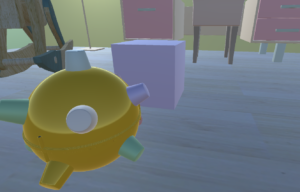
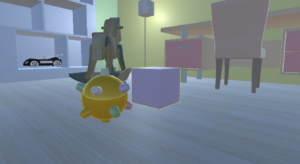
In the process of using AI voice, we still think that monotonous tone can’t replace real voiceover, and we may try to find a more suitable tone instead. For selecting objects, the reason we let players choose simple cubes and spheres, in the beginning, is because we found that our selection script doesn’t work for complex object models. We’ll continue to figure out how to solve this problem.
Mini-game
We were very enthusiastic about inserting mini-games into the game from the very beginning, but we didn’t go too far into this area for the sake of completeness in the process of making the game. However, we still haven’t given up on the idea of inserting some “accidents” that would allow players to trigger some special mechanisms to activate the mini-game during gameplay.
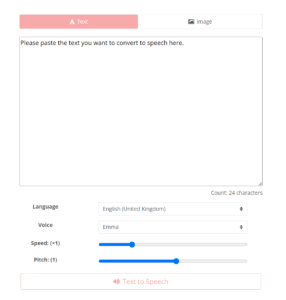
We wanted to add voice guidance to the game, but since no one uses English as a first language, we were worried that substandard pronunciation and the lack of subtitle prompts would cause problems for players instead. Combined with not being happy with our own tones, we finally decided to write the text and then use AI voices to complete this design.
The tool we used was the tone Emma from this site.
Once the player starts the game, the voice guidance will play and prompt the player according to the player’s progress in the game.
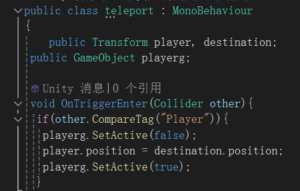
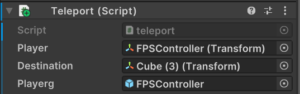
In our game, each level is a separate room. Therefore a teleportation mechanism was needed to send the player to the next room after completing the action. We chose to use the teleport script introduced to us by our tutor Eleni.
As we envisioned it, we would not tell the player during the playing whether their selection of objects was correct or not, but rather when the player enters the ending room, the corresponding ending sound design would be played according to the number of correct objects selected by the player. With a lot of study and help from our tutor and friends, this is how we implemented this logic:
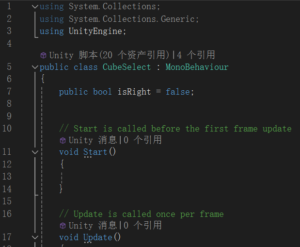
mark all selectable objects into correct and incorrect.
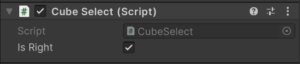
With this script, we only need to tick off the correct objects.
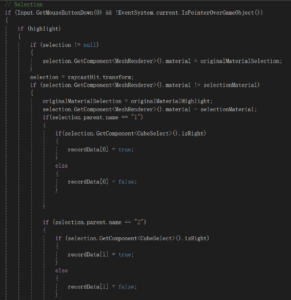
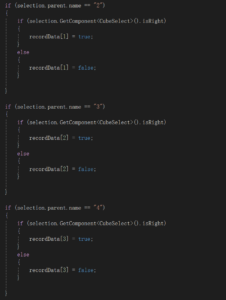
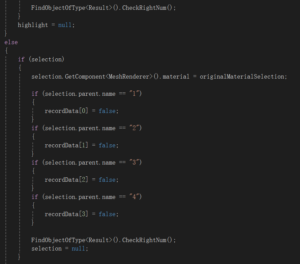
Calculate the score after the player completes the selection. For each correct object selected, the recorded data is increased by 1. This step is refined directly in the selection script.
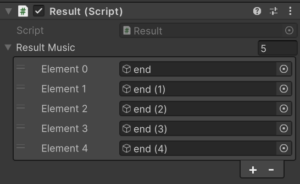
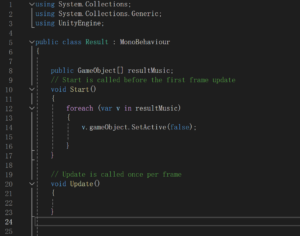
3. Based on the player’s total score, five carrier objects that play the ending sound design are set up, corresponding to scores 0 ~ 5. In this result script, only the object corresponding to that score will be visible, the other four will be hidden. Drag the corresponding object into the box can simply complete the setting.
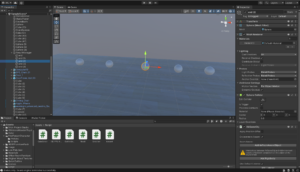
So when the player finally enters the ending room, they will only see the corresponding sphere and hear one of the sound designs.
In our game, the core gameplay is that the player needs to select the corresponding object according to the sound. Therefore, how to make the player complete the action of selecting an object is an important part of the game’s logic.
We adopted the basic structure of the script selection introduced in this video by asking tutors, discussing, searching, and learning.
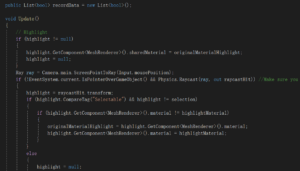
It can distinguish different objects by the tag selectable. When the player clicks on a selectable object, the color of that object changes according to the set material. (the original cube is white)
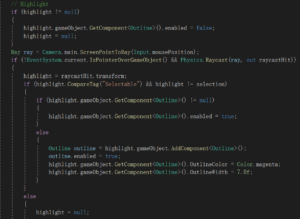
However, in actual running, we found some problems with this script. For example, it gets laggier as the game runs; the color change is not obvious in dim light, which is easy to confuse the player; when the player is too close to the object or the collider of the object is too big, the object will become difficult to select. We’ve tried a lot of solutions to this problem and finally used the script outline selection introduced in this video to complement and improve it.
Design the first view – hamster sounds: walking, running and other possible sounds, such as picking up or putting down objects, selecting objects, moving to the next level, etc.
Set up the basic gameplay in unity, such as moving the hamster, selecting objects.
Determine the rooms for the different levels.
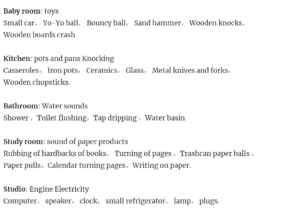
Determine the room style and corresponding object sounds for different levels. For example, kitchen, baby room, study room, etc. The possible objects and the corresponding sound elements.
Find palettes or textures that are each different in style but have a unity overall.
Envision the concepts and themes of the final sound design and how the different endings and collectible elements will be realized. Do research and references.
The definition of the style of the voice-over, as well as the writing, recording and editing of the lines.
mini-game design.
the setting of higher levels of difficulty.
Project Game Title
After a thorough proposal and discussion, my group and I decided to set the name of the game to Hamster Hear, where Hear is both a verb and the name we gave the hamster.
This name not only has a double meaning but also captures the core gameplay and features of the game very well. Firstly, as a verb, “Hear” points directly to the game’s reliance on sound to recognise and select objects, highlighting the importance of hearing in the gameplay experience. Secondly, the use of “Hear” as the hamster’s name adds a sense of personalisation and intimacy, making it potentially easier for players to remember and love the character.
In addition, the name is concise, easy to remember, and easy to understand, which makes it easy to attract players. It effectively conveys the main idea of the game, while also being fun and creative, which may help it stand out from other games. Overall, we all agree that this is a very appropriate and attractive name for the game.
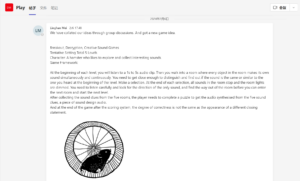
Players will take on the role of a small hamster who likes to explore and collect interesting sounds, and will be guided by sound elements to break through and solve puzzles. Before the start of each level, the player will listen to a piece of audio and then enter the level room, where each object in the room will emit a unique, representative sound, and the player needs to choose by looking for and approaching the object, and carefully distinguishing whether the object’s sound is the same as or similar to the audio that the player heard before the start of the level. Players will receive a sound clue fragment representing the object when they complete their selection, but move on to the next level regardless of whether that selection was made correctly or not. Once the clue fragments have been collected from all the rooms, the player will need to complete a sound puzzle to manually synthesise the pieces together to arrive at the final sound design audio.
Difficulty Setting
At the beginning of the game, the audio the player hears may be exactly the same as the correct object sound, and may be about 5 seconds long. However, as the game progresses in difficulty, the audio the player hears will become shorter and shorter, and may be at least 1 second long; the audio the player hears may also be the correct object sound that has been processed in a variety of ways, such as adjusting the equalisation, adding reverberation, and being partially distorted or intermittent. On the highest difficulty, the audio the player hears may only have a small resemblance to the real object sound. The player needs to struggle to distinguish and find the correct object while resisting these interferences.
Endings
Since as soon as the player chooses an object to end in the next level, the player only learns if they made the right choice after synthesising the sound clue fragments. Different choices lead to different endings. For example, if the player chooses the correct object in all five rooms, the final synthesised sound will be a complete, pleasing design, whereas comparatively, the more wrong choices the player makes, the weirder or harsher the final synthesised sound will be. At the same time, even if the same wrong object is chosen, a wrong choice in the first room and a wrong choice in the fifth room will result in a different synthesised sound, which will stimulate the player to replay the game in order to collect all the endings.
Mini-game
Among the multiple objects in the room, there may be special objects set up that the player will randomly get some special effects after selecting them, such as the next room can only be played in darkness, or the audio heard in the next room will be very muffled. The player can undo this by choosing to play some sound-related mini-games. Alternatively, the player can choose to play a mini-game to revive the game after selecting a special object that will lead to the end of the game.
Sound Design
According to our initial idea, the game is a creative game guided by sound elements, and the player can complete the final sound design by their own choices, thus leaving a lot of room for sound design. Firstly, in our conception, the game will not have text-based instructions, but rather a voice-over to tell the player how it needs to be operated and what needs to be done. The voice style of the narrator may be designed according to the overall style of the game and specific different levels. Secondly, how to design sounds exclusive to each object and how to process the audio that the player will hear must also be taken into consideration. Finally, in order to attract players to replay the game repeatedly, the game will have several different endings, how the sound material of each level can be combined to form the final sound design audio is another design focus. In the coming weeks, we will make various attempts to try to present the desired effect.
In a short meeting after submission 1, we discussed possible routes for the project to take next. The first step was to create a rough to-do list. The list included the various designs we wanted to implement in the game, such as sound elements and unity models. We need to arrange them in order of importance and complete them in sequence, this is to ensure that even if one of them cannot be completed, the final work will not be affected too much. Currently, the idea is to complete the basic gameplay first, such as hamster walking, selecting objects, etc. and then set up different styles of impression scenes with multiple levels. Finally, when there is spare time, we can try the design of mini-games and upgrade the difficulty.
For the most important element of the game, the sound, we should start to work on more detailed sound design. For the style of the final sound design, we can do some research and references, and for the basic gameplay, we can start to try to design the sound of some objects and do some sound examples.
Week 4, 8 February
Weekly meeting with Eleni
Group members elaborated on the new project outline and then discussed with Eleni, proposing new ideas, which included: the difficulty of the game and the setting of the levels, the impact of the player’s choices on the final ending, the form of the mini-game and the insertion mechanism, the style of the game graphics that might be referenced, and so on. After reaching a consensus, the group confirmed the content to be submitted for the upcoming submission 1.
Online Discussion
For the content that needs to be submitted for submission 1, the group summarises what can be accomplished at this stage as: elaboration on the uniqueness of the main core of the project, the source of inspiration, the expected goals, etc.; elaboration on the interactivity of the project’s gameplay specifics, the level settings, etc.; research and reference of the project’s related content; the presentation of the unity project in progress; Meeting records, project progress notes and summary index pages in the blog. After discussion and selection by the group members, the group finished setting up the division of labour for these contents and scheduled to make the final summary and revision before submission on the 12th.
Week 4, 7 February
Workshop with Eleni
In the first half of the workshop, guided by Eleni, the group learnt how to analyse and elaborate their own project outlines through the hypothetical imaginary project method. In the second half of the workshop, the group learnt how to use unity and tried out some of its operations with some free resources.
Week 4, 6 February
Online meeting
The group combined each person’s ideas, using Linghan’s hamster setting as the story background, Huixuan’s core gameplay of searching for objects through sound clues, and at the same time incorporating Liyuan’s mini-game and Wenxiao’s sound puzzle, and finally came up with a new project prototype as follows:
Week 4, 5 February
Weekly meeting with Eleni
Upload ideas to teams and discuss them with Eleni
Decided to consolidate their respective ideas into one concrete project by Thursday
Week 3, 1 February
Weekly meeting with Eleni
During the morning presentation, Jules suggested that our initial ideas for the project were too complex, and that instead of focusing on the core elements of Blind, we should just ditch the visuals and focus on the sound elements and player interaction. After sharing our idea with Eleni, we received similar feedback that our problem was that we wanted to focus on too many things, and that each element was so complex and specific that it might not be necessary to focus on both narrative and gameplay at the same time, and that it would be easier to focus on one core element and drill down to develop it. At Eleni’s suggestion it was decided to reverse the previous project outline and rethink it.
Online meeting
As the original proposal was not very feasible, the group discussed a few more similar ideas online, but none of them were agreed upon by the group. In the end, the group decided to each come up with another idea of their own, this time dropping the narrative elements and focusing on the gameplay and sound interactions of the project based on the references they had seen previously, and each posted it to the Teams for Eleni’s input by Monday of next week.
Week 3, 31 January
Offline meeting
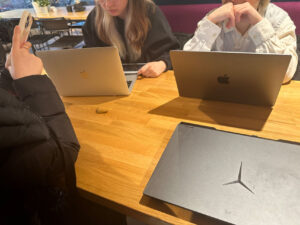
In order to come up with an initial project idea, the group decided to meet offline at the ECA’s cafe.
Regarding Eleni’s question at the end of last week, the group felt that making a sound-driven game with simple visual elements would be more in line with our needs. Based on this Liyuan came up with an initial idea centred on the element of BLIND. The other members of the group enriched this idea according to their preferences as mentioned before, and finally a rough project outline was formed. The outline included game keywords, element types, game difficulty settings, gameplay styles, and several possible story plots.
Week 2, 25 January
Weekly meeting with Eleni
In the first meeting, led by Eleni, the members of the group introduced themselves to each other and gave their initial thoughts on the play project. Although we all chose this project, all four of us have different preferences, for example, Huixuan is very fond of horror and suspense elements, and wants to create sound design that includes these elements; Liyuan values the interaction between reality and the mediums of visual and sound, and is interested in VR technology; Linghan is good at depicting stories, and wants to create game sound that is guided by the plot as the core, and has a deep connotation; Wenxiao wants to learn more about the technology and knowledge of game sound and visual because loving playing games.
Since the group was all from sound design programme and had little knowledge of visual techniques, Eleni showed us a variety of possible references for different types of games. Some of these references did not require visuals at all, some required a simple abstraction of the physical model to build the visuals, and some required time to learn some of the techniques in order to complete the more complete visuals. Eleni suggested that we let the group talk about their needs and decide in the next week what kind of project they would like to eventually complete.
Players need to pick or organise items in this game by sound according to the prompts.
Possible level setups:
The game provides the player with multiple roughly identical objects (e.g. square models that differ only in colour), and the player can hear different sounds when picking up these objects. The player needs to follow the hints and put the object with the corresponding sound effect into the empty slot. For example, if the hint for the level is “yellow”, the player needs to put the objects that make the sound “rubber duck”, “potato crisp” and “wasp” into the empty slots among multiple objects. If the hint for the level is “Seasons”, the player may need to place the symbols “Spring”, “Summer”, “Autumn”, “Winter” and “Spring” in order.
Reference:
A Little To The Left
2.Plot/Voice-lead focus
(1) Use the plot to explain why the protagonist needs to escape or explore through sound elements when the visuals are incomplete
(2) Needs a better backstory and plot guide
(3) Blurred vision
Basic plot and gameplay:
The main character is a high school student with high myopia. One day, their classmates steal their glasses to play a prank on him. Players need to control the main character to explore the surrounding area according to the sound clues without being able to see clearly, avoiding the sight of classmates while listening to their conversations to determine where the glasses are hidden, and finally find the glasses and escape from the school building.
Reference:
Lurking
Idea from this comment of the video: https://www.youtube.com/watch?v=zHIACxrmwaM
“‘Now I’m not gonna talk loudly because that will probably lead to me dying.’ My school life.”