Any views expressed within media held on this service are those of the contributors, should not be taken as approved or endorsed by the University, and do not necessarily reflect the views of the University in respect of any particular issue.

Visualizing Industrial Space Through 3D Scanning and Real-Time Point Cloud Interaction

Subtitle:
— A Visual Documentation of Spatial Reconstruction Using Leica G1,  TouchDesigner, and Audio-Driven Interaction

Ren Yuheng | s2593996

1. Scanning the Paper Factory

1.1 Preparing and Learning Leica G1

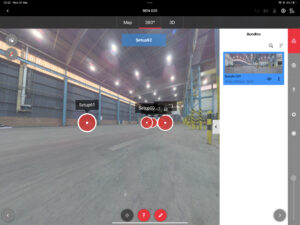
Before fieldwork, I spent time learning how to operate the Leica BLK G1 scanner, especially in conjunction with the Field 360 iPad app. This included planning scans, understanding bundle optimisation, using Quick-Link features, and managing live positioning feedback on-site.
1.2 Scanning Strategy Design

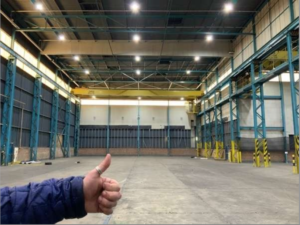
The scanning site—a decommissioned paper factory—comprised two interconnected rectangular volumes with varied interior heights and several hidden corners.
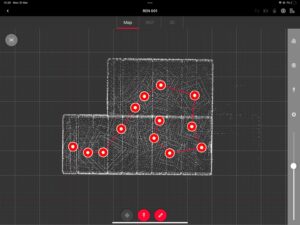
To minimise blind spots and ensure comprehensive spatial data capture, I designed a closed-loop scanning path focused along the longer edge of the building.
We decided on 13 scan positions, arranged in a clockwise circuit, each overlapping with at least two neighbours to ensure successful registration.
Choosing scan positions involved balancing structural visibility, minimal obstructions, and alignment feasibility.
1.3 On-Site Execution

On location, I carried out the scanning process with both precision and flexibility.
For each station, I carefully placed the scanner at optimal height, avoiding glass surfaces, light reflections, or metal interference.
After each scan, the Field 360 app allowed me to visually confirm if links were successful.
If the overlap was too low or bundle errors occurred, I manually removed the failed scan and rescanned the segment.
This hands-on control significantly reduced errors in post-registration
 

2. Point Cloud Processing and Data Export

2.1 Import and Registration

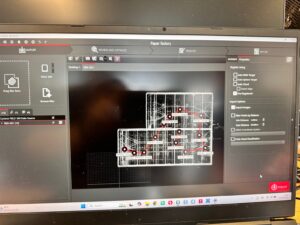
Following data capture, I transferred all .blk files into Cyclone Register 360, Leica’s dedicated point cloud processing software.
There, each scan was imported as a node in a global project and automatically aligned using visual linking.
Although the software provides semi-automated tools, I manually refined several connections, especially in corners where reflections or low overlap caused slight drift.
I also ensured that each scan had at least three strong links to neighbouring positions, meeting Leica’s recommended bundle criteria.

2.2 Quality Review with Leica Report

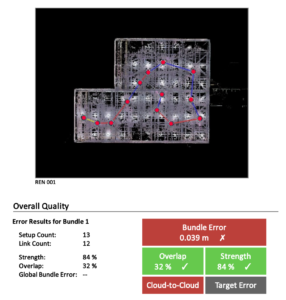
The Leica system generates a detailed registration report.
For our factory scans, the bundle had 13 setups and 12 links, with an overall strength of 84% and overlap of 32%.
Though a few links showed slightly high errors (0.04–0.06m), the final result was within acceptable bounds.
2.3 Cleaning and Exporting

Point cloud data, while rich in detail, often includes unwanted geometry: moving objects, noisy surfaces, or repeated elements.
I used Cyclone’s edit tools to segment the environment into logical areas—floors, ceilings, support beams—and removed unnecessary background data.
This cleaning process improved clarity, reduced processing load, and prepared the model for visualisation.
Finally, I exported the processed cloud in .XYZ format, which preserved each point’s XYZ coordinates and colour values (RGB) for later use.
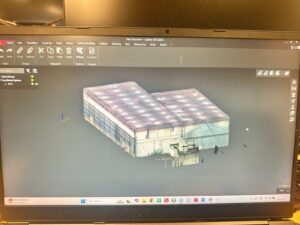
3. Visualisation in TouchDesigner

3.1 Building a Modular Visual System

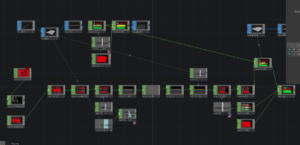
Given the density of the point cloud, I created two main patches in TouchDesigner:

  • One to manage spatial position data (XYZ)

  • One to control colour and brightness attributes (RGB)
    This modular approach allowed for better real-time control and visual efficiency.
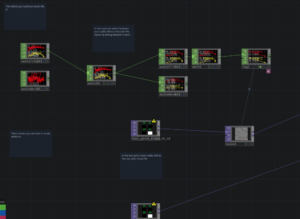
3.2 Connecting with Audio Input

Although I did not build the audio system itself (which was handled by teammates in MAX/MSP), I created a responsive bridge between their output and my visuals.
Using audiodevin CHOP in TouchDesigner, I received real-time frequency and amplitude data from a shared channel.
I then mapped frequency bands (bass, mids, treble) to visual parameters:

  • Bass influenced brightness intensity

  • Mids controlled Z-axis jitter

  • Highs added subtle hue shifts

This allowed the point cloud to react to sound in atmospheric ways—flickering gently to ambient tones or pulsing rhythmically to sharper audio triggers

4. Final Installation & Collaboration

In the final group exhibition, my TouchDesigner system was fully integrated with Jiaming’s projection mapping and ambient lighting setup.
Together, we built an immersive installation that projected the reconstructed factory onto a dark-walled room using high-resolution projection.
The point cloud floated in mid-air, responding to sound through subtle shifts, flickers, and spatial modulation.
Visitors were invited to walk around or sit inside the space, listening to the soundscape while watching the virtual factory respond in real time.
5. Reflection

This project offered me not only a technical learning experience but also a new way to reimagine industrial space through sensory transformation.
I began the journey thinking I would merely replicate a building’s geometry—but I ended up building a spatial interface that interacts with sound and presence.

Some key takeaways:

  • Scanning requires not only precision but creative planning—balancing coverage with speed

  • Visualisation is not about showing data, but communicating spatial feeling

  • Modular thinking in tools like TouchDesigner allows for flexibility across different outputs (installation, screen, or AR)

From Leica hardware to software pipelines, from raw data to immersive media, this process taught me how space can be sensed, shaped, and shared—not only as structure, but as experience.
Written by Ren Yuheng S2593996
Project Plan

Project Title: Hidden Resonance – Decoding the Sonic Memory of Industrial Ruins

Project Introduction

This project is based on the Hidden Door paper mill site as a sound collection point and is presented in an independent exhibition space as an immersive sound installation, exploring the hidden sounds within industrial ruins.

The paper mill was once a space filled with sound—machines operating, paper rustling, workers conversing—all forming its sonic history. But when production ceased, these sounds seemed to disappear with time. But do sounds truly vanish?

This project does not attempt to restore history but rather to decode the sonic information still embedded within the paper mill. Using contact microphones, ultrasonic microphones, and vibration sensors, we will capture imperceptible vibrations and resonances from the factory’s walls, machinery, floors, and pipes, then process and reconstruct them in the exhibition space.

In the exhibition, visitors will enter a sonic archaeology lab, where they will not passively listen but instead actively explore, touch, and adjust the way sounds are revealed, uncovering the lingering echoes of this vanished space.

Project Significance

1. Sounds do not disappear—they are stored in different forms

We often assume that when a physical space is abandoned, its sounds disappear along with it. However, materials themselves can retain the imprints of time—metals, wood, and pipes still carry the vibrations they once absorbed. This project challenges our understanding of the temporality of sound, using technological tools to reveal auditory information that still lingers, hidden within the structures.

2. Redefining “listening” – Exploring the hidden layers of reality

Traditional sound experiences involve direct listening, but this project disrupts the intuitive concept that “hearing = sound.” Instead, visitors must actively decode the auditory information embedded within the structure of the space. This shifts how we perceive sound and raises the question: Is the world richer than we consciously realize?

3. Do the boundaries of reality depend on our perception?

If we cannot hear certain sounds, does that mean they do not exist? If a space is abandoned yet still holds low-frequency vibrations and material resonance, is the factory still “alive”? This project is not just an auditory experience—it is a philosophical inquiry into the boundaries of perception and reality.

4. Memory is not fixed—it is shaped through interpretation

In this exhibition, visitors do not hear a fixed historical narrative. Instead, through their exploration, they reconstruct their own version of memory. This makes history not a static record, but an experience that is actively reshaped by each individual.

Ultimately, this project is not just about documenting and replaying sounds—it is about exploring how hearing shapes our perception of space, how the echoes of time can resurface, and how we can bridge the gap between reality and memory.

Written by Jingxian Li(s2706245) & Tianhua Yang(s2700229)

Project Plan

Project Overview: Echoes of Time – Memories on Paper

This project explores the themes of time, memory, and space, using sound to “revive” a former paper mill. The abandoned factory has become a silent space, but its memory lingers in the air and within its walls, waiting to be awakened. Meanwhile, another paper mill continues to operate, with machines humming, workers moving, and paper flowing along production lines.

This project brings the sounds of the new paper mill back to the old site, allowing the past to reemerge through sound. As visitors walk through the abandoned factory, they will hear its lost sounds. Their actions will influence how these sounds are presented, causing different layers of time to intersect and creating a unique perceptual experience.

Core Significance: Bridging the Gap Between Time, Reconstructing Forgotten Memories

This project is not just about restoring history; it is about using sound to bridge the gap between past and present. It does not simply present the passage of time but examines how memories are stored, forgotten, and reconstructed at different points in time.

Unlike traditional historical reconstruction projects, this is more of a sound-based time experiment. It does not just allow past sounds to resurface; it allows the past and present to exist simultaneously, overlap, and blend into a new, hybrid reality.

1. Sound as a Medium of Time, Not a Static Memory

In conventional studies of memory, we often rely on visual elements such as photographs, videos, or architectural remains to understand the past, viewing history as static and preserved. However, sound is different; it is fluid, ephemeral, and can only exist in the present moment. This project aims to use sound to demonstrate that time is not absolute but something that can be experienced and reconstructed.

In the abandoned paper mill, the goal is not merely to restore past sounds but to let those sounds continue to unfold in the present. The past and present soundscapes of the two mills will blend and intersect, making them indistinguishable at times. This approach challenges conventional historical recreation, allowing past, present, and future to exist in the same space.

This means that visitors will perceive time through sound rather than through static historical relics. History is no longer just a series of past events; it becomes an interactive, real-time experience that can be altered and reconstructed.

2. How Do Past and Present Intersect? Memory Is Not Static but Constantly Changing

This project does not simply allow the abandoned paper mill to “hear” past sounds; it also lets it “hear” the sounds of the currently operating factory.

This means:

  1. Memory is not static but changes with visitor interaction.
  2. The past sounds are not purely restored; they are influenced by present realities and may even be overridden by future soundscapes.

As visitors explore the space, the sounds they hear are not straightforward historical recreations but fragmented memories, recomposed through a process of layering and modification. Every visitor’s journey affects the final form of this “memory.”

Visitors do not passively receive history; they interact with it and change its course. This makes the concept of time more complex, demonstrating that the past is not always absolute but can be shaped by the present.

3. The Boundary Between Reality and Disappearance: What Defines a Space?

The physical space of the paper mill has been abandoned, yet its “sonic space” is being relocated there, making it sound as if it is still alive. This creates a sense of dissonance for visitors:

  • Am I standing in a ruin, or in a functioning factory?
  • If a space has disappeared but its sounds remain, can it still be perceived as real?
  • When sound does not match physical space, how does this alter our sense of reality?

In this project, sound revives a dead space, but the result is not a recreation of the original factory—it is a projection of memory. It is both past and real, but its authenticity is determined by the perception of the visitor.

This project challenges the boundary between physical space and sonic space, prompting visitors to ask: What is real? If a physical space disappears but its sounds persist, does it still exist?

4. Visitor Choices: Restoring the Past or Creating New Memories?

A defining feature of this project is that visitors are not forced to “listen to the past”; instead, they are given the power to shape their experience. Their actions determine the final outcome:

  • If they continuously explore and trigger past sounds, the memory of the paper mill’s soundscape will gradually become more complete.
  • If they allow the present-day factory’s sounds to dominate, the past will be overwritten and become fragmented.
  • If they introduce future electronic noise into the space, the past will eventually be erased entirely.

This means that:

  1. Memory is not fixed; it can be shaped and controlled.
  2. The relationship between history and reality is not one-directional—reality can alter past memories.
  3. The project is not just about restoring memories but about creating them.

This raises important questions: Can we truly restore the past, or is every act of remembering also an act of reinvention? Should memory be shaped by personal perception, or should it be faithfully recorded?

5. This Is Not a Traditional Historical Reconstruction but a Sound Experiment

Unlike projects that aim to faithfully recreate the past, this project focuses on exploring how memory is shaped, forgotten, and reconstructed over time.

Traditional historical restoration seeks to recreate a space’s soundscape as accurately as possible. This project, however, allows past sounds to change based on visitor interaction, ultimately resulting in a soundscape where past, present, and future are interwoven.

This means:

  1. Visitors will not hear a fixed version of history but an ever-evolving sound structure.
  2. Memory will take different forms for different visitors, making each experience unique and unrepeatable.
  3. The past may never be fully restored, as visitor interactions continuously reshape it.

This project is not just about exploring the past but also about understanding how memory is constructed. It challenges the notion that memory is absolute, demonstrating that it is always in flux.

Conclusion: The Core Significance of the Project

This project is not just about sound; it is a reflection on memory, reality, and time.

  1. Sound is a medium of time—it revives a disappeared space, but this revival is not static; it is shaped by present realities.
  2. The past is not a fixed entity but a memory that can be reshaped. Visitor interactions determine its final form.
  3. The boundary between reality and history becomes blurred—when a paper mill has been abandoned but its sounds persist, has it truly disappeared?
  4. Visitors are not passive observers but active creators; their exploration determines whether history is remembered, forgotten, or rewritten.
  5. Ultimately, the past may not be restored but created. This project challenges us to ask: Is what we remember truly the past, or is it a version of history shaped by the present?

This project is more than an auditory experience; it is a meditation on how memory is not something stored in time but something that continuously evolves alongside reality. Whether the past truly exists or can be heard depends entirely on how visitors engage with it.

Written by Jingxian Li(s2706245) & Tianhua Yang(s2700229)


Project Plan

Project Proposal: Echoes on Paper – Fragments of Memory

1. Project Overview

This project is developed in response to the Hidden Door 2025 design requirements, incorporating the concept of time and memory layers. It invites the audience to explore the historical memory of the paper mill and, through a combination of sound design, LiDAR scanning, and interactive devices, reconstruct, reinterpret, and reimagine the sounds that once existed within the space.

By conducting sound collection and spatial scanning at different locations within the paper mill, these audio fragments will be recorded, processed, and presented through immersive installations. This allows the audience to engage in a multi-sensory experience that merges sound, space, and visual elements, transforming the act of listening into an interactive discovery of history and time.

2. Core Concept

  • Exploring the Sonic Memory of Space– Through scanning and interaction, the audience will awaken the historical sounds of the paper mill.
  • Sound Restoration and Recreation– The audience is not just a passive listener but a sound archaeologist, piecing together the fragmented auditory history of the space.
  • Integration of Space, Sound, and Interaction– Through interactive sound installations, participants will experience the fluidity of time, navigating between past, present, and future through sound.

3. Engagement & Playfulness

This project transforms the audience from passive listeners into active explorers, giving them the role of sound archaeologists. Their task is to scan, trigger, and reconstruct the paper mill’s lost sounds, actively shaping their auditory experience.

Every action influences the way sound is perceived:

  • Walking through different areas→ Triggers different historical sound fragments.
  • Touching walls and surfaces→ Activates echoes of old machines.
  • Speaking or clapping→ Alters the reverberation and spatial sound effects.

A puzzle-like interaction: Instead of a fixed narrative, the experience allows for open-ended sonic exploration, where participants must actively uncover hidden soundscapes within the environment.

A unique and dynamic experience:

  • No two visitors will hear the same sounds, as their actions shape the unique compositionof their sonic journey.
  • Some may restore a cohesive auditory memoryof the factory, while others may hear only fragmented, distorted traces of the past.
  • This non-linear structureenhances replayability, as each interaction leads to a different discovery.

Navigating through time layers:

  • Past sounds→ The rhythmic hum of machines, murmuring workers, the rustling of paper.
  • Present sounds→ The hollow, desolate echoes of an abandoned space, the sound of wind through broken windows, dripping water, and creaking metal.
  • Future sounds→ AI-generated noise, distorted electronic signals, fragmented data transmissions.

Open-ended choices:

  • Visitors can restore the past, carefully piecing together a faithful reconstruction of historical sounds.
  • They can blend time layers, creating an experimental fusion of past and future.
  • They can erase history, allowing the past to be overtaken by digital noise, transforming the factory into a speculative sonic landscape.

Exploring the distortions of time:

  • Visitors do not just move through physical space—they navigate temporal dimensions.
  • Every decision shapes how they perceive time through sound, making each journey a personal, evolving experience.

4. Conceptual Significance

This project raises philosophical and artistic questions about memory, sound, and preservation in the digital age:

The Paper Mill as an Archive of Memory

  • The paper mill was once a hub of information production(books, newspapers, archives).
  • Now, it stands abandoned, stripped of its former function, becoming a space of erasure and forgetting.
  • The project asks: “When a place that once preserved information is itself forgotten, what happens to its sounds?”
  • By scanning and interacting, visitors metaphorically “read” the stored sonic imprintsof the space, turning the site into a living sound archive.

Sound as a Witness to History

  • The project emphasizes that sound is an archive of time—even as buildings decay, sonic traces remain.
  • Through interaction, the audience decides the fate of these sounds:
    • Restore history→ Let the past be fully reconstructed.
    • Remix time layers→ Create a hybrid of past, present, and future.
    • Erase the past→ Replace history with artificial digital noise.

An interactive, open-ended narrative

  • This installation does not dictate a fixed outcome—instead, the audience determines the paper mill’s sonic fate:
    • If they prioritize past sounds, the mill’s history becomes clearer.
    • If they activate more digital noise, the echoes of history are lost.

Rethinking Memory in the Digital Age

  • How do we store and reconstruct historyin an age dominated by data and algorithms?
  • Can we ever truly restore the past, or is all memory destined to be rewritten by the future?
  • What is the role of human interactionin shaping and preserving sonic heritage?

5. Conclusion

This project is more than an interactive installation; it is a multi-sensory exploration of time, memory, and interactivity.

  • The audience is no longer a passive observerbut an active participant, exploring and reconstructing the sonic past of the paper mill.
  • Their choices shape the outcome, determining whether history is preserved, fragmented, or erased.
  • Through sound, interaction, and immersive visuals, the project raises critical questions about how we experience and manipulate time through auditory perception.

The final question remains: Do the echoes of the past endure, or are they destined to dissolve into the ever-expanding noise of the future?

Written by Jingxian Li(s2706245) & Tianhua Yang(s2700229)

Welcome!

Welcome to your new blog site!

This is your first post. You can edit this or delete it and start blogging.

You should read the Terms of Use if you haven’t already.

For help and advice on getting started with a WordPress blog, see the Academic Blogging help pages.

Your blog is private by default

You can open your blog up to as many or as few people as you like in Dashboard > Settings > Reading > Site Visibility:

  • You can open your blog up to specific University members by adding them as users to your blog.
  • You can open your blog up to all University members who have an EASE login.
  • You can make you blog open to the world.


The featured image on this post comes from the University Collections. If you want to use more images in your blog posts, or perhaps use your own choice of image in your blog header, you can:


css.php

Report this page

To report inappropriate content on this page, please use the form below. Upon receiving your report, we will be in touch as per the Take Down Policy of the service.

Please note that personal data collected through this form is used and stored for the purposes of processing this report and communication with you.

If you are unable to report a concern about content via this form please contact the Service Owner.

Please enter an email address you wish to be contacted on. Please describe the unacceptable content in sufficient detail to allow us to locate it, and why you consider it to be unacceptable.
By submitting this report, you accept that it is accurate and that fraudulent or nuisance complaints may result in action by the University.

  Cancel