Any views expressed within media held on this service are those of the contributors, should not be taken as approved or endorsed by the University, and do not necessarily reflect the views of the University in respect of any particular issue.

Constructing a Soundscape: Reconstructing the Sounds of Paper Mills Across Eras Through Audio Technology

——Exploring the Process of Sound Restoration Through Field Recording, Sound Effects Editing, and Audio Synthesis

Dimple He & Jieqiong Zhang

1. Recording Blog

In our recording work, precision and efficiency are goals we constantly pursue. To ensure the perfect presentation of every scene and sonic detail, we adopted various professional recording devices combined with unique technical methods to establish a refined recording setup.

First, through a multi-point layout strategy, we planned each recording position in advance based on the spatial structure of the paper mill, ensuring comprehensive and multi-layered sound capture. This layout allowed us to create a wide-ranging and rich sound map, providing abundant material for later sound synthesis.

To adapt to changes in the on-site environment and real-time needs, we used dynamic on-site adjustments. During recording, we monitored and adjusted microphone positions and parameters in real time to respond to ambient noise and special sound effect requirements. This approach not only stabilized recording quality but also enhanced the expression of on-site sound effects.

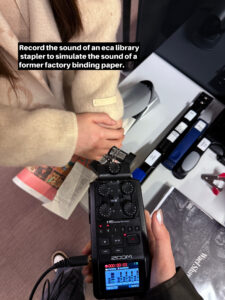
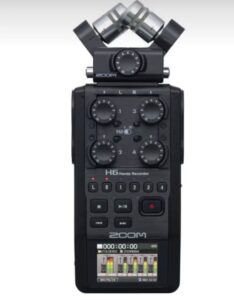
In terms of equipment, we carefully selected high-performance devices to meet the demands of different scenarios. The Zoom H6 multi-track recorder, one of our go-to tools, is widely used for film sync sound and environmental sampling. Its multi-track recording capability allows simultaneous capture of multiple sound sources, ensuring clarity and detail, and played a major role in our recording work at paper mills and libraries.

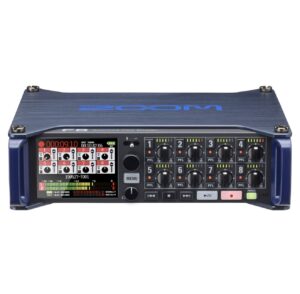
To capture 360° ambient sounds at the paper mill, we used the F8 spatial recording device. This recorder captures the full panoramic soundscape, helping us reconstruct the overall atmosphere and providing valuable material for surround mixing in post-production. This gave our recordings stronger spatiality and immersion.

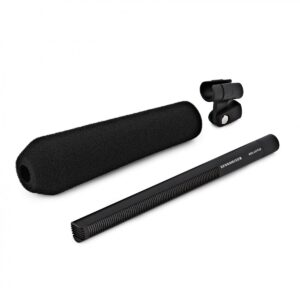
For specific detailed sounds, we relied on the Sennheiser MKH416. This highly directional and interference-resistant microphone is especially suited for capturing specific sounds in noisy environments, such as worker activity, machine startups, or chimes. It ensures these subtle sounds are recorded clearly and authentically.

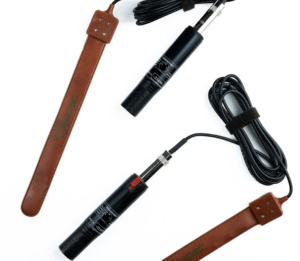
Finally, we used the C-Ducer Contact Microphone to record sounds that are difficult to capture with conventional mics. For example, the alarm sound of fire detectors or the electrical noise of printers—vibrations caused by mechanical operation—can be picked up by this contact mic, offering richer sound information and ensuring no detail is overlooked.

Through these refined technical approaches and the integration of professional equipment, we were able to comprehensively and accurately capture and reconstruct various environmental sounds, laying a solid foundation for subsequent sound creation. Every step reflects our pursuit of technical excellence and extreme attention to sound effects, ensuring the final work delivers a realistic and vivid sonic experience.

1.1 Four Recording Devices

Key Recording Techniques:

Multi-point layout: Plan recording positions in advance based on the paper mill’s spatial structure to form a sound map with wide coverage and rich layers.

Dynamic on-site adjustment: Monitor recording in real-time, adjusting mic positions and parameters according to ambient noise and specific sound effect needs.

1.1.1 Zoom H6 Multi-Track Recorder

The Zoom H6 Multi-Track Recorder is used for multi-track synchronous recording, suitable for film sync sound, environmental sampling, and more. Nearly all the sounds we recorded at paper mills and libraries involved the H6.
1.1.2 F8 Spatial Recording Device

The F8 Spatial Recording Device was used to capture the 360° ambient sound of the paper mill, recording the full soundscape to support surround mixing in post-production.
1.1.3 Sennheiser MKH416

The 416 directional microphone was used to precisely capture detailed sound effects (worker voices, machine startups, chimes, etc.). Its high directivity and resistance to interference made it suitable for specific sound collection in noisy environments.
1.1.4 C-Ducer Contact Microphone

The contact mic was used to capture vibrations and mechanical movement sounds (e.g., fire alarms, printer electrical noise), which are difficult to record with conventional mics.
1.2 Three Recording Locations

1.2.1 Library

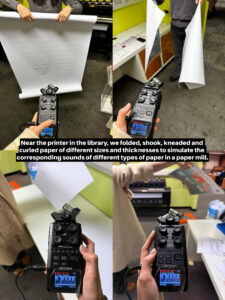
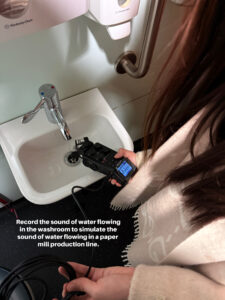
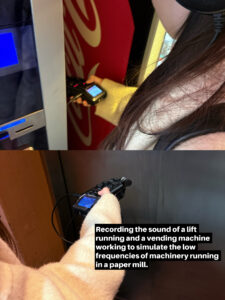
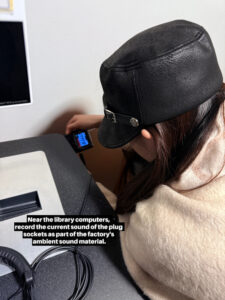
In our library recordings, we focused on reconstructing the paper mill’s sonic landscape through systematic collection of multi-dimensional environmental and object sounds. By simulating the handling of paper, electrical sounds, water flow, and low-frequency mechanical noises, we aimed to not only recreate sonic textures but also explore how sound serves as a medium of memory and spatial representation. This process reflects creative strategies for sampling sound in constrained spaces and aligns with sound art aesthetics—”building scenes with sound” and “creating environments through objects”—offering expressive sound material for post-production. 


1.2.2 ECA

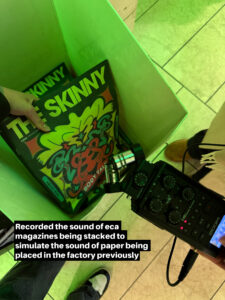
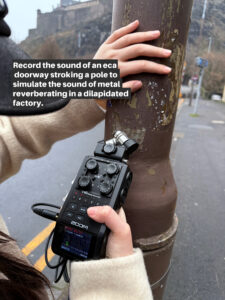
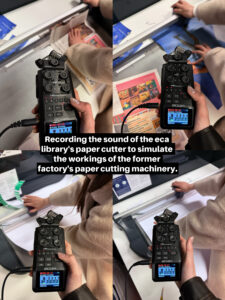
In the ECA campus recordings, we recontextualized everyday objects to simulate the sonic textures of paper processing and metallic machinery in old industrial environments. Metallic resonance from touching electric poles, the rhythmic sounds of paper cutters and staplers, the friction of wrapping paper and magazine stacks—these all evoke the tactile memory of past factory spaces. This method of “foley” in non-industrial settings demonstrates the mimetic strategies and symbolic coding in sound design. It also represents a kind of sound archaeology and artistic reconstruction of “lost industrial contexts,” transforming small contemporary sonic actions into reenactments of historical soundscapes.
 

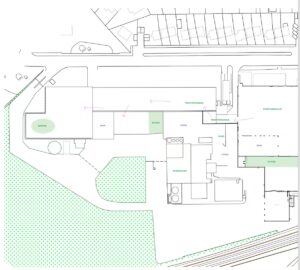
1.2.3 Paper Mill

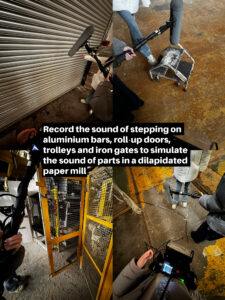
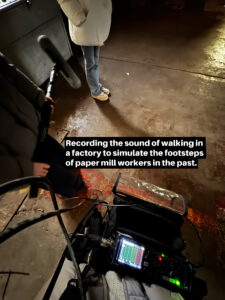
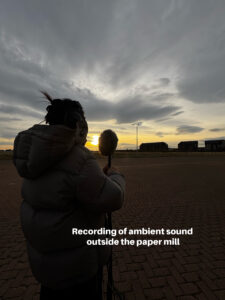
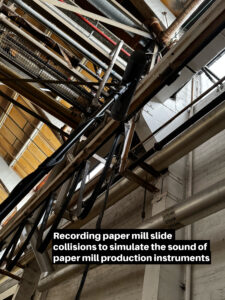
During on-site recording at the paper mill, we focused on the physical interactions between space and structure, reconstructing industrial memories through sound. By capturing natural ambient sounds outside the plant, we built an open, time-sensitive outer boundary for the overall soundscape. Inside the plant, the collisions and frictions—like sliding rails, iron gates, rolling shutters, carts, and aluminum strips—created a sense of mechanical texture and age. Footsteps echoing through factory corridors offered auditory cues for simulating the rhythm of daily worker activity. These sounds go beyond physical documentation to form an auditory archive, allowing present-day listeners to “hear” a vanishing industrial memory field through spatial acoustic detail.
2. Sound Library

2.1 Audio Editing

To prepare for randomized audio processing in Max/MSP and Logic Pro, and to provide trigger signals for random visual generation in TouchDesigner, we initially selected and trimmed the recorded audio. Based on the three main scenes and their respective environments and impulse responses (IR) defined in the project script, we categorized the organized audio as foundational resources for further creation.

2.2 Sound Effects Design

Our goal in sound design was to present each detail flawlessly using precise techniques and creative design, creating atmospheres tailored to specific environments. By artistically processing the recorded audio, we produced various sound effect fragments across categories, scenes, and objects. This process involved not only precise editing but also layering creativity and emotion, ensuring each effect possessed expressive power in its intended context.
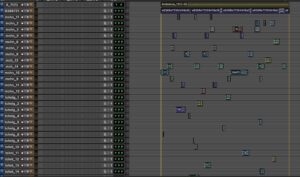
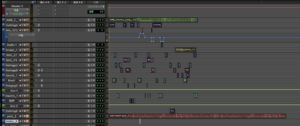
We performed full audio processing on the recordings. EQ adjustments allowed us to selectively boost or reduce frequency components, ensuring each sound remained clear and balanced in the mix. Low frequencies emphasized machine operations or factory rumble, while high frequencies highlighted mechanical details. Compression controlled dynamic range, avoiding distortion and ensuring every detail was clear. Reverb and delay enhanced spatial and temporal depth, enriching the interplay between ambient and detail sounds.

To further enrich sound effects creatively, we used acceleration and pitch-shifting techniques. These added rhythm and emotional tone—e.g., acceleration simulating rapid machinery, pitch-shifting conveying deformation or emotion.

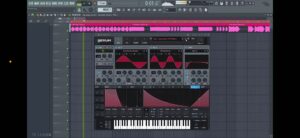
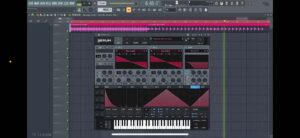
We also used tools like the Serum wavetable synthesizer to generate some sound elements. With its advanced synthesis capabilities, Serum enabled precise creation of scene-specific sounds. We used it to simulate machine startups, metallic friction, and air vibration—particularly effective for large industrial environments like paper mills.
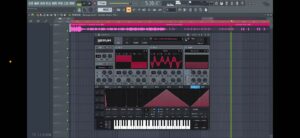
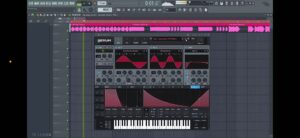
By adjusting Serum’s details, we generated time-specific industrial sounds. For example, modern equipment sounds were high-pitched and metallic, while older equipment produced deep, booming rumbles—adding a temporal dimension that linked sound evolution with historical changes in the factory.

Serum’s multidimensional modulation offered extensive sound transformation options. By tweaking oscillators, we simulated various paper mill sections: the pulper’s low hum, the high-frequency friction of the paper line, even steam and compressed air hiss—each presented through Serum’s modulation tools and merged with original audio for richer texture.

For background ambiance, we used Serum to synthesize low and mid-frequency environmental noise, simulating factory operational background. This avoided awkward silences and added fullness, enriching the overall soundscape without relying solely on field recordings.

This creative combination of synthesizers and field recordings broke through traditional design limitations, expanding possibilities in complex industrial sound design. The flexible, artistic approach captured unique and intricate sound elements, maintaining both technical accuracy and artistic freedom.

As our sound material grew, we began creative layering, the core step in our process. We organically merged ambient and detailed sounds, enhancing expression. Through multi-track mixing and layering, each segment retained presence and responded dynamically to scene needs. This process made our sound design more refined and compelling.

Finally, we integrated the sound effects with visual tools like TouchDesigner, ensuring smooth, natural interaction between sound and visuals. Sound wasn’t merely atmospheric—it functioned as a core element complementing the visuals. We fine-tuned every scene’s soundscape for emotional and expressive unity.

Conclusion

This series of sound design and processing efforts helped us construct a multi-dimensional sound world, giving each scene depth and dynamism. Through careful creativity and technical methods, we not only recreated the reality of paper mills but also delivered a deeply immersive audiovisual experience for the audience.

Attached is our produced sound library:
https://www.dropbox.com/scl/fo/m2gh2j3mftyjro77jamkz/AFxAjVl7-BHb-4ljF3-JY7w?rlkey=ctj1rn6buuhqodnqdqdtufsg7&st=fochaibl&dl=0

Recording Expedition: Capturing the Echoes of Industry in the Ruins

Dimple He & Jieqiong Zhang

I. Pre-Recording Preparations

  1. Project Background

The primary objective of this recording expedition is to conduct an on-site exploration of an abandoned paper factory and capture its distinctive industrial sound sources. These audio materials will serve as the foundation for subsequent sound processing, visual interaction, and sound design, with applications in film, video games, and experimental music.

  1. Equipment Selection

To capture a diverse range of sounds, we selected the following recording equipment:

  • Microphones:
  • Sennheiser MKH416 (Shotgun Microphone): Focused sound capture with minimal environmental noise interference.
  • S&K Contact Microphone: Captures vibrations from objects, such as metal pipes and machine casings.
  • Soundfield ST250 Ambisonic Microphone: Used for immersive spatial recording (not fully utilized due to equipment limitations).
  • Recording Devices:
  • Zoom F8 Field Recorder: Multi-track recording with high dynamic range support.
  • Rode 3m Boompole: Provides flexibility in microphone positioning.
  1. Site Assessment

(1) Acoustic Characteristics

The factory’s internal structure and materials shape its unique sonic characteristics:

  • Workshop: An open space filled with metal and machinery, producing strong low-frequency resonance and multiple reflections—ideal for recording industrial noise and metal impact sounds.
  • Food & Bar Area: Likely features low-frequency hums from fans and heating equipment with a background of human activity, suitable for ambient recordings.
  • Performance Stage: The high ceiling creates pronounced echoes, perfect for capturing long reverberations and eerie, atmospheric sounds.
  • Office & Mess Room: Enclosed spaces with sound-absorbing materials, minimizing echoes—ideal for clean background recordings.

(2) Environmental Noise

  • External Noise: The factory has multiple open entrances, allowing for potential interference from wind and traffic sounds.
  • Structural Noise: Residual machinery and pipes may generate subtle metallic clanks or low-frequency resonances due to temperature changes or wind exposure.

(3) Floor Materials

  • Concrete Flooring: Strong sound reflections, suitable for capturing dull reverberations.
  • Metal Grates/Steel Flooring: Produces metallic resonance and may emit creaking sounds due to rust or structural wear.
  • Wood Flooring (less common): May produce creaks due to aging, adding a vintage atmosphere to the recordings.
  1. Challenges & Opportunities

(1) Main Challenges

  • Noise Control: Uncontrollable environmental noise may interfere with recordings, requiring selection of optimal recording times (e.g., early morning or during low wind periods).
  • Wind Noise Issues: Some recording locations are exposed, necessitating the use of windshields (Deadcat) to minimize interference.
  • Equipment Protection: Dust and humidity could affect recording gear, requiring additional protective measures.

(2) Recording Opportunities

  • Unique Environmental Sounds: The factory’s residual metal resonances, machinery hums, and wind sounds provide a rich palette for sound design.
  • Immersive Recording Possibilities: The layered sonic textures—ranging from hallway echoes to pipe vibrations—help create a dynamic, multi-dimensional soundscape.


II. The Recording Process

  1. Recording Methods & Key Locations

We used multi-point recording, combining various techniques to capture a comprehensive sonic profile:

  • Ambient Sound Recording:
  • Placed ambisonic microphones at different locations to capture spatial atmospheres.
  • Used stereo microphones for wide spatial depth.
  • Targeted Sound Recording:
  • Shotgun microphones focused on mechanical impacts and metal rail sounds.
  • Contact microphones attached to metal pipes, door frames, and machinery casings to record vibrational audio.
  1. Interesting Sounds Discovered
  • Footsteps on Different Surfaces: Walking on concrete, metal grates, and wooden floors simulated various environmental settings.
  • Metal Gate Impact Sounds: The gate’s bounce-back effect created rich high-frequency reverberations.
  • Decayed Conveyor Belt Sliding: Producing a dull, elongated resonance, evoking an industrial past.
  • Cart Wheels Moving: Simulated aging tool friction with layered sonic textures.
  • Wind Moving Through a Roll-Up Door: Unexpectedly mimicked the sound of an old machine’s slow operation.
  1. Unexpected Challenges & Adjustments

(1) Contact Microphone Issues

  • Narrow Pickup Range & Sound Uniformity
  • Solution: Experimented with different placement points and supplemented recordings with ambient microphones.
  • Handling Noise & Vibration Interference
  • Solution: Secured microphones properly, reduced cable movement, and monitored recordings with headphones.
  • Weak or Distorted Signals
  • Solution: Used a high-impedance preamp (Zoom H6) to amplify signals while avoiding overload.


III. Post-Recording Processing & Analysis

  1. File Organization & Preliminary Analysis

After recording, I categorized and archived files by environment and sound type (e.g., metal impacts, footsteps, ambient atmospheres). Each recording was labeled with details like equipment used, recording method, specific location, and time for easy reference.

Listening back, I analyzed sound quality, noise interference, volume consistency, and microphone performance. For contact mic recordings, I examined resonance characteristics and signal clarity to determine their usability. Surprisingly, subtle details—like the slow metallic hum of a closing door or wind-induced tremors in metal sheets—became more apparent during playback.

  1. Unexpected Discoveries
  • Metal Cart Friction Sounds: Initially recorded as simple rolling noise, playback revealed intricate wheel vibrations and internal part rattles, adding realism.
  • Wind-Induced Metal Door Vibrations: The strong wind in the empty factory created a low-frequency mechanical hum, mimicking an old machine coming to life—perfect for cinematic and game sound effects.
  • Decayed Conveyor Belt Sliding: Generated a nostalgic mechanical resonance, reminiscent of a once-bustling factory.
  1. Improvement Strategies

(1) Equipment Adjustments

  • Microphone Selection: The contact mic recordings suffered interference; upgrading to a higher-quality preamp could improve signal strength and clarity. More use of the Soundfield ST250 Ambisonic Microphone would enhance spatial depth.
  • Wind Protection: Future recordings could benefit from advanced windshields (e.g., Rycote Deadcat) to reduce wind noise artifacts.

(2) Recording Techniques

  • Multi-Point Recording: Instead of using a single mic per sound, I plan to position multiple microphones around the same source (e.g., different angles of a metal gate impact) to capture varied perspectives.
  • Dynamic Recording: Instead of only static placements, moving microphones through space could reveal more realistic sound transitions.

(3) Timing & Environmental Adjustments

  • Selecting Quieter Recording Periods: Early morning or late-night sessions would reduce external noise interference.
  • More Interactive Sound Experiments: Beyond passive recordings, I could manipulate materials (e.g., striking metal pipes) to create richer industrial sound effects.


IV. Personal Reflections & Future Plans

1.  Most Satisfying Recordings

  • Metal Gate Reverberations: The layered metallic echoes captured a sense of history and decay, ideal for industrial and sci-fi settings.
  • Conveyor Belt Sliding: The blend of frictional noise and deep resonance evoked a strong sense of industrial nostalgia.

2. Key Takeaways

  • The Role of Space in Sound: Hard surfaces amplify resonance, while soft materials absorb it—essential knowledge for future environmental recordings.
  • Microphone Suitability: Shotgun mics are directionally focused but sensitive to background noise, while contact mics capture internal vibrations but are prone to handling noise.
  • Unexpected Sounds Add Value: Spontaneous elements, like wind-induced metal tremors, often provide the most compelling audio textures.

3. Future Applications

  • Sound Design: Use these recordings for film, game, and industrial ambiance creation.
  • Experimental Music: Process the sounds with granular synthesis, reverb, and delay for artistic projects.
  • Immersive Audio: Explore Ambisonics to create a virtual abandoned factory soundscape.


Project Additions

Here is the additional project content provided by the team after the meeting on 2.11.

References & Research:

A documentary about disused military installations called Cobra Mist which explores how these historic sites are recorded through sound, this documentary captures the ghostly sounds of disused military sites located in the UK. The subtle vibrations and changes in the buildings are amplified through the use of techniques such as contact microphones:

https://vimeo.com/28464270

Reviewing archival videos of industrial machinery can provide inspiration for our project, helping us to incorporate visual and aural elements to recall the machinery and equipment that once powered paper mills:

archive.org

akob Kierkegaard’s project 4 Rooms is a sound artwork that explores abandoned spaces and captures the unique soundscapes of these spaces. Focusing on industrial decline and the layered memories of these spaces, especially abandoned environments like the town of Pripyat in Chernobyl, the project can provide inspiration on how to represent the sound of industrial spaces reflecting their past and present decline:

https://jacobkirkegaardreleases.bandcamp.com/album/4-rooms

Kraftwerk is known for its mechanised electronic music, which can draw on Kraftwerk’s electronic noises, synthesizer low-frequency resonances, and repetitive rhythms to simulate the roar of machines and operational rhythms of an industrial environment, giving the sound design a more industrial feel. The theme of Kraftwerk – Radioactivity deals with the effects of technology, time, and radiation pollution. Kraftwerk – Radioactivity This song deals with the effects of technology, time and radiation pollution and expresses a futuristic approach:

https://www.youtube.com/watch?v=qg4RctdI35I


Project name: The Fractured Boundaries


Concept description:

The project explores the dissolution and reconstruction of time and memory in space by focusing on how ‘place’ is transformed from a clear material existence to a vague ‘non-place’ after the intervention of algorithms. Through the medium of sound, the project captures the soundscape of real space and uses algorithms to deconstruct and reorganise it, presenting the dissolution and regeneration of place in the auditory dimension. At the same time, the project will use the paper mill as the background and the history of the industrial space to present the intertwining of memory, time and space, challenging the definition of the boundaries of ‘place’ and ‘non-place’, exploring how time leaves its traces in industrial sites, and how these changes are experienced by the audience through sound and interaction. It explores how time has left traces on industrial sites and how the audience can experience these changes through sound and interaction.


Project Research Implications:

  1. Industrial space as a carrier of time and memory:

As one of the historically important industrial spaces, the paper mill carries a great change from prosperity to abandonment. By using the sound of the paper mill as the core medium of the project, we are able to present the flow of time and the change of memory. Through the gradual distortion and reconstruction of sound, the project symbolises the disappearance and regeneration of local memory. Elements such as the sound of factory machines and workers’ conversations in the past are gradually deconstructed and reorganised in the space through algorithms, allowing the audience to experience how industrial spaces and memories are gradually disintegrated and reconstructed under the effect of time.

2.The interweaving of time and space:

The historical change of the paper mill from busy production to gradual abandonment reflects the passage of time and the change of space. In the project, we will present this change through different sound layers and algorithmic interventions, and the audience will perceive the transformation from a vibrant factory to a derelict space to a factory space that may be resurrected in the future through the dynamics of sound. This narrative structure from past to present to future will help the audience to understand how time shapes spatial perception, and at the same time feel the close relationship between place and memory.

  1. Deconstruction and Reconstruction of Memory:

Through the algorithmic intervention of sound and the interaction with space, the project is not only a review of past memories, but also an exploration of how memories become blurred and fragmented with the passage of time. The loss and reconstruction of memory becomes an important theme in the historical context of the paper mill. The audience through interactive experience will gradually reveal the sounds of the factory’s past (e.g. the roar of the machines, the sounds of the workers’ labour, etc.), which will become fragmented with the intervention of the algorithm, and ultimately reconstructed into an abstract soundscape in the space, symbolising the regeneration of memory and the washing away of time.

  1. The profound impact of industrialisation on space and memory:

As an important symbol of industrialisation, the paper mill’s spatial and structural changes reflect the profound impact of industrialisation on human society. The project demonstrates the impact of industrialisation on human memory and spatial perception through dynamic changes in sound and space. For example, the roar of factory machines may be delayed, distorted or overlapped with other sound layers, simulating how memory is gradually distorted by the process of industrialisation. This distortion and reconstruction of sound allows the viewer not only to hear memories of the past, but also to feel how technology affects people’s understanding of time and space.

Narrative Structure:

Complete Local Soundscape: In this phase, the audience will experience the full environmental sound of the factory, creating a stable sense of “place.” Through high-fidelity recordings and surround sound technology, the audience will hear the mechanical roar of machines, workers’ conversations, and machine operations from a real factory, showcasing the lively past of the factory and forming a true sense of place perception. Design Approach: Using on-site recordings and surround sound technology, the spatial acoustic characteristics of the factory are simulated, such as reverberation and sound source localization.

The Intrusion of Algorithms and Deconstruction of Sound: As algorithms intervene, the audience will experience the gradual fragmentation of sound. The familiar factory machine noises, workers’ conversations, etc., are sliced into different frequency layers or time segments by the algorithm. The sounds become distorted, stretched, or interwoven with other sound layers, creating a sense of deconstruction of space and collapse of time. Design Approach: Using Max/MSP or SuperCollider for real-time pitch-shifting, delay, inversion, and other operations, introducing low-frequency noise or high-frequency piercing sounds to create auditory tension.

Generation of Multiple Boundaries: Sound layers gradually split, forming a multi-dimensional spatial experience. As the audience moves, they will perceive different layers of sound, each representing a different dimension of place in time and space. Design Approach: Using Ambisonics technology or a multi-channel system to dynamically generate sounds distributed in space, using algorithms to create unique rhythms and spectra, emphasizing auditory diversity and layering.

The Deconstruction and Reconstruction of the Non-Place: Eventually, all sounds will gradually dissolve into white noise, distorted effects, and silent fragments, representing the deconstruction of the “non-place.” Under the influence of algorithms, these residual sound fragments will reassemble into an abstract soundscape, expressing the dissipation and reconstruction of time and memory. Design Approach: Reconstructing the residual sound fragments through frequency modulation, particle delay, and fading effects, creating an emotional sense of rupture, and using sudden silence to express the disappearance of memory.

Interactive Design:

Devices and System Architecture: Devices: Surround speaker arrays and low-frequency transducers (for tactile feedback), touch interface (e.g., touchscreen or sensors) for audience interaction. Interactive Design: The audience can influence the distribution, speed, and modulation frequency of sound fragments through movement or the touch interface. Each interaction triggers a new combination of sounds, making the experience unique.

Visual Aids: Content: Add point cloud animations synchronized with the sound, showcasing the dynamic changes in the sound field, reflecting the process of the factory going from lively to abandoned, and possibly reborn. Technology: Using TouchDesigner or Blender to transform sound into visual effects in real-time, enhancing the synchronization between sound and visuals.

Summary:

This project, through the combination of sound and algorithms, closely links the industrial space (particularly a paper mill) with time and memory. Through ever-changing sound layers, algorithmic intervention, and audience interaction, it presents the transformation of industrial spaces over time and the deconstruction and reconstruction of memory. In the end, the audience will not only experience how sound shapes spatial perception but also deeply feel how industrial spaces carry and witness the flow of memory and time.


css.php

Report this page

To report inappropriate content on this page, please use the form below. Upon receiving your report, we will be in touch as per the Take Down Policy of the service.

Please note that personal data collected through this form is used and stored for the purposes of processing this report and communication with you.

If you are unable to report a concern about content via this form please contact the Service Owner.

Please enter an email address you wish to be contacted on. Please describe the unacceptable content in sufficient detail to allow us to locate it, and why you consider it to be unacceptable.
By submitting this report, you accept that it is accurate and that fraudulent or nuisance complaints may result in action by the University.

  Cancel