While having a binaural wolfhound-sized head is certainly worthwhile for capturing and crafting richer sonic possibilities, I must say— it demands a LOT of plasticine!
Category: Project
Mixing on Labrador
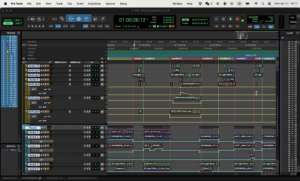
As we have recorded the background sounds according to different kinds of dogs’ sizes and hearing traits, coupled with sound effects that they would hear or make, we presented them in the mixing as much as possible.
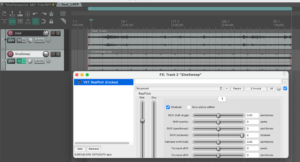
For the blind Labrador part, I went with binaural audio — so the sound feels like it’s happening all around your head, helping listeners feel a bit more “dog” in the process.
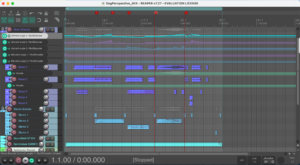
For dogs who have issues with watching, an orange speaker was added to its soundtrack to boost the sensation of acuity and sensitivity.
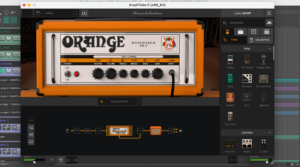
And other details about processing are listed below for reference.
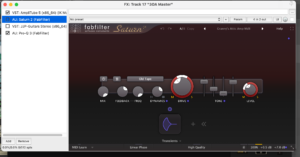
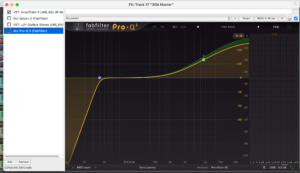
The deaf dog version is processed based on the blind dog’s configuration (but not binaural anymore, because it can only hear things on one side as discussed). However, I’ve panned the previous soundtrack to the left channel, while adding a pure sine sweep—two octaves above—into the right, amplifying the sensation of distraction and disorientation. (I suspect those dogs can’t perceive orientation at all.)
At last, I want to explain why I was so determined to add various distortion plug-ins to these soundtracks. I was deeply moved and inspired by the film Sound of Metal (2019, Darius Marder), which powerfully portrays how individuals with hearing loss might perceive sound — metallic, distorted, even robotic — yet rendered in an unexpectedly simple and affecting way.
Group 1_Video Production Process
- Video Filming-Chao Li, Ruotong Wu
-
Video Editing and Color Grading- Chao Li
Video Production Process
Filming
- After deciding on a video-based format, we discussed how to create an immersive experience that also highlights the differences between a dog’s and a human’s perspective. Through two rounds of prototype testing, we finalized the current presentation style.
- The format involves a dog and its owner roaming Calton Hill together, switching between the dog’s and the owner’s viewpoints to help the audience appreciate the uniqueness of the canine perspective.
- We consulted Mia, a dog expert, to better understand canine behavior, she provided valuable insights. This greatly helped us mimic a dog’s state during filming.
- We attempted to use a GoPro mounted on a real dog to capture the roam, but encountered two major challenges: 1) We couldn’t find a dog that would fully cooperate, and renting one exceeded our budget. 2) Although a kind stranger on Calton Hill allowed us to test with their dog, the dog was unwilling to work with the GoPro harness, so we had to abandon this approach.
- Ultimately, we conducted three formal shoots and cleverly edited footage from all three sessions into the final film. We were fortunate to have good weather for all shoots, which made it easier to blend the footage seamlessly.
Post-Production
- Before editing, we conducted extensive research on canine hearing and vision to inform our audio-visual production choices.
- Dogs have a wider hearing range than humans, especially in the high-frequency region (up to 60kHz). We decided to enhance the high-frequency elements in the audio to make sounds sharper and clearer, simulating a dog’s sensitivity to high-pitched noises.
- We also added emotional elements, such as reverb and amplifying subtle sounds that humans might overlook, to simulate a dog’s heightened emotional response to certain auditory cues.
- In terms of vision, dogs differ from humans in several key ways:
- Color Perception: Dogs have dichromatic vision, seeing primarily shades of blue and yellow, while red and green appear as shades of gray.
- Visual Acuity: Dogs have poorer visual acuity (about 20/75), meaning they need to be much closer to objects to see them clearly compared to humans.
- Motion Detection: Dogs excel at detecting motion due to more rod cells in their retinas and a higher flicker fusion rate (~75 Hz).
- Field of View: Dogs have a wider field of view (about 240° depending on breed) but narrower binocular overlap (about 60°), resulting in reduced depth perception.
- Light Sensitivity: Dogs are more sensitive to brightness and shades of gray, thriving in dim environments, while humans are optimized for bright light and color differentiation.
Based on this research, I used color curves in editing software to adjust for canine vision characteristics, including edge distortion and color grading. To simulate the difference in depth perception, I selectively blurred parts of the image. For the human viewpoint, I applied a LUT to make colors more natural and vibrant, emphasizing the contrast with the dog’s perspective.
Specific Editing Steps
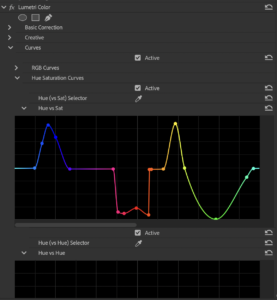
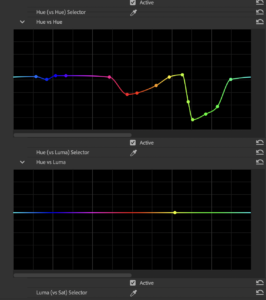
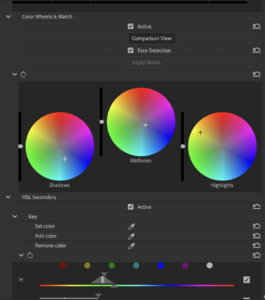
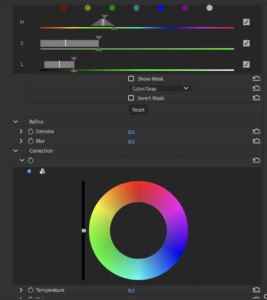
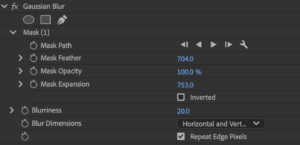
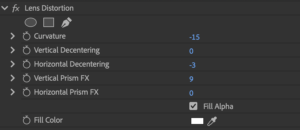

Step 1: Adjust Color Perception
- Use the Lumetri Color effect on the dog’s clips or an adjustment layer.
- In the Curves Panel, utilize the Hue vs Saturation Curve:
- Reduce saturation for red and green tones.
- Enhance saturation for blue and yellow tones.
Step 2: Simulate Reduced Visual Acuity
- Apply the Gaussian Blur effect to the dog’s clips or adjustment layer.
- Set the blur radius to subtly reduce sharpness without making the footage unrecognizable.
- Use masking tools to isolate areas and feather edges for a natural look.
Step 3: Adjust Field of Vision
- Apply Lens Distortion.
- Adjust curvature settings to slightly widen the perspective, creating a fisheye-like effect.
Reflection and Summary
During the color grading process, I spent a significant amount of time trying to achieve a more pronounced yellow tone, but was never fully satisfied with the results. Since yellow and red are close on the spectrum, adjusting one often brought out unwanted green tones. After weighing the options, I settled on the current version, which features predominantly blue, cooler tones, creating a strong contrast with the human perspective. If I had more time, I would continue refining the grading to bring out more yellow tones and achieve a more satisfying result.
Group 1_Live Experience by MAX
- MAX patcher design- Ruotong Wu
- Testing and connecting MAX patcher- Chao Li, Ruotong Wu
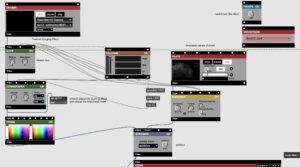
We believe that a dog’s sense of smell is an important perspective. Through our research, we discovered that thermal imaging can be used to visualize gases, so we plan to use a thermal imaging effect to represent how dogs perceive smells. After seeking help from Jules, we found out that MAX can generate thermal imaging effects directly.
During our exploration, we realized that if we use MAX to process live footage into a dog’s perspective, it could create a better experience for the audience. Therefore, we decided to set up an interactive experience point based on a video tour of Calton Hill. We will use MAX’s Vizzie modules to apply visual effects to the video in real time, while also recording sound from three directions. The sound will influence the visuals, creating a live experience for the audience.
I divided the entire pacher into three parts. The design of each part is mostly the same, but they represent different aspects.
- The First Aspect-Dog’s Vision
I referred to the patcher from Andrew’s workshop, Jules’ detailed explanation of the Vizzie modules and I combine the ‘help’ for each Vizzie component. Based on my research, I experimented and created a version of how I imagine the world looks through a dog’s eyes. I focused on three main aspects to represent a dog’s vision:
–Color: Mostly blue, with yellow and gray as secondary tones
–Blur: Dogs see with less clarity than humans
• Glow: Dogs are more sensitive to light movement, and fast motion can create a glowing effect
The most difficult part was adjusting the colors. There wasn’t a single Vizzie module that could fully recreate the way I see a dog’s visual world. I originally tried to use the object of ‘jit.gl.pix’ to completely remove red, but after many attempts, it didn’t work as expected. In the end, I used the MAPPR module and its RGB function to achieve the color style of dog vision.
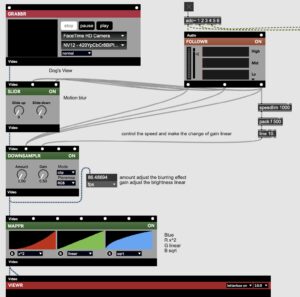
- The Second Aspect-Thermal Imaging Effect
For this part, we still use vizzie to simulate the thermal imaging effect and add the effect of gas to combine it with the video to simulate the sense of smell of dogs. For the color part, I used ‘2 TONR’ to retain the blue and purple to simulate the video effect captured by the thermal imager. Then I collected the smoke effects online and mixed them using the addictive mode of MODEMIXR.
- The Third Aspect-Dog’s Mood
The design of this part is very simple. I only kept the yellow color and then adjusted the frequency of the screen flickering through sound. Because dogs have very sensitive hearing, even the slightest change in sound will attract their attention, even many subtle sounds that we humans never notice.
In addition, each video corresponds to a different microphone. I input the sound into different modules to influence the changes in the video, making the auditory stimulation to the audience more visual. Then I also did a simple mix by MAX to enable it to adjust the frequency of the real-time sound. Additionally, I added the reverb and distortion effects to make the ambience heard by the audience closer to the hearing of a dog.
The day before our presentation, we got help from Jules and Andrew. We used the H6 Essential as an audio interface to record live ambience. Andrew suggested that we add a MIDI controller so the audience could interact and adjust things themselves. This would make the experience more fun and immersive. It was a really helpful suggestion for our project. Luckily, we managed to borrow a MIDI controller just one second before the staff at the music store closed for the day — it was such a close call! I used six knobs to control three video channels and three audio channels. The audience could turn the knobs to mix visuals and sound in real time.
The link of introduction of MAX patcher:
https://media.ed.ac.uk/media/t/1_a41mxuyi
MAX Patcher:
https://drive.google.com/file/d/18VtVyBSB_TXkSPUOz0npl_-im6KSij-Z/view?usp=share_link
Reference:
https://www.dropbox.com/scl/fi/l85vr4wvodzx3c3jjugt9/JR-DMSP-VIZZIE.mp4?rlkey=l58aqdullda4rcjn8m9keqev9&e=2&st=16s7toh5&dl=0
https://drive.google.com/file/d/1-OqBNyjkxgPgQw_my38LQSTLAf_-FZ_j/view?usp=share_link
Group 1_Sound Design
- Synchronous Recording- Yiting Liu
- Sound Editing and Sound Mixing-Ruotong Wu, Yiting Liu
- Final Mixing-Chao Li
1. Synchronous Recording
In the early stage, we captured the ambience by recording both point sources and area sound sources. We went to Calton Hill and used the Zoom H6 recorder to record the ambience in different directions of Calton Hill.
We also went to the target locations to record the ambient sounds, such as Prince Street, the church, etc., in preparation for the subsequent video switching.
In the middle stage, we recorded additional point sound sources and used the shotgun microphone Sennheiser MKH416 to record more precise point sound sources, such as bells, chirps, kids and so on. In addition, we re-record some ambience use this microphone to collect high-quality audio and improve the sound quality of the project.
2. Post-production Sound Design
When designing from the human perspective, we focused mainly on building the soundscape. From the dog’s perspective, we used abstract sound and visuals to express the cultural and historical significance of key locations around Calton Hill.
– Human Perspective
Based on our multiple recordings at Calton Hill, we combined the natural sounds and human activities we collected to recreate and restore the soundscape of the area. We tried to blend distant city ambience with nearby sounds such as footsteps and visitors’ laughter, aiming to build the unique sound texture of Calton Hill through sound.
With this reconstruction, we hope the audience cannot only hear the place, but also feel the memories and emotions that exist within it.
However, one regret is that if we had been able to use binaural recording, the immersive experience for the audience would have been even stronger. But on the one hand, the dummy head recorder was too heavy to carry around while walking and recording, which made it difficult to use in the field. On the other hand, due to limited time for post-production, we were not able to create a binaural version of the audio.
– Dog’s Perspective
From the dog’s perspective, we added footsteps, sniffing sounds, and panting to help the audience better imagine the experience of being a dog.
We also set Arthur’s Seat, the National Monument of Scotland, the Portuguese Cannon, Princes Street, and St Mary’s Episcopal Cathedral as key stop points. When the audience reaches these locations, sounds related to each site will be triggered. Our goal is to use abstract sound to express the history, culture, and deeper meaning of these landmarks.
Eg. The Sound Design of Arthur’s Seat
At the stop at Arthur’s Seat, I wanted to use sound to evoke a sense of the Iron Age site and convey its deep, weighty history.
I added the sound of turning bearings as a symbol of the “wheels of time.” As the dog runs toward Arthur’s Seat, time seems to reverse, and the path of history slowly begins to emerge. At the foot of the hill, I layered low rumbles, granular textures, the sound of rolling stones, and wind to create a rich, multi-layered soundscape. The goal was to let listeners feel the ancient power held by this land.
These sounds are more than just representations of the environment — they are echoes of the past. Through the dog’s perspective, we wanted to show how memory and myth settle into the landscape, and how they still resonate in invisible ways today.
Test Demo of Viewing National Monument from Dog’s Perspective
This is my perspective, imagining what a dog might perceive/ hear when it sees the national monument, with the help of Zixuan’s incredible editing and Carly’s pictures and meticulous photos arrangement. At first, seeing people coming, shaking their tails and scratching the grass, indicates massive excitement. Then, when it comes to the monument, it has a metaphor within. It is a memorial to the Scottish soldiers and sailors who died fighting in the Napoleonic War. Such sound piece consists of lighting fire, very deep breath (exaggerated by bass plug-in) and drone. After that, when it meet other dogs like itself, it feels cheerful, where shepard tone and the whoosh would tell.
Also I’ve made an ambience plugged-in distortion to make a deafaid-like effect to mimick the blur hearing of a dog.
Audio of Mimicking Dog’s Perspective
That’s my version of what a dog might hear, which is set in the range of 40-20kHz and made in far-away-like, mimicking that dog can perceive sound from far away. Also, I added a distortion plug-in to simulate the effect of a deaf aid.
Also, it’s interesting that Andrew suggested that we could let the dog listen to the music while it’s walking around the hill. So I put my music piece into the initial audio, which is set in the same plug-ins but also added an EQ of phone filter to make it real. (and another kind of distortion plug-in to make it more abstract)
Sometimes, it just doesn’t have to be that real to comply with the reality; just making something closer to common sense would be more appropriate (in a human way).
Ruiqi
Converting photos to a dog colour scale
Converting colour scale from typical spectrum to Deuteranopia spectrum
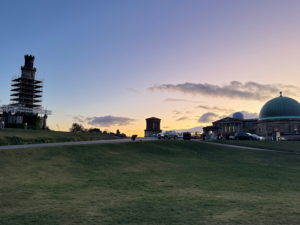
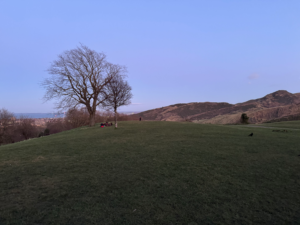
After taking some test photos at Calton Hill ( see: https://blogs.ed.ac.uk/dmsp-perspective25/2025/03/03/carly-and-zixuan-at-calton-hill/ ), I decided to try producing the change in colour on the images. It is to be noted that these were test images taken on an iPhone, and it is expected that the final images will be taken with a professional camera and with different lenses, such as wide-angle or fish-eye lenses.
As we researched, we know that dogs see in a yellow and blue scale of colours, contrary to the common belief that dogs see in black and white(“What Colors Can Dogs See? Can Dogs See Color?,” n.d.). This is also known as Deuteranopia, Red-Green color blindness, which also affects some humans.
“There’s a myth that dogs only see in black and white. However, a dog’s vision is actually comparable to the vision of roughly 9% of humans with red-green color blindness. Dogs have dichromatic vision, meaning they can see shades of blue and yellow in addition to shades of gray, but they cannot see colors such as red, orange, and green.” (Petch 2023)
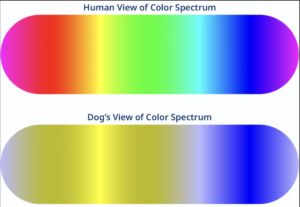
Different website options
I tried different websites to change the images, but sadly, I couldn’t find one that worked well enough.
- TrustedHousesitters
- Woof me!
- Pilestone Color Blind Experts
- Colblindor
Here are some examples of what I could obtain from these websites:
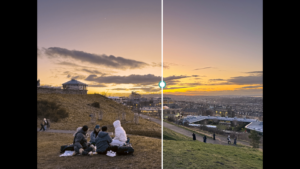
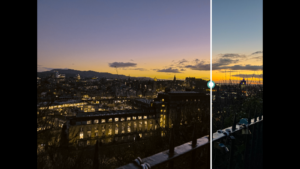

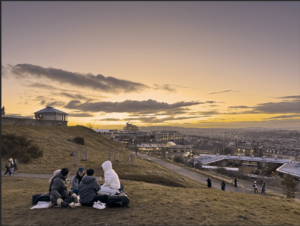
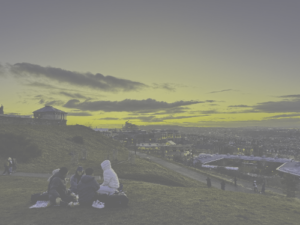
Some images don’t display the change correctly, some show colours that are excluded with deuteranopia, some are too dark, some wouldn’t let me download, and all would greatly degrade the image quality.
Trying Adobe Photoshop
The only way I could get the images to look a certain way was via Adobe Photoshop. Sadly, when exported, it wouldn’t show as the process would be done with the “view tool”. This seems to be a common problem (“Dogs Color Vision – Help/How To – Shotcut Forum” 2018) (“Export Photo/Video With Color Blindness Simulation” 2022)
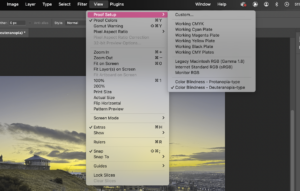
I need to do more research to find out how to export these images with the Deuteranopia effect on them; for the moment, I’ve opted for screenshoting.
Results
Here, we can see the altered images:
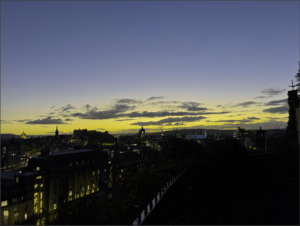
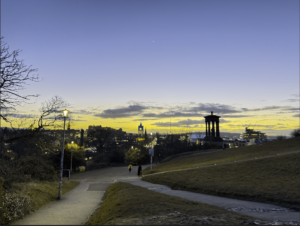
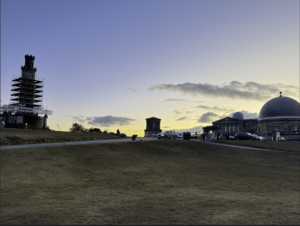
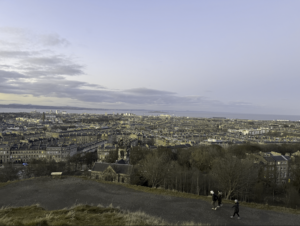
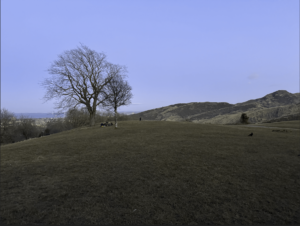
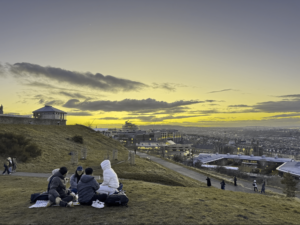
Here, we can see the original images:




Conclussion
After comparing the website’s obtained images with the ones from Photoshop, I’ve concluded that Photoshop is the answer for the effect that we are looking for. However, it is important to keep in mind that I have to do more research to find a way to export them without losing quality or to find a better tool to change the colour scale.
References:
“What Colors Can Dogs See? Can Dogs See Color?” n.d. Bow Wow Labs. https://www.bowwowlabs.com/blogs/news/what-colors-can-dogs-see
“Dogs Color Vision – Help/How To – Shotcut Forum.” 2018. Shotcut Forum. December 12, 2018. https://forum.shotcut.org/t/dogs-color-vision/8642
“Export Photo/Video With Color Blindness Simulation.” 2022. Https://Community.Adobe.Com. November 10, 2022. https://community.adobe.com/t5/photoshop-ecosystem-discussions/export-photo-video-with-color-blindness-simulation/td-p/12136430
“Dog Vision Converter – Your Dog’s Vision | Woof Me – Woof Me.” 2023. Woof Me. January 8, 2023. https://woofme.ie/vision-converter/
Petch, Danielle. 2023. “Through Pet’s Eyes.” TrustedHousesitters, February 10, 2023. https://www.trustedhousesitters.com/blog/pets/through-pets-eyes/?irclickid=3y1Tt5088xyKUm0UFpxj9xLfUkswKB1kCQd8QE0&irgwc=1&utm_source=impact&utm_medium=affiliate&utm_content=27795-CPN
Petch, Danielle. 2023. “Through Pet’s Eyes.” TrustedHousesitters, February 10, 2023. https://www.trustedhousesitters.com/blog/pets/through-pets-eyes/?irclickid=3y1Tt5088xyKUm0UFpxj9xLfUkswKB1kCQd8QE0&irgwc=1&utm_source=impact&utm_medium=affiliate&utm_content=27795-CPN
https://katzenworld.co.uk/2023/02/13/see-the-world-through-your-pets-eyes-with-this-filter/.
https://pilestone.co.uk/pages/color-blindness-simulator#
https://www.color-blindness.com/coblis-color-blindness-simulator/.
Project Idea Update
Ruiqi:
I’m thrilled about exploring sound-making ideas inspired by the story of the missing Piper boy. Ruotong suggested minimizing familiar sounds to amplify those we often overlook, creating a twisted, upside-down audiovisual experience unlike anything I’ve encountered before. However, the location remains a significant challenge for us.
Yiting:
I researched Edinburgh’s myths and legends, many of which revolve around nightmares. Key inspirations include Mary King’s Close, the Mackenzie Poltergeist, and the Phantom Drummer of Edinburgh Castle. To contrast these darker tales, I also looked into warm legends like Greyfriars Bobby and the Wishing Stone of Edinburgh Castle.
For our project, I envision starting with a nightmare but ending with warmth. For example, we could introduce a boy standing at his basement door with a rusty key, seeking forgotten truths buried under Edinburgh. Additionally, I’m considering using a contact microphone to capture subtle sounds for our sound design.
Ruotong:
I conducted research on global issues that resonate with our project’s themes of nightmares and entrapment. Key topics include:
– Global climate change and its impact on extreme weather events
– The COVID-19 pandemic and its psychological toll
– Political instability and conflicts worldwide, such as the Ukraine crisis and Middle East tensions
Among these, I believe climate change is particularly relevant. Its effects—like wildfires in California—highlight humanity’s vulnerability and could be integrated into our project to draw parallels between personal nightmares and global crises.
Zixuan:
I explored additional myths to enrich our narrative:
1. Stone of Destiny: A symbol of Scottish sovereignty with deep historical significance, tied to coronation rituals and national identity.
2. Major Thomas Weir: A 17th-century figure whose dark confessions of witchcraft turned him into a ghostly legend in Edinburgh’s Old Town.
3. Arthur’s Seat: A hill linked to the legend of a sleeping dragon, adding a layer of mystery and romance to Edinburgh’s folklore.
These stories deepen our connection to Edinburgh’s cultural heritage and provide rich material for our project’s narrative framework.
Carly:
Our project is inspired by the myth of the missing Piper boy, aiming to depict his nightmare while drawing parallels to today’s global challenges—seen as nightmares without escape. By presenting perspectives from humans, animals, and insects, we hope to shift viewpoints and magnify overlooked details.
Given filming constraints in Edinburgh’s tunnels, we’ll use footage from McEwan Hall tunnels to design a virtual maze in Cinema 4D2. Sound is central to our immersive installation; we’ll use ambisonic recording for a 360-degree experience and record impulse responses (IRs) in tunnels to recreate authentic reverb in studio recordings. A real piper player will accompany this journey through soundscapes designed to evoke psychological horror.
Chao:
I’ve been reflecting on how our project could balance its nightmare theme with hope at the end. For instance, after experiencing fear and entrapment, the boy could face a bright pathway or an open-ended resolution, offering solace and prompting deeper thought from the audience. This balance could make the experience more impactful by pairing terror with eventual hope.
