Ruiqi:
Aha! We used the Play-Doh to make three dog heads in different sizes.
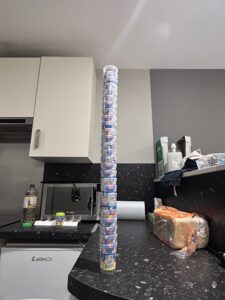
We’ve recorded what dogs may notice or do in a binaural format, including human footsteps, dog’s footsteps, toy ball rolling (in various perspectives), squeezing the toy ball, dog sniffing (actually Ruiqi…) and collar shaking and so on.
Zixuan:
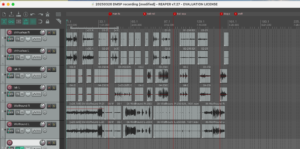
Today, Ruiqi and I went to the studio to record sounds using our dog head microphone setup. Since it’s just before our presentation, it was really difficult to book a recording space—but luckily, we managed to find an available slot and got in!
Our main recording equipment was a pair of AKG C414 XLS microphones, chosen for their excellent sensitivity and clarity, perfect for capturing the subtle environmental sounds we need for this simulation project. To make the recordings feel as close as possible to a dog’s hearing experience, we tried to replicate the physical characteristics of a dog’s head and ear position as accurately as possible.
One challenge we faced was with the Chihuahua model. It’s such a small dog with a very low shoulder height, and we couldn’t find a regular mic stand that worked at that level. In the end, we placed the Chihuahua model on a flat trolley, which turned out to be the perfect height, around 15 cm, very close to a real Chihuahua’s ear position.
Another issue was that the dog heads couldn’t be mounted directly onto a mic stand. So, we borrowed a speaker stand tray from the music store and used it to support the dog head models. This worked really well, keeping everything stable and secure during the recording.
We recorded at different heights according to the breeds:
– Chihuahua: about 15 cm
– Labrador: about 60 cm
– Irish Wolfhound: about 120 cm
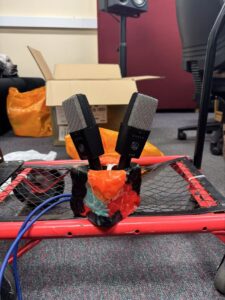
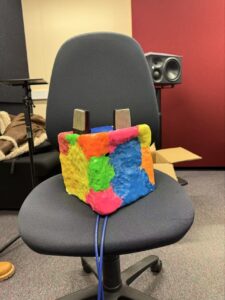
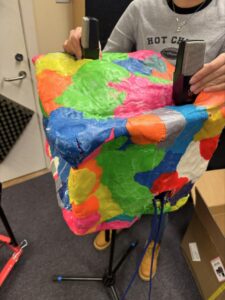
These heights correspond roughly to each dog’s natural ear position when standing, helping us better simulate spatial hearing differences between breeds.
One problem with the studio environment was the flooring. Our video scenes are set on grass, but the studio had a carpeted floor. To recreate the sound of footsteps on grass, we improvised: we layered a sheet of hard plastic underneath a sheet of soft plastic, then placed both under the carpet. The result was surprisingly convincing—when stepped on, the layered surface produced a sound quite similar to walking on grass.
As for sound content, we followed the details from our storyboard and recorded specific elements, including:
– Human footsteps (to simulate off-screen presence)
– Dog footsteps (running, turning, stepping on grass)
– Dog tag jingling sounds
– Toy ball rolling sounds
– Toy ball being squeezed or bitten
Originally, we had also hoped to record background crowd noise and bird sounds to enrich the ambient layers. However, since the dog head models are fragile and not very portable, we decided to skip outdoor recording for now.
All in all, the recording session was really productive. Despite some limitations in space and materials, we managed to recreate the environment and capture the sounds we needed. Once the recordings are sorted, we’ll move on to editing and mixing. I can’t wait to hear how the world sounds from inside a dog’s head!
