Any views expressed within media held on this service are those of the contributors, should not be taken as approved or endorsed by the University, and do not necessarily reflect the views of the University in respect of any particular issue.
On February 4th, our tutor Andrew guided us through an engaging workshop on audio-visual interaction in Atrium. The session provided a hands-on opportunity to explore how sound and visuals can influence each other, offering valuable insights for developing immersive and interactive projects. Below is an overview of the setup and process we experienced during the workshop.
Visual Setup:
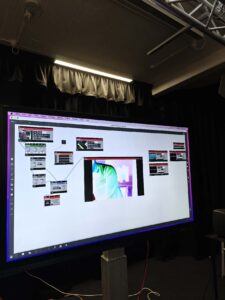
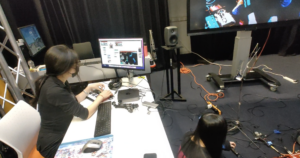
We used MAX software to present and manipulate video effects.
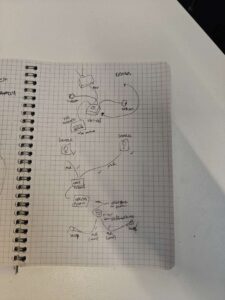
Two cameras were connected to the computer to capture visuals, while their built-in microphones recorded audio. The captured audio influenced the visual effects.
Parameters controlling the video effects in the MAX patch were mapped to a physical controller, enabling real-time adjustments.
Audio Setup:
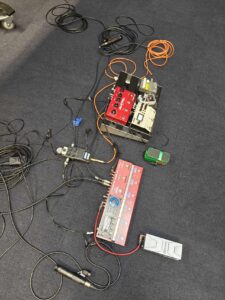
Two Genelec speakers were placed on either side of the monitor for audio output.
Two condenser microphones were used for sound recording.
Andrew prepared various vocal and instrument effect modules, along with a Boss RC-600 loop station. These were connected to create diverse sound effects.
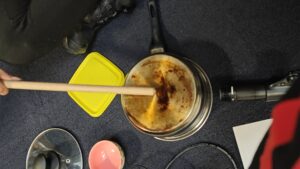
Kitchen utensils were also used as foley materials for sound creation.
Workshop Process:
One participant controlled the MAX patch to create different video effects.
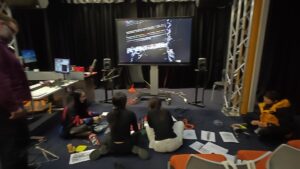
Two participants experimented with creating sounds using the microphones.
Two others managed the loop station and effect modules to generate dynamic and varied soundscapes. These sounds influenced the visual effects in real time.
Participants creating sound effects observed the visuals on the monitor to match or enhance them with suitable sounds, or explored ways to create more exciting audio.
Throughout the workshop, we rotated roles, allowing each participant to experience different aspects of the project. This rotation enabled everyone to gain a comprehensive understanding of how each role contributes to the overall audio-visual interaction.
By switching between controlling the MAX patch, creating sounds, managing effects, and observing the interplay between audio and visuals, we developed a deeper appreciation for the collaborative nature of the project and the unique challenges and creative opportunities each role presented.
This collaborative project demonstrated how sound and visuals can interact and influence each other, allowing everyone to actively participate and enjoy the process. The workshop was highly engaging, providing us with inspiration on how to develop immersive and interactive elements in our own projects. The role rotation aspect enhanced our learning experience, fostering a more holistic understanding of audio-visual interaction.
Ruiqi:
I’m thrilled about exploring sound-making ideas inspired by the story of the missing Piper boy. Ruotong suggested minimizing familiar sounds to amplify those we often overlook, creating a twisted, upside-down audiovisual experience unlike anything I’ve encountered before. However, the location remains a significant challenge for us.
Yiting:
I researched Edinburgh’s myths and legends, many of which revolve around nightmares. Key inspirations include Mary King’s Close, the Mackenzie Poltergeist, and the Phantom Drummer of Edinburgh Castle. To contrast these darker tales, I also looked into warm legends like Greyfriars Bobby and the Wishing Stone of Edinburgh Castle.
For our project, I envision starting with a nightmare but ending with warmth. For example, we could introduce a boy standing at his basement door with a rusty key, seeking forgotten truths buried under Edinburgh. Additionally, I’m considering using a contact microphone to capture subtle sounds for our sound design.
Ruotong:
I conducted research on global issues that resonate with our project’s themes of nightmares and entrapment. Key topics include:
– Global climate change and its impact on extreme weather events
– The COVID-19 pandemic and its psychological toll
– Political instability and conflicts worldwide, such as the Ukraine crisis and Middle East tensions
Among these, I believe climate change is particularly relevant. Its effects—like wildfires in California—highlight humanity’s vulnerability and could be integrated into our project to draw parallels between personal nightmares and global crises.
Zixuan:
I explored additional myths to enrich our narrative:
1. Stone of Destiny: A symbol of Scottish sovereignty with deep historical significance, tied to coronation rituals and national identity.
2. Major Thomas Weir: A 17th-century figure whose dark confessions of witchcraft turned him into a ghostly legend in Edinburgh’s Old Town.
3. Arthur’s Seat: A hill linked to the legend of a sleeping dragon, adding a layer of mystery and romance to Edinburgh’s folklore.
These stories deepen our connection to Edinburgh’s cultural heritage and provide rich material for our project’s narrative framework.
Carly:
Our project is inspired by the myth of the missing Piper boy, aiming to depict his nightmare while drawing parallels to today’s global challenges—seen as nightmares without escape. By presenting perspectives from humans, animals, and insects, we hope to shift viewpoints and magnify overlooked details.
Given filming constraints in Edinburgh’s tunnels, we’ll use footage from McEwan Hall tunnels to design a virtual maze in Cinema 4D2. Sound is central to our immersive installation; we’ll use ambisonic recording for a 360-degree experience and record impulse responses (IRs) in tunnels to recreate authentic reverb in studio recordings. A real piper player will accompany this journey through soundscapes designed to evoke psychological horror.
Chao:
I’ve been reflecting on how our project could balance its nightmare theme with hope at the end. For instance, after experiencing fear and entrapment, the boy could face a bright pathway or an open-ended resolution, offering solace and prompting deeper thought from the audience. This balance could make the experience more impactful by pairing terror with eventual hope.
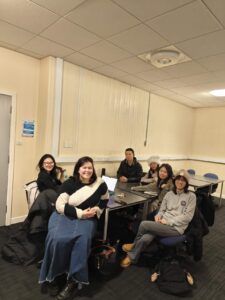
On Friday, January 31, 2025, our group gathered at Alison’s house in the post-grad common room at 1:00 p.m. It was a productive session during which we discussed the progress of our project and planned for the upcoming tutorial with Andrew, which is scheduled for Tuesday, February 4, at 10:00 a.m.
Key Discussion Points:
Project Concept Development:
We finalized the idea of basing our project on Edinburgh’s “Piper Boy” myth. This psychological horror concept will metaphorically connect myths to real-world issues like climate change. Participants will explore a tunnel with doors that open to reveal inescapable realities, such as visuals and sounds representing global problems.
Technical Implementation:
The team plans to use 3D modeling software (e.g., 3ds Max) to recreate tunnels and add interactive doors. This approach allows us to customize textures and expand the tunnel’s structure.
For sound design, we will record Impulse Responses (IRs) in a studio to simulate tunnel acoustics without external noise interference.
Task Assignments: Each member was assigned specific responsibilities for research and preparation:
Expanding the idea on paper: Carly Salvador-Almeida Soler
Myths in Edinburgh: Zixuan
Different types of vision and hearing (humans, animals, insects): Ruiqi
Current world problems: Ruotong
Culture in Edinburgh/Scotland: Chao
Accessing McEwan Hall for photography and IR recording: Yiting
Research Goals:
Investigate Edinburgh’s myths and culture to provide historical context.
Study how different species perceive the world to incorporate diverse perspectives into the project.
Explore global issues like climate change to strengthen thematic connections.
Collaboration Guidelines:
While tasks are divided, members are encouraged to support each other’s research and share findings collaboratively.
Upcoming Meetings:
February 5, 10:00 AM: Tutorial with Andrew to discuss progress.
February 7 and February 11: Group meetings to finalize research and prepare submissions.
Reflection:
The meeting was highly productive, with clear task delegation and collaborative planning. We are making steady progress toward our project goals while ensuring that everyone contributes effectively.
Individual Contributions:
Ruiqi:
Dear Diary,
I’m excited about the concept of sound-making ideas in the story of the missing Piper boy. It came up from Ruotong, who says we could minimise the sound we get used to maximise the sound we don’t pay much attention to. And it would be a twisted and upside-down audiovisual world I’ve never been to.
But the location remains a huge challenge.
Many thoughts,
Ruiqi
Zixuan:
In this group discussion, we revisited the questions raised in the previous tutorial and discussed them in depth. Based on our discussion, we identified additional questions that needed to be addressed and divided the tasks accordingly. Each member chose a different topic to explore based on their interests. I chose to focus on the myths and legends of Edinburgh because I found this topic fascinating. It provides an alternative perspective on understanding the city, and the myths add to the charm of this ancient place. Additionally, I can explore connections between mythology and the real world.
We also expanded on our existing ideas and discussed elements that could be integrated with mythology. Finally, we agreed on a time for our next meeting to facilitate faster exchange of our progress.
I have researched a total of four myths: Anne’s Room, Arthur’s Seat, Major Thomas Weir, and the Stone of Destiny. Exploring these myths has given me a greater interest and enthusiasm for the ancient city of Edinburgh and has also deepened my understanding of this historic city.
Ruotong:
In this meeting, we finalized the project’s theme—depicting the nightmare of the piper boy from different perspectives. From a technical standpoint, we will use 3D modeling to construct the scenes we aim to recreate. And we also want to create an immersive experience for the audience by ambisonic. Additionally, I am responsible for collecting and summarizing real-time global events and integrating them into the piper boy’s nightmare. This will guide the audience to reflect on and raise awareness of the disasters currently occurring in the world.
Yiting:
In the second group meeting, our group discussed project story building. Our project on edinburgh‘s “piper boy”myth. The audience will enter the tunnel from the perspective of the little boy and open different doors. Behind the doors are different world current events, such as global climate change. We will present the project to the audience through 3D modeling or 3D video, combined with surround sound. Our first step was to find a tunnel in Edinburgh, then we recorded impulse responses (IRs) and simulated the acoustic sounds inside the tunnel. Our group assigned different tasks to each member this week, and I was assigned to ask the professor if we could enter the underground tunnels of McHall to record IR, and to rent equipment if necessary. In addition, I looked up relevant information about 3D photography and learned that the Insta360 panoramic camera can shoot panoramic videos, which can make it easier for the audience to experience our project immersively.
Carly:
The idea for this project is based on the myth of the ghost of the missing Edinburgh piper boy. From this myth, we aim to showcase the nightmare that the child endured. In this instance, we also wish to connect it to the current global situation, as it can also be perceived as a nightmare without escape. We want to present the audience with various perspectives, such as those of humans, animals, and insects. By highlighting these different viewpoints, we hope to shift our own perspective, enabling us to see problems from alternate angles to magnify the small things we typically overlook and vice versa. As the myth is set within the Edinburgh tunnels, and considering the inaccessibility of filming there, we have decided to capture footage in the tunnel at McEwan Hall and use that to map the tunnels in the software Cinema 4D. This software will allow us to design a new maze based on our footage. We believe it is best to present the project to an audience as an installation, with screens and speakers surrounding the space. We want this experience to impart a sense of being trapped; there will be no escape, creating a psychological horror-themed project.
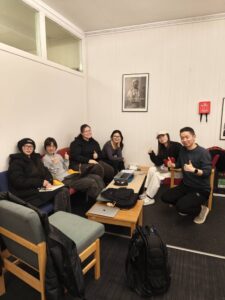
In our first group meeting, we had a productive discussion and aligned on several key aspects of our project. Below is a summary of our ideas, decisions, and plans moving forward:
1. Idea Stage
During the meeting, everyone shared their initial ideas for the project:
– Carly’s Idea: Focus on Edinburgh’s myths. The concept involves a tunnel where a young boy opens different doors, each revealing content that showcases Edinburgh’s history, culture, and its influence on the present.
– Zixuan’s Idea: Explore perspectives from different animals, which could be an engaging and unique approach.
– Ruotong’s Idea: Amplify subtle sounds while minimizing louder ones to highlight elements we often overlook in daily life.
– Chao’s Idea: Use old buildings as anchors to showcase Edinburgh’s history and culture.
-Yiting’s Idea: Use a 3D camera to shoot and create 3D videos to express our project.
2. Final Concept Decision
After discussion, we decided to base our project primarily on Carly’s idea of Edinburgh’s myths. We will integrate Zixuan’s concept of diverse perspectives and Ruotong’s sound-focused approach to create a rich and immersive experience. We even considered locating an old tunnel as part of the installation.
3. Role Assignments
To ensure smooth collaboration, we assigned roles based on individual strengths and interests. While everyone will contribute to the overall project, here are the primary responsibilities:
We also discussed three key questions to clarify our motivations and goals for the project:
1. What excites you about this project/course?
– Chao: Collaborating with others and exploring UK culture and history.
– Ruotong: Broadening my horizons.
– Zixuan: Exploring media possibilities, learning new coding techniques, and building an interactive sound product step by step.
– Ruiqi: Collaboration, installation, and high expectations for the outcome.
– Yiting: Exploring Edinburgh’s history, comparing past and present, and using VR technology.
– Carly: Researching myths, exploring tunnels, and creating an engaging final product.
2. What do you want to achieve in this project?
– Chao: Create an interactive sound environment.
– Ruotong: Produce a soundscape.
– Zixuan: Learn how to collaborate effectively and draw inspiration from others.
– Ruiqi: Achieve unique sound experiences.
– Yiting: Combine video and audio in an immersive way to tell architectural stories.
– Carly: Introduce audiences to an immersive experience that contrasts myths with modern reality.
3. What do you need to achieve these goals?
– Chao: Explore more possibilities in sound design for the project.
– Zixuan: Technical support and knowledge of culture/history.
– Ruiqi: Collaboration with peers.
– Yiting: VR technology and live recording tools.
– Carly: Research, sound software, recording equipment, video equipment, editing software, and suitable locations.
5. Learning Goals
Finally, we identified areas where we want to grow through this project:
– Ruotong: Achieve the production of a soundscape.
– Chao: Learn how to use multimedia storytelling to create interactive experiences for audiences.
– Chao & Zixuan: Transform abstract ideas into tangible media outputs.- Zixuan: Build equipment for interactive experiences.
– Ruiqi: Develop storytelling skills.
– Yiting: Improve teamwork, communication, and proficiency in interactive technology.
– Carly:
This meeting set a strong foundation for our project. We are excited about combining our ideas into a cohesive concept that highlights Edinburgh’s myths through innovative use of soundscapes, visuals, and interactivity. Stay tuned for more updates as we progress!
Individual Contributions:
Carly:
This was our first meeting as a group without any tutors. We gathered together, brainstormed various ideas for the project, and later, when we felt we had enough, we held a vote. In this instance, we didn’t settle on one unique idea but opted instead to merge three ideas, resulting in our final concept for the project. After deciding on the idea and weighing the pros and cons of each option, we allocated roles for the project. Rather than drawing another vote, we allowed everyone to express their preferred roles. I, for one, wanted to take on the planner role, but Yiting Liu was interested in it as well. I was averse to becoming the project lead, yet ultimately, I was persuaded into it, and now I find myself as the project lead. I must say I’m genuinely excited about what is on the horizon for the project.
Zixuan:
During our first group meeting, we mainly accomplished three tasks. First, we shared our ideas about the project, with each member presenting their own thoughts. Second, we assigned roles within the group. Third, we discussed the questions given by the professor.
In the end, we selected three key ideas to form the core theme of our project: Carly’s idea of using the legend of the Edinburgh Piper Boy as the story background, Ruotong’s concept of reversing the scale of everyday sounds—making loud sounds small and small sounds loud, and my idea of simulating audiovisual experiences from different creatures’ perspectives. Combining these elements, we shaped our project’s central theme. I found this particularly interesting because the inescapable nightmare of the Piper Boy provided us with great creative space, allowing both our auditory and visual designs to be abstract, which aligns well with the ideas Ruotong and I proposed.
Additionally, we divided responsibilities within the group. I took on the role of technical support, with my main task being to learn various software tools to help bring our project to life. I chose this role because I wanted to challenge myself—learning new software will greatly enhance my skills, and I find this process very exciting. Through this project, I hope to improve my technical abilities.
Finally, we shared our thoughts on the professor’s discussion questions, and Chao recorded them for reference
Ruotong:
We can exaggerated the sounds that overlooked in our daily life by amplifying subtle. For example, in a traffic scene, the overall noise of vehicle flow can be reduced while enhancing the sound of tires friction against the ground, emphasizing its texture and detail. (make big to small and small to big)
Five Questions
1.Write three things that excite you about this project/course.
This project can shift perspectives, allowing us to see or hear the unnoticed details of everyday life.
This project can use digital media to represent or recreate urban spaces, creating entirely new experiences that I have never encountered before.
It allows for a multidimensional understanding and exploration of a city.
2.What do you want to achieve in this project?
To uncover an interesting new perspective
To help more people, including myself, better understand Edinburgh.
Trying to create the soundscape
3.What do you need to achieve these things?
Conduct extensive research on the city’s background.
Understand the definition of soundscape, explore the acoustic characteristics of the city, and study how to integrate them into the project.
4.What are the things that you want/need to learn in this project?
The ability to complete the project through collaborative efforts.
How to use digital media as a new artistic form to interpret the relationship between sound and image and create a more immersive experience.
In this meeting, firstly we discussed the research direction of this project, and everyone shared their own ideas and concepts. And we determined the project’s theme through a voting process. We integrated the ideas of three team members, using different perspectives to tell a story about Edinburgh. Then we divided the project tasks and identified six different roles that we needed to take on. I chose the position of Image Director, which means I am responsible for overseeing the filming aspect of the project. Finally, we discussed the five key questions mentioned in the lecture that we need to consider.
Ruiqi:
Today was our first group meeting, and we focused on generating ideas and establishing the foundation of our project. Each team member introduced themselves and received their roles. As the sound director, I am responsible for the overall sound design, ensuring that audio elements align with the project’s vision. We decided to create an immersive sound environment for the myth installation, using techniques like ambisonics. Ruotong came up with the idea of maximizing sounds we often overlook and minimizing the ones we’re accustomed to, linking this concept to our project name, Perspective. We’ll tailor the sound to match the hearing ranges and habits of different animals, like dogs, cats, insects, etc.