Any views expressed within media held on this service are those of the contributors, should not be taken as approved or endorsed by the University, and do not necessarily reflect the views of the University in respect of any particular issue.
Week 11 is the presentation week and our project has reached its final stage. We have completed 80% of the video and sound.
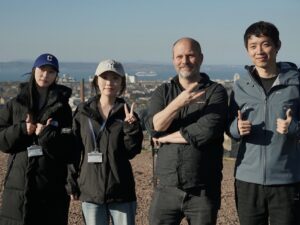
On Monday, we went to Calton Hill to test the video ourselves. During the test, we found that the video speed was faster than the actual speed, which made it impossible for viewers to keep up with the video speed. That evening, we adjusted the video and sound to the normal viewing speed, and the video and sound were finalized. After finalizing, we uploaded the video to the vimeo website, and also uploaded the video to Jules’ account for backup.
On Tuesday, we conducted a max test to test whether the microphone and camera could work properly. Before that, we also conceived a map and promotional cards for viewers. On Tuesday afternoon, the cards and maps were completed and printed.
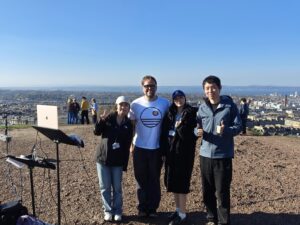
On Wednesday, the day of the presentation, we prepared three computers, three microphones, three cameras, a sound card and a midi controller. At one o’clock in the afternoon, we took all the equipment to Calton Hill for advance arrangements, and pointed three microphones and cameras in three different directions of Calton Hill to capture different sounds and images. Viewers will first receive a project introduction card to learn about the project overview, and then take the project map to watch the video and take a walk on Calton Hill, which takes about 10 minutes. After the tour, return to the starting point of the project for a real-time max audio and video experience. After each viewer completes the experience, we record their feedback so that we can present better projects in the future.
A dog’s hearing range is much wider and farther than a human’s, so it can hear sounds from beyond Calton Hill. Based on this characteristic, we explored the area around the hill and thought it would be great to add the sound of church bells in our project. We researched nearby churches with scheduled bell ringing times, and then checked if they were visible from Calton Hill. In the end, we chose St Mary’s Episcopal Cathedral.
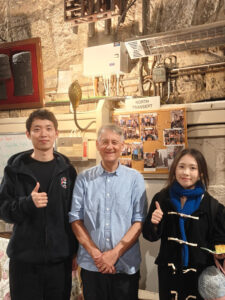
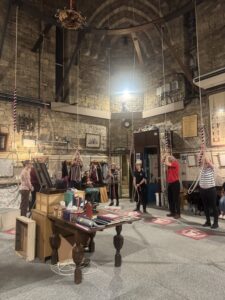
On the evening of March 27th, we arrived at the cathedral, hoping to record the sound of the bells. It was raining at the time, so we couldn’t really record anything from outside. Then we noticed a small side door and thought maybe we could go in to avoid the noise of the rain. Luckily, we met one of the bell ringers. After we explained what we were doing, he kindly offered to take us up to the bell tower.Getting up there wasn’t easy, we made great efforts to get there.
At first, we were a bit worried that our unexpected visit might be a bother, but every bell ringer we met was so kind and welcoming. They even took the time to explain the whole bell-ringing process to us. Before this experience, I always thought the sound of the bell came from one person ringing it. But I only learned today that this is a job that requires teamwork to complete. Each bell strike depends on timing, teamwork, and precision. Standing in the bell tower, watching them move in sync in such a small space, I could really feel the dedication and tradition behind their work. It’s not just about ringing the bell—it’s about trust, teamwork, and respect for time, rhythm, and tradition.
Even though the sound only made it into our project for a few seconds, the experience gave us a strong sense of connection to the city and its people. This is an experience I will cherish for the rest of my life.
Testing and connecting MAX patcher- Chao Li, Ruotong Wu
We believe that a dog’s sense of smell is an important perspective. Through our research, we discovered that thermal imaging can be used to visualize gases, so we plan to use a thermal imaging effect to represent how dogs perceive smells. After seeking help from Jules, we found out that MAX can generate thermal imaging effects directly.
During our exploration, we realized that if we use MAX to process live footage into a dog’s perspective, it could create a better experience for the audience. Therefore, we decided to set up an interactive experience point based on a video tour of Calton Hill. We will use MAX’s Vizzie modules to apply visual effects to the video in real time, while also recording sound from three directions. The sound will influence the visuals, creating a live experience for the audience.
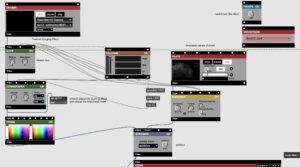
I divided the entire pacher into three parts. The design of each part is mostly the same, but they represent different aspects.
The First Aspect-Dog’s Vision
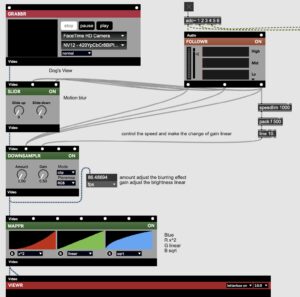
I referred to the patcher from Andrew’s workshop, Jules’ detailed explanation of the Vizzie modules and I combine the ‘help’ for each Vizzie component. Based on my research, I experimented and created a version of how I imagine the world looks through a dog’s eyes. I focused on three main aspects to represent a dog’s vision:
–Color: Mostly blue, with yellow and gray as secondary tones
–Blur: Dogs see with less clarity than humans
• Glow: Dogs are more sensitive to light movement, and fast motion can create a glowing effect
The most difficult part was adjusting the colors. There wasn’t a single Vizzie module that could fully recreate the way I see a dog’s visual world. I originally tried to use the object of ‘jit.gl.pix’ to completely remove red, but after many attempts, it didn’t work as expected. In the end, I used the MAPPR module and its RGB function to achieve the color style of dog vision.
The Second Aspect-Thermal Imaging Effect
For this part, we still use vizzie to simulate the thermal imaging effect and add the effect of gas to combine it with the video to simulate the sense of smell of dogs. For the color part, I used ‘2 TONR’ to retain the blue and purple to simulate the video effect captured by the thermal imager. Then I collected the smoke effects online and mixed them using the addictive mode of MODEMIXR.
The Third Aspect-Dog’s Mood
The design of this part is very simple. I only kept the yellow color and then adjusted the frequency of the screen flickering through sound. Because dogs have very sensitive hearing, even the slightest change in sound will attract their attention, even many subtle sounds that we humans never notice.
In addition, each video corresponds to a different microphone. I input the sound into different modules to influence the changes in the video, making the auditory stimulation to the audience more visual. Then I also did a simple mix by MAX to enable it to adjust the frequency of the real-time sound. Additionally, I added the reverb and distortion effects to make the ambience heard by the audience closer to the hearing of a dog.
The day before our presentation, we got help from Jules and Andrew. We used the H6 Essential as an audio interface to record live ambience. Andrew suggested that we add a MIDI controller so the audience could interact and adjust things themselves. This would make the experience more fun and immersive. It was a really helpful suggestion for our project. Luckily, we managed to borrow a MIDI controller just one second before the staff at the music store closed for the day — it was such a close call! I used six knobs to control three video channels and three audio channels. The audience could turn the knobs to mix visuals and sound in real time.
On Tuesday of the tenth week, we showed the demo to Andrew. Andrew suggested adding a transition between the human and dog perspectives, and mentioned using thermal imaging to show the smell.
On Wednesday we went to Calton Hill again to record additional video and sound materials. This time we used a shotgun microphone to record a single point sound source. We also went to the church to record bells to provide more sound effects for later sound design (Blog- Cathedral Recording).
In addition, we are also preparing to provide project easter eggs for the audience. When the audience walks along Calton Hill and reaches the end, they can use Max to perform real-time sound and picture conversion and experience the changes in the picture brought about by the sound on the spot. I think this will be very interesting.(Blog- Live Experience by MAX)
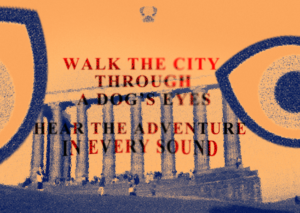
Coincidentally, there was also an exhibition on Calton Hill recently. After finishing the work, I visited the exhibition and found it quite inspiring. We’re planning to design a postcard for our project and have come up with a slogan:
“Walk the City Through a Dog’s Eyes, Hear the Adventure in Every Sound.”
We also included a brief overview of the project on the postcard and plan to imbed a QR code linking to the final roaming video. This way, even if someone doesn’t make it to Calton Hill in person, they can still experience the world through a dog’s eyes and enjoy the landscape of Calton Hill.
I want to test whether we can tell stories primarily through sound from dog perspective. In other words, by creating a soundscape of the dog world, we can show the dog’s world. I exaggerate some effects in the human world that go unnoticed, such asgrating, chirp, vibration and so on.
But I found it is difficult to create sound without screen. So I think we can still use the video as an aid(do some abstract processing).on this basis, creating soundscape to show the dog’s perspective in our view. In addition, it is important to increase the audience’s interaction and sense of experience. We need to explore how to complete it.