Author: Ruiqi
Submission 2_A COMPARATIVE OF DOG PERSPECTIVES on Calton Hill
Group 2 Submission 2
Here is the final version of how three different dogs perceive the world.
Labrador Final:
https://media.ed.ac.uk/media/t/1_3ijoperb
Blind Labrador (Presentation/ Final Version)
https://media.ed.ac.uk/media/Deaf%20Labrador%20Presentation%20Version/1_r1kdztmy
Deaf Labrador (Presentation Version)
https://media.ed.ac.uk/media/Deaf%20Labrador%20Final%20Version/1_tpv3zaug
Deaf Labrador Final Version
https://drive.google.com/drive/folders/1bPVJsmr0vwP2Lb89HpMJszykojbboqWk?usp=share_link
Chihuahua & Irish wolfhound
Group 2 Resources Collection
Ruiqi:
What’s listed below are what audio materials that I used in the presentation/ final version:
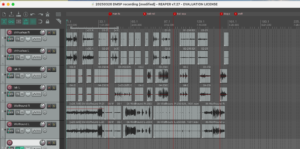
P.S. What I want to talk specifically about is how the sound of the plane has been made. It was initially started with a pure Brownian noise from Audacity, then processed with Reapitch on Reaper (first 15 seconds pitched up, latter 15 seconds pitched down, on automation envelope), and so was the volume. Plus, other used plug-ins are listed below for reference.
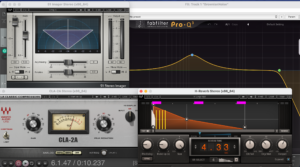
Acknowledgement:
The sound of a dog barking, the camera shutter is from open sound resource website, whose resource websites are listed below:
https://pixabay.com/sound-effects/search/dog-barking/
https://pixabay.com/sound-effects/search/camera-shutter/
And the sound of the street comes from my friend Zelin.
Zixuan:
What’s listed below are what audio materials that I used in the presentation/ final version:
The sound of the dog comes from my friend Song
The sound of the street people talking comes from my friend Yu
The sound of the forest comes from my friend Shi
The sound of the bird’s wings comes from my friend Xue
All the sound used here is with permission.
Carly:
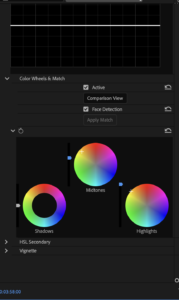
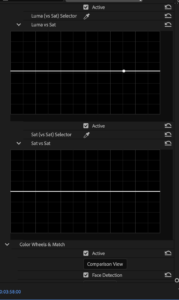
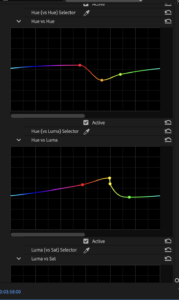
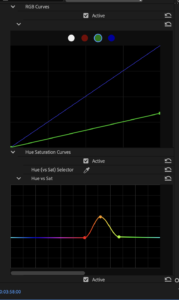
In my case I didn’t source elements outside of the videos and photos we took, but what I did however do was research how to create a Deuteranopia effect in premier pro as I already knew how to do it in photoshop, as there was a filter, but in premier pro it was a whole different deal.
The places where I obtained useful information are the following:
- Design for color blind users: https://blog.eppz.eu/design-color-blind-users/
- Simulate Color-Blindness in Final Rendered Project: https://community.adobe.com/t5/premiere-pro-discussions/simulate-color-blindness-in-final-rendered-project/m-p/12136770
- How to Simulate Color Blindness in a Video?: https://www.reddit.com/r/premiere/comments/oqhv4r/how_to_simulate_color_blindness_in_a_video/?rdt=48169
The Lumetri colour controls ended up as this result:
Presentation—A COMPARATIVE OF DOG PERSPECTIVES on Calton Hill
Ruiqi:
1. Presentation Procedure:
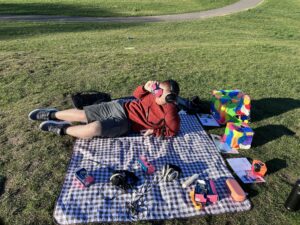
Experiencers head to the spots near the brink of the hill — not quite falling off, but close enough for a great view of the city and Arthur’s Seat.
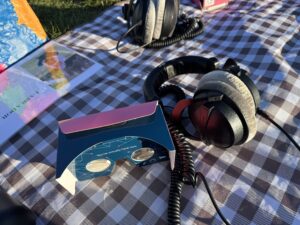
They plop down on the blanket, put on some cardboard VR headsets, and dive into the world as seen and heard by an Irish Wolfhound and a Chihuahua — one tall, one tiny, both dramatic.
Next, they move a bit closer to the hill’s edge — still safe — and can choose to sit down again or stay standing, depending on how brave or cold they’re feeling.
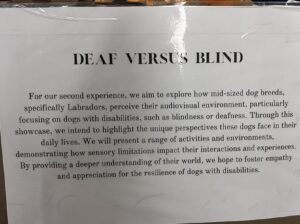
Then, it’s headset time again, this time to experience the world like a slightly confused Labrador: vision a bit blurry, hearing a bit off (or on), but vibes? We think it is matched.
2. Presentation Materials:
⭐️Binaural dogs’ heads: Chihuahua/ Labrador/ Irish wolfhound
⭐️Beyerdynamic Headphones x3
⭐️Adaptor 6.5mm to lightning x2/ Type C x1
⭐️Cardboard VR headsets
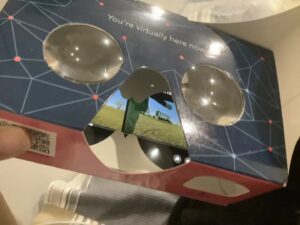
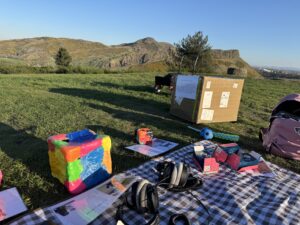
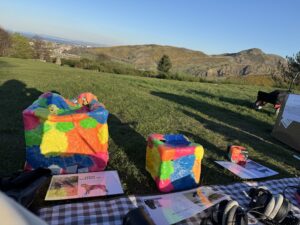
⭐️Blanket (For experiencers to sit/ kneel down to fully be engaged in the dogs’ perspectives)
⭐️Dog chewer (For immersive decoration)
⭐️Dog treat ball (why we choose the blue one—blue and yellow are the colours that dogs see most clearly. )
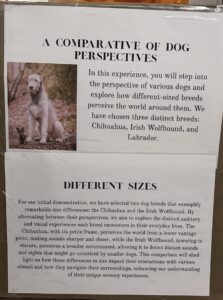
⭐️Laminated cue boards
3. Presentation Purpose
In this experience, people will see the world through the eyes (and ears) of three very different breeds of dogs. Ever wondered how a tiny Chihuahua, a giant Irish Wolfhound, or a slightly confused Labrador makes sense of things? Well, now’s your chance.
4. How Human Beings Are Connected to the Dogs?
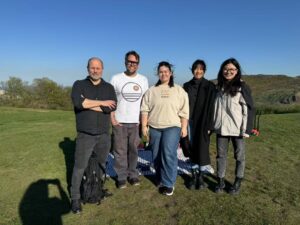
5. Lovely Moment—Warm Group Photo
Zixuan:
Today, we officially held our immersive exhibition on Calton Hill. The event went smoothly overall, and we received many valuable pieces of feedback that gave us a lot to reflect on.
This exhibition was divided into two main sections:
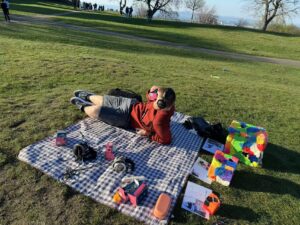
The first section focused on the auditory differences between large and small dogs. We set this part up on the grass, where we laid out a picnic blanket so participants could choose to sit or lie down—bringing their physical perspective closer to that of a dog. To enhance immersion, we also placed real props—the same balls and dog toys shown in the video—on the lawn. This allowed participants to see the objects from both a dog’s perspective (in VR) and their own, deepening the contrast between the two and reinforcing the immersive effect.
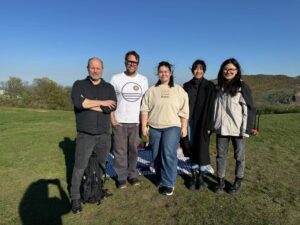
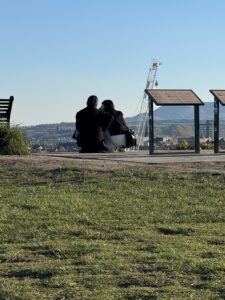
The second section took place near the edge of the hill, where participants had a clear view of Arthur’s Seat and the surrounding landscape. The scenery was stunning, and we found that the natural beauty of the environment made the contrast with the “sensory impairment” content (blind/deaf dogs) even more striking and poignant.
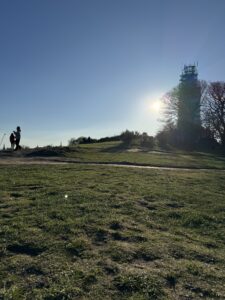
To maintain immersion, we scheduled the presentation at nearly the same time of day as when we shot our footage. This ensured that the lighting and sun angle matched, providing a consistent and believable visual experience.
One fun and unexpected moment during the exhibition was when a dog that happened to be playing on the hill ran off with one of our toy props—a treat ball from the setup. It seemed to really enjoy it, and the moment brought a smile to everyone’s face, making the experience feel even more alive.
🎧 Feedback & Reflections
After the participants finished the experience, we had short conversations with many of them to gather feedback. Based on their responses, I reflected on a few aspects that could be improved:
-
VR Headset and Accessibility
Some participants had vision issues, such as nearsightedness or astigmatism, which made it uncomfortable for them to use the cardboard VR headset. Those with astigmatism saw double images, while nearsighted users reported dizziness. This made me realize that we hadn’t fully considered the diversity of user needs during the design phase, and future iterations should take this into account. -
Video Transition Breaks Immersion
In the second part of the experience, participants had to manually switch videos between two segments. This broke the sense of immersion for a few people. I’m considering changing it to automatically play both videos in sequence, which would create a smoother, uninterrupted experience. -
Headphone Isolation Issue
Our headphones weren’t effective in blocking out ambient noise. Some of the more delicate audio details we designed were lost in the background noise. In the future, we may need to use more closed or noise-cancelling headphones to preserve the full quality of the soundscape. -
Insightful Feedback from Professor Jules
Professor Jules offered some thoughtful suggestions after experiencing the work. He recommended experimenting with bone conduction audio to simulate a more realistic, first-person auditory experience. He also noted that the sense of depth in the hearing experience—especially between large and small dogs—could be more pronounced. This was a detail I hadn’t fully considered before, and I plan to improve this in the next version of the sound mix.
Carly:
On the 2nd of April, we presented our project to the world at the top of Calton Hill. We met 2 hours before the presentation so we could have enough time to get up there, reserve the specific spot and set everything up for the presentation. When 16.00 arrived, I went to the top of the stairs to meet Jules and Andrew. Jules was the first one to experience our presentation, while Andrew checked the other group’s presentation. When finished, they exchanged, and Andrew experienced our presentation.
We got some great feedback from our professors, classmates, colleagues and friends. Some said they felt like a dog, some would have loved more movement, some said that it was really interesting that the sun placement was the same as the one we were showing them…
Binaural Recording…But in dogs’ perspective?
Ruiqi:
Aha! We used the Play-Doh to make three dog heads in different sizes.
We’ve recorded what dogs may notice or do in a binaural format, including human footsteps, dog’s footsteps, toy ball rolling (in various perspectives), squeezing the toy ball, dog sniffing (actually Ruiqi…) and collar shaking and so on.
Zixuan:
Today, Ruiqi and I went to the studio to record sounds using our dog head microphone setup. Since it’s just before our presentation, it was really difficult to book a recording space—but luckily, we managed to find an available slot and got in!
Our main recording equipment was a pair of AKG C414 XLS microphones, chosen for their excellent sensitivity and clarity, perfect for capturing the subtle environmental sounds we need for this simulation project. To make the recordings feel as close as possible to a dog’s hearing experience, we tried to replicate the physical characteristics of a dog’s head and ear position as accurately as possible.
One challenge we faced was with the Chihuahua model. It’s such a small dog with a very low shoulder height, and we couldn’t find a regular mic stand that worked at that level. In the end, we placed the Chihuahua model on a flat trolley, which turned out to be the perfect height, around 15 cm, very close to a real Chihuahua’s ear position.
Another issue was that the dog heads couldn’t be mounted directly onto a mic stand. So, we borrowed a speaker stand tray from the music store and used it to support the dog head models. This worked really well, keeping everything stable and secure during the recording.
We recorded at different heights according to the breeds:
– Chihuahua: about 15 cm
– Labrador: about 60 cm
– Irish Wolfhound: about 120 cm
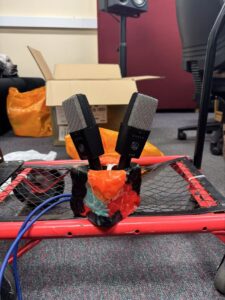
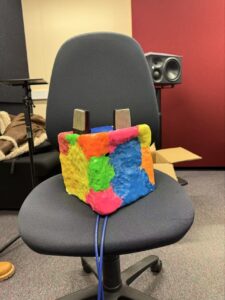
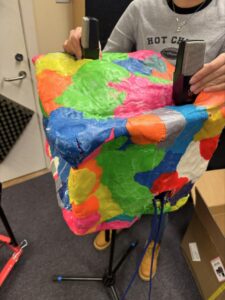
These heights correspond roughly to each dog’s natural ear position when standing, helping us better simulate spatial hearing differences between breeds.
One problem with the studio environment was the flooring. Our video scenes are set on grass, but the studio had a carpeted floor. To recreate the sound of footsteps on grass, we improvised: we layered a sheet of hard plastic underneath a sheet of soft plastic, then placed both under the carpet. The result was surprisingly convincing—when stepped on, the layered surface produced a sound quite similar to walking on grass.
As for sound content, we followed the details from our storyboard and recorded specific elements, including:
– Human footsteps (to simulate off-screen presence)
– Dog footsteps (running, turning, stepping on grass)
– Dog tag jingling sounds
– Toy ball rolling sounds
– Toy ball being squeezed or bitten
Originally, we had also hoped to record background crowd noise and bird sounds to enrich the ambient layers. However, since the dog head models are fragile and not very portable, we decided to skip outdoor recording for now.
All in all, the recording session was really productive. Despite some limitations in space and materials, we managed to recreate the environment and capture the sounds we needed. Once the recordings are sorted, we’ll move on to editing and mixing. I can’t wait to hear how the world sounds from inside a dog’s head!
Irish wolfhound is MUCH bigger than you can imagine
While having a binaural wolfhound-sized head is certainly worthwhile for capturing and crafting richer sonic possibilities, I must say— it demands a LOT of plasticine!
Mixing on Labrador
As we have recorded the background sounds according to different kinds of dogs’ sizes and hearing traits, coupled with sound effects that they would hear or make, we presented them in the mixing as much as possible.
For the blind Labrador part, I went with binaural audio — so the sound feels like it’s happening all around your head, helping listeners feel a bit more “dog” in the process.
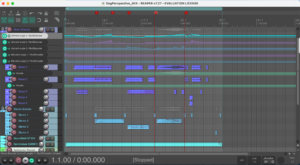
For dogs who have issues with watching, an orange speaker was added to its soundtrack to boost the sensation of acuity and sensitivity.
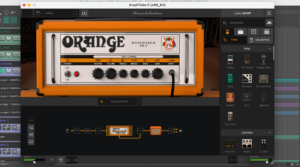
And other details about processing are listed below for reference.
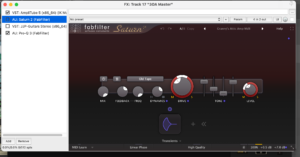
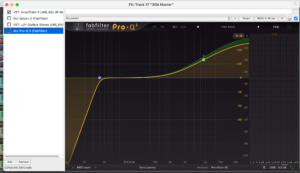
The deaf dog version is processed based on the blind dog’s configuration (but not binaural anymore, because it can only hear things on one side as discussed). However, I’ve panned the previous soundtrack to the left channel, while adding a pure sine sweep—two octaves above—into the right, amplifying the sensation of distraction and disorientation. (I suspect those dogs can’t perceive orientation at all.)
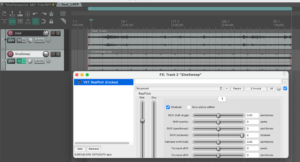
At last, I want to explain why I was so determined to add various distortion plug-ins to these soundtracks. I was deeply moved and inspired by the film Sound of Metal (2019, Darius Marder), which powerfully portrays how individuals with hearing loss might perceive sound — metallic, distorted, even robotic — yet rendered in an unexpectedly simple and affecting way.
Test Demo of Viewing National Monument from Dog’s Perspective
This is my perspective, imagining what a dog might perceive/ hear when it sees the national monument, with the help of Zixuan’s incredible editing and Carly’s pictures and meticulous photos arrangement. At first, seeing people coming, shaking their tails and scratching the grass, indicates massive excitement. Then, when it comes to the monument, it has a metaphor within. It is a memorial to the Scottish soldiers and sailors who died fighting in the Napoleonic War. Such sound piece consists of lighting fire, very deep breath (exaggerated by bass plug-in) and drone. After that, when it meet other dogs like itself, it feels cheerful, where shepard tone and the whoosh would tell.
Also I’ve made an ambience plugged-in distortion to make a deafaid-like effect to mimick the blur hearing of a dog.
Audio of Mimicking Dog’s Perspective
That’s my version of what a dog might hear, which is set in the range of 40-20kHz and made in far-away-like, mimicking that dog can perceive sound from far away. Also, I added a distortion plug-in to simulate the effect of a deaf aid.
Also, it’s interesting that Andrew suggested that we could let the dog listen to the music while it’s walking around the hill. So I put my music piece into the initial audio, which is set in the same plug-ins but also added an EQ of phone filter to make it real. (and another kind of distortion plug-in to make it more abstract)
Sometimes, it just doesn’t have to be that real to comply with the reality; just making something closer to common sense would be more appropriate (in a human way).
Ruiqi
