Any views expressed within media held on this service are those of the contributors, should not be taken as approved or endorsed by the University, and do not necessarily reflect the views of the University in respect of any particular issue.
I want to test whether we can tell stories primarily through sound from dog perspective. In other words, by creating a soundscape of the dog world, we can show the dog’s world. I exaggerate some effects in the human world that go unnoticed, such asgrating, chirp, vibration and so on.
But I found it is difficult to create sound without screen. So I think we can still use the video as an aid(do some abstract processing).on this basis, creating soundscape to show the dog’s perspective in our view. In addition, it is important to increase the audience’s interaction and sense of experience. We need to explore how to complete it.
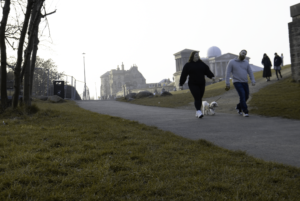
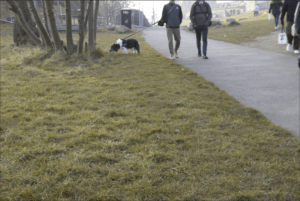
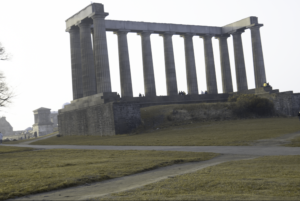
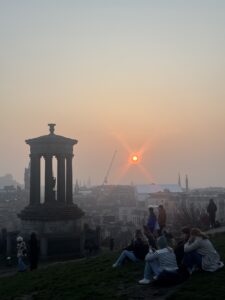
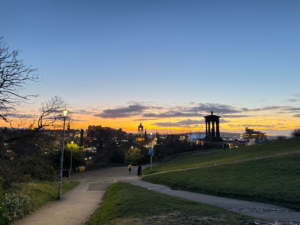
This is my perspective, imagining what a dog might perceive/ hear when it sees the national monument, with the help of Zixuan’s incredible editing and Carly’s pictures and meticulous photos arrangement. At first, seeing people coming, shaking their tails and scratching the grass, indicates massive excitement. Then, when it comes to the monument, it has a metaphor within. It is a memorial to the Scottish soldiers and sailors who died fighting in the Napoleonic War. Such sound piece consists of lighting fire, very deep breath (exaggerated by bass plug-in) and drone. After that, when it meet other dogs like itself, it feels cheerful, where shepard tone and the whoosh would tell.
Also I’ve made an ambience plugged-in distortion to make a deafaid-like effect to mimick the blur hearing of a dog.
Demo Recording and Photography- Chao Li, Yiting Liu
Editing Demo of Video- Yiting Liu
Editing Demo of Audio-Chao Li
This week was an online meeting, during which we discussed making a demo first and sorted out the equipment that might need to be rented. On Friday, Chao Li and Yiting headed to the location Andrew recommended: Jacob’s Ladder. Unfortunately, the trail was closed due to poor condition. We could only record some sound and video materials at the edge of the path. On the way back, we passed Prince Street. We sat on the benches on Prince Street, and the camera and recorder simultaneously recorded the passers-by. It was fascinating.
On Sunday Mar 09th, we integrated the audio and video, performed editing, color grading, transitions, special effects and other processing on the video, and performed pitch, EQ, and vocal extraction on the audio.
We successfully completed the demo and will show it to Andrew on Tuesday. I hope he will like it.
On Sunday, the 9th of March, all four of us went to Calton Hill.
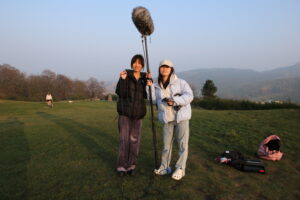
We met at Alison House as we had some equipment stored in a locker in the music store. Thankfully, we just needed to book a shotgun mic, a boom pole, XLR cables, a tripod, and a camera lens, as I have a Zoom H6 recorder and a camera. This meant that we could get the equipment, as the recorder was not available for the weekend.
On Calton Hill, we discussed the project presentation location and one of the directions so we could demo it.
Zixuan and I took photos of the desired location, and Ruotong and Ruiqi focused on capturing the sound.
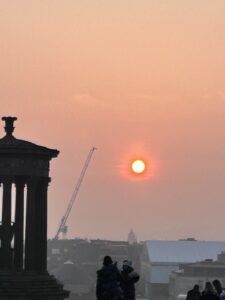
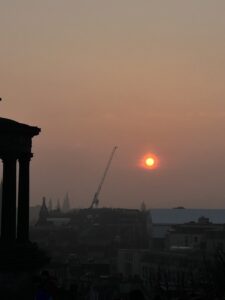
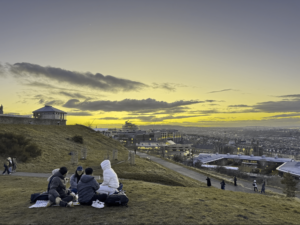
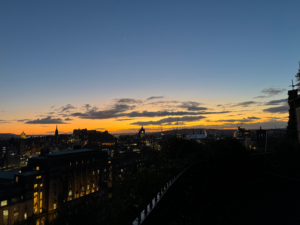
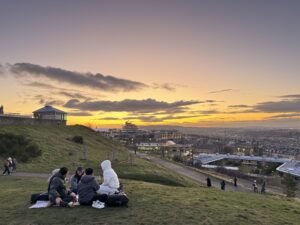
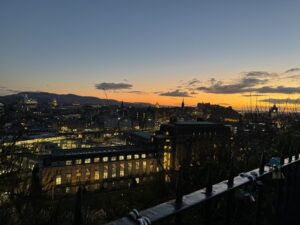
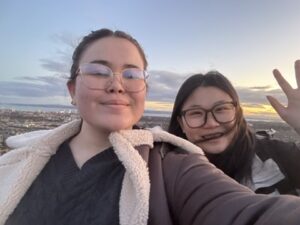
We were pretty productive, which allowed us to sit and admire the sunset, which was quite beautiful and foggy.
Overall, we worked and had fun. I’m really happy with our dynamic and the work we achieved on Sunday.
Zixuan:
On a topic, we went for a short visit to Calton Hill earlier today, hoping we could find pieces of the thing to help us with the project or to get inspired. The weather was gorgeous; I saw a great view at the peak, although it was quite stirring.
We took a map and went on quite a big round of the hill, noticing and taking brief notes. One of the things that stood out to me the most was how many tourists were there, from all over the world. It was an interesting experience to hear so many different languages talking all at the same time. This obvious diversity made me think that it might serve a purpose in our piece, representing humans’ connection and their continuous movement.
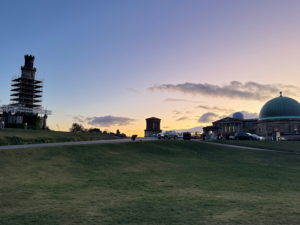
From the top of the hill, we could take a glance of Arthur’s Seat, Princes Street, and St. Catherine’s Cathedral as well. This resonated with an openness, with a kind of worldly peace we were surprised to experience and it gave some idea about how to make a sound design with spatial layers. This, for instance, could become the base to make sounds with reverb or multiple layers of atmospheres.
It was so nice to see, for instance, the amount of people walking around, continuing their hike with their pooches. dogs were jumping and running all around the grassy areas, and here we stopped for a while, just watching them play. The sounds that they produced, the movements they were making, and the lively energy actually played an inspirational role in conveying rhythm and giving a sense of how living things are supposed to have a sound.
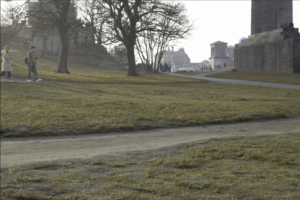
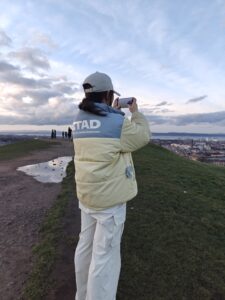
Carly and I captured some photographs to be used afterwards as visual references and for the purposes of creative inspiration (for curling, some monuments, and a few cute dogs). Over on Ruiqi and Ruotong’s side, sounds were being recorded (ambient, mostly voices and steps) from the hill, all the while the crowd of visitors were milling about. This will, for sure, be the most useful content to be incorporated into our demo.
That’s my version of what a dog might hear, which is set in the range of 40-20kHz and made in far-away-like, mimicking that dog can perceive sound from far away. Also, I added a distortion plug-in to simulate the effect of a deaf aid.
Also, it’s interesting that Andrew suggested that we could let the dog listen to the music while it’s walking around the hill. So I put my music piece into the initial audio, which is set in the same plug-ins but also added an EQ of phone filter to make it real. (and another kind of distortion plug-in to make it more abstract)
Sometimes, it just doesn’t have to be that real to comply with the reality; just making something closer to common sense would be more appropriate (in a human way).
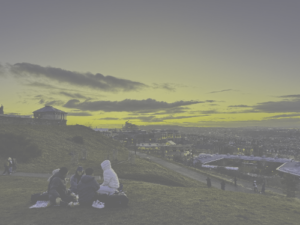
Converting colour scale from typical spectrum to Deuteranopia spectrum
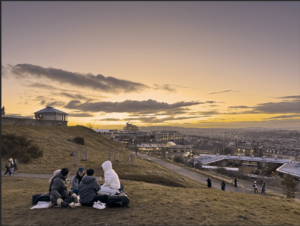
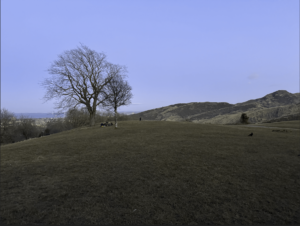
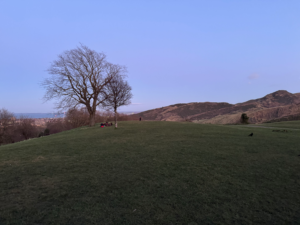
After taking some test photos at Calton Hill ( see: https://blogs.ed.ac.uk/dmsp-perspective25/2025/03/03/carly-and-zixuan-at-calton-hill/ ), I decided to try producing the change in colour on the images. It is to be noted that these were test images taken on an iPhone, and it is expected that the final images will be taken with a professional camera and with different lenses, such as wide-angle or fish-eye lenses.
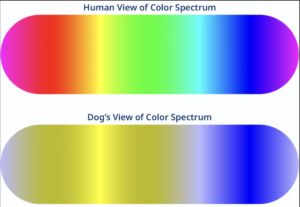
As we researched, we know that dogs see in a yellow and blue scale of colours, contrary to the common belief that dogs see in black and white(“What Colors Can Dogs See? Can Dogs See Color?,” n.d.). This is also known as Deuteranopia, Red-Greencolor blindness, which also affects some humans.
“There’s a myth that dogs only see in black and white. However, a dog’s vision is actually comparable to the vision of roughly 9% of humans with red-green color blindness. Dogs have dichromatic vision, meaning they can see shades of blue and yellow in addition to shades of gray, but they cannot see colors such as red, orange, and green.” (Petch 2023)
Some images don’t display the change correctly, some show colours that are excluded with deuteranopia, some are too dark, some wouldn’t let me download, and all would greatly degrade the image quality.
Trying Adobe Photoshop
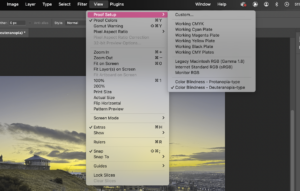
The only way I could get the images to look a certain way was via Adobe Photoshop. Sadly, when exported, it wouldn’t show as the process would be done with the “view tool”. This seems to be a common problem (“Dogs Color Vision – Help/How To – Shotcut Forum” 2018) (“Export Photo/Video With Color Blindness Simulation” 2022)
I need to do more research to find out how to export these images with the Deuteranopia effect on them; for the moment, I’ve opted for screenshoting.
Results
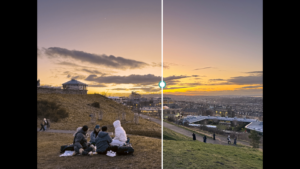
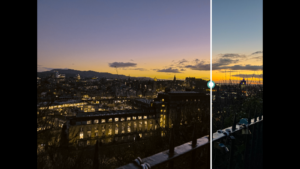
Here, we can see the altered images:
Here, we can see the original images:
Conclussion
After comparing the website’s obtained images with the ones from Photoshop, I’ve concluded that Photoshop is the answer for the effect that we are looking for. However, it is important to keep in mind that I have to do more research to find a way to export them without losing quality or to find a better tool to change the colour scale.
References:
“What Colors Can Dogs See? Can Dogs See Color?” n.d. Bow Wow Labs. https://www.bowwowlabs.com/blogs/news/what-colors-can-dogs-see
“Dogs Color Vision – Help/How To – Shotcut Forum.” 2018. Shotcut Forum. December 12, 2018. https://forum.shotcut.org/t/dogs-color-vision/8642
“Export Photo/Video With Color Blindness Simulation.” 2022. Https://Community.Adobe.Com. November 10, 2022. https://community.adobe.com/t5/photoshop-ecosystem-discussions/export-photo-video-with-color-blindness-simulation/td-p/12136430
“Dog Vision Converter – Your Dog’s Vision | Woof Me – Woof Me.” 2023. Woof Me. January 8, 2023. https://woofme.ie/vision-converter/
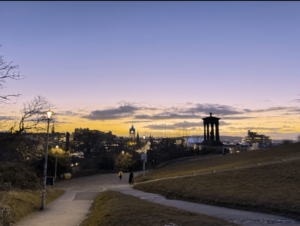
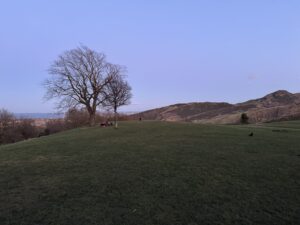
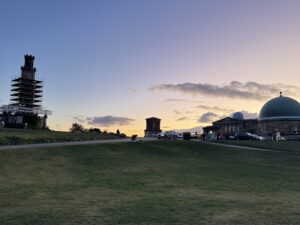
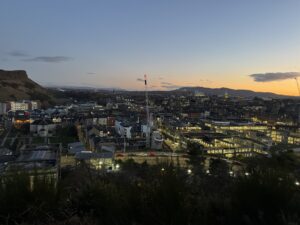
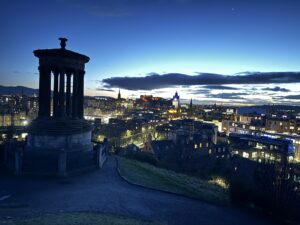
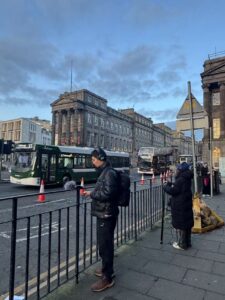
On Thursday, after we met with Jules, we decided to grab some lunch and take a stroll at Calton Hill so we could take some test photos and think about locations to show our project to the class. We also discussed how to achieve the project using Max MSP.
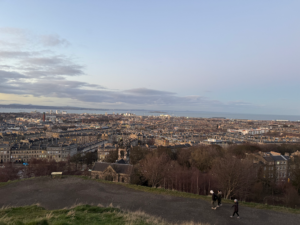
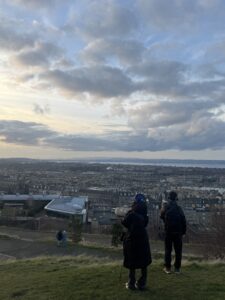
We took photos from different points at Calton Hill so we could have a general view.
We thought that this location would be a great place to hold the exhibition, as it has enough space for everyone.
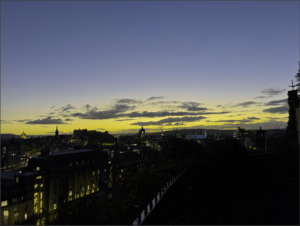
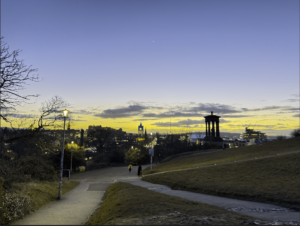
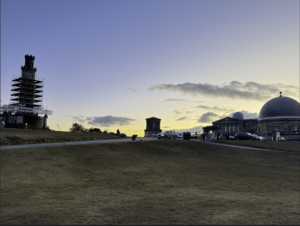
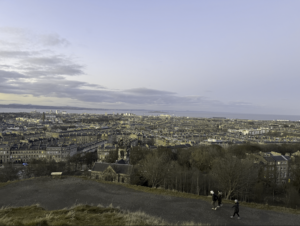
Some of the photos taken as test photos:
We took great inspiration at Calton Hill and thought that it was a nice outing, too.
PS: Lunch was great! It was a really nice outing overall <3
participant:Carly and Zixuan
Today, Carly and I took a journey to Calton Hill, a prominent Edinburgh landmark offering panoramic views of the city and beyond. Our objective was to assess its suitability as a location for our sound design project and to capture photographic reference material to guide our final decisions.
We explored various points on the hill, each offering unique perspectives and soundscape opportunities. From the top of the hill, we can see views of Edinburgh’s cityscape, including Princes Street, the church, the sea, and Arthur’s Seat. This diverse range of visual elements presented a wealth of sound possibilities, perfectly matching our project’s goals and providing more possibilities for creative exploration.
Calton Hill has a dynamic soundscape, with elements such as city traffic, church bells, seagulls, and wind contributing to a rich and evolving acoustic environment. We believe this location offers the perfect setting for our project, allowing us to capture and manipulate a wide variety of sounds to create a compelling and immersive experience.
During our exploration, we took numerous photographs, capturing the hill’s diverse views and architectural details. These images will serve as valuable reference material as we refine our project’s direction and develop our sound design concepts.
Calton Hill proved to be an ideal location for our sound design project, offering both visual inspiration and a diverse soundscape. We are excited to further explore this location and capture the sounds that will bring our project to life.
The team debated whether to use “Greyfiars Bobby” as the main character or switch to a generic dog for more creative flexibility. Ultimately, they leaned toward using a normal dog to simplify the narrative and allow for abstract storytelling.
Three locations were confirmed for the project: the National Museum of Scotland, Carlton Hill, and the Royal Botanic Garden. These landmarks will serve as settings to explore both human and dog perspectives.
The group discussed transitioning between realism and abstraction to depict different sensory experiences.
2. Technical and Conceptual Decisions:
Agreed to use normal cameras instead of panoramic ones to keep the process simple and cost-effective.
Decided on creating immersive soundscapes combining real and abstract sounds for each location.
Confirmed that the final output will be in video format, potentially presented with installation elements like screens and speakers.
3. Next Steps:
Develop a clear narrative structure addressing key questions:
What is the story we want to tell?
What do we want the audience to feel?
Why are we using these specific locations and perspectives?
Create a mood board and storyboard to visualize ideas.
Research permissions for filming in selected locations.
Scheduled a follow-up meeting with Jules on Thursday afternoon after class to seek further guidance on narrative development and technical execution.
Individual Contributions:
Yiting:
In this week’s meeting, we changed our thinking and started a new travel experience from the puppy’s perspective. We were no longer limited to the fixed human perspective of the project, but explored things in life that we don’t usually discover. The experience includes the National Museum, the Royal Botanic Gardens and Calton Hill. The project is derived from the perspective of a puppy, and you can experience the world and hearing through the eyes of a puppy. The project interweaves abstraction and reality, combining the two to enhance the audience’s sensory experience. This week we also met with Jules, who gave us some suggestions on our proposal, such as the possibility of layering sounds to record distant and nearby sounds. And conduct relevant research on the puppy’s vision, hearing, smell, etc. This Friday, Li Chao, Wu Ruotong and I went to Calton Hill to do some environmental recording. We recorded the ambient sounds from three different directions of Calton Hill in preparation for simulating the puppy’s hearing later.
Zixuan:
In this week’s meeting, we renew our project. In this weeks tutorial, Andrews suggested us to simplify our project, and foucouse on one specific thing. So we decided to simplify the entire project, focusing on two perspectives: one from a human and the other from a dog. We aim to highlight the differences between these perspectives through contrasting and switching between them. We plan to use three landmarks of Edinburgh to facilitate these perspective shifts: the Botanic Garden, the Museum, and Calton Hill. The story will follow a person and a dog as they explore these locations, showcasing the contrasting experiences of each.
We plan to utilize both abstract and realistic approaches in this project. We believe that things possess multiple layers, and it’s crucial not to focus solely on what we see with our eyes. We also need to pay attention to the inside core of things. We aim to employ an abstract style to express the essence of things as we perceive it as accurately as possible.
Finally, we discussed several issues related to the project and further clarified our goals and ideas.
Project Goal: To showcase the differences between human and dog perspectives and encourage people to rethink their understanding of Edinburgh.
Design Concept: Combining abstraction and realism to explore the essence beyond the surface, offering a multi-layered experience.
Choice of Cultural Landmarks: Connecting with Edinburgh’s culture and citizens through its iconic landmarks.
Expected Outcome: Encouraging people to recognize the multi-layered nature of the world and fostering an open mindset for exploration and discovery.
This time, we presented our current ideas to Professor Jules for discussion. Through our conversation with the professor, we decided to further simplify our project. We will focus solely on the dog’s perspective and reduce the number of locations to just one. This will allow us to concentrate better on showcasing the dog’s point of view. Additionally, the meeting provided us with many interesting new ideas and creative suggestions, such as exhibiting the project on Calton Hill. This would enable us not only to present the dog’s perspective but also highlight its unique qualities. Moreover, the professor’s idea of simulating the dog’s hearing and vision through camera movement is particularly intriguing.
Chao:
This meeting mainly focused on how to quickly advance the project rather than getting stuck in tedious documentation work. I summarized Andrew’s advice from Tuesday morning and shared it with the team members. On Wednesday, we started discussing the story, and the final outcome was to focus the project on switching perspectives between dogs and humans. We also selected three locations in Edinburgh as material collection points for the project. Meanwhile, team members worked together to complete some documentation tasks.
After speaking with Jules on Thursday, I realized that we must take action as soon as possible and create some prototypes. Therefore, on Friday, Yiting, Ruotong, and I formed a mobile team, borrowed recording equipment, and went to Carlton Hill. We recorded approximately 40 minutes of sound material (Carlton Hill soundscape, Princes Street soundscape, street movement soundscape) and captured some videos mimicking human and dog perspectives. The materials were uploaded to the group’s shared space for discussion with other team members to see if these materials could be used for experiments, helping us continue pushing the project forward.
Ruiqi:
Dear dear diary,
We’ve changed our story to focus only on a dog’s perspective instead of a variety of species and cut off the narrative of the piper boy. And we’ve pulled down the old narrative arc and tried to make a new one, happening in Calton Hill. Thanks to Chao, we now have some ambient sound happening in Calton Hill and Princes Street, and we sort of have a profile of what’s happening in such environments, but the only concern is I now don’t know what to do with such recordings so far since we don’t have a clear narrative, but we’ll figure it out. Also, I’ve made a sound piece of my version of a dog that represents how they perceive, which is set in the range of 40-20kHz and made in far-away-like, mimicking that dogs can perceive sound from far away. Also, I added a distortion plug-in to mimic the deaf-aid.
Carly:
In this meeting, we discussed trashing the previous idea and creating a new one that could take a simpler approach but still work and make the audience feel what we intend to.
After a long conversation, we decided on Edinburgh through landmarks, meaning we would use the perspective of a dog and a human to portray different types of vision, keeping in mind that dogs see in a scale of yellow and blue, contrary to humans. We also decided on mixing abstract and realism concepts and chose 3 landmarks:
Royal Botanic Gardens (show a different scenery within the city)
National Museum of Scotland (shows a specific location of the Old Town)
Calton Hill (show a general view of Old Town)
Another thing worth noting is that when the idea of using the story of Greyfriars Bobby first came up, I communicated to the group that I didn’t see the need for it. It would go against the pejorative of simplifying the project, as it would mean adding a new layer and also would limit us more than it would expand. The group wanted to use Bobby’s story to represent that the dog is from Edinburgh, but as I explained, there are a lot of dogs in Edinburgh, and as we are setting the story in Edinburgh, it would be redundant, and it wasn’t a need, after explaining my point of view regarding this idea, we decided as a group that it would be best to discard it and just use a normal dog.
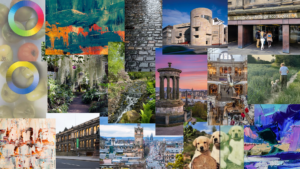
We crafted a mood board that can be seen in this diary entry. We discussed what this would entail. The next day, we met with Jules, and keeping in mind his opinions, we focused on just one location and the dog’s perception.
During the meeting with Jules, we also discussed some problems that appeared in the group work, such as communication and proactivity. Since the meeting, it seems that they have changed.
Ruotong:
This week we made a big change to our project, in our initial project, we wanted to express so many things that the theme was less clear and hard to realize. Therefore, we dropped the piper boy and global events parts of the project, leaving only the animal perspective. We chose Edinburgh’s landmark, Calton Hill, as the location for our project, hoping to show the difference between a dog’s perspective and a human’s perspective and to discover the world that cannot be seen or heard due to the limitations of a human’s perspective. On Friday we went to Carlton Hill to see what it looks like from a dog’s perspective, and it was very rewarding.
The group decided to abandon the previous project and start anew, focusing on the “dog and human perspectives” theme in Edinburgh.
The new idea emphasizes exploring Edinburgh through landmarks (e.g., the National Museum of Scotland, Botanic Gardens, Carlton Hill) while alternating between human and dog perspectives.
Jules encouraged narrowing the scope to focus on one location (e.g., Carlton Hill) to achieve depth and manageability within the project timeline.
2. Key Suggestions from Jules
Dog Perspective Focus: Jules found the dog perspective more exciting than the human perspective and suggested emphasizing “other-than-human perception” as a unique angle.
Multisensory Approach: Jules recommended incorporating sound, vision, and even smell to simulate a dog’s sensory experience. For example:
Use sound design techniques like layering field recordings or manipulating frequencies to mimic dog hearing.
Experiment with visual elements such as wide-angle or fisheye lenses to reflect a dog’s field of view.
Consider imaginative ways to represent smell and movement as part of a dog’s perception.
Practical Suggestions:
Conduct field recordings at Carlton Hill using tools like shotgun microphones.
Divide the group into smaller teams to cover different tasks or locations efficiently.
Create multiple experimental outputs (e.g., videos, soundscapes) rather than aiming for one polished product.
3. Productivity and Team Dynamics
Jules emphasized the importance of clearly defining roles, setting deadlines, and maintaining personal responsibility within the team.
He suggested using a task rota or map to allocate responsibilities effectively and ensure progress.
Addressed communication challenges within the group, urging members to clarify misunderstandings proactively.
4. Immediate Next Steps
Begin fieldwork at Carlton Hill by Tuesday, experimenting with sound and visual recordings.
Develop initial sketches or prototypes (e.g., short “dog sense” recordings or videos) for feedback in upcoming meetings.
Focus on iterative experimentation rather than perfection at this stage.
Narrative Structure IssuesThe current proposal integrates three overlapping narratives (“Piper Boy Mythology,” “Urban Perspective Shifts,” and “Environmental Themes,” respectively), resulting in content bloat. The advisor emphasizes that a 10-minute experience cannot sustain complex storytelling and recommends focusing on a single core concept.
Presentation Deficiencies
Mood boards lack concrete visual guidelines (e.g., specific applications of balloons/lighting)
Audio samples missing timestamp annotations and creative intent documentation
The technical proposal lacks venue layout diagrams and equipment wiring schematics
II. Core Optimization Recommendations
1. Narrative Simplification Options
Option A: Retain the Piper Boy FrameworkLinear structure: Underground labyrinth → Bird’s-eye perspective → Escape sequence, using urban field recording transformations for perspective shifts
Option B: Urban Creature PerspectivesPresent Edinburgh’s urban ecology through canine/aquatic/insect auditory perspectives, employing audio modulation techniques to隐喻 human environmental impact
2. Technical Implementation Enhancements
Audio system: 4-channel spatial configuration (speakers at venue corners)
Projection vs. screen display solutions requiring finalization