Any views expressed within media held on this service are those of the contributors, should not be taken as approved or endorsed by the University, and do not necessarily reflect the views of the University in respect of any particular issue.

Group meeting 5

Summary & Key Takeaways

Meeting 5 (February 12, 2025)

Summary & Key Points
The team convened to finalize and polish Submission 1, focusing on refining the document, ensuring accuracy in citations, and preparing for the next project phase. Key takeaways include:

  • Document Finalization: The group completed the final touches on Submission 1, including adding research, visual references, and a recording plan. Citations and references were standardized for consistency.

  • Visual and Sound Design: Members contributed ideas for sound amplification (e.g., low-frequency sounds for earthquakes) and visual construction based on events like fire, flood, storm, and earthquake. These elements will guide future project development.

  • Narrative Structure: The team discussed the narrative arc in detail, emphasizing the importance of a clear beginning (waking up as Piper Boy), middle (exploring challenges like climate disasters), and end (light symbolizing hope).

  • Perspective Shifts: The group debated transitions between perspectives (e.g., Piper Boy to animals) and their narrative justification. This remains a critical focus for immersive storytelling.

  • Documentation Standards: Clarifications were made regarding individual contributions to group documentation. Each member must submit their input with their name clearly labeled to ensure fair grading.

  • Next Steps: Preparations for Submission 2 are underway, including equipment rental and planning for video recording within the next month.


Individual Contributions

Carly:

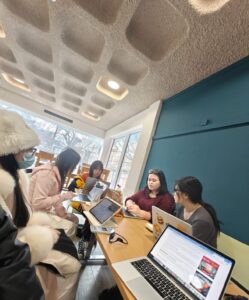
Today, we met to review our document before submission, meaning we made the final touches on it. We added more research, a recording plan, retouched the cites and references, added some visual references, and polished the document.

Ruotong:

In this meeting, we summarized all the sections. I inserted images representing the four events—fire, flood, storm, and earthquake—which can serve as references for our future sound and visual construction. Additionally, based on the storyline, I have envisioned some image recording plans that need to be completed in the next phase of the project.

Zixuan:In this group meeting, we sorted out and supplemented our project documents. Added some references we missed earlier. This is our last meeting before submission1, and we want to make sure that our project is perfect before we hand it in. Carly helped me to modify the citation format of the references in the part I was responsible for, which was a very useful help for me because I didn’t know how to quote correctly. We also supplemented the reference videos we provided to explain why we chose them as references.

Yiting:

Let’s work together to improve submission 1 and change the details of each part. I marked the date and location of each meeting and recording, and looked for good examples for the project for us to learn from. In the case of The tunnel, I observed that the video shooting used repeated montage techniques to create a sense of loss of control. I think we need to learn this shooting technique, which can make the nightmare look more full.In addition, in order to prepare for the implementation of Submission 2, we have contacted for the rental of filming equipment and expect to implement the filming plan within the next month.

Ruiqi:

Since Carly said it’s a cute beginning, I will continue that:

Dear Diary,

Today is the last opportunity for our group to review and adjust what we have and our plan, and it’s urgent. I’ve made a sound recording plan regarding IRs recording, piper playing sound and other detailed elements relating to the narration. Fortunately, we have settled up the research and references, which may look nicer and cleaner and which suits my MBTI so well. Haha.


Chao:

Today we have improved all the content of Submission1. My work is mainly to perfect the research of the historical and cultural parts of Edinburgh and Scotland, and then to analyze the project reference aspects of several reference prototype videos I selected.
Group meeting 4

Meeting Summary & Key Points
The discussion in Meeting 4 revolved around refining the narrative structure, technical execution, and conceptual focus of the project. Key takeaways include:

  • Narrative Arc Development: The team identified the need to clearly define the beginning, middle, and end of the narrative. The story starts with waking up in a tunnel (as the Piper Boy), transitions through challenges symbolizing climate change (e.g., fire, flood), and concludes with a light at the end of the tunnel representing hope.

  • Perspective Shifts: Emphasis was placed on using different perspectives (e.g., animals like dogs or ants) to explore climate change impacts. The team debated how to justify these perspective shifts narratively and technically.

  • Immersive Techniques: Suggestions were made to simplify immersive elements by incorporating video clips, sound design, and minimal modeling. The idea of live narration versus pre-recorded video was also discussed to enhance audience engagement.

  • Project Goals: The overarching goal is to shift audience perspectives on pressing global issues like climate change by creating an emotionally impactful experience.

  • Technical Decisions: Agreement on a runtime of 10 minutes for the installation with approximately four “doors” symbolizing different climate challenges. Discussions included sound amplification (e.g., low-frequency sounds for earthquakes) and visual storytelling techniques.

  • Documentation & Collaboration: Clarifications were made regarding documentation responsibilities. Each member must submit their contributions individually for transparency and grading purposes.


Individual Contributions:

Zixuan:

During this group discussion, we mainly worked on organizing, integrating, and refining our project. We finalized our main theme—climate issues. Each door in the nightmare will represent a different climate-related problem. We plan for the entire experience to last approximately ten minutes, with two minutes for the introduction, six minutes for the main exploration, and two minutes for the conclusion. The middle section will feature four doors, each leading to a different climate issue.


Next, we discussed the narrative arc and further detailed our story. In the introduction, the Piper Boy will wake up in the tunnel from a human perspective, followed by a brief narration to introduce the legend of the Piper Boy. Then, the exploration phase will begin. In the middle section, we will include four doors, each representing a different perspective on climate change:


Fire – Fish

Floods – Insects

Earthquake – Dog

Typhoon – Bird

Each of these doors will depict climate abnormalities from the perspective of different creatures.


For the ending, we initially considered using narration to conclude the experience. However, Ruotong suggested an interesting idea: instead of a traditional narration, we could have all four doors open simultaneously, allowing the sounds from all the environments to mix into a chaotic noise. Then, the narration would guide the Piper Boy towards a distant, faint light, symbolizing his attempt to escape, leaving the story with an open-ended conclusion.

Through this approach, we aim to convey that these climate issues are inescapable and unsolvable for now, yet we will continue to strive and explore solutions.

Yiting:

Since Assignment 1 needed to be submitted soon, our group increased the number of discussions in the hope of further perfecting the assignment details. In today’s tutorial, Andrew and Jules mentioned that our project might be too ambitious. So we streamlined the content and chose to focus on looking at world current affairs from the perspective of insects and animals, looking at one event from different perspectives or one perspective on multiple events. We have determined that there are four doors in total, representing the four elements of China’s five elements: wood, water, fire and earth. Behind these doors correspond to current events in the world with the same attributes. In addition, Andrew mentioned that the final presentation of the project can be more immersive and screened through multiple projectors. During the group discussion, we also determined the narrative line, which is divided into beginning, middle and end, totaling about eight minutes.


Ruotong:

After our meeting with Andrew and Jules, we identified some issues with our project and promptly held a discussion. At this stage, our ideas were too broad and scattered, making the overall project theme unclear. To address this, we restructured the piper boy storyline, shifting our focus to global climate issues. We selected four global events as focal points— Valencia floods, wildfires in California, storm Éowyn hits the UK and earthquakes—with each news event symbolizing a door. By presenting different audio-visual perspectives behind these four doors, we aim to recreate piper boy’s nightmare. Additionally, in our upcoming research, we need to determine the most effective visual representation—whether 3D modeling or video would better convey the story.


Ruiqi:

We were somewhat lost temporarily, possibly because we don’t have a solid narrative or reference work yet. Today, we had our tutorial session where we felt off track but tried our best to get back on course. However, we made progress on the narrative and developed the narrative arc, which is exciting. Carly suggested finding someone to act as a storyteller at the installation’s start to provide an introduction, while Chao proposed using video narration. I believe it might be better to combine both, though it may require more work. Aha! (Carly’s imitation is so funny.)


Carly:

Today, we discussed the feedback received during this morning’s tutorial and class. We also assessed the research and decided on different ways to change the project to align with the feedback and our project idea. Then, we created the narrative arc for this project. It was a long meeting, but we finally came to a consensus. At one point, I felt that we were stuck and suggested taking a break to clear our minds and come back to the meeting refreshed.


Rodney Street Tunnel Fieldwork and Photography

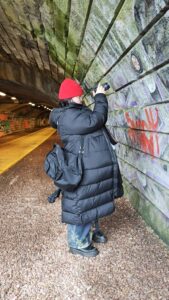
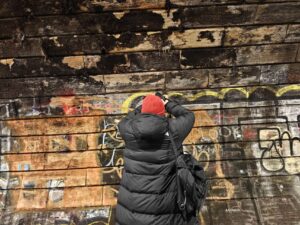
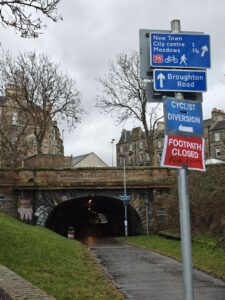
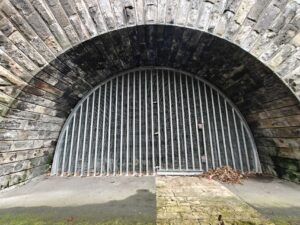
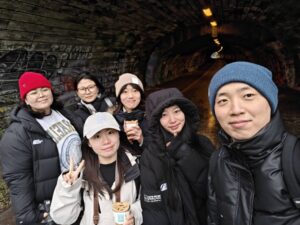
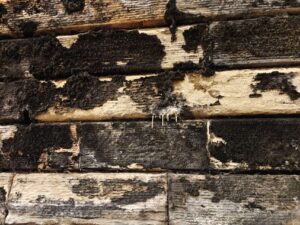
This morning, around 10 AM, we conducted a fieldwork session at Rodney Street Tunnel to capture photographs for our 3D modeling process. During the shoot, we encountered an issue: the tunnel’s graffiti gave it a modern appearance, which conflicted with the historical aesthetic we envisioned. To address this, we focused on photographing sections without graffiti and captured various angles of the walls and floor.

Next Steps:

  1. Test whether the current photographs can be effectively used for 3D model synthesis.
  2. Consult Andrew during Tuesday’s tutorial to:
    • Evaluate the feasibility of our project.
    • Seek advice on tunnel selection, photo-based 3D modeling techniques, sound design, and enhancing interactivity and immersion.

By addressing these points, we aim to refine our approach and ensure alignment with our project’s goals.


Carly:

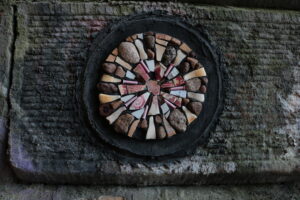
In the tunnel, we took around 120 photos total as test photos for textures. We also found some interesting things, such as stalagmites and a piece of art.

From my understanding, we can develop some interesting textures from the photos taken and then apply them to our model to create interesting scenes. We’ve also decided against recording a new Impulse Response and instead used the ones I recorded in the innocent railway tunnel from last semester.


Group Meeting 3

Project Overview

  1. Theme and Concept:
    • The project is inspired by the myth of “Piper Boy,” focusing on the theme of nightmares as a metaphor for inescapable global crises such as climate change, inflation, and societal challenges.
    • The narrative will center around a symbolic tunnel representing these crises, with a faint light at the end suggesting a distant hope.
  2. Objective:
    • To create an immersive installation that encourages reflection on global issues while avoiding overt political commentary or judgment.

Design and Execution Plan

  1. Interactive Immersive Installation:
    • The installation will simulate a tunnel experience using 3D modeling, where participants collectively decide which doors to open. Behind each door, curated scenes or videos will depict various global crises.
    • The audience’s choices will guide the progression, maintaining a balance between immersion and limited interactivity.
  2. Technical Aspects:
    • Use 3D modeling software like 3D Max to design the tunnel and its branching paths.
    • Incorporate real-time decision-making by allowing participants to vote on door selection.
    • Ensure a 360-degree immersive visual experience.
  3. Visual and Audio Elements:
    • High-resolution photographs of tunnels will be used for texture mapping.
    • Ambient sounds (e.g., door creaks, wind) will enhance realism.
    • Graffiti or modern elements will be avoided to maintain thematic consistency.

Logistics and Next Steps

  1. Fieldwork:
    • Scheduled visit to a local tunnel on Tuesday morning at 10:00 AM to take photographs for modeling purposes.
    • Equipment includes a Canon EOS camera for high-quality images; sound recording equipment may be used later if needed.
  2. Modeling and Development:
    • Begin 3D modeling based on collected images.
    • Design multiple tunnel paths with varying visual and thematic elements.
  3. Team Collaboration:
    • Use shared documents for collaborative editing and referencing.
    • Ensure proper citation using Chicago-style referencing for all sources and visuals.
  4. Tutorial Feedback:
    • Discuss the feasibility of interactivity with the tutor during the next session.
    • Explore ways to balance immersive storytelling with technical constraints.

Key Decisions

  • The project will prioritize immersion over full interactivity due to practical constraints (e.g., group size, equipment availability).
  • Avoid overtly political content; instead, present issues objectively to provoke thought without bias.
  • Incorporate a subtle narrative structure (introduction, conflict, open-ended resolution) to align with storytelling conventions.

Individual Contributions:

Ruiqi:

We were somewhat lost temporarily, possibly because we don’t have a solid narrative or reference work yet. Today, we had our tutorial session where we felt off track but tried our best to get back on course. However, we made progress on the narrative and developed the narrative arc, which is exciting. Carly suggested finding someone to act as a storyteller at the installation’s start to provide an introduction, while Chao proposed using video narration. I believe it might be better to combine both, though it may require more work. Aha! (Carly’s imitation is so funny.)


Yiting:

In the third week of group discussion, we focused on the theme of nightmares and discussed what current events in the world we need to include in our nightmares. Looking at current events from different perspectives (e.g. insects, animals) can lead to reflection on global issues. During the discussion, I thought of the Edinburgh gale and the British avian influenza. Both events are worthy of our attention and study, as nature and humans coexist. In addition, the team agreed to go to the Rodney street tunnel in Edinburgh on 2025.02.10 to take photos and collect materials for modeling. After the group discussion, I collected four world current events, namely: Japan’s Fukushima nuclear wastewater discharge caused controversy, South Korea’s Jeju Air crash, torrential rain hits the UK, and Human cases of avian influenza found in the UK. These four events were reported on BBC news and The Times.


Ruotong:

I conducted a research study on global real-time hot topics and collected and organized some major social events that have occurred worldwide in recent years:

  • The COVID-19 pandemic sweeping across the globe
  • Global climate change leading to extreme weather ✅
  • The U.S. presidential election and political turmoil ✅
  • Instability in the Middle East: the Israel-Palestine war, the Syrian civil war ✅
  • The escalation of the Ukraine conflict
  • Wildfires in California, USA ✅
  • A presidential coup in South Korea
  • The resignation of the French Prime Minister

Among these major social events, I conducted an in-depth investigation into several that I believe could be relevant to our project.I think global climate change is a crucial issue that we should focus on and integrate into our project.

With global climate change, the frequency and intensity of extreme weather events have significantly increased. This not only threatens ecosystems and reduces natural resources but also has profound effects on human physical and even mental health, especially for vulnerable groups. Earlier this year, the wildfires in the Los Angeles area once again highlighted the deep impact of climate change on human life and the environment.

In this meeting, we revisited the real-time news section that I had researched. We decided to avoid politically sensitive topics and instead focus on incorporating global ecological issues that affect everyone into our project. Additionally, since the originally planned location was unavailable, we selected a new tunnel for the project. We then conducted a site survey and recorded IRs to assess the feasibility of the project’s implementation.

Zixuan:

During this group discussion, we refined our project and established a comprehensive framework. Our plan is to depict the Piper Boy being perpetually lost in a tunnel, attempting to escape but ultimately failing. Along his journey, he will continuously encounter doors blocking his way, and behind each door will be various real-life issues we currently face. Through this approach, we aim to bridge mythology with reality. Additionally, we plan to showcase these issues from different perspectives—those of humans, animals, and insects.

During our discussion on theme selection, we agreed to avoid direct political topics. Since the story takes place in a nightmare, it inherently carries a negative tone, and we do not want political themes to introduce additional negativity into the narrative.

Beyond thematic discussions, we also outlined our presentation approach. We plan to create an immersive experience by using 3D modeling and video to showcase our project, aiming to encourage audience reflection after viewing. We also explored the possibility of integrating audience choices into the project, allowing them to decide which door to enter. Additionally, we are considering whether to include interactive elements and plan to discuss this with our professor in the next tutorial.

Finally, we set a date for an on-site visit to a tunnel to collect materials, hoping to gather resources for basic 3D modeling.

Carly:

In this meeting, we reviewed the research conducted individually. There seemed to be some confusion regarding academic text writing, as the referencing and formatting were inconsistent. I took the time to explain how it generally works so we can present our research as effectively as possible. During the meeting, we also discussed the next steps, specifically different tunnel possibilities. As there is no access to the tunnel below McEwan Hall, we determined that the Rodney Street tunnel would be our best option. We also scheduled various meetings for the following week, including one to access the tunnel on Monday and two additional meetings on Tuesday and Wednesday to complete the first submission.


Workshop with Andrew:Exploring Audio-Visual Interaction

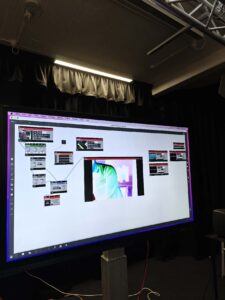
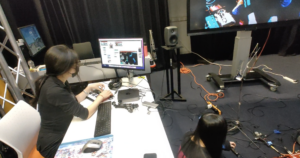
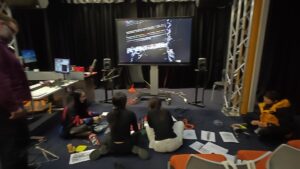
On February 4th, our tutor Andrew guided us through an engaging workshop on audio-visual interaction in Atrium. The session provided a hands-on opportunity to explore how sound and visuals can influence each other, offering valuable insights for developing immersive and interactive projects. Below is an overview of the setup and process we experienced during the workshop.

Visual Setup:

  • We used MAX software to present and manipulate video effects.
  • Two cameras were connected to the computer to capture visuals, while their built-in microphones recorded audio. The captured audio influenced the visual effects.
  • Parameters controlling the video effects in the MAX patch were mapped to a physical controller, enabling real-time adjustments.

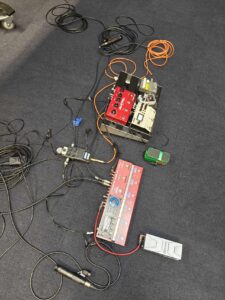
Audio Setup:

  • Two Genelec speakers were placed on either side of the monitor for audio output.
  • Two condenser microphones were used for sound recording.
  • Andrew prepared various vocal and instrument effect modules, along with a Boss RC-600 loop station. These were connected to create diverse sound effects.
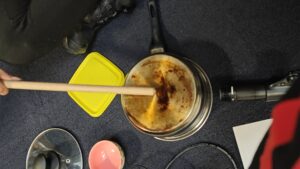
  • Kitchen utensils were also used as foley materials for sound creation.

Workshop Process:

  1. One participant controlled the MAX patch to create different video effects.
  2. Two participants experimented with creating sounds using the microphones.
  3. Two others managed the loop station and effect modules to generate dynamic and varied soundscapes. These sounds influenced the visual effects in real time.
  4. Participants creating sound effects observed the visuals on the monitor to match or enhance them with suitable sounds, or explored ways to create more exciting audio.
  5. Throughout the workshop, we rotated roles, allowing each participant to experience different aspects of the project. This rotation enabled everyone to gain a comprehensive understanding of how each role contributes to the overall audio-visual interaction.
  6. By switching between controlling the MAX patch, creating sounds, managing effects, and observing the interplay between audio and visuals, we developed a deeper appreciation for the collaborative nature of the project and the unique challenges and creative opportunities each role presented.

This collaborative project demonstrated how sound and visuals can interact and influence each other, allowing everyone to actively participate and enjoy the process. The workshop was highly engaging, providing us with inspiration on how to develop immersive and interactive elements in our own projects. The role rotation aspect enhanced our learning experience, fostering a more holistic understanding of audio-visual interaction.

Project Idea Update


Ruiqi:
I’m thrilled about exploring sound-making ideas inspired by the story of the missing Piper boy. Ruotong suggested minimizing familiar sounds to amplify those we often overlook, creating a twisted, upside-down audiovisual experience unlike anything I’ve encountered before. However, the location remains a significant challenge for us.

Yiting:
I researched Edinburgh’s myths and legends, many of which revolve around nightmares. Key inspirations include Mary King’s Close, the Mackenzie Poltergeist, and the Phantom Drummer of Edinburgh Castle. To contrast these darker tales, I also looked into warm legends like Greyfriars Bobby and the Wishing Stone of Edinburgh Castle.
For our project, I envision starting with a nightmare but ending with warmth. For example, we could introduce a boy standing at his basement door with a rusty key, seeking forgotten truths buried under Edinburgh. Additionally, I’m considering using a contact microphone to capture subtle sounds for our sound design.

Ruotong:
I conducted research on global issues that resonate with our project’s themes of nightmares and entrapment. Key topics include:
– Global climate change and its impact on extreme weather events
– The COVID-19 pandemic and its psychological toll
– Political instability and conflicts worldwide, such as the Ukraine crisis and Middle East tensions

Among these, I believe climate change is particularly relevant. Its effects—like wildfires in California—highlight humanity’s vulnerability and could be integrated into our project to draw parallels between personal nightmares and global crises.

Zixuan:
I explored additional myths to enrich our narrative:
1. Stone of Destiny: A symbol of Scottish sovereignty with deep historical significance, tied to coronation rituals and national identity.
2. Major Thomas Weir: A 17th-century figure whose dark confessions of witchcraft turned him into a ghostly legend in Edinburgh’s Old Town.
3. Arthur’s Seat: A hill linked to the legend of a sleeping dragon, adding a layer of mystery and romance to Edinburgh’s folklore.

These stories deepen our connection to Edinburgh’s cultural heritage and provide rich material for our project’s narrative framework.

Carly:
Our project is inspired by the myth of the missing Piper boy, aiming to depict his nightmare while drawing parallels to today’s global challenges—seen as nightmares without escape. By presenting perspectives from humans, animals, and insects, we hope to shift viewpoints and magnify overlooked details.

Given filming constraints in Edinburgh’s tunnels, we’ll use footage from McEwan Hall tunnels to design a virtual maze in Cinema 4D2. Sound is central to our immersive installation; we’ll use ambisonic recording for a 360-degree experience and record impulse responses (IRs) in tunnels to recreate authentic reverb in studio recordings. A real piper player will accompany this journey through soundscapes designed to evoke psychological horror.

Chao:
I’ve been reflecting on how our project could balance its nightmare theme with hope at the end. For instance, after experiencing fear and entrapment, the boy could face a bright pathway or an open-ended resolution, offering solace and prompting deeper thought from the audience. This balance could make the experience more impactful by pairing terror with eventual hope.

css.php

Report this page

To report inappropriate content on this page, please use the form below. Upon receiving your report, we will be in touch as per the Take Down Policy of the service.

Please note that personal data collected through this form is used and stored for the purposes of processing this report and communication with you.

If you are unable to report a concern about content via this form please contact the Service Owner.

Please enter an email address you wish to be contacted on. Please describe the unacceptable content in sufficient detail to allow us to locate it, and why you consider it to be unacceptable.
By submitting this report, you accept that it is accurate and that fraudulent or nuisance complaints may result in action by the University.

  Cancel