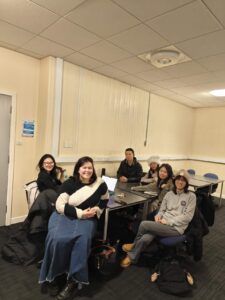
Meeting Overview:
On Friday, January 31, 2025, our group gathered at Alison’s house in the post-grad common room at 1:00 p.m. It was a productive session during which we discussed the progress of our project and planned for the upcoming tutorial with Andrew, which is scheduled for Tuesday, February 4, at 10:00 a.m.
Key Discussion Points:
- Project Concept Development:
- We finalized the idea of basing our project on Edinburgh’s “Piper Boy” myth. This psychological horror concept will metaphorically connect myths to real-world issues like climate change. Participants will explore a tunnel with doors that open to reveal inescapable realities, such as visuals and sounds representing global problems.
- Technical Implementation:
- The team plans to use 3D modeling software (e.g., 3ds Max) to recreate tunnels and add interactive doors. This approach allows us to customize textures and expand the tunnel’s structure.
- For sound design, we will record Impulse Responses (IRs) in a studio to simulate tunnel acoustics without external noise interference.
- Task Assignments: Each member was assigned specific responsibilities for research and preparation:
- Expanding the idea on paper: Carly Salvador-Almeida Soler
- Myths in Edinburgh: Zixuan
- Different types of vision and hearing (humans, animals, insects): Ruiqi
- Current world problems: Ruotong
- Culture in Edinburgh/Scotland: Chao
- Accessing McEwan Hall for photography and IR recording: Yiting
- Research Goals:
- Investigate Edinburgh’s myths and culture to provide historical context.
- Study how different species perceive the world to incorporate diverse perspectives into the project.
- Explore global issues like climate change to strengthen thematic connections.
- Collaboration Guidelines:
- While tasks are divided, members are encouraged to support each other’s research and share findings collaboratively.
- Upcoming Meetings:
- February 5, 10:00 AM: Tutorial with Andrew to discuss progress.
- February 7 and February 11: Group meetings to finalize research and prepare submissions.
Reflection:
The meeting was highly productive, with clear task delegation and collaborative planning. We are making steady progress toward our project goals while ensuring that everyone contributes effectively.
Individual Contributions:
Ruiqi:
Dear Diary,
I’m excited about the concept of sound-making ideas in the story of the missing Piper boy. It came up from Ruotong, who says we could minimise the sound we get used to maximise the sound we don’t pay much attention to. And it would be a twisted and upside-down audiovisual world I’ve never been to.
But the location remains a huge challenge.
Many thoughts,
Ruiqi
Zixuan:
In this group discussion, we revisited the questions raised in the previous tutorial and discussed them in depth. Based on our discussion, we identified additional questions that needed to be addressed and divided the tasks accordingly. Each member chose a different topic to explore based on their interests. I chose to focus on the myths and legends of Edinburgh because I found this topic fascinating. It provides an alternative perspective on understanding the city, and the myths add to the charm of this ancient place. Additionally, I can explore connections between mythology and the real world.
We also expanded on our existing ideas and discussed elements that could be integrated with mythology. Finally, we agreed on a time for our next meeting to facilitate faster exchange of our progress.
I have researched a total of four myths: Anne’s Room, Arthur’s Seat, Major Thomas Weir, and the Stone of Destiny. Exploring these myths has given me a greater interest and enthusiasm for the ancient city of Edinburgh and has also deepened my understanding of this historic city.
Ruotong:
In this meeting, we finalized the project’s theme—depicting the nightmare of the piper boy from different perspectives. From a technical standpoint, we will use 3D modeling to construct the scenes we aim to recreate. And we also want to create an immersive experience for the audience by ambisonic. Additionally, I am responsible for collecting and summarizing real-time global events and integrating them into the piper boy’s nightmare. This will guide the audience to reflect on and raise awareness of the disasters currently occurring in the world.
Yiting:
In the second group meeting, our group discussed project story building. Our project on edinburgh‘s “piper boy”myth. The audience will enter the tunnel from the perspective of the little boy and open different doors. Behind the doors are different world current events, such as global climate change. We will present the project to the audience through 3D modeling or 3D video, combined with surround sound. Our first step was to find a tunnel in Edinburgh, then we recorded impulse responses (IRs) and simulated the acoustic sounds inside the tunnel. Our group assigned different tasks to each member this week, and I was assigned to ask the professor if we could enter the underground tunnels of McHall to record IR, and to rent equipment if necessary. In addition, I looked up relevant information about 3D photography and learned that the Insta360 panoramic camera can shoot panoramic videos, which can make it easier for the audience to experience our project immersively.
Carly:
The idea for this project is based on the myth of the ghost of the missing Edinburgh piper boy. From this myth, we aim to showcase the nightmare that the child endured. In this instance, we also wish to connect it to the current global situation, as it can also be perceived as a nightmare without escape. We want to present the audience with various perspectives, such as those of humans, animals, and insects. By highlighting these different viewpoints, we hope to shift our own perspective, enabling us to see problems from alternate angles to magnify the small things we typically overlook and vice versa. As the myth is set within the Edinburgh tunnels, and considering the inaccessibility of filming there, we have decided to capture footage in the tunnel at McEwan Hall and use that to map the tunnels in the software Cinema 4D. This software will allow us to design a new maze based on our footage. We believe it is best to present the project to an audience as an installation, with screens and speakers surrounding the space. We want this experience to impart a sense of being trapped; there will be no escape, creating a psychological horror-themed project.