Theme and Concept:
Perceiving Tides — a phenomenon where the Earth’s ocean surfaces experience periodic rises and falls due to the tidal forces exerted by the Sun and the Moon.
The tidal phenomena on Earth are primarily driven by the gravitational forces of the Moon and the Sun. Although the Moon has a more significant impact on tides, the Sun’s gravitational pull also plays a crucial role.
Perceiving tides is of significant importance to us: Tides originate from the gravitational forces between celestial bodies, reminding us that the power of the universe is closely connected to all living beings on Earth. By sensing the tides, we can deepen our connection with nature and understand the close relationship between humans, Earth, and the broader universe.
Overall Design:
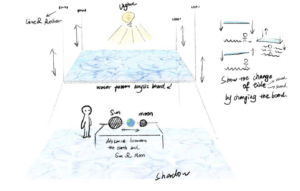
Sketch by Yanis
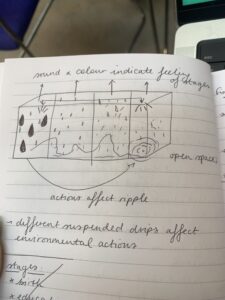
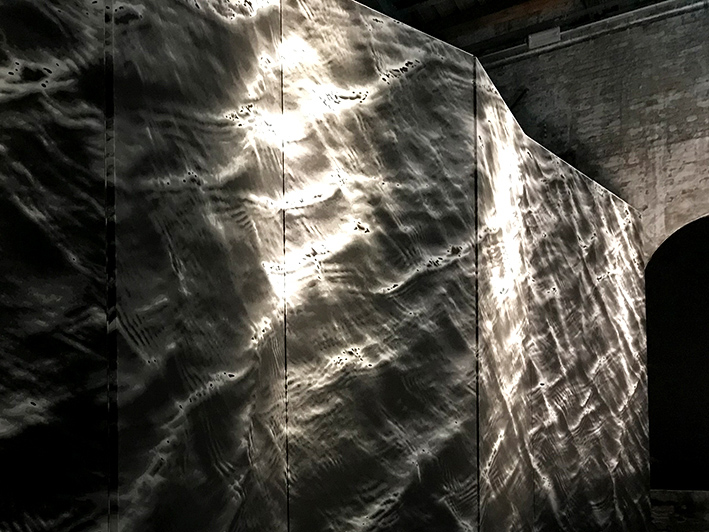
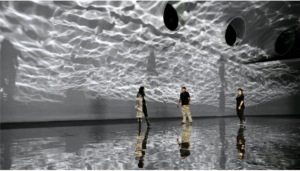
At the center of the exhibition hall, an adjustable acrylic panel with water ripple patterns symbolizes the Earth’s ocean surface. Above this panel, projectors cast varying light and wave effects. Models of the Earth, Sun, and Moon are placed centrally.
By altering the distances between the Sun and Earth, as well as the Moon and Earth, we simulate gravitational variations, thereby depicting tidal phenomena. The rising and lowering of the acrylic panel, combined with projected wave and light changes, along with accompanying sound and musical effects, allow visitors to perceive the presence and fluctuations of tides and gravitational forces.
Visual Presentation:
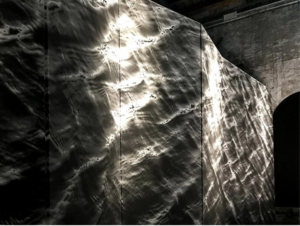
When the distance between the spheres is altered, the acrylic panel rises and falls above the audience’s head, simulating the tidal rise and fall influenced by tidal forces.During this process, the heights of the panel’s four corners can be adjusted randomly, introducing slight tilts to enhance artistic effect.
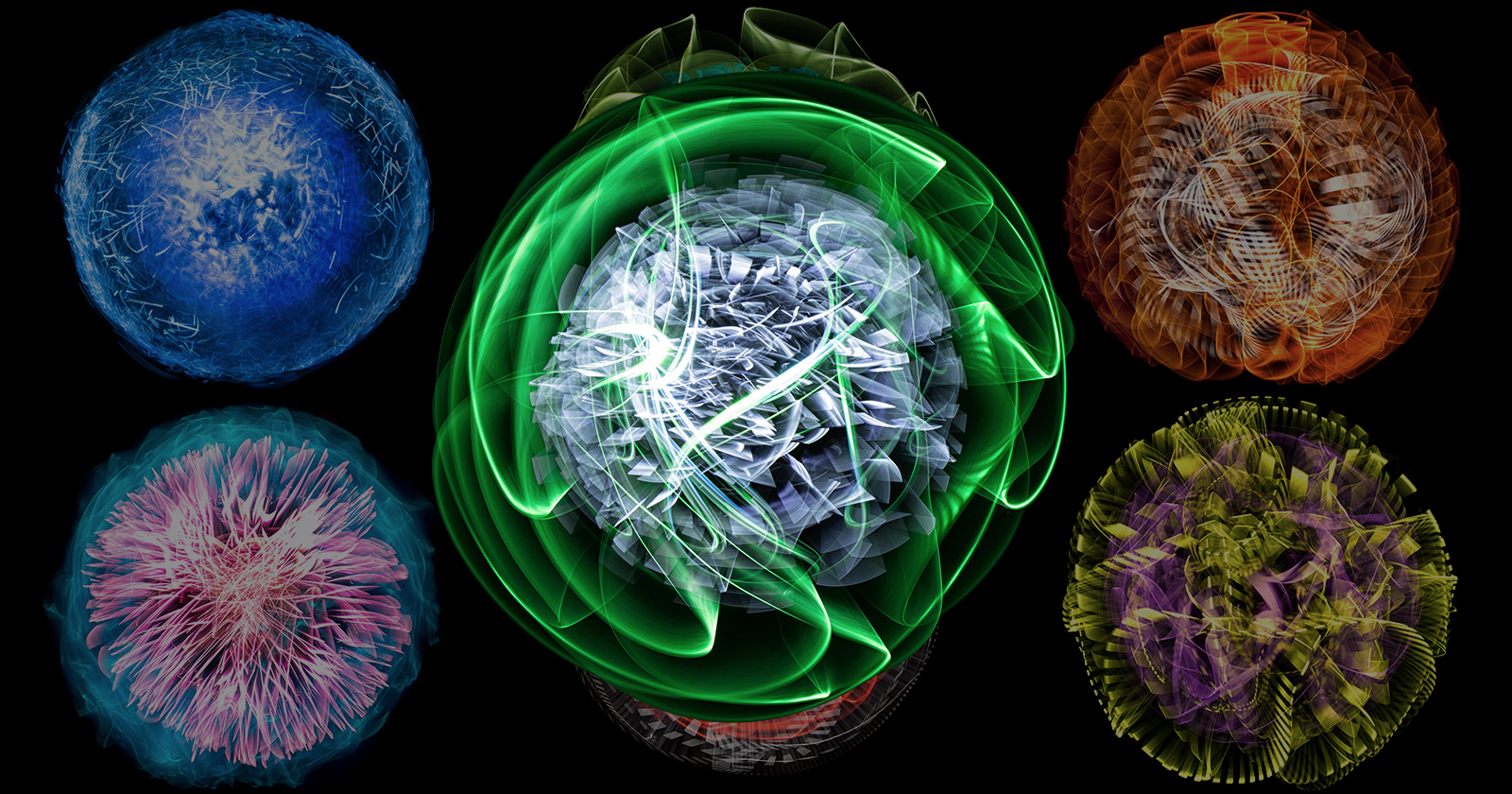
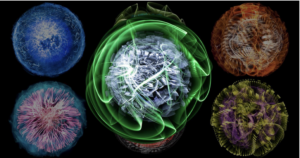
Projectors will display different lighting effects based on the strength of gravitational forces: when the gravitational pull is strong, brighter and more intense lights and colors are used; when the pull is weaker, the lighting and colors become softer and dimmer.
Auditory Presentation:
Tides are formed by the gravitational pull between the Sun, Moon, and Earth. We want to use tidal forces as a starting point to explore how celestial bodies interact through gravity, experiencing this invisible pull through the rise and fall of the tides.
Our design focuses on two main aspects:
1.Creating an Interactive Tidal Soundscape
2.Composing Interactive Music Inspired by Tidal Forces
Interactive soundscape: a dynamic audio experience shaped by tides
First, we aim to capture the changing sounds of ocean waves under the influence of tidal forces, layering them to create an immersive and evolving sound environment:
First, there is the ambient sound of the sea, and then according to the different forms of the waves, several audios reflecting different tidal states are switched according to the gravity of sun and moon. As the tidal force increases and decreases, waves of different sizes fade in and out.
- Ambient sea:
- Calm wave:
- Strong wave:
- Very strong:
Audio from Jackson
The changing tidal forces directly influence the movement of ocean waves. In the physical world, the more dramatic the shift in tidal forces, the more intense the wave motion becomes.
In our soundscape design, the speed and complexity of wave movement–along with other environmental elements–are closely tied to tidal forces. We aim to create a dynamic feedback system where audiences can manipulate the positions of the Sun and Moon, causing changes in tidal force intensity. As a result, the density, layering, and richness of wave sounds and ambient effects will shift accordingly, vividly illustrating the impact of tidal forces.
Interactive Music: Shaping Musical Emotion Through Tidal Forces
Interaction methods:
We want the representation of tides to go beyond just a soundscape. It should also reflect the natural gravitational pull between the Sun and the Moon. Through our interactive music system, we aim to let the audience intuitively feel the tension and fluctuations of gravitational forces, translating these cosmic interactions into an immersive auditory experience.
So in the interactive component, we want to first calculate the tidal forces generated by the audience’s adjustments to the positions of the Sun and Moon. The tidal force is determined using the following formula:
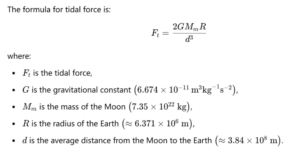
We map these tidal forces to various musical dimensions, including instrumentation, rhythm, melody, and volume. For example, in the demonstration video below, the numerical values of the slider simulate the intensity of tidal forces, dynamically influencing the musical expression in real time.
Video by Hasse
Through this interactive sound and music experience, we want the audience to intuitively perceive the cosmic forces behind tidal phenomena. By engaging with the ebb and flow of tidal forces, they can experience the tension, release, and rhythmic variations driven by these celestial interactions.
Musical Elements
We are continuously exploring the most suitable musical styles for this project. Below are some of our key musical references:
Chopin – Étude Op. 25 No. 12 “Ocean”
https://www.youtube.com/watch?v=9vA8qX_p11w
The changes in emotion, tempo, and dynamics resemble strong ocean winds stirring up waves that crash against the rocks, with the left-hand accents representing the rocks. The texture and dynamic variations can serve as a reference, while the combination of powerful chords and rapidly rolling arpeggios can be used as the main elements of the musical melody.
Secret Garden – Chaconne
The harp performance resembles the movement of waves and can serve as a reference for harmonic structuring. The bagpipes highlight the cold, maritime atmosphere, making them a suitable element for atmospheric embellishment.
Beethoven – Moonlight Sonata (1st Movement: Adagio sostenuto)
https://www.youtube.com/watch?v=4Tr0otuiQuU
The C♯ minor key creates a tranquil, melancholic, and mysterious atmosphere. The left-hand harmonies effectively depict the cyclical yet ever-changing motion of ocean waves.
Interactive Presentation:
- Audience push the “moon” and “sun” spheres, and the sensor detects its movement, triggering changes in the projection of the tides,and also the sound and music.
- Core Technology: Arduino + Ultrasonic sensor(Sensors are attached to the “moon” and “sun” spheres, and they measure the distance between the spheres by emitting ultrasonic waves.)
- Visual: The distance data retrieved is sent to TouchDesigner, which then projects the visual representation through the projector.
- Auditory: The distance data is sent to Max/MSP, which processes it and plays the sound through the stereo speakers.
Image References:
(1) https://images.lecho.be/view iid=dc:134806531&context=ONLINE&ratio=16/9&width=1280&u=1540530325000
(2)https://www.lechantdudesign.com/wp-content/uploads/2019/12/Venise-2019-Arsenal-8.jpg
(3)https://petapixel.com/assets/uploads/2017/02/orbs_feat.jpg
(4)https://m.media-amazon.com/images/I/51YPpqV3VpL._AC_UF894,1000_QL80_.jpg