Any views expressed within media held on this service are those of the contributors, should not be taken as approved or endorsed by the University, and do not necessarily reflect the views of the University in respect of any particular issue.
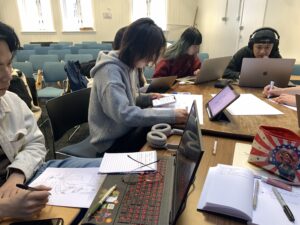
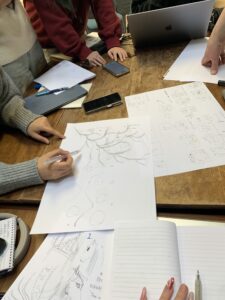
We first went to the wrong room, once we found each other, we moved some tables around to make a good thinking environment.
Dave gave us creative challenges on the concept of time:
How could you visually represent sayings about time?
How to visually represent different moments in our own life?
How to visually represent the passage/experience of someone else’s time?
Discussion: brainstorm and develop ideas
During the challenges I made some random observations:
3 out of 7 used sound -> during our discussion I realised it was actually 2 out of 7
3 out of 7 using pen and paper +1 if you count Dave
7 out of 7 were silent
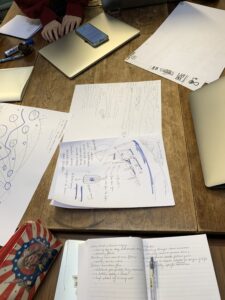
6 sheets of paper were used in total
5 laptops were open
1 tablet was being used
1 sound deck
1 hour passed during the challenges
2 sets of headphones were used, but 3 sets were brought
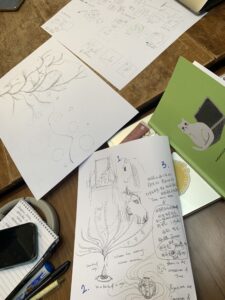
Outcomes: some of us used these to create whole concepts for the project
Task 1:
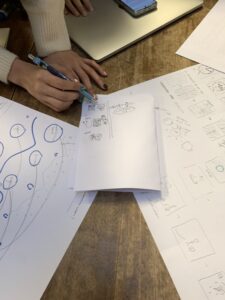
Caitlin: Very literal interpretation of the challenge. I drew little clock figures and knives, all sorts to literally represent the sayings. One thing I drew was similar to Yanis, I had drawn one saying like a pulse.
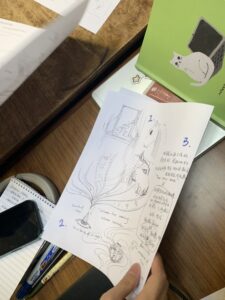
Yanis: Very deep and philosophical take on the sayings. He also used Chinese sayings and tried to represent those. One thing he thought about was about how water has memory; all memories can flow down into a single droplet of water and once it drops, that represents the end of life, just done in a blink.
Lulu: She used a Chinese saying that was about how people die, but objects live on. She drew some cute illustrations of a teddy bear and a person growing up until death, with the teddy bear staying intact. We talked about this a little bit about how time can move around an object and how they perceive life much slower than the world around them.
Shuzhang: She combined task one and two and made a soundscape (?) about how time flies. It involved sounds that reminded her of her childhood, but also had elements like time ticking in the background.
Jackson: He also made a soundscape about the saying time flies. He talked about how childhood passes by quickly but now feels like hazy memories to him. His sound included a high-pitched ringing sound that almost felt like it was trying to snap the listener out of the memory. This prompted us to talk about how memories can be tied to music and can transport us back to the moment that we associate it with.
Dave: He also took things literally. I don’t remember the sayings he used, but I remember he made drawings of how the flow of time felt. He showed this through dots and lines, and an hourglass. The most interesting though was a drawing of a film roll with mechanical hands grabbing a memory to show. It was an interesting visual to see and got us thinking about the endless possibilities with this topic.
Task 2:
Shuzhang: She made a sound that reminded her of her hometown and the typical sounds that she grew up hearing, and she felt were only found there.
Lulu: She talked about shared generational objects to represent life stages. For example, she drew a small paper folding game and (I think) a certain TV show that are representative of the childhood of Chinese people of her generation. It made us think about culturally shared memories.
Yanis: He talked about a stand-out memory from childhood involving a plane ride. He remembers the music and colours, and other sounds that were present then. He said that even though, at the time, it wasn’t a particularly interesting experience, he will still remember it to this day when he hears the familiar music/sound and that it has almost become a bitter memory.
Caitlin: I thought about my life on the same type of day and the feeling of emotions over time. I used the first day of primary and secondary school, undergraduate and postgraduate. I found that for each event, my emotions became more complex, but the time felt shorter. I drew lines like a pulse for each emotion and then how the speed of time felt. It ended up looking like mountains
Task 3:
Lulu: She talked about a girl with cancer who recently passed. Soon before she passed, people all over the world rallied to fulfill her ultimate wish; to appear as an animated character alongside her favourite animated characters. Lulu talked about how even though she isn’t physically with us anymore, her digital representation will live on in that space.
Caitlin: I talked about mountains. The previous tasks inspired me to think about how objects, or in this case mountains, experience time. A place like Arthur’s Seat will have seen so much already but will “personally” experience little change, and at a much slower pace. So how there is micro and macro time, and how that can be shown visually.
Dave: He talked about loss and fleeting images combined with music. He talked more about how music can bring up memories, for example in people with alzheimers and how it’s often the last thing they can actually tie memories to. He played some work, by an artist whose name I don’t remember, that dealt with this phenomenon. He created a song that sounded like an old record player playing in an empty ballroom. The music felt nostalgic, empty and dusty almost. It was interesting to hear as it got us thinking about the way music was used here.
Yanis: He thought about how 1 minute passes differently for everyone. He referred back to the exercise Jules made the whole class do last week, where he asked everyone to put their hand up when we thought a minute had passed. He thought about how we all had a different perception of this same amount of time, but that machines for example will get it on the dot right, but there’s no thought behind it; it’s cold and meaningless.
Discussion:
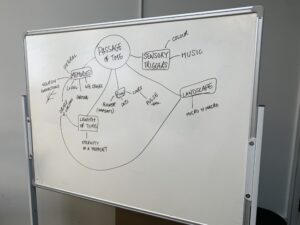
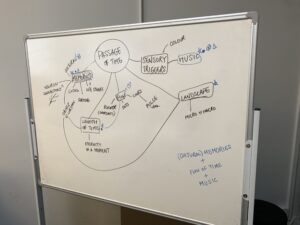
We talked about our ideas a bit, and tried to organise them into categories to make some sense of them. I put them on the white board that was standing next to our table.
The overarching theme that naturally appeared was the passage of time. The categories we ended up with were memories, the length of time, flow, sensory triggers, and landscape. We then added the sub-topics to each of these e.g., life stages, music, micro vs macro, pulse, objects, cultural, etc. David asked us each to point out our favourite things on the white board. I assigned everyone a different little symbol to have a clear view (Caitlin = star, Yanis = dot, Hasse = cross, Lulu = heart, Shuzhang = flower, Jackson = triangle). The most popular options ended up being: (CULTURAL) MEMORIES + FLOW OF TIME + MUSIC From this we tried making some connections. One option that came up was looking at the passage of a small time frame (perhaps a minute or so) per life stage, and represent a prevalent emotion from that life stage. Take childhood for example; you’re at school, full of curiosity and excitement, how would a minute feel to them compared to someone in their 20s working. We liked this but decided to do some more research into our 3 main topics relating to our overarching theme.
Before you die, you may have a brief moment to think about all the happy clips in your life. I wondered whether we could represent these memories in images from a non-human perspective, just as our memories of the past are often from the perspective of a third person perspective. Like the perspective of a pet, a camera, a toy, a plant, or a speck of dust. And the images from these perspectives are fuzzy and incomplete, but very atmospheric, like our memories. In our installation, these images and sounds flicker rapidly and chaotically on the surrounding, light and color change rapidly within the installation, and after a minute return to darkness and silence. In my imagination, it is composed of all kinds of human voices, sounds of nature, sounds of the city, sounds of daily housework, and gradually exciting music. Just some ideas and imagination)
How do we feel? Happy to have our idea, excited that it matches up and makes us excited to make the output and go through the process. We finished the meeting chatting a bit about last semester and the sound designers’ projects (which dealt with perception), also Hasse and Shuzhang played the piano a bit. We also discussed our team roles 😀
Look at brain activity right before dying – could there be a visual link?
How do we want people to feel about this experience?
Different cultures have different definitions of this phenomenon -> Perhaps could be an interesting angle?
How do we pass onto the next stage? Is it a cycle?
Loop of memory – time is repeating itself in a way – Make someone reflect on their own life
Time and the universe:
Interactive system that affects visual outcome
Life categories change visual/sounds/textures
Trees could be a focus – carry proof of their life through rings
Projection mapping + interactive real environment + motion capture – could be considered -> Difficult to execute -> Lifecycle through motion capture?
Could have lines to represent the choices that people make – would make the visitors think of how many different choices/lived experiences there are -> Interactive space -> Shows difference in perception
Life path -> What do we want people to experience/feel? -> What is that exact focus?: science, religion, regeneration, …?
Using a small time frame – could help narrow down focus to how and what people feel (within) a small time frame
What is our big idea?
How people perceive time and think about a small experience
Make them reflect on their own life and time
Don’t push an outcome or expectation, let people make their own conclusion/thoughts
How do we make them think?
Is it through objects?
Is it through interactive experiences?
…..
We’re interested in how people react and reflect on a shared, universal experience, being time.
To do:
Research different emotions
Research different timeframes
Research different choices
Research different ages
Research different performances
Research different objects
Look into Michelle Bastion – Architecture lecturer, we can email Jules to get contact info
Look into Bryan Nino (?)
-> all in relation to time
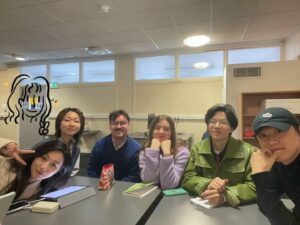
Our first team picture, Shuzhang couldn’t make it so we added a little drawing to represent her 🙂
We met each other for the first time, and found out about our backgrounds and interests.
We came up with some basic ideas just around the word perception and what comes up when we think of that word. Some things were the movie Soul which explores how people can enter a flow state and go to the Great Beyond. Lose themselves in something which everyone will have a different perception of. Another was looking at sounds in relation to time and size. So micro and macro sounds, and how objects can have a soul through sound or lifetime. The changing tide came up with the push and pull of the moon, also visually representing music through a game. There were also some more literal interpretations like how people literally perceive, and how that differs from person to person, this could then be applied to a multitude of topics.