Any views expressed within media held on this service are those of the contributors, should not be taken as approved or endorsed by the University, and do not necessarily reflect the views of the University in respect of any particular issue.
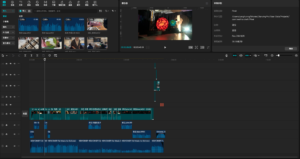
We started the video editing work at the end. We divided the video into three parts to show our project:
The first part is the introduction of the project theme
The second part is the introduction of the installation, from the basic design logic to the technical principles used in each part.
The third part is a detailed introduction from the three aspects of sound design, visual design, and music design, and tells about their mutual influence
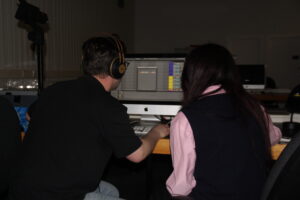
After the meeting, we finally decided to submit it in the form of a video. I was responsible for the production process, the on-site shooting tasks and the post-editing video.
Preliminary preparation: Recording from the final stage of preparation and rehearsal, the progress of each rehearsal and the rehearsal process.
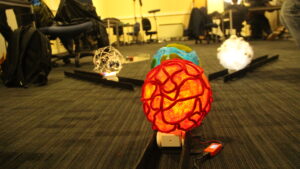
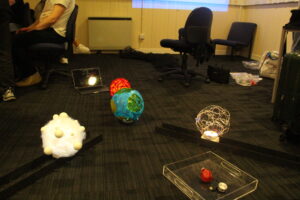
On-site shooting: The photography equipment is a SLR camera and a mobile phone, equipped with a recorder and microphone. The SLR camera is used to capture close-ups of tourists using the equipment on site and interviews with tourists. The mobile phone uses a fixed position for time-lapse photography to record the overall situation on site, from the layout of the site to the start of the event.
2025.2.12
Since the project involves tides, the sound part must include the sound element of waves.
In the early stage of the project, we simply used three relatively different sounds, which lacked interactivity. In order to achieve the purpose of the installation, we need to let the audience feel the influence of tidal forces. When pushing the planet, the sound of the waves will also change. It should be interactive, not static.
2025.2.25
So the direction of our wave sound effect design is to enhance the changes of the wave sound effect while ensuring the auditory experience.
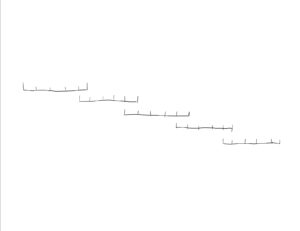
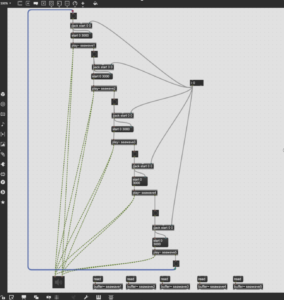
First, we tried to use a method similar to the simulated particle synthesizer in max to edit a wave sound effect into multiple sound clips with a duration of 5s. Then there is a variable to determine its playback time and end time. When we want the waves to have obvious changes, each one starts from the first second and ends in the second second. (At that time, it was not decided whether to use the distance variable between the planets or the speed variable of the planets). The logic diagram is as follows:
3.20
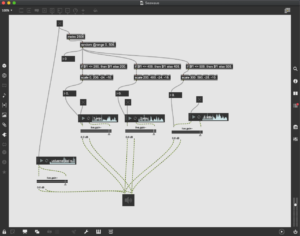
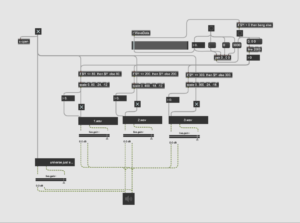
After Jules’s reminder, we thought it would be more convenient to mix the complete long audio together, so we made a new design for the changes in the waves. We mixed three long, complete, and different waves together, and used the size of the variable to affect the volume changes of the three audios, so that the sound quality is also good while the waves are changing.
The Max demo at that time was as follows: Design, mixed three long, complete, and different waves together, and used the size of the variable to affect the volume changes of the three audios, so that the sound quality is also good while the waves are changing.
The Max demo at that time was as follows:
The max demo at that time was as follows:
3.23
In the end we decided to use the speed of movement between the planets and the Earth as a variable affecting the sound of the waves, and merged this part into the final Max patch along with the music and other interactive parts.
The final edited sound of the waves are as follows:
Before we finalized the design direction and technical logic of the ocean wave sound, we determined the design concept of the ocean wave sound, which will guide our subsequent promotion.
Ocean Wave Sound Design Concept
Tides are a silent dialogue between the universe and the ocean. In this sound design, we turned the speed of the planet into an invisible baton, allowing the breathing of different waves to rise and fall with it. The change in the speed of the planet is like the gentle gesture of gravity, constantly stirring the rhythm of the ocean: when the stars move slower, the sound of the waves is low and low; when the stars move faster, the waves become more turbulent. This metaphorical sound experience poetically presents how tidal forces – this invisible cosmic dance – silently shape the world around us.