Any views expressed within media held on this service are those of the contributors, should not be taken as approved or endorsed by the University, and do not necessarily reflect the views of the University in respect of any particular issue.

Final Video Editing Statement

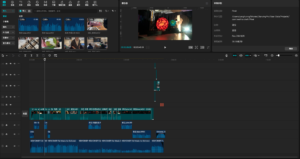
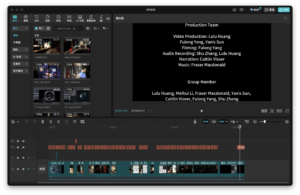
For the final submitted video, our initial editing structure was as follows: the first part would introduce the overall concept, the second part would explain the production process, the third would present the on-site installations, and the final section would feature interviews. However, during the actual editing process, we found that this structure made some sections overly lengthy and caused the overall pacing to feel sluggish, which affected the viewing experience. After several rounds of adjustments, I decided to adopt a new structure: starting with the core concept, then interweaving the installation introductions with interview footage, and ending with behind-the-scenes clips. This restructuring made the video more dynamic and better organized in terms of rhythm and narrative flow.

All audio materials used in the video were originally created by our team. These include musical compositions and sound effects tailored for each moon, ambient ocean sounds, background music, and recorded narration. The narration script was written based on the core concept of our project — The Breath of Tidal Force. It begins with the natural phenomenon of tidal force and gradually leads the audience through various aspects of the exhibition, including spatial layout, visual design, soundscapes, interactive elements, and the construction of the installation. The video was carefully edited to align with the narration’s pacing, ensuring a cohesive and logically structured presentation.

Finally, we sincerely thank every team member for their dedicated effort, as well as the teachers who offered us valuable guidance and support throughout the process.
Installation Introduction

Tidal force — a subtle yet powerful natural phenomenon.It arises from the gravitational interactions between celestial bodies in the universe,silent and unseen, yet day after day, it shapes the breathing rhythm of the ocean.

In this installation — “The Breath of Tidal Force”,we give form to this invisible pull through visual, auditory, and musical experiences.You are invited to step into a sensory universe we have created,where light and movement intertwine,and feel the pulse and resonance that echo from the depths of the moon and the far reaches of the cosmos.

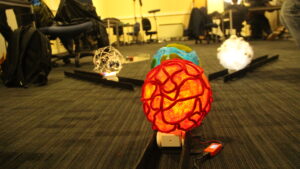
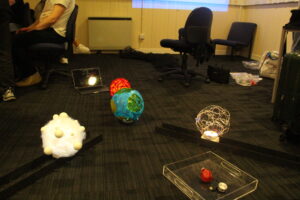
We blocked most of the light with black curtains to create a quiet, immersive universe. Four planets are arranged in a triangle around a central star, guiding the audience into the space. Each planet has its own texture—twisted wire for metal, chunky wool for lava, light cotton for gas, and a handmade Earth-like center.

The orbiting planets sit on 3D-printed trains and tracks, and visitors can pull handles to move them, becoming a tidal force in the universe.

On both sides, atmospheric videos made with TouchDesigner and Premiere express abstract feelings of water and time. Projectors cast visuals onto sheer black fabric, which ripples gently with passing movement, creating a tide-like effect. The central projection connects planets and ripples with the central star.

We have embedded the M5StickC Plus, which is connected to an ultrasonic sensor, inside a sphere, allowing it to measure the real-time distance between the “celestial body” and the “Earth.” This data is wirelessly transmitted to the host machine and then sent to the MAX/MSP project. Through the calculation of tidal force formulas, the distance data is dynamically converted into music, sound effects, and particle visual controls, thus creating an interactive system that blends scientific logic with sensory experience.

In terms of sound design, we control the dynamic sound effects of each planet through changes in tidal gravitational forces, and adjust the intensity of the sound of the waves based on the planet’s movement speed. This allows the audience to intuitively perceive the interaction between the “force” and the environment during the interactive process.

Regarding the music, the fluctuations in melody, instrumentation, and volume correspond to the strength of gravitational forces. The main melody of each celestial body is played by the closest speaker in a 4.0 channel system, enhancing the sense of immersion and presence for the audience in space.

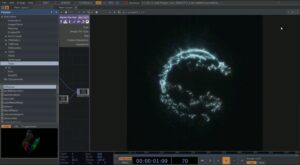
In the visual aspect, we have created a dynamic particle system that simulates the movement of celestial bodies and the flow of waves. The attraction between the particles is controlled in real-time by the distance data. The color gradient from white to blue showcases the visual tension brought about by the changes in gravitational force.

Additionally, we have set up a water pool with a Bluetooth vibrating speaker embedded in it. The vibration frequency synchronizes with the emotional intensity of the music. The vibrations create real ripples on the water’s surface, which are projected onto the wall by a top-mounted projector, making the sound “visualized” in the form of water. This provides the audience with a multi-dimensional, tactile sensory experience.

Final Project

Final video:

Documentary video report:

Resources:

Touchdesigner video instructions – Yanis

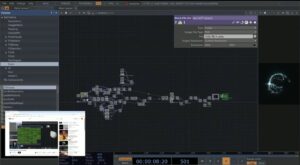
Based on our concept and with the help of Caitlin and Pradyumna, I created a Touchdesigner visual based on a YouTube tutorial (https://www.youtube.com/watch?v=dzYyrvyY-zc&t=1687s) and adjusted the effects and colors to our project. We were trying to substitute the formulas that the team projected into Touchdesigner to use, but it didn’t work out in the end. However, the attractor used in this visual matched the concept of our project so well that we decided to keep the visual and make an ambient video to place in the room.

Final presentation video

2025.4.20-4.23

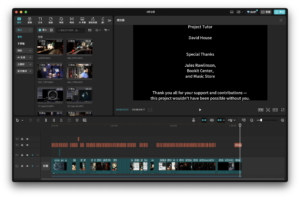
We started the video editing work at the end. We divided the video into three parts to show our project:

The first part is the introduction of the project theme

The second part is the introduction of the installation, from the basic design logic to the technical principles used in each part.

The third part is a detailed introduction from the three aspects of sound design, visual design, and music design, and tells about their mutual influence

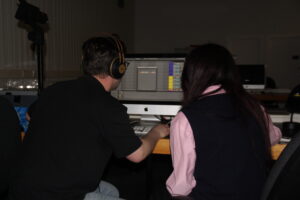
On-site shooting:Fulong Yang & Shu Zhang

Post-production editing:Lulu Huang & Fulong Yang

Music:Fresar Macd

Preparation for the final video

2025.4.3-2025.4.5

After the meeting, we finally decided to submit it in the form of a video. I was responsible for the production process, the on-site shooting tasks and the post-editing video.

Preliminary preparation: Recording from the final stage of preparation and rehearsal, the progress of each rehearsal and the rehearsal process.

On-site shooting: The photography equipment is a SLR camera and a mobile phone, equipped with a recorder and microphone. The SLR camera is used to capture close-ups of tourists using the equipment on site and interviews with tourists. The mobile phone uses a fixed position for time-lapse photography to record the overall situation on site, from the layout of the site to the start of the event.

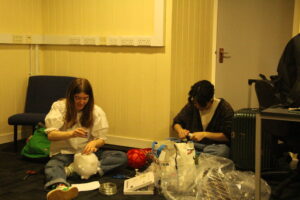
Photos from the rehearsal:


Experimentation: Water Wave Projection

Wave Projection Experiment – 25/02/25 – By Fraser Macdonald

Video:

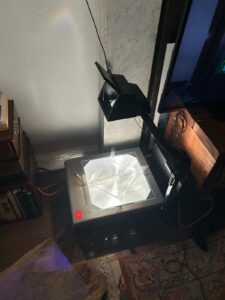
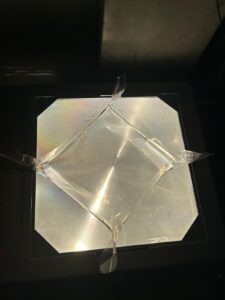
Setup: 3M Overhead Projector with clear acetate basin, filled with water, projecting onto white wall.

3M Projector for water projection experiment
Acetate Basin for Water Projection Experiment

Photos:

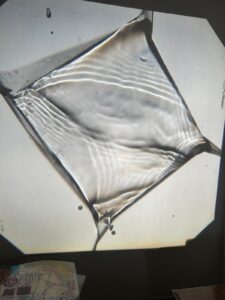
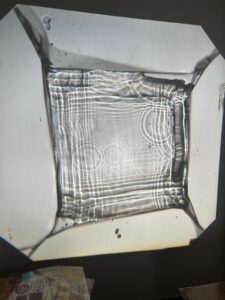
Water projection with wave
Water projection 2
Water projection with waves and droplets
Water Projection 1

Conclusion: Interacting with the water and seeing the peaks of the waves projected onto the wall in real time was engaging and satisfying. I also enjoyed observe the interaction between the peaks, and the way the square basin shapes the waves. When the water is initially poured into the basin, bubbles of air are trapped on the surface, and when they pop, generate circular ripples in an unexpected and very satisfying fashion. A downside to the 3M projector is it is very bright and straining on the eyes to use for prolonged periods of time (I should have worn sunglasses).

Follow up questions: Is there a way to project this downwards on to the floor as in the design? Should use actual water rather than acetate imitating water? How would different basin sizes affect the interaction between the waves?

Next experiment: Wave generation via contact speaker on basin.

Engine Building: Music Generation MAX PATCH

This is a demo max patch that takes the data from three planets, generating MIDI notes in set rhythmic and bar patterns, moving through seven modes, with seven chord possibilities for each mode.


The following video shows the integrated atmosphere engine, made with samples from Shu and Fulong, working within the wider MIDI engine:

Atmosphere Screen Grab DMSP


by Fraser David Macdonald for DMSP Perception

css.php

Report this page

To report inappropriate content on this page, please use the form below. Upon receiving your report, we will be in touch as per the Take Down Policy of the service.

Please note that personal data collected through this form is used and stored for the purposes of processing this report and communication with you.

If you are unable to report a concern about content via this form please contact the Service Owner.

Please enter an email address you wish to be contacted on. Please describe the unacceptable content in sufficient detail to allow us to locate it, and why you consider it to be unacceptable.
By submitting this report, you accept that it is accurate and that fraudulent or nuisance complaints may result in action by the University.

  Cancel