Any views expressed within media held on this service are those of the contributors, should not be taken as approved or endorsed by the University, and do not necessarily reflect the views of the University in respect of any particular issue.

Final project idea: The Perception of Tides

Theme and Concept:

Perceiving Tides — a phenomenon where the Earth’s ocean surfaces experience periodic rises and falls due to the tidal forces exerted by the Sun and the Moon.

The tidal phenomena on Earth are primarily driven by the gravitational forces of the Moon and the Sun. Although the Moon has a more significant impact on tides, the Sun’s gravitational pull also plays a crucial role.

Perceiving tides is of significant importance to us: Tides originate from the gravitational forces between celestial bodies, reminding us that the power of the universe is closely connected to all living beings on Earth. By sensing the tides, we can deepen our connection with nature and understand the close relationship between humans, Earth, and the broader universe.


Overall Design:
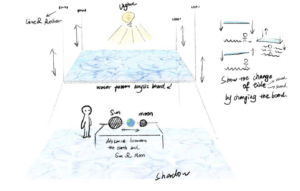
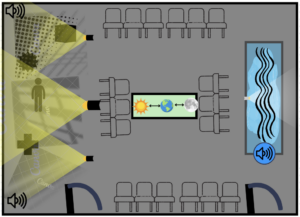
Sketch by Yanis

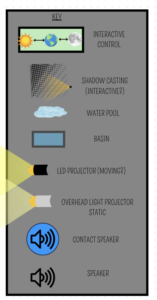
At the center of the exhibition hall, an adjustable acrylic panel with water ripple patterns symbolizes the Earth’s ocean surface. Above this panel, projectors cast varying light and wave effects. Models of the Earth, Sun, and Moon are placed centrally. 

By altering the distances between the Sun and Earth, as well as the Moon and Earth, we simulate gravitational variations, thereby depicting tidal phenomena. The rising and lowering of the acrylic panel, combined with projected wave and light changes, along with accompanying sound and musical effects, allow visitors to perceive the presence and fluctuations of tides and gravitational forces.


Visual Presentation:

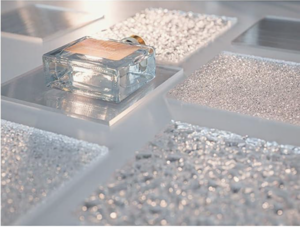
When the distance between the spheres is altered, the acrylic panel rises and falls above the audience’s head, simulating the tidal rise and fall influenced by tidal forces.During this process, the heights of the panel’s four corners can be adjusted randomly, introducing slight tilts to enhance artistic effect.

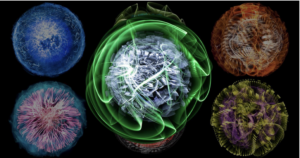
Projectors will display different lighting effects based on the strength of gravitational forces: when the gravitational pull is strong, brighter and more intense lights and colors are used; when the pull is weaker, the lighting and colors become softer and dimmer.
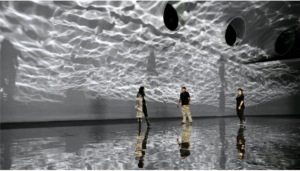
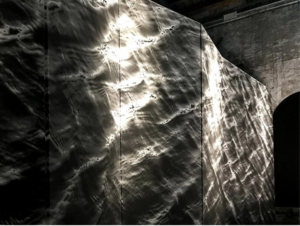
  1.      
  2.      
  3.      
  4.      


Auditory Presentation:

Tides are formed by the gravitational pull between the Sun, Moon, and Earth. We want to use tidal forces as a starting point to explore how celestial bodies interact through gravity, experiencing this invisible pull through the rise and fall of the tides.

Our design focuses on two main aspects:

1.Creating an Interactive Tidal Soundscape

2.Composing Interactive Music Inspired by Tidal Forces


Interactive soundscape: a dynamic audio experience shaped by tides

First, we aim to capture the changing sounds of ocean waves under the influence of tidal forces, layering them to create an immersive and evolving sound environment:

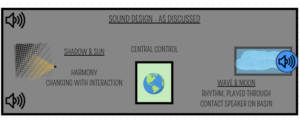
First, there is the ambient sound of the sea, and then according to the different forms of the waves, several audios reflecting different tidal states are switched according to the gravity of sun and moon. As the tidal force increases and decreases, waves of different sizes fade in and out.

  • Ambient sea:
  • Calm wave:
  • Strong wave:
  • Very strong:


Audio from Jackson

The changing tidal forces directly influence the movement of ocean waves. In the physical world, the more dramatic the shift in tidal forces, the more intense the wave motion becomes.

In our soundscape design, the speed and complexity of wave movement–along with other environmental elements–are closely tied to tidal forces. We aim to create a dynamic feedback system where audiences can manipulate the positions of the Sun and Moon, causing changes in tidal force intensity. As a result, the density, layering, and richness of wave sounds and ambient effects will shift accordingly, vividly illustrating the impact of tidal forces.


Interactive Music: Shaping Musical Emotion Through Tidal Forces

Interaction methods:

We want the representation of tides to go beyond just a soundscape. It should also reflect the natural gravitational pull between the Sun and the Moon. Through our interactive music system, we aim to let the audience intuitively feel the tension and fluctuations of gravitational forces, translating these cosmic interactions into an immersive auditory experience.

So in the interactive component, we want to first calculate the tidal forces generated by the audience’s adjustments to the positions of the Sun and Moon. The tidal force is determined using the following formula:
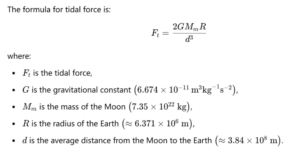
We map these tidal forces to various musical dimensions, including instrumentation, rhythm, melody, and volume. For example, in the demonstration video below, the numerical values of the slider simulate the intensity of tidal forces, dynamically influencing the musical expression in real time.

Video by Hasse

Through this interactive sound and music experience, we want the audience to intuitively perceive the cosmic forces behind tidal phenomena. By engaging with the ebb and flow of tidal forces, they can experience the tension, release, and rhythmic variations driven by these celestial interactions.

Musical Elements

We are continuously exploring the most suitable musical styles for this project. Below are some of our key musical references:

Chopin – Étude Op. 25 No. 12 “Ocean”

https://www.youtube.com/watch?v=9vA8qX_p11w

The changes in emotion, tempo, and dynamics resemble strong ocean winds stirring up waves that crash against the rocks, with the left-hand accents representing the rocks. The texture and dynamic variations can serve as a reference, while the combination of powerful chords and rapidly rolling arpeggios can be used as the main elements of the musical melody.

Secret Garden – Chaconne

https://www.bilibili.com/video/BV1mv411M7Fq?spm_id_from=333.788.videopod.episodes&vd_source=55d0157ee1d06696c171ec53ee04efe8&p=12

The harp performance resembles the movement of waves and can serve as a reference for harmonic structuring. The bagpipes highlight the cold, maritime atmosphere, making them a suitable element for atmospheric embellishment.

Beethoven – Moonlight Sonata (1st Movement: Adagio sostenuto)

https://www.youtube.com/watch?v=4Tr0otuiQuU

The C♯ minor key creates a tranquil, melancholic, and mysterious atmosphere. The left-hand harmonies effectively depict the cyclical yet ever-changing motion of ocean waves.


Interactive Presentation:

  • Audience push the “moon” and “sun” spheres, and the sensor detects its movement, triggering changes in the projection of the tides,and also the sound and music.
  • Core Technology: Arduino + Ultrasonic sensor(Sensors are attached to the “moon” and “sun” spheres, and they measure the distance between the spheres by emitting ultrasonic waves.)
  • Visual: The distance data retrieved is sent to TouchDesigner, which then projects the visual representation through the projector.
  • Auditory: The distance data is sent to Max/MSP, which processes it and plays the sound through the stereo speakers.


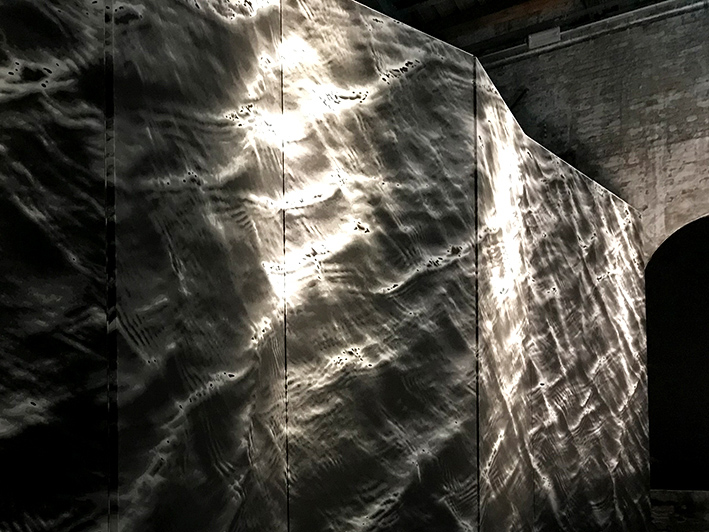
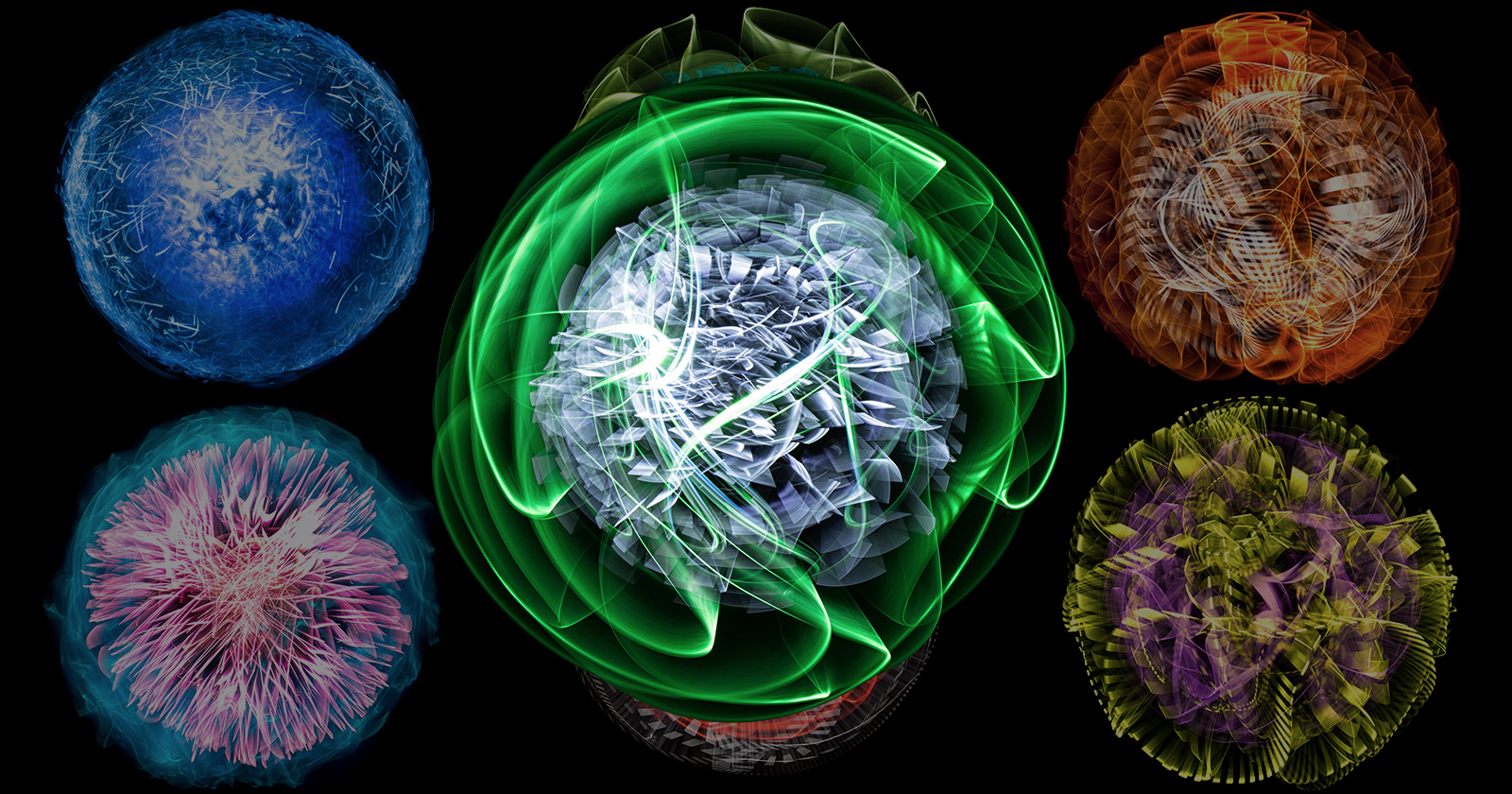
Image References:

(1) https://images.lecho.be/view iid=dc:134806531&context=ONLINE&ratio=16/9&width=1280&u=1540530325000

(2)https://www.lechantdudesign.com/wp-content/uploads/2019/12/Venise-2019-Arsenal-8.jpg

(3)https://petapixel.com/assets/uploads/2017/02/orbs_feat.jpg

(4)https://m.media-amazon.com/images/I/51YPpqV3VpL._AC_UF894,1000_QL80_.jpg


Idea conception diary: the discourse of three week’s brainstorming

21/01/2025 – Meeting phase

We met for the first time and discussed our backgrounds and interests. Our initial ideas revolved around perception, including the movie Soul and its exploration of the flow state, the relationship between sound, time, and scale, the changing tide as a metaphor influenced by the moon, and how individual perception varies from person to person.


27/01/2025 – Thinking phase

We explored perception, time, and human experience through interactive and immersive mediums. Inspired by Soul, it delves into abstract ideas of creation and consciousness, using VR/3D environments, light, colour, and texture to represent thoughts and ideas inside the brain.

Notes:

  • Music visualization as a journey, where movement and environment respond to beats and tempo.
  • Time as an abstract shape, expressed through lines, motion, particle effects, and light.
  • Tide and cosmic forces, drawing from the traditional Chinese calendar and the moon’s influence.
  • The Great Beyond and flow state, creating an immersive installation where people “disappear” into focus.
  • Social distancing reimagined, using sound and nostalgia to redefine personal space.
  • Life flashing before death, visually exploring the universally known concept of seeing one’s life in a moment.


28/01/2025 – Time phase

We’re interested in how people react and reflect on a shared, universal experience, being time.

  • 1 minute

To explore the moments before death, questioning whether brain activity has a visual representation and how this experience should feel. Different cultures interpret this transition uniquely, offering a compelling perspective. It considers whether passing on is a cycle, with memory looping and time repeating, encouraging deep reflection on one’s own life.

  • Time and universe

An interactive system where life experiences shape visual, auditory, and textural outcomes. Trees, with their rings as a record of life, could serve as a central metaphor. Techniques like projection mapping, interactive environments, and motion capture may be used, though challenging to execute. Motion capture could also depict life cycles, while lines could represent personal choices, prompting visitors to reflect on different lived experiences and perspectives. The focus is on life paths and perception, questioning whether the experience should center on science, religion, or regeneration. Narrowing it to a small time frame could deepen the emotional impact, emphasizing how people feel in fleeting moments.

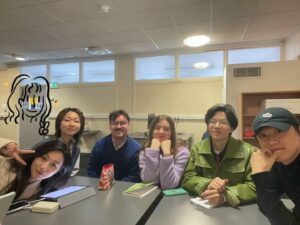
Our first team picture, Shuzhang couldn’t make it so we added a little drawing to represent her 🙂


02/02/2025 – Interactive wall phase

We had a short meeting to talk about our ideas based on what we talked about in the previous phase. Lulu and Yanis presented the most developed ideas so we discussed these in particular. Lulu’s focused more on the tech side of things so having an interactive wall for people to touch. Yanis’ focused on the concept of our project, talking about the perception of things rather than human beings. We discussed perhaps combining these ideas in a way and what that would look like. What tech would we need and have to learn? What would we have to research still based on the concept? We were happy to have an idea, and felt excited that it matched up and made us excited to make the output. We finished the meeting chatting a bit about last semester and the sound designers’ projects (which dealt with perception). 


04/02/2025 – Intense brainstorm phase

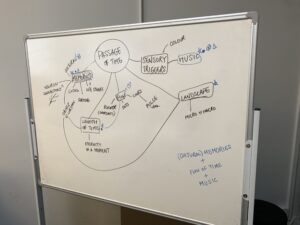
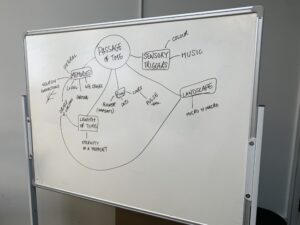
We first went to the wrong room, once we found each other, we moved some tables around to make a good thinking environment. Once we had settled in Dave explained to us how this workshop would go. He felt that we were still quite undecided on a topic for our project and this workshop could hopefully help us narrow down what our big idea would be. He set some challenges which were followed by discussion that involved drawing a mind map on a white board. We ended up concluding on the most popular concept ideas: (CULTURAL) MEMORIES + FLOW OF TIME + MUSIC. None of us really knew where this could lead us, and to what BIG idea, so we went away from the meeting with these topics in mind and to research them for the next meeting.

08/02/2025 – Scatter phase

This is a random collection of things that were talked about in our meeting:

  • Fraser said use different types of tech representative of time – old projector for old show
  • Water holding memory feels pseudoscience but we can twist it and own it for our project
  • Fraser talked about art installations – show resources shared through pics
  • Talked about water
  • We talked about nfc’s and interactive art
  • What’s the element that changes over time? How to set ourselves apart from normal exhibition?
  • Time zones -> falling asleep and waking up at the same time
    Time dilation?
  • Talked about water more and the flow of time
  • Agreed to go away and research more
  • We’re showing them where our studio is before the meeting starts


10/02/205 – Water phase + Dave

Water was a big topic during this meeting. We had already talked about using water in the previous meeting, but now it was in full force. All the ideas for tech, or installations were all on the basis of using water as our “shepherd” in a way. Through the meeting we concluded using different forms of water to show different life scenarios/feelings like love, loss, joy,…. And how these could be interactive. We had the idea to have five different feelings represented in different places in a big room, and have each place be interactive in some way. This was a very BIG idea. We knew it was extremely broad, but it was the closest we had gotten to a final idea. We seemed to never be able to find something that fit quite right with us. 

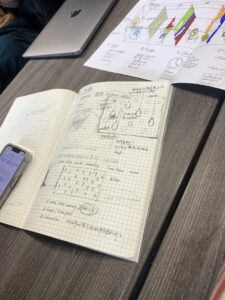
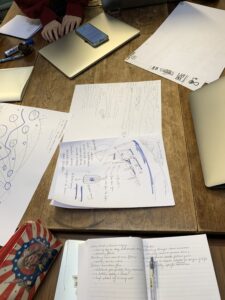
Sketches by Hasse, Caitlin and Fraser


11-12/02/2025 Reshaping, Rethinking, Redoubting, …. Re-everything phase

Started from meeting with Jules and it snowballed in all types of directions. Starting with concluding this: an installation that explores our perceptions of dimensions of time

Flow, motion, continuity – 

Ripples and waves in time – 

Moments, frozen in time –

Which then evolved into this:

  • Sun & Shadow – lights and projectors moving to lengthen and shorten shadows
  • Flow & Ripples – interactive ripple wall – Yanis – Chaotic – container/cupboards with different reactions in light colour and sound
  • Tides & Moon – interactive moon influences the tides (projected)
  • Objects representing the transitions between sections

Still it didn’t feel complete or finished.


12/02/2025 – Resolve Phase

Lots of ideas were being thrown into the groupchat. And it all felt very broad. Lulu then texted us saying that her and Hasse had sat together and tried to figure out how to attack this. They proposed a completely new idea about the perception of the tides, which is something we discussed all the way in our initial meeting. They proposed a project about how the tides can be perceived differently and make an interactive installation/exhibition where the audience can control elements like lighting and music by “altering” the push and pull of the gravitational forces. This would use movement sensors, sculptures, projectors, ambient soundscapes and a whole lot of water. We all looked over the proposal and it was the first time the project actually made some sense and had a central theme. We were able to tie together all the small bits of ideas we had discussed over the past weeks and it feels like our interests are all equally shown in our finished big idea! It maybe wasn’t the most efficient way to get to our end project idea, however it was really nice to explore ideas this much and consider very broad ideas, but also very small ones. Each week we were thinking of something new, and it was very exciting thinking of where we could go with this

Video by Fraser


Acknowledgements

MINUTES: 10/02/2025 – Final meeting with Dave before deadline and presentation

We met in Q.25 in the Hunter Building in the ECA main campus, which is the DDM studio so it felt nice to have a change of scenery.

Lulu wasn’t able to make it sadly, but we kept going nonetheless.

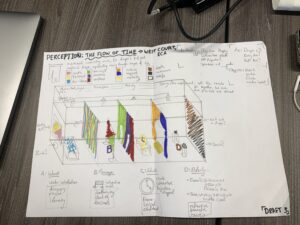
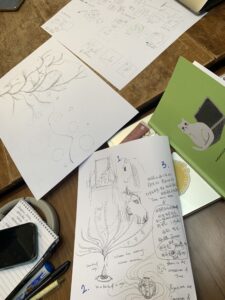
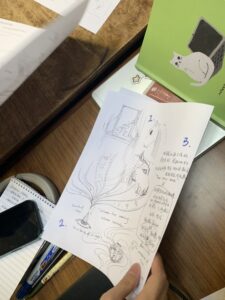
  • Fraser showed us a sketch that he made of an installation based off of what we discussed in the last meeting:
    It came down to the perception of the flow of time through life stages. It included draped fabric coming down from the ceiling dividing a room into different sections and also had physical objects to display the passing of time.
  • We realised we all had separate ideas – so we need to unify them
  • The question I was wondering then was; what is the common denominator in our idea? What ties is all together?
  • We talked about if we wanted to have the installation divided into different, strict, stages. Yanis argues that it should be one big room because time and emotion – life –  doesn’t pass the same for everyone. It is chaotic and we should let our audience decide where they want to go, what they will feel and what they will take from it. We shouldn’t suggest a right way.
  • Hasse mentioned not telling the audience what stage is where;
    This made us shift our focus a bit to stage rather than age, and how that would relate to our installation.


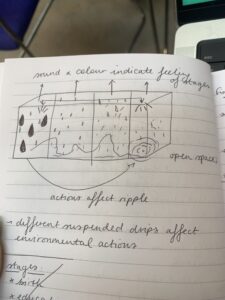
Through discussion a theme started forming. Water was a big thing that kept being mentioned so that got established as our vessel to communicate our message. Hasse had considered making large suspended interactive drips of water, that when interacted with, the environment of the installation would change. We really enjoyed this idea and decided to look into the tech of this to inform our outcome.

Eventually we ended with the flow of time through emotional time, and using water to represent these emotions. That brought us to:

Installation that represents moments in time through forms of water.

  1. LOVE – RIPPLES – TWO PEOPLE INTERACT
  2. UNCERTAIN – RAIN – UNDETERMINED
  3. LOST – EVAPORATION – INTERACTIVE WALL HUMIDIFIER FOG
  4. JOY – RAINBOW – PROJECTOR
  5. FOCUS – FLOW – INTERACTION

We all really liked this idea, and how interactive it would be for the audience. I think we still need to fully understand what we’re saying.


RESEARCH NEEDED:

  • Interactive wall
  • Flow of water with magnets
  • Projection Mapping


MINUTES: 08/02/2025 – Meeting to decide final idea

This is a random collection of things that were talked about in our meeting:

  • Fraser said use different types of tech representative of time – old projector for old show
  • Water holding memory feels pseudoscience but we can twist it and own it for our project
  • Fraser talked about art installations – show resources shared through pics
  • Talked about water
  • We talked about nfc’s and interactive art
  • What’s the element that changes over time? How to set ourselves apart from normal exhibition?
  • Time zones -> falling asleep and waking up at the same time
    Time dilation?
  • Talked about water more and the flow of time
  • Agreed to go away and research more
  • We’re showing them where our studio is before the meeting starts


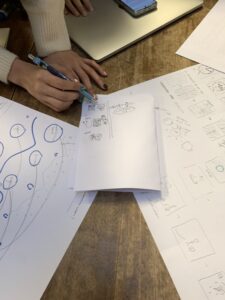
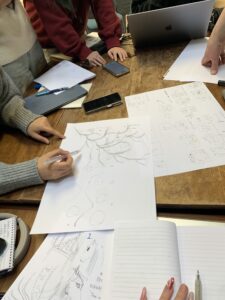
MINUTES: 04/02/2025 – First workshop with Dave ideation -> conception -> output

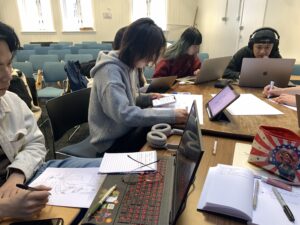
We first went to the wrong room, once we found each other, we moved some tables around to make a good thinking environment.

Dave gave us creative challenges on the concept of time:

  1. How could you visually represent sayings about time?
  2. How to visually represent different moments in our own life?
  3. How to visually represent the passage/experience of someone else’s time?
  4. Discussion: brainstorm and develop ideas

During the challenges I made some random observations:

  • 3 out of 7 used sound -> during our discussion I realised it was actually 2 out of 7
  • 3 out of 7 using pen and paper +1 if you count Dave
  • 7 out of 7 were silent
  • 6 sheets of paper were used in total
  • 5 laptops were open
  • 1 tablet was being used
  • 1 sound deck
  • 1 hour passed during the challenges
  • 2 sets of headphones were used, but 3 sets were brought

Outcomes: some of us used these to create whole concepts for the project

  • Task 1:
    • Caitlin:
      Very literal interpretation of the challenge. I drew little clock figures and knives, all sorts to literally represent the sayings. One thing I drew was similar to Yanis, I had drawn one saying like a pulse. 
    • Yanis:
      Very deep and philosophical take on the sayings. He also used Chinese sayings and tried to represent those. One thing he thought about was about how water has memory; all memories can flow down into a single droplet of water and once it drops, that represents the end of life, just done in a blink. 
    • Lulu:
      She used a Chinese saying that was about how people die, but objects live on. She drew some cute illustrations of a teddy bear and a person growing up until death, with the teddy bear staying intact. We talked about this a little bit about how time can move around an object and how they perceive life much slower than the world around them. 
    • Shuzhang:
      She combined task one and two and made a soundscape (?) about how time flies. It involved sounds that reminded her of her childhood, but also had elements like time ticking in the background. 
    • Jackson:
      He also made a soundscape about the saying time flies. He talked about how childhood passes by quickly but now feels like hazy memories to him. His sound included a high-pitched ringing sound that almost felt like it was trying to snap the listener out of the memory. This prompted us to talk about how memories can be tied to music and can transport us back to the moment that we associate it with. 
    • Dave:
      He also took things literally. I don’t remember the sayings he used, but I remember he made drawings of how the flow of time felt. He showed this through dots and lines, and an hourglass. The most interesting though was a drawing of a film roll with mechanical hands grabbing a memory to show. It was an interesting visual to see and got us thinking about the endless possibilities with this topic. 
  • Task 2:
    • Shuzhang:
      She made a sound that reminded her of her hometown and the typical sounds that she grew up hearing, and she felt were only found there. 
    • Lulu:
      She talked about shared generational objects to represent life stages. For example, she drew a small paper folding game and (I think) a certain TV show that are representative of the childhood of Chinese people of her generation. It made us think about culturally shared memories. 
    • Yanis:
      He talked about a stand-out memory from childhood involving a plane ride. He remembers the music and colours, and other sounds that were present then. He said that even though, at the time, it wasn’t a particularly interesting experience, he will still remember it to this day when he hears the familiar music/sound and that it has almost become a bitter memory. 
    • Caitlin:
      I thought about my life on the same type of day and the feeling of emotions over time. I used the first day of primary and secondary school, undergraduate and postgraduate. I found that for each event, my emotions became more complex, but the time felt shorter. I drew lines like a pulse for each emotion and then how the speed of time felt. It ended up looking like mountains
  • Task 3:
    • Lulu:
      She talked about a girl with cancer who recently passed. Soon before she passed, people all over the world rallied to fulfill her ultimate wish; to appear as an animated character alongside her favourite animated characters. Lulu talked about how even though she isn’t physically with us anymore, her digital representation will live on in that space. 
    • Caitlin:
      I talked about mountains. The previous tasks inspired me to think about how objects, or in this case mountains, experience time. A place like Arthur’s Seat will have seen so much already but will “personally” experience little change, and at a much slower pace. So how there is micro and macro time, and how that can be shown visually. 
    • Dave:
      He talked about loss and fleeting images combined with music. He talked more about how music can bring up memories, for example in people with alzheimers and how it’s often the last thing they can actually tie memories to. He played some work, by an artist whose name I don’t remember, that dealt with this phenomenon. He created a song that sounded like an old record player playing in an empty ballroom. The music felt nostalgic, empty and dusty almost. It was interesting to hear as it got us thinking about the way music was used here. 
    • Yanis:
      He thought about how 1 minute passes differently for everyone. He referred back to the exercise Jules made the whole class do last week, where he asked everyone to put their hand up when we thought a minute had passed. He thought about how we all had a different perception of this same amount of time, but that machines for example will get it on the dot right, but there’s no thought behind it; it’s cold and meaningless.


  • Discussion:

We talked about our ideas a bit, and tried to organise them into categories to make some sense of them. I put them on the white board that was standing next to our table. 

The overarching theme that naturally appeared was the passage of time. The categories we ended up with were memories, the length of time, flow, sensory triggers, and landscape. We then added the sub-topics to each of these e.g., life stages, music, micro vs macro, pulse, objects, cultural, etc. David asked us each to point out our favourite things on the white board. I assigned everyone a different little symbol to have a clear view (Caitlin = star, Yanis = dot, Hasse = cross, Lulu = heart, Shuzhang = flower, Jackson = triangle). The most popular options ended up being:
(CULTURAL) MEMORIES + FLOW OF TIME + MUSIC
From this we tried making some connections. One option that came up was looking at the passage of a small time frame (perhaps a minute or so) per life stage, and represent a prevalent emotion from that life stage. Take childhood for example; you’re at school, full of curiosity and excitement, how would a minute feel to them compared to someone in their 20s working. We liked this but decided to do some more research into our 3 main topics relating to our overarching theme.

To do:

  • Research our overarching theme and three topics

MINUTES: 02/02/2025 – Team meeting to discuss output – 10am on a Sunday

LuLu idea: touching interactive wall

  • Touch designer
  • Arduino + Bare Conductive + Maxmsp
  • Projector

-> What if objects and light were used?

-> Excited about the idea

-> Use in combination with Yanis’ idea

Yanis idea:

Before you die, you may have a brief moment to think about all the happy clips in your life. I wondered whether we could represent these memories in images from a non-human perspective, just as our memories of the past are often from the perspective of a third person perspective. Like the perspective of a pet, a camera, a toy, a plant, or a speck of dust. And the images from these perspectives are fuzzy and incomplete, but very atmospheric, like our memories. In our installation, these images and sounds flicker rapidly and chaotically on the surrounding, light and color change rapidly within the installation, and after a minute return to darkness and silence. In my imagination, it is composed of all kinds of human voices, sounds of nature, sounds of the city, sounds of daily housework, and gradually exciting music. Just some ideas and imagination)

How do we feel?
Happy to have our idea, excited that it matches up and makes us excited to make the output and go through the process. We finished the meeting chatting a bit about last semester and the sound designers’ projects (which dealt with perception), also Hasse and Shuzhang played the piano a bit. We also discussed our team roles 😀

Yanis = Visual Director

LuLu = Project Manager

Caitlin = Note Taker/Visual + Interaction

Hasse = Interaction Director 

Shuzhang = Sound Design

Jackson = Sound Design

Fraser = TBD

To do:

  • Exhibition
  • Inspiration visual
  • Research
  • Learn about technology


css.php

Report this page

To report inappropriate content on this page, please use the form below. Upon receiving your report, we will be in touch as per the Take Down Policy of the service.

Please note that personal data collected through this form is used and stored for the purposes of processing this report and communication with you.

If you are unable to report a concern about content via this form please contact the Service Owner.

Please enter an email address you wish to be contacted on. Please describe the unacceptable content in sufficient detail to allow us to locate it, and why you consider it to be unacceptable.
By submitting this report, you accept that it is accurate and that fraudulent or nuisance complaints may result in action by the University.

  Cancel