Any views expressed within media held on this service are those of the contributors, should not be taken as approved or endorsed by the University, and do not necessarily reflect the views of the University in respect of any particular issue.

Summary of past 2 meetings

Meeting Notes:

Dates: 28th and 29th of February

1. Venue Selection:
– Consensus reached on utilizing the atrium at Alison House for the Mycelium Network experience.

2. Lighting Selection:
– Deliberation on using diode lights for the immersive experience.

3. Mother Mushroom Sensor and Node Aesthetics:
– The decision to retain the mother mushroom concept due to its efficiency with only one sensor.
– Exploring materials suitable for the stem’s flexibility and stability.

4. Node Aesthetics:
– Agreement on adopting a less realistic aesthetic, favouring an artistic approach such as paper lanterns for the nodes.

5. Visualization of Signaling Complexity:
– Brainstorming methods to represent various signalling types:
1. Stress signals
2. Food signals
3. Symbiotic relationships with other plants

6. Project Timeline:
– Acknowledgment of the five-week timeframe and the necessity for a detailed plan to ensure project completion. Therefore, we assigned roles:

  • Joe: produce sound examples for next week.
  • Agnes: design UX and visual of the exhibit after what was discussed.
  • Shirin: experiment with materials to bring to life the M5 stick mushroom.

Next Meeting: Wednesday 6th of March

Plan:

  • Choose exhibition hours and book it.
  • Get LEDs and try them out.
  • Look into booking a soldering workshop.


Prototyping – M5 stick and Max workshop with prof. Jules Rawlinson

Workshop on M5 and Max Usage: Mon Feb 12

During the workshop, it was discussed that the Arduino sketch retrieves various data bits from the device and transmits a message with an address, enabling the M5 stick to receive these values. The patch for submission 1 (due tomorrow) is nearly complete, requiring some adjustments and debugging.

Professor Jules outlined the following tasks:

    1. Address the high activity level of the M5 stick by implementing data smoothing.
    2. Develop a calibration routine to instruct Max on the usable range of the stick.

Fixes and Notes:

  • The gyro and accelerometer data are grouped, resulting in reduced activity.
  • The M5 stick oscillates between 0 and 90 and back to 0 degrees instead of 180.
  • To smooth the data, utilize sliding parameters (e.g., “slide 10 10”). However, for improved effectiveness, adjust to “slide 50 50” to obtain an average and stabilize the readings. Despite expectations, using smaller sliding numbers twice provides better filtering.
      • Ensure that the data types are specified as floats.
  • For scaling, designate numbers within the range of -90 to +90 degrees (e.g., “scale -90.90.0.1”). This instruction prompts the program to obtain values between 0 and 1, simplifying the scaling process.

    Patching the ‘data filtering’.
  • Given the intention to apply double sliding and scaling to other project components, this procedure will be patched. So if there needs to be a change it will update in all the places.
  • Developed a basic soundwave oscillator to input pitch data into the program.
      • When working with pitch, add 440 to achieve a final value of 220 at 440 if it’s halved.
  • After the initial motion-sound testing: The outcome indicates a lack of smoothness in the generated sound; the pitch fluctuates abruptly, stepping up and down.
  • For light, on Max, we would set which numbers equal ‘neutral’ blue or ‘disturbed’ red.

Research – Mycological Genetics and Signaling Pathways


This research aims to further understand how and why mycelium communicates.

  1. Cell-to-Cell Communication: Filamentous fungi exhibit complex cell-to-cell communication and fusion processes. Molecular and genetic mechanisms mediate interactions between Ascomycete cells, facilitating intricate communication and fusion events within the fungal network (Pierre-Louis Alaux et al., 2020).
  2. Conscious Patterns: Fungal mycelia display decision-making abilities and modify their developmental patterns in response to interactions with other organisms. This indicates a level of consciousness or responsiveness within the mycelium network, showcasing its adaptability and dynamic nature (Money, 2021).
  3. Calcium Signaling: Studies reveal that mycelial networks transmit information through local calcium signals. Visualization techniques identify downstream effects, providing insights into the signalling mechanisms within the fungal network (Itani et al., 2023).
    Many fungi live as mycelia, which are networks of hyphae. Mycelial networks are suited for the widespread distribution of nutrients and water. The logistical capabilities are critical for the extension of fungal survival areas, nutrient cycling in ecosystems, mycorrhizal symbioses, and virulence (Itani et al., 2023).
  4. Interplant Communication for Risk Prevention: Common Mycorrhizal Networks (CMN) in arbuscular mycorrhizal fungi establish channels for interplant communication. Plants connected by CMN can communicate and prepare for various environmental challenges, such as aphid attacks (Pierre-Louis Alaux et al., 2020)(Zdenka Babikova et al., 2013).

Conclusion:

Communication within mycelium occurs as a means of mitigating environmental risks, facilitating nutrient exchange, coordinating virulence factors, fostering symbiotic relationships, and ultimately, fostering adaptation to maintain ecological equilibrium.

Sources:

  • Itani, A., Shunsuke Masuo, Yamamoto, R., Serizawa, T., Fukasawa, Y., Naoki Takaya, Toyota, M., Shigeyuki Betsuyaku and Takeshita, N. (2023). Local calcium signal transmission in mycelial network exhibits decentralized stress responses. PNAS nexus, [online] 2(3). doi:https://doi.org/10.1093/pnasnexus/pgad012.
  • Money, N.P. (2021). Hyphal and mycelial consciousness: the concept of the fungal mind. Fungal Biology, [online] 125(4), pp.257–259. doi:https://doi.org/10.1016/j.funbio.2021.02.001.
  • Pierre-Louis Alaux, Françoise Naveau, Declerck, S. and Cranenbrouck, S. (2020). Common Mycorrhizal Network Induced JA/ET Genes Expression in Healthy Potato Plants Connected to Potato Plants Infected by Phytophthora infestans. Frontiers in Plant Science, [online] 11. doi:https://doi.org/10.3389/fpls.2020.00602.
  • Zdenka Babikova, Gilbert, L., Toby, Birkett, M., Caulfield, J.C., Woodcock, C., Pickett, J.A. and Johnson, D. (2013). Underground signals carried through common mycelial networks warn neighbouring plants of aphid attack. Ecology Letters, [online] 16(7), pp.835–843. doi:https://doi.org/10.1111/ele.12115.

Design – Concept Art and Diagram of Installation

Wed Feb 7 Meeting outcome

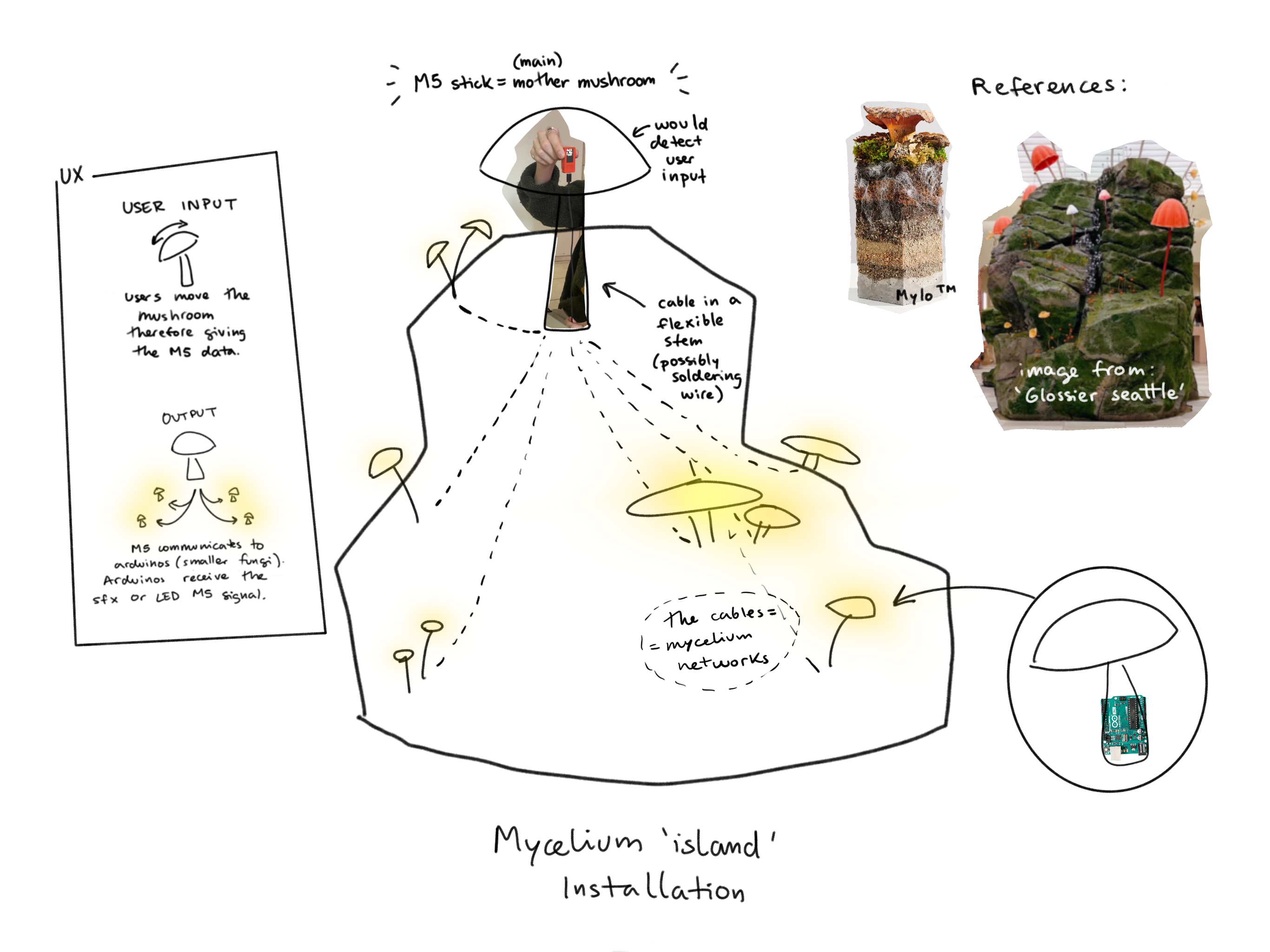
We have conceived a physical installation centred around an M5 Stick (sensor) and Arduino framework. Illustrated in the diagram below is how this tangible ‘island’ embodies the intricate signalling network of mycelium, each element communicating with others following user interaction with the piece.

At the structure’s apex resides the “mother” or main mushroom housing the M5 Stick. This component has been meticulously programmed to emit signals to the Arduinos upon detecting movement. With each input detected, a distinct sound resonates, accompanied by an illuminating display of light. The remaining fungi, each housing an Arduino, respond by emitting the same sound, symbolizing the transmission of information akin to the researched ‘language of the mushrooms’ – a method of communication observed in natural ecosystems to relay strategies for risk prevention.

While still in the brainstorming phase regarding materials, we envision utilizing flexible wires for the stems, allowing for a degree of bendability, while incorporating artificial moss and other naturalistic elements to evoke the ambience of a forest setting.

Diagram of the installation.

Furthermore, I have made some concept art to help with the designing phase.

Original artwork.
Monochromatic version: allows the user to focus on the signalling (lighting).


css.php

Report this page

To report inappropriate content on this page, please use the form below. Upon receiving your report, we will be in touch as per the Take Down Policy of the service.

Please note that personal data collected through this form is used and stored for the purposes of processing this report and communication with you.

If you are unable to report a concern about content via this form please contact the Service Owner.

Please enter an email address you wish to be contacted on. Please describe the unacceptable content in sufficient detail to allow us to locate it, and why you consider it to be unacceptable.
By submitting this report, you accept that it is accurate and that fraudulent or nuisance complaints may result in action by the University.

  Cancel