20/05/24
At this meeting, the following was discussed:
-
- The location where the exhibit would take place.
- The equipment needed.
- The possible interactions with the main mushroom.
- The UX for the audience.
- Possible ways to better the Max files.
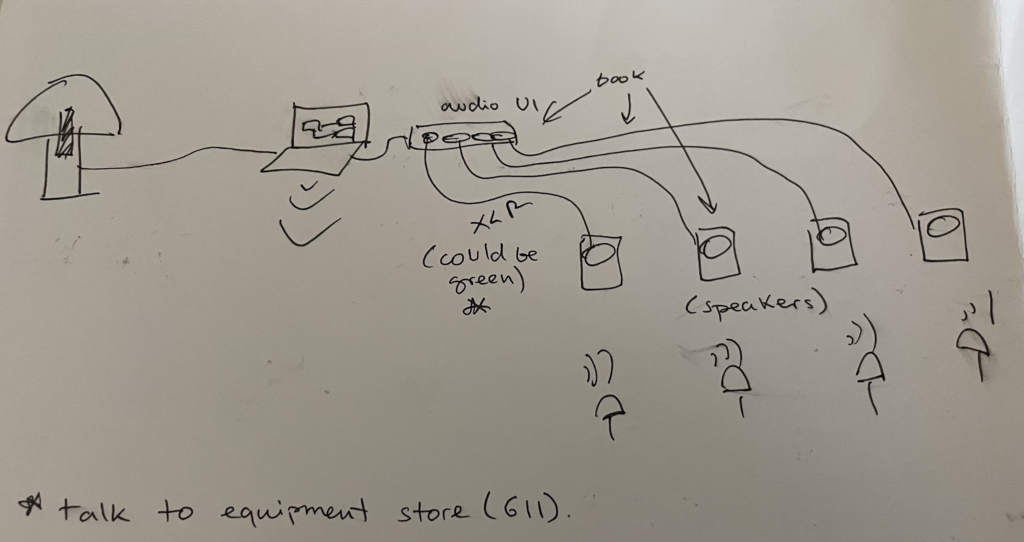
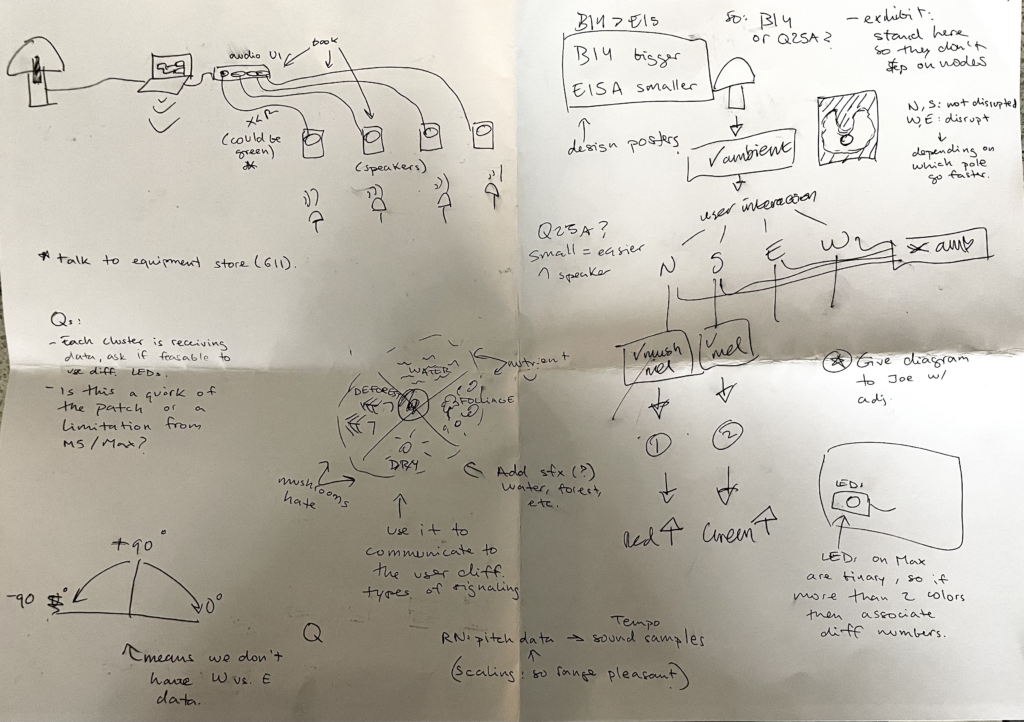
This diagram illustrates the main mushroom on the left connected to a laptop, which in turn is linked to an audio interface. Instead of relying solely on a single speaker or utilizing speakers provided by the location, the decision was made to enhance the immersive experience of the installation by employing smaller speakers, one for each node. Ideally, these speakers will be connected to the user interface using green XLR cables. This approach aims to improve users’ understanding of the correlation between light flickers and sound, as both will emanate from the same direction.
In these diagrams, the concept of establishing four distinct “extremes of interaction” was investigated. The proposal suggests that along the North to South axis (up and down), the mushroom would maintain a balanced state of interaction, whereas along the West to East axis (left to right), it would exhibit a disrupted state. This disruption could be manifested through an increase in tempo in the corresponding sound. To facilitate user comprehension of this interaction and to deepen their understanding of the installation’s themes, the idea of creating a diagram depicting four factors that fungi favour or disfavour is explored, as depicted in the right image. For instance, if a node were oriented towards the west, resembling a sunny arid landscape, it would trigger the disrupted state, while orienting it towards water would induce the opposite effect.
During our exploration of potential locations, we visited rooms B14 and E15A. Following the tour, we concluded that B14 appealed to us more due to its aesthetic, characterized by broken walls and paint that align with our desired aesthetic. However, we had reservations about the space’s isolation in the ECA building and its popularity for other student projects. Conversely, this meeting took place in the Design and Digital Media room Q25, which features a storage area at the back, making it the most suitable option for our project for several reasons. Firstly, its accessibility facilitates regular work sessions leading up to the exhibit. Consequently, we settled on Q25.A as our chosen location.
Considering the compact size of Q25.A, we deliberated on the user experience of entering the space and conceived the idea of a U-shaped installation. This layout would allow users to enter the space without needing to navigate around it, enhancing accessibility and engagement.
Furthermore, we discussed the possibility of creating mushroom clusters instead of individual nodes. However, this decision remains unresolved, as the number of nodes will depend on the quantity of M5 sticks provided by Joe Hathaway.