
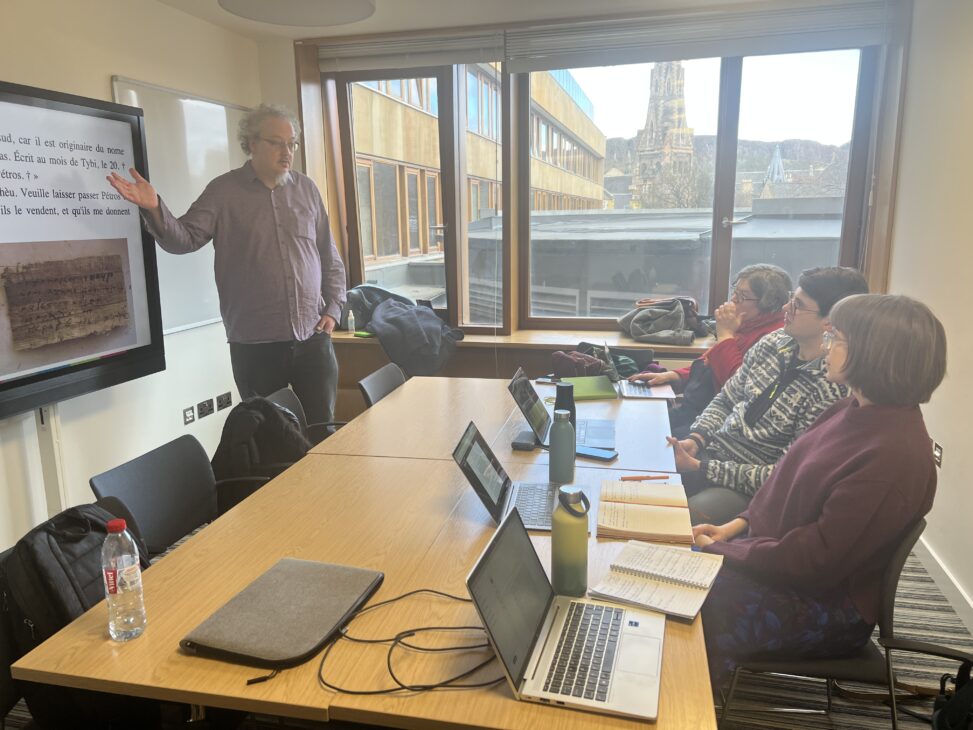
On Thursday 26th and Friday 27th February, the Caliphal Finances team had the joy and privilege of meeting Professor Alain Delattre, Coptic and Greek papyrologist and Dean of the Faculty of Literatures, Translation and Communication at the Université Libre de Bruxelles. Also present were Eline Scheerlinck, who recently left the project and is now a postdoc at Aix-Marseille Université; Sophie Kovarik, who will join the Caliphal Finances team very soon as a postdoc; PhD student Georgi Obatnin; and PI Marie Legendre.
Our discussions centred on papyri, in all three languages of the fiscal administration, from our interpretations to more technical discussions of readings and editions.
Thursday morning addressed issues concerning the language of the fiscal administration of Egypt. The discussions ranged from which fiscal documents were written in which languages at which times to the role of translation as a practice of administration and governance in early Islamic Egypt. We touched on these issues while discussing a draft of an article I (Eline) am writing. Another topic we addressed in discussing the draft was fugitives: the interest in them shown in the administrative documents of the time and how this relates to fiscal practice.
After lunch, we moved on to a more socio-economic viewpoint, discussing part of a chapter draft of Georgi’s PhD. We focused on the concept and practice of adaeration (paying kind levies in cash) as a fiscal practice in early Islamic Egypt. Georgi guided us through his argument, and we had a fruitful discussion, e.g. about the importance of intermediary actors in the fiscal and economic landscape of early Islamic Egypt.
On Friday, we had a great time examining images of various fiscal papyri, all dated between the 8th and the 11th centuries. In our morning session, we discussed various aspects of Copto-Arabic (fiscal) accounting, prompted by a fiscal accounting document in Coptic and Arabic that Marie is editing together with Jennifer Cromwell. The document can be dated to the 11th century and features many different taxes and quite large amounts of money.
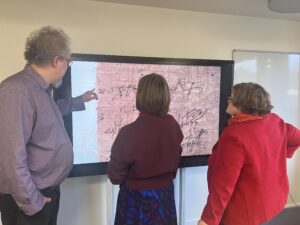
We also discussed a forthcoming edition by Alain Delattre of Coptic local travel permits kept as material for bookbinding by the 8th-century monk Frange. They were used during a short time span to pass a checkpoint near Djeme (Medinet Habu, Western Theban area). Some of these documents have an explicit fiscal link: they mention that the person carrying the permit (invariably men) needed to pass the checkpoint because of his taxes.
Boud’hors, Anne & Delattre, Alain. Papyrus et parchemins de la tombe thebaine 29. Laissez-passer et autres textes. Papyrologica Bruxellensia 45, Bruxelles: Association Égyptologique Reine Élisabeth; Leuven: Peeters, 2026 (forthcoming).
Sophie presented to us a number of Greek 8th-century fiscal papyri that she is editing from various collections. These included land surveys and other accounting documents with various fiscal units, allowing Sophie to sketch an image of the fiscal toponomy at the time.
These meetings underscored the value of close collaboration between papyrologists and historians, yielding fresh insights into fiscal language, administrative practice and socio-economic actors in early Islamic Egypt. We look forward to continuing this exchange as editions and articles progress, further illuminating the fiscal landscape from the eighth to the eleventh centuries.



Leave a Reply