


Over the past year, the Caliphal Finances team has been reading newly published works and compiling a list of publications to explore that address taxation or broader fiscal matters in Egypt primarily and in the Islamic world to a lesser extent, between the sixth and the thirteenth centuries.
This post highlights only a selection of monographs and articles—please do not hesitate to contact us if you would like us to add further references to the list. All the works mentioned below demonstrate how rich and informative documentary sources are for writing the history of taxation, regardless of the period under consideration.
Sonego, Leonora. “Annotated Bibliography “Arabic Papyrology: Taxes and Taxpayers”: New Publications 2024” Der Islam, vol. 102, no. 2, 2025, pp. 521-537.
This Annotated Bibliography offers a list of monographs, PhDs, and articles in relation to a topic at the heart of the Caliphal Finances research.
Matthias Stern, Taxes and Authority in the Late Antique Countryside. The Reach of the State and the Pagarchs of Byzantine Egypt (284-642 CE), De Gruyter, 2025.
The book is available as a free eBook.
About
How did the late Roman Empire operate in rural areas, where most of its subjects lived? The papyri from Egypt provide glimpses of state activity at the local level, how the countryside responded to it, and thus how “empire” looked on the ground. Since a major motivator for state activity at the local level was tax collection, Taxes and Authority in the Late Antique Countryside homes in on the pagarchs: key fiscal actors at the intersection between provincial, city, and village institutions from the fourth through the seventh centuries CE. The book contextualizes the pagarchs’ dealings, backgrounds, and networks from the imperial sphere to the village level, exploring topics such as tax collection procedures in the villages, central accounting and staffing in the cities, the competition of local aristocrats over the countryside, official careers, and local agency versus imperial policy. The result is an analysis of the social mechanics of the fiscal regime in a region of the imperial periphery. Exploring the abundant and diverse papyrological source material, this book offers a uniquely detailed insight into the dynamic relationship between the Roman Empire and local communities in late antiquity.
Ahmed Nabil Maghraby, Mathieu Tillier, “Arab domination and fiscal tensions in the Delta under the Marwānids: An official investigation regarding the punishment of a reluctant taxpayer”, Journal of Semitic Studies, Volume 70, Issue 1, Spring 2025, pp. 197-257,
https://doi.org/10.1093/jss/fgae043
About
From the end of the seventh century CE, Egypt was increasingly destabilised by taxpayer protests, which culminated in significant armed revolts in the following century. In this article, we present the edition, translation, and analysis of papyrus P. Utah Inv. 114 that uniquely documents an incident in the northern Delta, dating to the late seventh or the early eighth century CE. The death of a taxpayer, at the hands of a Christian official in a case of tax evasion, triggered an administrative investigation by the Arab-Muslim authorities. The resulting report not only shows how local authorities addressed cases of tax resistance, but offers new insights into the legal procedures implemented by provincial authorities. The document also allows for a better understanding of Arabic administrative terminology. Finally, it contains the earliest recorded use of the term ‘Arabs’ to refer to the group of conquerors, attributing a moral and religious significance to the term.
Alasdair Grant,”Taxation, Rebellion and Withdrawal in Early ʿAbbāsid Armenia, 754–775 CE/136–158 AH”, in H.-L. Hagemann and A. C. Grant (eds), Between Rebels and Rulers in the Early Islamicate World: Power, Contention and Identity (Edinburgh: Edinburgh University Press), 2024, pp. 167-190.
The chapter of Alasdair (read about Alasdair’s research in his Interview) is part of a volume edited by Hannah-Lena Hagemann and Alasdair C. Grant entitled Between Rebels and Rulers in the Early Islamicate World – one of the outputs of the SCORE Project, available Open Access.
About the volume:
Between Rebels and Rulers in the Early Islamicate World offers the first dedicated examination of the phenomenon of rebellion across the early Islamicate world. It combines discourse analysis with a return to long-neglected social-historical analysis in its study of contention and the ways in which it was narrated and enacted. These approaches are pursued through 14 case studies, ranging geographically from North Africa to Central Asia and chronologically from the sixth to tenth centuries CE.
These diverse examples reveal several patterns. First, rebellion operated as a normative means of negotiating power and obtaining justice. Secondly, the main constituencies of rebellion were local elites, both Muslims and non-Muslims, Arabs and members of pre-conquest societies, separately or together. Accordingly, this volume challenges the ‘othering’ of rebels found in written sources and reflected in scholarship and reframes them and their discourses as integral parts of an imperial system. And thirdly, they show how social ties provided a framework for the mobilisation of rebellious constituencies and the resolution of conflict.
Theresa Grabmaier, « When Taxes Tell Stories: A Document Cluster of Tax Registers from the Southern Fayyūm”, Der Islam, 102/2.
https://doi.org/10.1515/islam-2025-0020
Over the past few months, Theresa has been associated with the ERC Caliphal Team, sharing her expertise on the tax registers she is studying as part of her PhD.
About her article:
This article presents a preliminary description and analysis of four tax registers that form the core of a larger cluster of Arabic documents from the 9th– and 10th–century Fayyūm. The cluster was discovered in the Ägyptisches Museum und Papyrussammlung Berlin during efforts to identify document clusters within a corpus of 1,000 unpublished documents. The four tax registers mention common names and villages, indicating they were created by a local tax administration office in the southern Fayyūm. Notably, two extensive tax ledgers (P.Berl.inv. 15070; P.Berl.inv. 15069), together housing the names of approximately 400 individual taxpayers from the villages of Shidmūh, Miqrān, and possibly a third village, are of particular interest. Both ledgers emphasize the completion of payments, suggesting they reflect the lowest stage of a tax collection cycle. The taxpayers are identified in various ways, typically by name (ism) and the father’s name (nasab) or the name of the first-born son (kunya), but also by profession, origin, or even nickname. The third and fourth tax registers (P.Berl.inv. 15073; P.Berl.inv. 15081) presented here exhibit a different layout and structure, representing a later administrative step. Collectively, this cluster offers promising opportunities for investigating village social structures and various forms of kinship.
Geoffrey Khan, Arabic Documents from Medieval Nubia, Cambridge, Cambridge University Press, 2025.
The book is available in Open Access
About the book:
This volume presents an edition of a corpus of Arabic documents datable to the 11th and 12th centuries AD that were discovered by the Egypt Exploration Society at the site of the Nubian fortress Qaṣr Ibrīm (situated in the south of modern Egypt). The edition of the documents is accompanied by English translations and a detailed analysis of their contents and historical background. The documents throw new light on relations between Egypt and Nubia in the High Middle Ages, especially in the Fatimid period. They are of particular importance since previous historical studies from the perspective of Arabic sources have been almost entirely based on historiographical sources, often written a long time after the events described and distorted by tendentious points of view.
About taxes, you can look at the part entitled ‘Taxes’ and you will find additional aspects from page 34 where the author addresses the question of baqt and gift exchange.
Arezou Azad, The Warehouse of Bamiyan, Economic Life in Medieval Afghanistan, The Islamicate East: New Approaches to Texts and History, Edinburgh, Edinburgh University Press, 2026.
 About the book:
Bamiyan, in present-day Afghanistan, is famous for its giant Buddhas, but what was life like for its rural inhabitants 500 years after the Muslim conquest? The Warehouse of Bamiyanuncovers the untold history of the region’s warehouse, revealing the lives of farmers, landholders, the taxes they paid, and their role in the economy. Based on newly discovered documents studied since the late 2010s, Arezou Azad details the reconstruction of the archive and the scholarly methods used behind the scenes to read medieval documents ‘against the grain.’ The book offers a fresh perspective on the medieval eastern Islamicate lands through the lens of medieval Bamiyan, highlighting the significance of agricultural societies and shedding light on the diverse roles of rural communities often overlooked in royal narratives.
Read more about the book here: The Warehouse of Bamiyan: Q&A with Arezou Azad
Yossef Rapoport, Becoming Arab: The Formation of Arab Identity on the Medieval Middle East, Princeton, Princeton University Press, 2025-2026.
About the book:
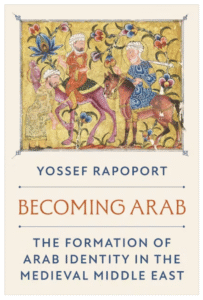 During the later Middle Ages, peasants in Egypt and Greater Syria came to view themselves as members of Arab clans that had originated in the Arabian Peninsula. They expressed their Arab identity by wearing Arab headgear, adopting an Arab dialect, and circulating a new genre of popular epic that told heroic tales of pre-Islamic Arabia. In Becoming Arab, Yossef Rapoport argues that this proliferation of Arab village clans did not come about through mass migration and displacement but reflected an internal transformation. Drawing on extensive documentary, literary, administrative, and material evidence, Rapoport shows that the widespread formation of Arab village clans in late medieval Egypt and Greater Syria was a gradual process, the result of mass rural conversion to Islam and a new landholding regime in which peasants shifted from being landowners to being tenants. After the eleventh century, Rapoport contends, Middle Eastern villagers were turning Arab.
These Arab village clans were not merely administrative regimes imposed from above; villagers enthusiastically embraced their new identities. New converts to Islam adopted Arab lineages to claim status and as a counter-identity to urban-based Turkish elites. Arab identity was used by clans to mobilize rural uprisings against the ruling sultans and to resolve disputes among villagers. Challenging traditional historiography of the Middle East, which views Arab clansmen as pastoralists whose identity separated them from that of the wider peasantry, Rapoport argues that the pervasive establishment of Arab village clans was the most important development in the history of the Middle Eastern countryside in the Islamic era.
About Taxation, read Chapter 1, Protection, Tax Collection, and Rural elites, 970-1070 (25-47)
(Banner Image credit: Gallica.bnf.fr – Bibliothèque municipale de Toulouse)


Leave a Reply