Paul Dhillon
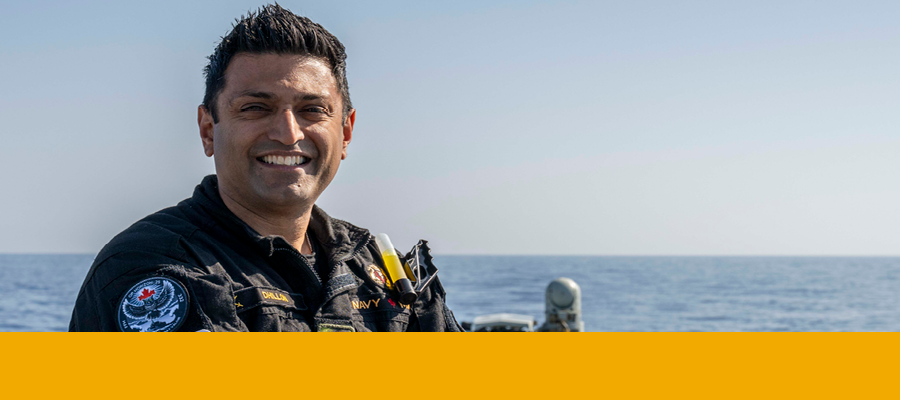
Paul divides his time between clinical work in the emergency room and leadership responsibilities in the Canadian Armed Forces. His career has been far from typical, taking him – among other places – aboard the HMCS Ville de Québec and to Sierra Leone during the Ebola outbreak.
Name: Dr Paul Dhillon
Degree course: Postgraduate Certificate in Surgical Sciences
Year of graduation: 2010
At the moment
What is your current role, and how did you get there?
My current professional life is a mosaic of clinical medicine, military leadership, and medical education. Currently, I serve as the Brigade Surgeon for 39 Canadian Brigade Group (CBG) and work as an emergency room physician in British Columbia. My fascination with aviation also led me to become a Civil Aviation Medical Examiner, where I work with pilots from Air Canada.
My path has been anything but linear. It began with a foundational interest in emergency and disaster medicine, which naturally evolved into a career in the Canadian Armed Forces. Most recently, this journey took me overseas on Operation Horizon aboard the HMCS Ville de Québec. We operated alongside the UK’s HMS Prince of Wales aircraft carrier, navigating through the Suez Canal — a high-tempo deployment that tested every facet of my medical and leadership training.
Parallel to my clinical and military work, I co-founded The Review Course in Family Medicine and the Vital FM (Family Medicine) Update. What started as a goal to improve exam preparation has grown into a leading provider of medical education for family physicians across Canada. Reaching this point required a willingness to embrace “niche” fields — tropical medicine, disaster response, and rural ER — while maintaining a commitment to teaching the next generation of doctors.
What inspired your interest in this field?
My interest in medicine was never just about the clinic; it was about the application of medicine in austere and high-stakes environments. I have always been drawn to the “frontiers” of the profession. Whether it’s the immediate pressure of a rural emergency room or the logistical complexity of a naval deployment, I am inspired by the challenge of providing high-quality care when resources are limited and the environment is unpredictable.
The military aspect of my career was inspired by a desire for service and the unique camaraderie found in uniform. There is a profound sense of purpose in ensuring our members are medically fit for the rigors of global operations. This same drive for excellence inspired the educational side of my career. I realised that family physicians are the backbone of the Canadian healthcare system, yet they often lack concise, high-yield updates that respect their busy schedules.
Seeing the impact of The Review Course — knowing we are helping thousands of colleagues stay current and confident — is incredibly rewarding. Ultimately, I am fueled by variety; transitioning from the deck of a frigate in the Red Sea to a quiet aviation medical exam, and then to a lecture hall, keeps my passion for medicine vibrant and evolving.
Career journey
What were some key milestones in your career journey?
My career has been defined by a commitment to service and medical excellence in challenging environments. A foundational milestone was joining the Canadian Armed Forces as a Medical Officer, where I have served in various capacities including as a Captain with the 13 (BC) Field Ambulance and currently as the Brigade Surgeon for the 39 Canadian Brigade Group. This path has allowed me to integrate clinical expertise with operational leadership on a global scale.
Two other significant milestones include:
- Co-founding The Review Course in Family Medicine
In 2015, I co-founded this initiative, which has grown into Canada’s leading provider of medical education for family physicians. Serving as the Chief Educational Officer, I have helped thousands of colleagues prepare for their board examinations through high-yield, nationwide courses.
- Humanitarian Service during the Ebola Outbreak
In early 2015, I served as a doctor with Save the Children UK at the Kerry Town Ebola Treatment Centre in Sierra Leone. This experience in a high-stakes, resource-limited setting solidified my dedication to humanitarian healthcare and disaster medicine.
How did your time at the University shape your professional path?
After medical school and an internship in Ireland, I was looking for a way to start my postgraduate training while still working. I found the Surgical Sciences programme offered online by the University of Edinburgh and the Royal College of Surgeons.
At the time, I was impressed by how efficient the online system was; the communication was quick, and the digital platform felt seamless. This remained true even when I had to travel to Edinburgh for my exams. While those trips from Ireland were definitely stressful, I have great memories of the relief that came after finishing an assessment. I would walk out onto the cobbled streets, find the nearest Indian restaurant for a meal, and then head to a pub to decompress and talk through the exam’s challenges with my classmates.
The University of Edinburgh provided a pivotal turning point by offering a Certificate in Surgical Science through a collaborative online distance learning programme. This flexible format was instrumental; it allowed me to maintain my clinical commitments while gaining specialised knowledge that was globally recognised.
This ability to study overseas — both virtually and in person — opened doors to international opportunities that would have otherwise been inaccessible. The academic rigor of the programme, combined with the convenience of online delivery, fostered a mindset of lifelong, borderless learning. It directly led to further in-person opportunities, such as pursuing my European Masters in Disaster Medicine in Italy and Belgium. Ultimately, this educational foundation gave me the confidence to accept diverse roles — from rural ER (Emergency Room) shifts in Saskatchewan to naval deployments — knowing I had a robust, internationally-informed medical perspective.
It’s been a rewarding journey from those early days. Recently, I returned to Edinburgh to be inducted as a Fellow of the Faculty of Remote, Rural and Humanitarian Healthcare, which felt like a natural full circle from where I started my training.
Can you share a standout achievement or moment you’re proud of?
One of the most profound honours of my career is serving as the Chief Medical Officer for the Invictus Games 2025 Vancouver-Whistler. Leading the medical team for this international multi-sport event is a unique opportunity to support wounded, injured, and sick service personnel and veterans from around the world.
In this role, I am responsible for overseeing the comprehensive medical strategy to ensure the safety and well-being of hundreds of competitors navigating the Games’ first-ever winter edition. This achievement stands out because it perfectly bridges my dual worlds of military service and sports medicine, allowing me to give back to the veteran community while managing the complex logistical and clinical requirements of a world-class athletic competition. It is a privilege to play a part in a movement that uses the power of sport to inspire recovery and support rehabilitation on a global stage.
Industry insights
What are the biggest challenges and opportunities in your field right now?
The most significant challenge and opportunity lies in preserving the “human” in medicine as technology accelerates. In an era of rapid digitisation, the ability to remain deeply empathetic, to reflect on the complexities of the human condition, and to communicate the nuances of life and death is more critical than ever. We have a unique opportunity to use technology to handle data, freeing us to focus on the essential, irreplaceable task of connecting with patients during their most vulnerable moments.
Alumni wisdom
What do you wish you had known at the start of your career?
I spent years collecting letters after my name and diplomas from across the globe, thinking excellence was found in the ink of a textbook. I wish I had known sooner that the words you study are merely the entry fee; the real currency is the people you meet. Whether it’s a colleague in a Sierra Leone treatment centre or a sailor on a frigate in the Suez, the relationships and shared experiences define a career far more than any curriculum ever could. The network is the knowledge.
What advice would you give to students or alumni looking to enter your field?
Medicine, especially in the fringes and the front lines, is less about the answers you have and more about the grace with which you handle not having them. My advice? Be relentlessly humble. The moment you think you’ve mastered the variables of a trauma bay or a deployment, the world will correct you. Ask the questions no one else is asking. And when the weight of the human condition or the bureaucracy of the machine becomes too much to parse, don’t over-analyse. Simply find a quiet corner, have another pint, and remember that you are a human first and a clinician second.
Are there any books, podcasts, or resources that have influenced you?
I have found more utility in ancient porch-talk and pub-nights than in modern medical journals. Stoic philosophy — the works of Marcus Aurelius and Epictetus — has been my primary compass. In the chaos of an emergency room or the uncertainty of a military operation, Stoicism teaches you to distinguish between what you can control and what you must endure. It provides a necessary emotional distance, not out of coldness, but out of a practical need for clarity. It turns obstacles into the path itself, which is a useful trick when the path is frequently on fire.
All opinions expressed in this article are those of the individual and do not necessarily reflect those of the University of Edinburgh.
The University of Edinburgh is not responsible for the content and functionality of any linked external websites and nor does a link imply any endorsement.