María Fernanda Souza
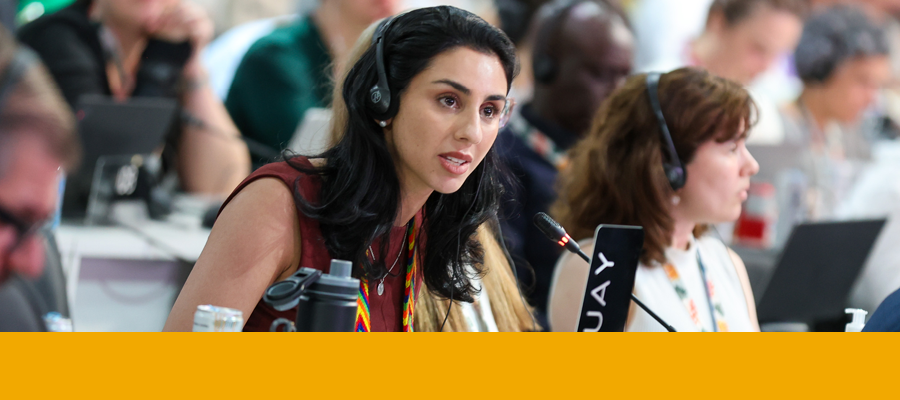
Studying at the University of Edinburgh helped María find her voice and broaden her perspective on climate issues. She’s now a leading figure in Latin America’s climate diplomacy, serving as Uruguay’s National Director for Climate Change while still drawing on her Edinburgh experience.
Name: María Fernanda Souza
Degree course: MSc Global Environment, Politics and Society
Year of graduation: 2022
At the moment
What is your current role, and how did you get there?
I serve as Uruguay’s National Director for Climate Change, a role that brings together diplomacy, public policy and a deep sense of responsibility toward the people and territories that shaped my understanding of environmental justice. I arrived here through a path rooted in public service and in years of listening to the realities of rural workers, rice-producing communities and families whose daily lives reveal the frontlines of the climate crisis. Those early experiences taught me that climate policy is not an abstract arena, but a question of dignity, work and the right to remain on one’s land. Later, in the government of Montevideo, I worked on environmental governance and institutional coordination during a complex political period, learning how climate decisions are navigated amid competing priorities and institutional pressures. A defining chapter came when I served as adviser to Ricardo Perez Manrique, President of the Inter-American Court of Human Rights. Working on the La Oroya case and coordinating Uruguay’s contribution to the Montevideo request for an Advisory Opinion on the Climate Emergency deepened my sense of responsibility toward the region. My postgraduate studies at the University of Edinburgh consolidated the analytical foundation I carry into policymaking. These experiences – territory, institutions, jurisprudence, diplomacy – converged in my appointment as National Director in 2025.
I studied for an MSc in Global Environment, Politics and Society at the University of Edinburgh, a programme that reshaped the way I understood power, inequality and the climate crisis. Edinburgh offered not only academic rigour but also a space where discussions on politics, ethics and science intertwined naturally. Immersed in a highly international community, I learned to see climate governance through the lens of global asymmetries, yet with deep respect for the knowledge that comes from local experience. This combination of intellectual depth and cultural diversity strengthened my analytical tools and grounded my conviction that solutions must be both scientifically sound and socially just. It was an environment that sharpened my voice, expanded my horizons and taught me to negotiate ideas firmly yet respectfully – skills I carry with me in diplomatic rooms and national policy spaces alike.
What inspired your interest in this field?
My interest in climate action did not emerge from a single moment but from years of witnessing how environmental change shapes daily life in vulnerable communities. Growing up with close ties to rural areas, I saw how droughts, heat waves and shifting seasons altered work, land and opportunities. Later, working directly with rural families and agricultural workers, I understood the depth of the inequality that climate impacts intensify. These experiences revealed how essential strong public institutions are for protecting people and ensuring dignity. Over time, climate governance became, for me, not only a technical or environmental matter but a profound ethical responsibility – one rooted in justice, rights and the long histories of our region.
Career journey
What were some key milestones in your career journey?
Some milestones stand out as pivotal in shaping my trajectory. Working closely with rural and agricultural communities grounded my understanding of vulnerability not as an abstraction but as a lived reality. Serving as adviser to the President of the Inter-American Court of Human Rights deepened my awareness of environmental harm as structural inequality, especially while working on the La Oroya case. Coordinating Uruguay’s participation in the Montevideo Advisory Opinion request allowed me to help bring a regional voice into global climate jurisprudence. My postgraduate studies at the University of Edinburgh strengthened my analytical perspective on governance and justice. Serving on the Board of the Green Climate Fund later expanded my engagement with global climate finance and the particular challenges faced by the Global South. Representing Uruguay in the United Nations Framework Convention on Climate Change (UNFCCC) finally brought all these threads together – territory, law, diplomacy and public service.
How did your time at the University shape your professional path?
Edinburgh offered me the intellectual space to interrogate climate governance through political, economic and scientific lenses. The programme demanded discipline and nuance, encouraging me to bridge theory with the realities faced by communities and states. Being part of a globally diverse academic environment exposed me to perspectives from regions carrying heavy climate burdens, and reinforced my conviction that global policies must respect the voices and needs of the Global South. Edinburgh refined my ability to negotiate ideas, articulate evidence and move between technical and political conversations. These skills have been essential in diplomatic rooms, national planning processes and moments of institutional tension, where clarity and empathy make all the difference.
Can you share a standout achievement or moment you’re proud of?
One moment I am particularly proud of is leading Uruguay’s delegation during a demanding negotiation cycle where adaptation indicators were central for developing countries. The process required long hours, technical precision and the ability to remain firm while building bridges where possible. I am also proud of contributing to Uruguay’s long-term resilience planning and to the development of the sustainability-linked sovereign bond tied to adaptation outcomes – an innovative step linking policy, finance and measurable impact. These experiences reflect what I value most: combining evidence and diplomacy to create outcomes that serve people and honour the responsibilities of public service.
Industry insights
What are the biggest challenges and opportunities in your field right now?
One of the greatest challenges is the widening gap between the urgency of climate impacts and the resources available to respond – particularly in the Global South. Yet within this challenge lies an opportunity: strengthening adaptation finance, building institutional capacity and advancing policies that protect communities while respecting ecological limits. The work ahead is demanding, but it holds the possibility of reshaping development models toward greater resilience and justice.
What trends or innovations are shaping the future of your industry?
Several trends are transforming climate policy. Adaptation metrics and indicators are becoming essential tools for planning and accountability. Climate-aligned finance is expanding, offering new instruments that reward resilience outcomes rather than promises. Just transition frameworks are gaining strength as countries recognise the need to pair climate ambition with social protection. These innovations open new doors for developing countries seeking fairer pathways to long-term resilience.
Alumni wisdom
What do you wish you had known at the start of your career?
I wish I had understood earlier the importance of continuity and persistence. Climate governance advances slowly, often unevenly, and it requires patience as much as technical skill. What truly shapes long-term change is a combination of strong relationships, institutional memory and the ability to stay focused on the broader horizon even when daily work feels fragmented.
What advice would you give to students or alumni looking to enter your field?
When navigating complex decisions in this field, I have learned that clarity rarely arrives as absolute certainty. It tends to come quietly, as alignment between our values, our experience and the communities that shaped us. My advice is not to expect perfect answers at every step, but to remain close to the purpose that brought you to this work. When doubts appear, returning to your roots—your stories, your territory, your sense of justice – often restores perspective. Climate governance can be overwhelming, but integrity, patience and connection make the work more sustainable. Hold on to what grounds you, listen deeply and trust that when your choices reflect who you are, the path reveals itself.
Are there any books, podcasts, or resources that have influenced you?
Latin American literature has profoundly shaped my understanding of extractivism, inequality and territory. Waslala by Gioconda Belli, Nicaragua tan violentamente dulce by Julio Cortázar and Las venas abiertas de América Latina by Eduardo Galeano have influenced how I interpret our region’s histories and struggles. The work of Maristella Svampa on neoextractivism and Pedagogía del oprimido by Paulo Freire guide my thinking about resistance, agency and collective action. Podcasts such as Humo and Radio Ambulante weave climate politics with memory and everyday life, grounding the abstract in the deeply human.
All opinions expressed in this article are those of the individual and do not necessarily reflect those of the University of Edinburgh.
The University of Edinburgh is not responsible for the content and functionality of any linked external websites and nor does a link imply any endorsement.