Any views expressed within media held on this service are those of the contributors, should not be taken as approved or endorsed by the University, and do not necessarily reflect the views of the University in respect of any particular issue.
Skip to content

Neon sign on a brick wall. Letters spell out: This is the sign you’ve been looking for.
Photo by Austin Chan on Unsplash

In our third and final post about the LILAC conference (you can find part one here and part two here) I wanted to touch on the topic of becoming better teachers. Although there was so much to take in from the conference – as you’ll have read from Ruth and Christine’s posts – one of the most impactful things I learned from the sessions was that the work we do is so important and impactful on our students, and it’s in all of our best interests that we consider that we have a powerful role to play in teaching.

The session I attended on the topic of Students, academic reading and information literacy in a time of COVID really reminded me that there can be a marked difference in the information we think our students want, and what they actually want. The panellists explored the results of the Academic Reading Format Information Study (D Mizrachi, 2021) which shows that over 70% of students prefer to use print books for academic study, with only 8.7% preferring ebooks. A later examination of student trends during the pandemic showed that 73% of students who responded in the US would not complete all their prescribed readings for their course due to their availability online. These results surprised and somewhat concerned us, particularly as many institutions operate on an e-first policy for library acquisitions now. If students don’t want ebooks, are we doing them a disservice by putting such emphasis on online access? Do we need to communicate and provide better training in order to help make these resources more accessible? Ultimately these questions could be answered by working more directly with students and not making assumptions about what information needs they have.

There were also inspiring sessions to encourage us to continue to develop as professionals ourselves, because by allowing ourselves time to write and research and read more about developments in our profession, we not only share the student experience with those we teach but we also develop better praxis for ourselves. All three of our academic support librarian delegates attended the Getting Your Writing Groove Back workshop run by the Journal of Information Literacy representatives, and I think all of us found it both fun and instructive. As a result we’ve already restarted the L&UC Journal Club, and look forward to building research and writing further into our current workplace activities in the future.
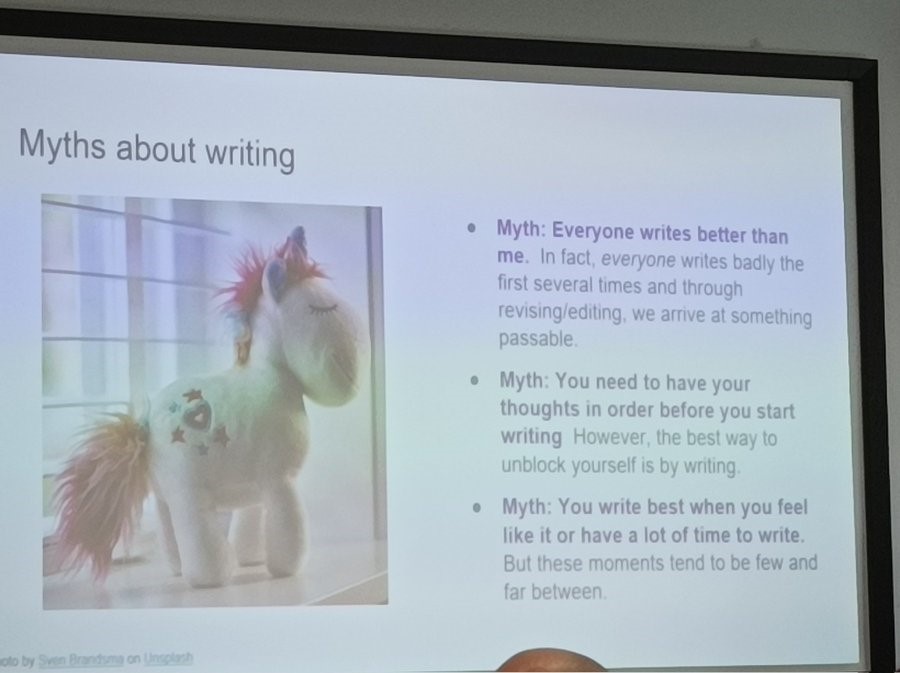
Slide from Getting Your Writing Groove Back presentation. Slide is entitled 'Myths about writing' with a picture of a stuffed unicorn on the left. Full slide content is available via the LILAC Conference website.
Slide from Getting Your Writing Groove Back presentation, by the team from the Journal of Information Literacy.

My final thought on becoming better teachers as librarians is that we need to seek out recognition of the work we’re already doing. The fact is that many library workers don’t consider themselves teachers, but by attending this conference I was able to hear many people from around the country talk about the impact their work has, and it reminded me that we’re already doing lots of this. Whether it’s creating subject guides or video demonstrations of resources, writing web content or blogs to help highlight useful databases, or directly providing instruction in front of hundreds of students, we are teachers too.

Ruth already spoke about the inspiring words of Marilyn Clarke and Emily Drabinski, but I must return to their keynotes as they both drove home the point for me. Libraries are important and library workers have influence. We must be intentional in the work we do. We have the power to affect great change in the lives of our students and our institutions, whether it’s including a range of examples in our work to help our students feel like they belong in their classes, or challenging them to find a wider variety of voices beyond their prescribed reading. We are supporting their learning and we need to recognise the power we have in order to use it to be the best teachers we can be.

SarahLouise McDonald
Academic Support Librarian

sarahlouise.mcdonald@ed.ac.uk

Geese wandering freely alongside a canal in manchester.
Geese and goslings on Rochdale canal

Last month, three of our Academic Support Librarians team attended the LILAC conference. LILAC is a conference for librarians and information professionals who teach information literacy skills, are interested in digital literacies and who want to improve the information seeking and evaluation skills of library users. You may have seen our previous post about LILAC 22 here.

Much of the conference covered issues of critical information literacy, including long and slightly intimidating words such as critical pedagogy and decolonisation, and it was great to have the space to explore what these mean.

Keynote speaker Marilyn Clarke, Director of Library Services at Goldsmiths, University of London, spoke on Decolonisation as a means to creating an equitable future.

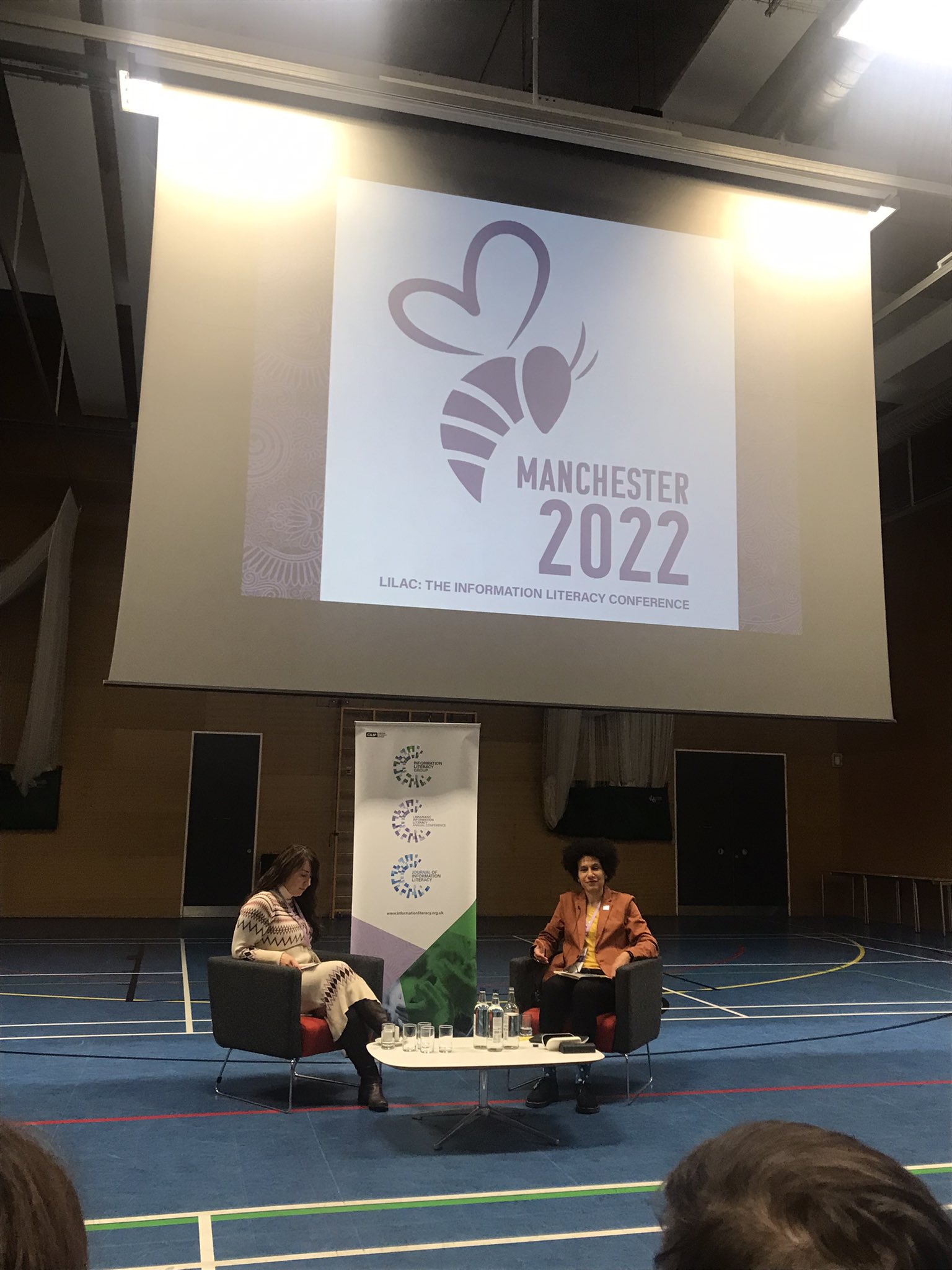
Keynote speaker Marilyn Clarke and chair Elizabeth Brookbanks sit beneath a screen with Manchester 2022 and a bee logo projected onto it.
Marilyn Clarke with discussion chair Elizabeth Brookbank at LILAC 2022.

Marilyn clarified succinctly the difference between decolonising and diversifying library collections; diversifying ≠ decolonising, we need to ask the question why are these voices underrepresented?

She highlighted fantastic work at Goldsmiths to dismantle Eurocentric structures in the library and university, including funds for the ‘Liberate My Degree’ collection set aside for student book purchase suggestions to address gaps in the library collection. At the University of Edinburgh we have the Student Request a Book service which empowers students to request purchase of books and other resources to be added to the Library collections.

When cataloguing their Zines collection, librarians gather suggestions for keywords (used as a finding aid in the catalogue) from the authors themselves, to ensure the language used is representative. This is not just about addressing race, but also other systemic oppression such as LGBTQ+ and class.

In the final keynote of the conference, Emily Drabinski, Critical Pedagogy Librarian at the Graduate Center, City University of New York, explored how information literacy can reveal and challenge structures of power, and equip our students with tools to recognise and understand power dynamics.

By power, this mean the ability to change things, do things, influence things – we all have power in different ways and different situations. As librarians who help people find, use and understand information, we need to take societal values and power structures into account.

For example, who designed this database? With whom in mind? What is included in the database and what isn’t, and who makes those decisions? That feeling, where you get no results from a search, or too many, or their wrong – that’s not you, that’s the way the system is constructed with power.

Myself, I will be doing more to incorporate discussions of power into my teaching. It’s something I do when teaching literature searching for Systematic Reviews in medicine and biomedical sciences (these aim to find and synthesise all clinical evidence on a topic), where comprehensive searches and minimising bias are a core foundation of the review methodology – and as such, knowing what is included in a database, and crucially what is excluded, is crucial. But we can introduce this criticality earlier in students’ academic careers. I am not sure yet what that will look like exactly, but it’s exciting to consider.

Ruth Jenkins, Academic Support Librarian
https://www.ed.ac.uk/information-services/help-consultancy/rm-and-consultancy/academic-support-librarians

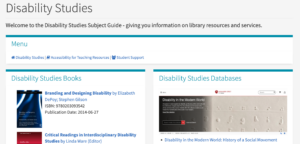
The Subject Guides are a useful tool in getting started with your research. Whether you’re an Engineer or a Classicist, they contain a wealth of information for navigating library resources, including journals, databases, and bibliographies, available to students here at the University of Edinburgh. Part of my role as Digital Engagement Intern involves reviewing and creating guides within the remit of Equity, Diversity, and Inclusion, and I’m delighted to share our newest Subject Guide in Disability Studies.

Preview of the Disability Studies Subject Guide

This guide has been created to both assist students in the academic study of Disability and highlight ways the University can support you with any additional learning needs you might have. We’ve included access information for students using the Main Library, advice on how to make your device more accessible, and details of several groups and societies for students to get involved with. As well as supporting students, we’ve also included various materials to assist staff in creating more accessible learning environments, signposting additional training and resources available at the University. 

We hope that this guide will serve as a helpful tool for students and staff to access the support that’s available by bringing these resources together in one guide that will continue to grow over time. If you have any feedback or suggestions on ways this guide can be improved, then we would love to hear from you! 

You can access the Disability Studies Subject Guide to clicking on the link or navigating to the webpage at the following URL: https://edinburgh-uk.libguides.com/disabilitystudies. 

Tristan Craig
Digital Engagement Intern (Equity, Diversity and Inclusion)

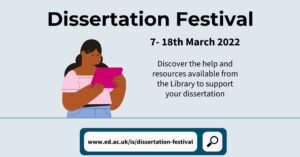
Dissertation. A word that scares and confuses many students, including me. It seems like a difficult and mysterious concept that most of us must deal with at some point on our academic journey. I have been wondering for a long time if there is any way I can make the whole experience of writing it at least a bit easier and less scary. I must admit that this year’s dissertation festival has provided me with a lot of tools and information to do just that.

During the dissertation festival, I attended three sessions: Introduction to reference managers, Improve your research skills with SAGE Research Methods, and DataLiteracy for Beginners. They were all very informative, both for students currently writing their dissertation, but also for students like me, who are only beginning to think about their dissertation now.

The first event was an overview of four reference managers. I really enjoyed the fact that the presentation did not only cover one reference manager but as many as four. This gave me a chance to get a feel of all of them and choose my favourite one (which, I must admit, has got to be EndNote). The second event covered SAGE Research Methods database, which I was not aware of before, yet I found it to be a very useful resource. The last event I attended emphasized the importance of critical thinking while dealing with various kinds of information, especially the statistics part of it.

I enjoyed all the events a lot! The only thing I would change about these, would it be their form. I prefer to attend in-person events, especially after covid ‘trauma’ that we have all experienced – it would be nice to see all the presenters and attendees offline. But well, one cannot have everything, maybe next time!

Overall, I recommend every student to attend the next edition of the dissertation festival, whether they are in their fourth, third or second year. All events provided me with great tools that I will not only use while writing my dissertation but also other coursework.

Zofia Matuszczyk
Communications Officer Intern

For over 400 years, more than 15 million men, women and children were victims of the transatlantic slave trade. And on 25th March every year, the International Day of Remembrance of the Victims of Slavery and the Transatlantic Slave Trade offers the opportunity to honour and remember those who suffered and died at the hands of the brutal slavery system, while also raising awareness about the dangers of racism and prejudice today.

At the Library we have access to a range of digital resources that give you access to original primary source material from archives around the world that allow you to find out more about the Transatlantic Slave Trade and the victims of slavery. These are a few that you might like to explore:

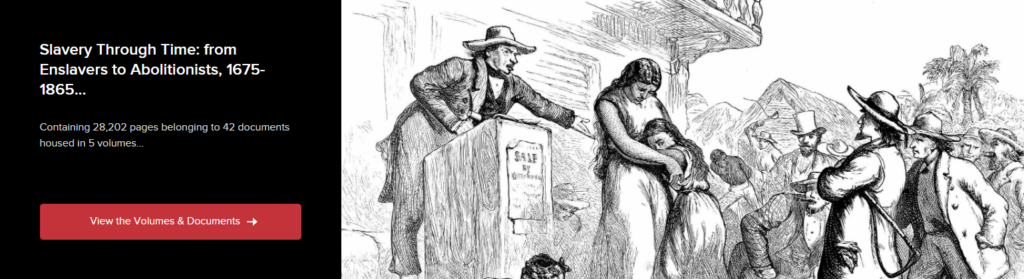
Slavery: supporters and abolitionists, 1675-1865
(also known as Slavery Through Time: from Enslavers to Abolitionists, 1675-1865)

...continue reading "The Transatlantic Slave Trade and Slavery: primary sources"

By now we hope the name LibSmart is familiar to you. Whether you've seen a slide in a presentation from an Academic Support Librarian, a page on the display screens in the library, or you're just an avid reader of this blog, we hope you know that our online information literacy course is up and running, ready for any staff or students at the University of Edinburgh to self-enrol via Learn.

You may also know that for every module you complete in LibSmart you receive a Digital Badge, issued to you by the ASL team via Badgr. We've been keeping an eye on the number of students enrolled and also the number of badges we've issued for each module, and we're starting to see some trends emerge even though it's still early in the academic year.

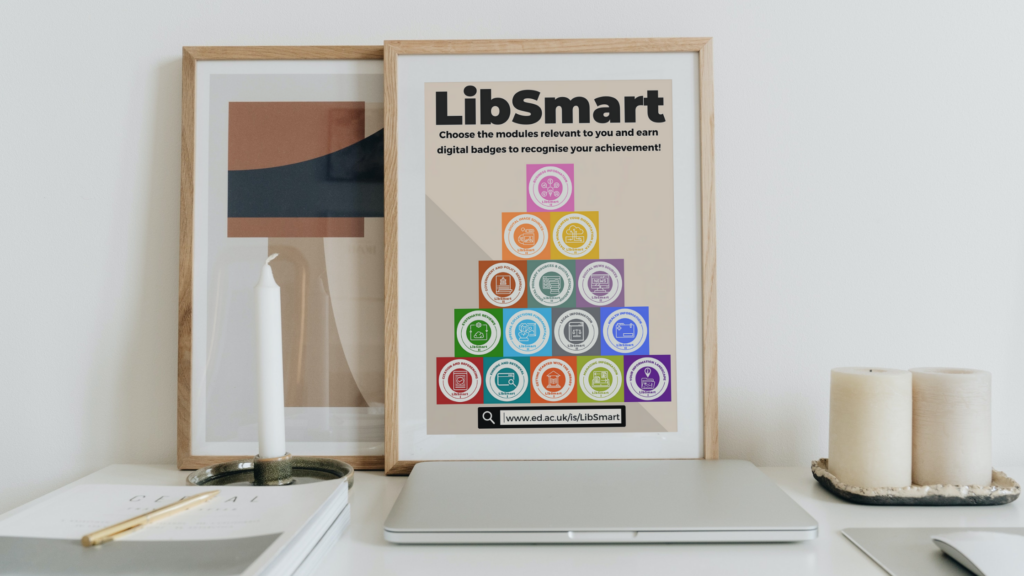
Image of all LibSmart Badges with text "Choose the modules relevant to you and earn digital badges to recognise your achievement!"
LibSmart badges

For LibSmart I, we've definitely seen the most badges issued for the first module Getting Started With The Library. This isn't a great surprise as it is the first module and therefore a logical place for people to start. We're also seeing great numbers in our Your Information Landscape module which helps students orientate themselves with the resources that are helpful for their subject area. We've also seen the most growth month-to-month in our Referencing and Plagiarism module, perhaps because we're getting close to assessment time now and people are making sure they're familiar with how to reference correctly for their assignments.

When it comes to LibSmart II, we've had a nice even spread of badges being awarded across all modules. The most popular so far has been Data mindfulness: finding and managing data for your dissertation, which shows a real appetite for assistance with dissertation and thesis work. This is great news as this is exactly what we hoped LibSmart II would do - help those at an advanced stage of study complete the big pieces of work! We've also got a three-way tie in second place for the Health Literature, Digital Images and Special Collections Fundamentals modules all having the same number of badges awarded. Because we assume these would appeal to students of quite different disciplines, it's great to see the word is getting out to different schools!

Have you had a look to see what LibSmart can offer yet? Check the website for more information, or watch our self-enrol demonstration video to help you get started.

1

Where to start?

Following on from my general tips for finding resources and navigating the online library, this blog post will cover why you should check out Subject Guides, and highlights some resources, old and new, that you may not already know about for studies. 

When you are looking for resources, remember not everything in the Library collection is on DiscoverEd, so it’s best to check out your Subject Guide.  

Subject Guides bring together all the most relevant library resources for a subject or topic. These guides, put together by Academic Support Librarians (ASLs), are always a good place to start when you’re looking for resources.   ...continue reading "Finding Resources: Subject Guides"

Most researchers have heard of and understand the needs of a systematic review (SR), however the concept of a mixed methods review (MMR) can be confusing. The types of questions students and researchers ask can include:

  • Can I do this type of research?
  • How do I combine the data?
  • My quantitative and qualitative data are different – how do I make sense of this?

MMRs differ from the traditional model of SR as they aim to answer complex interventions and social policy type questions. They go beyond what works and look to highlight the complexity of what is happening, to explain why things make an impact and what may influence how an intervention works, offering context to interventions.

To answer such questions MMRs need to draw from both quantitative and qualitative material (Pearson et al, 2015), but this does not mean they cannot be systematic!

To be systematic they should demonstrate the same transparent and explicit approach that established SR methods require - so have a protocol, as well as detailed reporting of methods. There would need to be appraisal and analysis of the included literature. They would need to show a rigorous research process (Gough et al, 2017).

There are different review approaches included in this type of research, but it is important that the research question uses both qualitative and quantative data. If the research question does not then it may be better to use another type of review method. An overview of review types can be found in an article by Sutton et al (2019).

How the types of data are combined depends on the research objectives of the review.

The resource SAGE Research Methods (which is available to all staff and students at the University via our Library Databases pages) has lots of information and advice on the ways that the differing data can be analysed and combined, as well as an overview of this family of research methodology.

https://www.ed.ac.uk/information-services/library-museum-gallery/finding-resources/library-databases/databases-a-z/databases-s

Book cover for SAGE handbook of Mixed Methods in Social & Behavioural ResearchBook cover for Mixed Methods Research: A guide to the fieldBook cover for An Introduction To Fully Integrated Mixed Methods Research

Donna Watson
Academic Support Librarian 

1

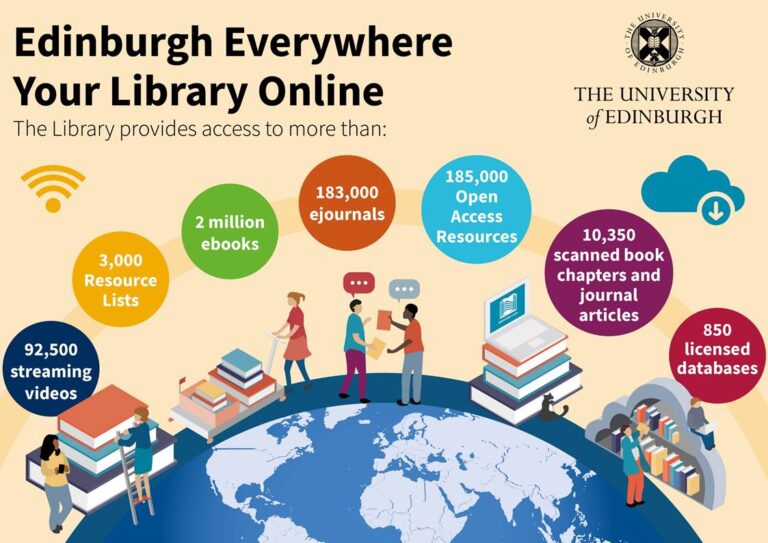
The Online Library is a vast resource. Whatever you study, you will find what you need in the Library collections. For all that it is wide and wonderful, however, I know (from personal experience) navigating the Online Library can be overwhelming. Read on for tips on where to look for resources and how to get the best out of the Online Library... 

Subject Guides 

Subject Guides are a great place to start your search for resources. If you haven’t already, head over to the Subject Guides list and find all the most relevant library resources for your subject and more... 

Check out our blog dedicated to Subject Guides for more information, coming soon...
...continue reading "Finding Resources: Navigating the Online Library"

Image outside the Main Library entrance on George Sqauare
The Main Library entrance on George Square. [Taken by Paul Dodds, copyright of the University of Edinburgh]
As the semester gets going you may be keen to visit one of our many beautiful libraries to find materials, use a study space, or generally just soak up the atmosphere.

However we know that after the past year some students may be anxious about coming on to campus, and may be worried about what to expect. In order to help with that we’ve prepared Library Orientation Guides for each of our sites so you can familiarise yourself with the building before your visit. It includes information on what’s in the collections, photos of the library, and links to other helpful resources you may want to use. You can find them here:

Library Orientation Guides

You’ll also find a guide to Using the Library Online, which we think will be helpful for our online or distance students, or those who are self-isolating or in quarantine.

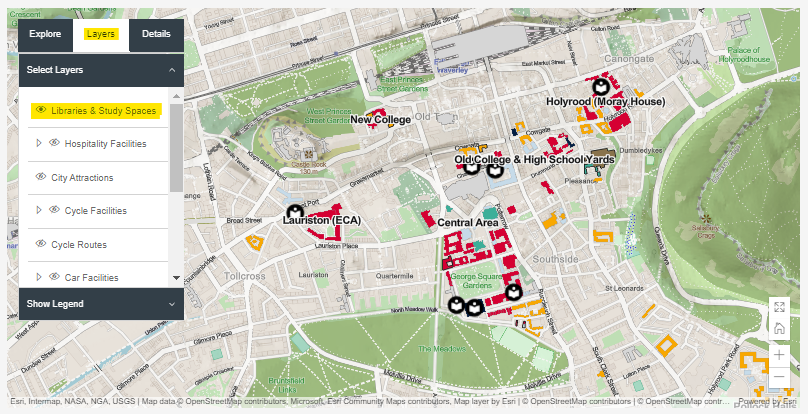
Other preparations for visiting campus may include looking at maps. Did you know we’ve got an interactive campus map? If you visit the Maps page and use the key to select the Layers tab, and then click the eye icon to make Libraries and Study Spaces visible, you can see all our locations across the city!

Screen capture of the interactive campus map. The image shows a map of the central part of the Edinburgh campus with several small icons denoting the locations of campus libraries.

We look forward to seeing you on campus soon!

Note: The Microsoft Sway platform uses moving images in their templates, and each of the above Sways use one moving image at the top of the page. If you require the information in an alternative format please contact us by email: library-academic-support@mlist.is.ed.ac.uk

css.php

Report this page

To report inappropriate content on this page, please use the form below. Upon receiving your report, we will be in touch as per the Take Down Policy of the service.

Please note that personal data collected through this form is used and stored for the purposes of processing this report and communication with you.

If you are unable to report a concern about content via this form please contact the Service Owner.

Please enter an email address you wish to be contacted on. Please describe the unacceptable content in sufficient detail to allow us to locate it, and why you consider it to be unacceptable.
By submitting this report, you accept that it is accurate and that fraudulent or nuisance complaints may result in action by the University.

  Cancel