Any views expressed within media held on this service are those of the contributors, should not be taken as approved or endorsed by the University, and do not necessarily reflect the views of the University in respect of any particular issue.
Skip to content

Welcome back to all staff and students! This blog has been a bit quiet of late due to high workload and some understaffing in our team, but we wanted to start off the new year with some good news and thought we'd alert everyone to some of the excellent e-resource trials we have going on!

Did you know?
Before the library subscribes to a new database we often arrange for a trial free of charge and link them on the E-Resources Trials page. We then ask anyone who's tested the resource out to fill in a short feedback form to let us know their thoughts so we can decide how useful it will be for our users. Some of the trials we have ongoing at the moment are listed below.

Several scientific flasks and beakers are placed in a line on a workbench. Each contain a different coloured liquid. The image conveys an experiment or trial.
Image by deepakrit on Pixabay

Radical Irish Newspaper Archives

Radical Irish Newspaper Archives is an extraordinary collection of over 115 Irish radical and political newspapers, journals, pamphlets and bulletins. Fully searchable and consisting of more than 11,000 editions with a total page count of 102,755 these newspapers, according to Dr Ciarán Reilly of Maynooth University, ‘hold the key to understanding Ireland in the turbulent decades of the early twentieth century’. Spanning one of the most important periods in Irish history, from the Home Rule debates of the 1880s to Ireland on the eve of the Second World War, these somewhat obscure titles provide an insight into a myriad of opinions on Irish life.

Trial access until: 08/01/2023 (so have a look this weekend!) 


SAGE Research Methods: Doing Research Online

This new multimedia collection has been designed to support novice or experienced social science researchers who are conducting research online. Whether conducting their first or their hundredth study online, users will find support to employ a variety of digital methods from online surveys, interviews to digital ethnography, social media, and text analysis, as well as learn how to manage, store and archive digital data. Privacy and other ethical considerations specific to conducting research online are also covered. Researchers will also get support with how to navigate the challenges of being supervised online.

Content & Features:

  • ‘How to Guides’ (providing practical help with using digital research methods);
  • Videos (tutorials, expert interviews, video case studies, etc.);
  • Case studies (focused on challenges of designing and conducting research online);
  • Teaching sets of data with a guide (suggesting a method to analyze both digitally created and existing online data, plus a step-by-step guide to how to do it so that students can practice data analysis);

Trial access until: 26/02/2023.


Archives of Sexuality and Gender: International Perspectives on LGBTQ Activism and Culture

Archives of Sexuality and Gender: International Perspectives on LGBTQ Activism and Culture examines diversity in underrepresented areas of the world such as southern Africa and Australia, highlighting cultural and social histories, struggles for rights and freedoms, explorations of sexuality, and organizations and key figures in LGBTQ history. It insures LGBTQ stories and experiences are preserved. Among many diverse and historical 20th century collections, materials include: the Papers of Simon Nkoli, a prominent South African anti-apartheid, gay and lesbian rights, and HIV/AIDS activist; Exit newspaper (formerly Link/Skakel), South Africa's longest running monthly LGBTQ publication; Geographic Files, also known as "Lesbians in…" with coverage from Albania to Zimbabwe; and the largest available collection of digitized Australian LGBTQ periodicals.

NB The Library has purchased access to three other modules of the Archives of Sexuality and Gender database - these can be found on the A databases page.

Trial access until: 12/07/2023.


We actually have TWELVE trials currently running at the moment. You can find out more on the E-Resources Trials page of the library website, where we have links and descriptions for all items as well as a link to the feedback form (login required).

If there's a resource you'd like us to get a quote and trial for, please let us know by contacting the relevant librarian for your subject area.
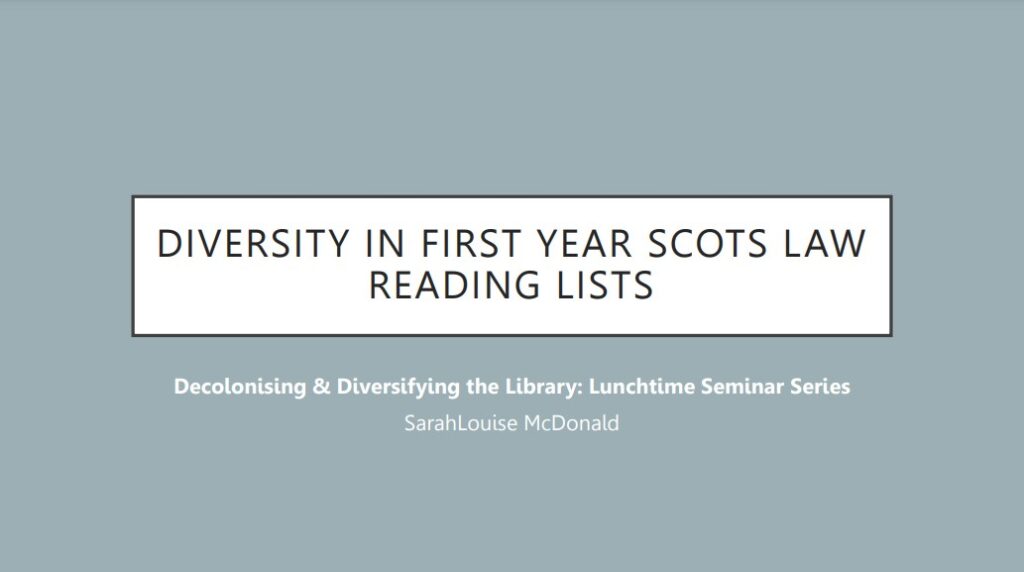
Our recent post on Decolonising and Diversifying the Library introduced the short seminar series the ASL team ran during lunchtimes in July. We're delighted to be able to follow up that post with the news that recordings of all three sessions have now been added to Media Hopper. Please use the links below to access the videos:

Diversity in First Year Scots Law Reading ListsOpening slide from Diversity in First Year Scots Law Reading Lists presentationSupporting Diversity using the ECA Artists Book and Zine CollectionsTitle slide from session on 'supporting diversity with the ECA library artists books & zines collections'

Diversifying your Reading List from a Student PerspectiveTitle slide for session on Diversifying your Reading from a Student Perspective.

For more information on these sessions or if you have ideas for what you'd like to see in future lunchtime seminars, please contact us by email or leave us a comment.

Geese wandering freely alongside a canal in manchester.
Geese and goslings on Rochdale canal

Last month, three of our Academic Support Librarians team attended the LILAC conference. LILAC is a conference for librarians and information professionals who teach information literacy skills, are interested in digital literacies and who want to improve the information seeking and evaluation skills of library users. You may have seen our previous post about LILAC 22 here.

Much of the conference covered issues of critical information literacy, including long and slightly intimidating words such as critical pedagogy and decolonisation, and it was great to have the space to explore what these mean.

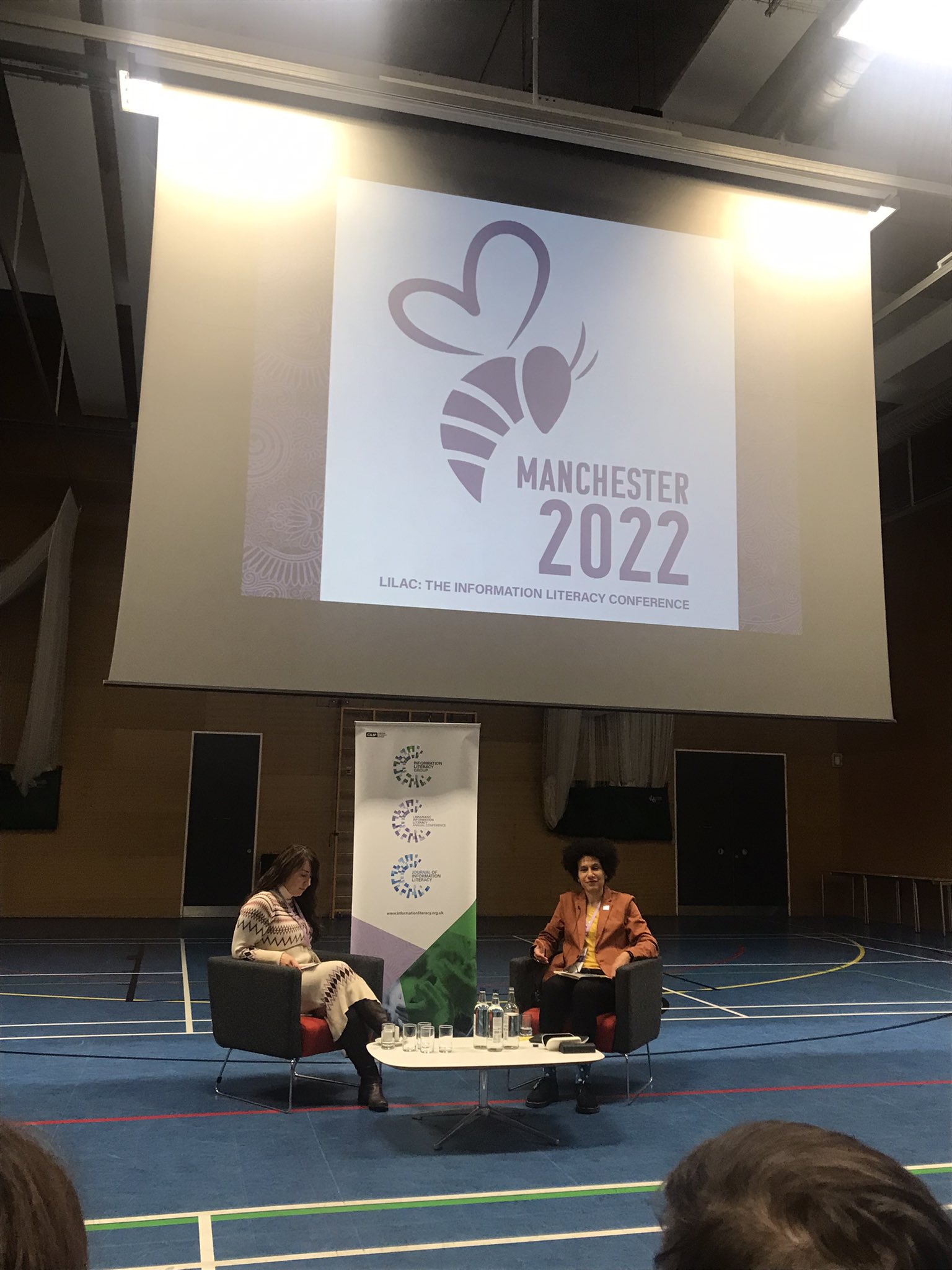
Keynote speaker Marilyn Clarke, Director of Library Services at Goldsmiths, University of London, spoke on Decolonisation as a means to creating an equitable future.

Keynote speaker Marilyn Clarke and chair Elizabeth Brookbanks sit beneath a screen with Manchester 2022 and a bee logo projected onto it.
Marilyn Clarke with discussion chair Elizabeth Brookbank at LILAC 2022.

Marilyn clarified succinctly the difference between decolonising and diversifying library collections; diversifying ≠ decolonising, we need to ask the question why are these voices underrepresented?

She highlighted fantastic work at Goldsmiths to dismantle Eurocentric structures in the library and university, including funds for the ‘Liberate My Degree’ collection set aside for student book purchase suggestions to address gaps in the library collection. At the University of Edinburgh we have the Student Request a Book service which empowers students to request purchase of books and other resources to be added to the Library collections.

When cataloguing their Zines collection, librarians gather suggestions for keywords (used as a finding aid in the catalogue) from the authors themselves, to ensure the language used is representative. This is not just about addressing race, but also other systemic oppression such as LGBTQ+ and class.

In the final keynote of the conference, Emily Drabinski, Critical Pedagogy Librarian at the Graduate Center, City University of New York, explored how information literacy can reveal and challenge structures of power, and equip our students with tools to recognise and understand power dynamics.

By power, this mean the ability to change things, do things, influence things – we all have power in different ways and different situations. As librarians who help people find, use and understand information, we need to take societal values and power structures into account.

For example, who designed this database? With whom in mind? What is included in the database and what isn’t, and who makes those decisions? That feeling, where you get no results from a search, or too many, or their wrong – that’s not you, that’s the way the system is constructed with power.

Myself, I will be doing more to incorporate discussions of power into my teaching. It’s something I do when teaching literature searching for Systematic Reviews in medicine and biomedical sciences (these aim to find and synthesise all clinical evidence on a topic), where comprehensive searches and minimising bias are a core foundation of the review methodology – and as such, knowing what is included in a database, and crucially what is excluded, is crucial. But we can introduce this criticality earlier in students’ academic careers. I am not sure yet what that will look like exactly, but it’s exciting to consider.

Ruth Jenkins, Academic Support Librarian

https://www.ed.ac.uk/information-services/help-consultancy/rm-and-consultancy/academic-support-librarians

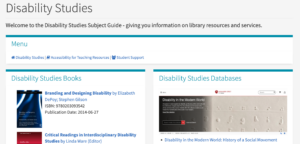
The Subject Guides are a useful tool in getting started with your research. Whether you’re an Engineer or a Classicist, they contain a wealth of information for navigating library resources, including journals, databases, and bibliographies, available to students here at the University of Edinburgh. Part of my role as Digital Engagement Intern involves reviewing and creating guides within the remit of Equity, Diversity, and Inclusion, and I’m delighted to share our newest Subject Guide in Disability Studies.

Preview of the Disability Studies Subject Guide

This guide has been created to both assist students in the academic study of Disability and highlight ways the University can support you with any additional learning needs you might have. We’ve included access information for students using the Main Library, advice on how to make your device more accessible, and details of several groups and societies for students to get involved with. As well as supporting students, we’ve also included various materials to assist staff in creating more accessible learning environments, signposting additional training and resources available at the University. 

We hope that this guide will serve as a helpful tool for students and staff to access the support that’s available by bringing these resources together in one guide that will continue to grow over time. If you have any feedback or suggestions on ways this guide can be improved, then we would love to hear from you! 

You can access the Disability Studies Subject Guide to clicking on the link or navigating to the webpage at the following URL: https://edinburgh-uk.libguides.com/disabilitystudies. 

Tristan Craig
Digital Engagement Intern (Equity, Diversity and Inclusion)

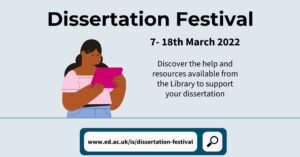
Dissertation. A word that scares and confuses many students, including me. It seems like a difficult and mysterious concept that most of us must deal with at some point on our academic journey. I have been wondering for a long time if there is any way I can make the whole experience of writing it at least a bit easier and less scary. I must admit that this year’s dissertation festival has provided me with a lot of tools and information to do just that.

During the dissertation festival, I attended three sessions: Introduction to reference managers, Improve your research skills with SAGE Research Methods, and DataLiteracy for Beginners. They were all very informative, both for students currently writing their dissertation, but also for students like me, who are only beginning to think about their dissertation now.

The first event was an overview of four reference managers. I really enjoyed the fact that the presentation did not only cover one reference manager but as many as four. This gave me a chance to get a feel of all of them and choose my favourite one (which, I must admit, has got to be EndNote). The second event covered SAGE Research Methods database, which I was not aware of before, yet I found it to be a very useful resource. The last event I attended emphasized the importance of critical thinking while dealing with various kinds of information, especially the statistics part of it.

I enjoyed all the events a lot! The only thing I would change about these, would it be their form. I prefer to attend in-person events, especially after covid ‘trauma’ that we have all experienced – it would be nice to see all the presenters and attendees offline. But well, one cannot have everything, maybe next time!

Overall, I recommend every student to attend the next edition of the dissertation festival, whether they are in their fourth, third or second year. All events provided me with great tools that I will not only use while writing my dissertation but also other coursework.

Zofia Matuszczyk
Communications Officer Intern

For over 400 years, more than 15 million men, women and children were victims of the transatlantic slave trade. And on 25th March every year, the International Day of Remembrance of the Victims of Slavery and the Transatlantic Slave Trade offers the opportunity to honour and remember those who suffered and died at the hands of the brutal slavery system, while also raising awareness about the dangers of racism and prejudice today.

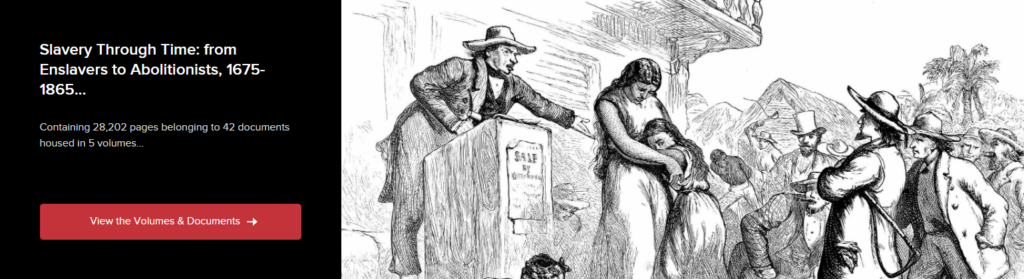
At the Library we have access to a range of digital resources that give you access to original primary source material from archives around the world that allow you to find out more about the Transatlantic Slave Trade and the victims of slavery. These are a few that you might like to explore:

Slavery: supporters and abolitionists, 1675-1865
(also known as Slavery Through Time: from Enslavers to Abolitionists, 1675-1865)

...continue reading "The Transatlantic Slave Trade and Slavery: primary sources"

By now we hope the name LibSmart is familiar to you. Whether you've seen a slide in a presentation from an Academic Support Librarian, a page on the display screens in the library, or you're just an avid reader of this blog, we hope you know that our online information literacy course is up and running, ready for any staff or students at the University of Edinburgh to self-enrol via Learn.

You may also know that for every module you complete in LibSmart you receive a Digital Badge, issued to you by the ASL team via Badgr. We've been keeping an eye on the number of students enrolled and also the number of badges we've issued for each module, and we're starting to see some trends emerge even though it's still early in the academic year.

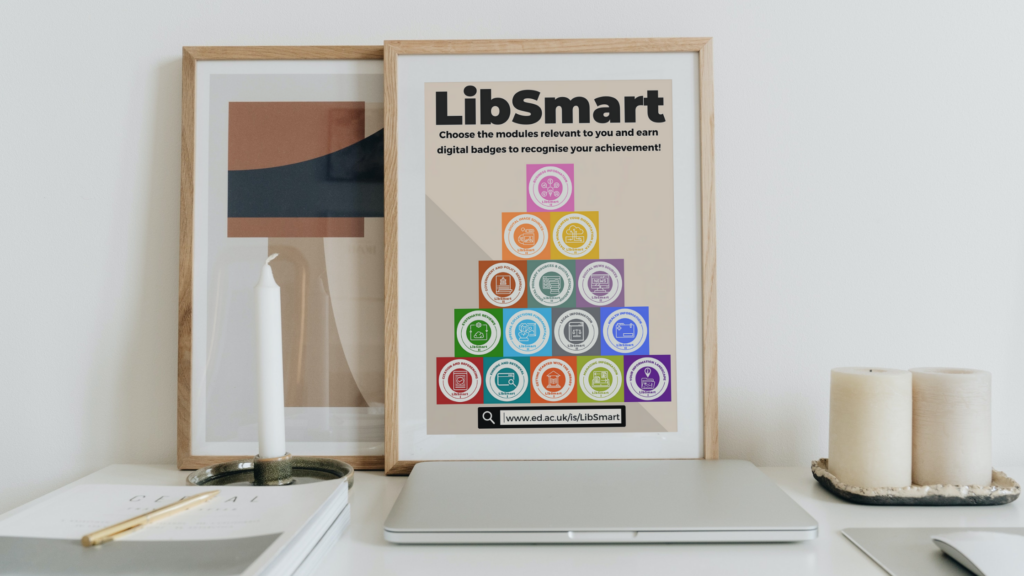
Image of all LibSmart Badges with text "Choose the modules relevant to you and earn digital badges to recognise your achievement!"
LibSmart badges

For LibSmart I, we've definitely seen the most badges issued for the first module Getting Started With The Library. This isn't a great surprise as it is the first module and therefore a logical place for people to start. We're also seeing great numbers in our Your Information Landscape module which helps students orientate themselves with the resources that are helpful for their subject area. We've also seen the most growth month-to-month in our Referencing and Plagiarism module, perhaps because we're getting close to assessment time now and people are making sure they're familiar with how to reference correctly for their assignments.

When it comes to LibSmart II, we've had a nice even spread of badges being awarded across all modules. The most popular so far has been Data mindfulness: finding and managing data for your dissertation, which shows a real appetite for assistance with dissertation and thesis work. This is great news as this is exactly what we hoped LibSmart II would do - help those at an advanced stage of study complete the big pieces of work! We've also got a three-way tie in second place for the Health Literature, Digital Images and Special Collections Fundamentals modules all having the same number of badges awarded. Because we assume these would appeal to students of quite different disciplines, it's great to see the word is getting out to different schools!

Have you had a look to see what LibSmart can offer yet? Check the website for more information, or watch our self-enrol demonstration video to help you get started.

1

Where to start?

Following on from my general tips for finding resources and navigating the online library, this blog post will cover why you should check out Subject Guides, and highlights some resources, old and new, that you may not already know about for studies. 

When you are looking for resources, remember not everything in the Library collection is on DiscoverEd, so it’s best to check out your Subject Guide.  

Subject Guides bring together all the most relevant library resources for a subject or topic. These guides, put together by Academic Support Librarians (ASLs), are always a good place to start when you’re looking for resources.   ...continue reading "Finding Resources: Subject Guides"

1

The Online Library is a vast resource. Whatever you study, you will find what you need in the Library collections. For all that it is wide and wonderful, however, I know (from personal experience) navigating the Online Library can be overwhelming. Read on for tips on where to look for resources and how to get the best out of the Online Library... 

Subject Guides 

Subject Guides are a great place to start your search for resources. If you haven’t already, head over to the Subject Guides list and find all the most relevant library resources for your subject and more... 

Check out our blog dedicated to Subject Guides for more information, coming soon...
...continue reading "Finding Resources: Navigating the Online Library"

You may have read our recent article about LibSmart I, the foundation of our online information literacy course hosted on Learn. If you haven't, check it out here.

Where LibSmart I provides a solid start in the library and information landscape, we think that LibSmart II offers a great next step for those a little further in their university career.

Picture of LibSmart digital badges in a wooden picture frame leaning against a wall
Earn digital badges for every module you complete in LibSmart I and II.

So what does LibSmart II offer? 

You can pick and mix from ten subject specific modules to develop knowledge of a wide range of digital resources. You can also learn specialised or advanced digital search techniques and develop the skills to manage your research literature and data effectively. We recommend you complete LibSmart I before moving on to LibSmart II, as you will build on the foundations developed in the first level of the course as you complete each of your chosen modules.

A brief overview of LibSmart II and its learning objectives 

The ten modules which are currently available to study are:

  • Business information
  • Data mindfulness: finding and managing data for your dissertation
  • Digital news sources
  • Digital primary sources and digital scholarship
  • Finding and using digital images
  • Government and Policy Research
  • Health information
  • Legal information
  • Special Collections fundamentals
  • Systematic reviews

We estimate each course will take a maximum of 3 hours to complete, and you can select as many or as few as you like. You'll earn a digital badge for each module you complete to show off your new achievement!

LibSmart II banner

Ready to get started?

Visit the LibSmart webpage to find out more about how to self-enrol for this course.

If you have any questions or concerns about LibSmart you can contact us via the EdHelp portal.

css.php

Report this page

To report inappropriate content on this page, please use the form below. Upon receiving your report, we will be in touch as per the Take Down Policy of the service.

Please note that personal data collected through this form is used and stored for the purposes of processing this report and communication with you.

If you are unable to report a concern about content via this form please contact the Service Owner.

Please enter an email address you wish to be contacted on. Please describe the unacceptable content in sufficient detail to allow us to locate it, and why you consider it to be unacceptable.
By submitting this report, you accept that it is accurate and that fraudulent or nuisance complaints may result in action by the University.

  Cancel