Week 2: Breaking out of the White Cube
This week I want to start getting the ball rolling on developing curatorial themes beyond just methods of engagement & curation — in that vein, a first idea is an exhibition in which all work has to be made within the ‘gallery space’ throughout the duration of the show, shifting the gallery into a shared studio space of sorts. I put gallery space in quotes as this can encapsulate off-site public art or installations that are developed concurrently, inhabiting the broader conceptual ‘gallery space’. In this way, the exhibition can be used in a bespoke way by participating artists: as a residency, a site for duration-based performance works, a fabrication shop, a hub for ongoing participatory artworks… I have often had friends who come into my own studio in the past comment on how ‘inviting’, ‘warm’, or ‘inspiring’ the space is. Why, then, are many (if not most) art-viewing venues designed to be sterile, boring, and lifeless? (see highlighted quotes in figure 1).
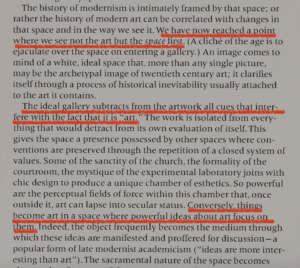
Figure 1: O’Doherty, Brian. “Inside the White Cube”, The Lapis Press, 1986. p.14
I am continually (negatively) struck by the ways in which art institutions plaster over and sterilise the incredibly unique architectures of the historic spaces they inhabit, evident when I recently visited the National Museum of Scotland Modern One (on the contrary, Anselm Kiefer’s installation at the Palazzo Ducale during the 2022 Venice Biennale notably left the building’s Venetian Gothic architecture and grand frescoes on display; more befitting than the sparse warehouses or grand white walls his work is typically shown in). In my curatorial work, I am more interested in getting non-art publics excited about and interested in art than presenting work to an art audience that, for the most part, will go out of their way to attend a gallery opening. In an ongoing, constantly developing ‘exhibition’, publics are inspired to engage in or consider how they can engage with the themes being actively developed and explored in each artist’s practice.
Of this week’s arts organizations I researched I was most inspired by Arts Catalyst and Taipei Biennial’s curatorial missions and executions. Arts Catalyst’s community-driven focus on social action and art as a means of opening up learning to publics highlights the opportunities of bringing art out into the world, from a community gardening project to an English language book created by and for the refugees and asylum seekers of Sheffield. How does this level of participation and engagement alter publics’ perspectives on the role art can play in their lives – and the world?
The inclusion of a music room at the Taipei Biennial is another inspiring curatorial format as it innately invites a different intersection of publics into the space; people crave third spaces and community, while paradoxically digital fatigue makes the planning and execution of social events (like going to visit a gallery) difficult. Bringing publics in with concerts, artist talks, workshops, or community engagement events can be an effective way to engage publics by ‘meeting them where they are’ in a way.
In Maria Lind’s e-flux article “Situating the Curatorial”, when discussing an interview with Irit Rogoff on curation, she explains that “curated events contain epistemological processes and are presentational rather than representational, a distinction that Rogoff credits to the visitors to an exhibition”(see Lind). Lind goes on to state that “the curatorial goes beyond “roles” and takes the shape of a function and a method, even a methodology”(see Lind). This is clearly evidenced by organizations like Grizedale and Arts Catalyst, and I am curious to explore how I can move beyond my presupposed notions of curating into approaching it as a methodology.
Over the next week, I plan on researching further into Lind’s notion of “contact zones” as developed by Mary Louise Pratt and James Clifford to deepen my knowledge and develop methodologies of creating zones of meaningful conversation, interaction, and knowledge sharing between publics&art, art&art, and publics&publics.
Notes
Lind, Maria. “Situating the Curator”, e-flux Journal #116, https://www.e-flux.com/journal/116/378689/situating-the-curatorial
Rogoff, Irit and Bismarck, Beatrice von, “Curating/Curatorial: A Conversation Between Irit Rogoff and Beatrice Von Bismarck,” in Cultures of the Curatorial, ed. Beatrice von Bismarck, Jörn Schafaff, and Thomas Weski (Berlin: Sternberg Press, 2012), 23
https://artscatalyst.org/?NoSplash
https://www.taipeibiennial.org/2023/list/musicroom
https://palazzoducale.visitmuve.it/en/exhibition/exhibition-anselm-kiefer/
https://www.rollingstone.com/music/music-features/speedrunning-hip-hop-1234968918/