Week 13: Floor Plans & Commissions
Floor Plan & Exhibition Design
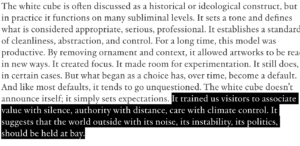
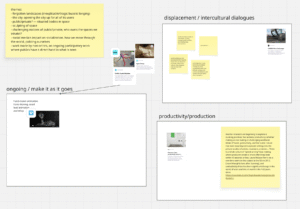
Screenshot of Formafantasma, “On Exhibition Design” in Mousse Magazine

As I have been working out the exhibition design for my project, Formafantasma’s article “On Exhibition Design” in Mousse Magazine has been critical in guiding my thinking about “how exhibition design can articulate a position, rather than simply hosting one” (Formafatasma 2026). 
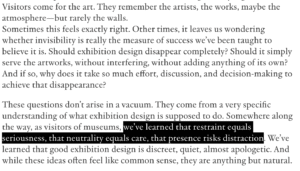
 

Screenshot of Formafantasma, “On Exhibition Design” in Mousse Magazine

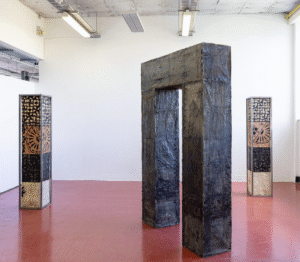
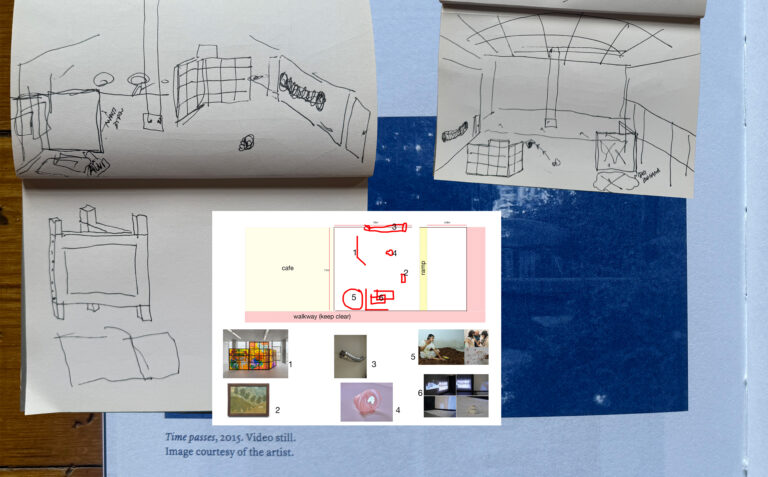
In particular, aspects such as the suspended wall texts and canvas works at the Diriyah Biennale offer more exciting yet approachable ways of interacting with the works, challenging the expectations and neutralization of the white cube. As such, I have two key layouts for the exhibition I have been experimenting with:
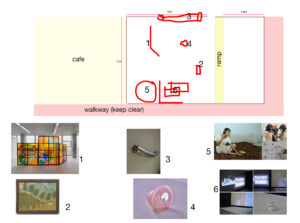
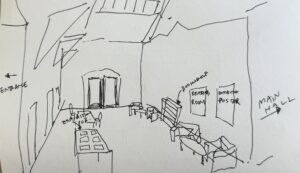
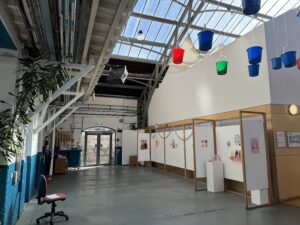
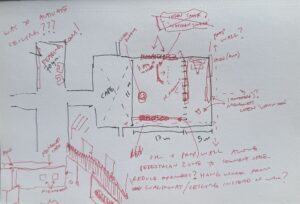
Exhibition Floor Plan #1
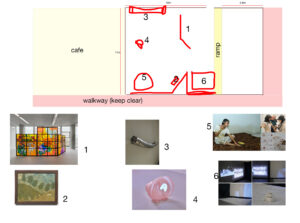
Exhibition Floor Plan #2


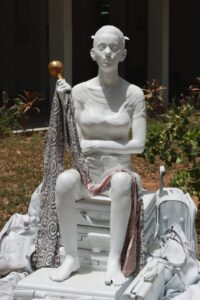
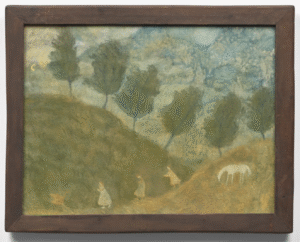
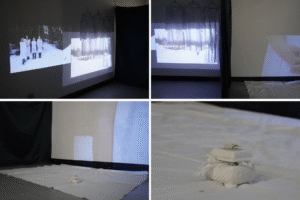
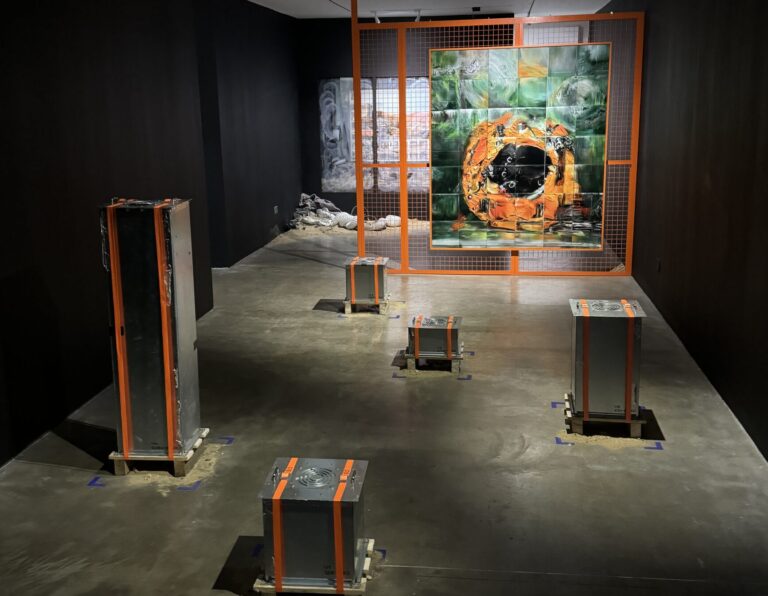
In the first plan (which I am now leaning towards), Mia Kokkoni’s painting is suspended from the rafters of the building (there are multiple examples of objects, banners, and other weighted items being suspended from the rafters so this should be permitted). This layout incorporates portable white walls as Alvi Östgård’s work “Savn” necessitates a wall to project onto, though I am considering building bespoke walls that incorporate fabric stretched over exposed wood frames or hanging curtains to divide the space, so that the exhibition includes no white walls at all, fostering zones of interaction between works that reflect the exhibition themes at large.


On Commissions and Contemporaneity
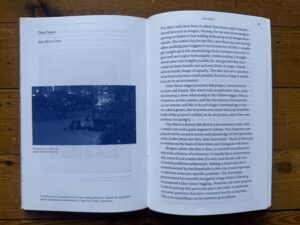
Photograph of Guttu, Anna Hjort, “Time Passes” in Cervetto, Renata, On Boycott, Censorship and Educational Practices The Fellow Reader #1, pp 136-137.

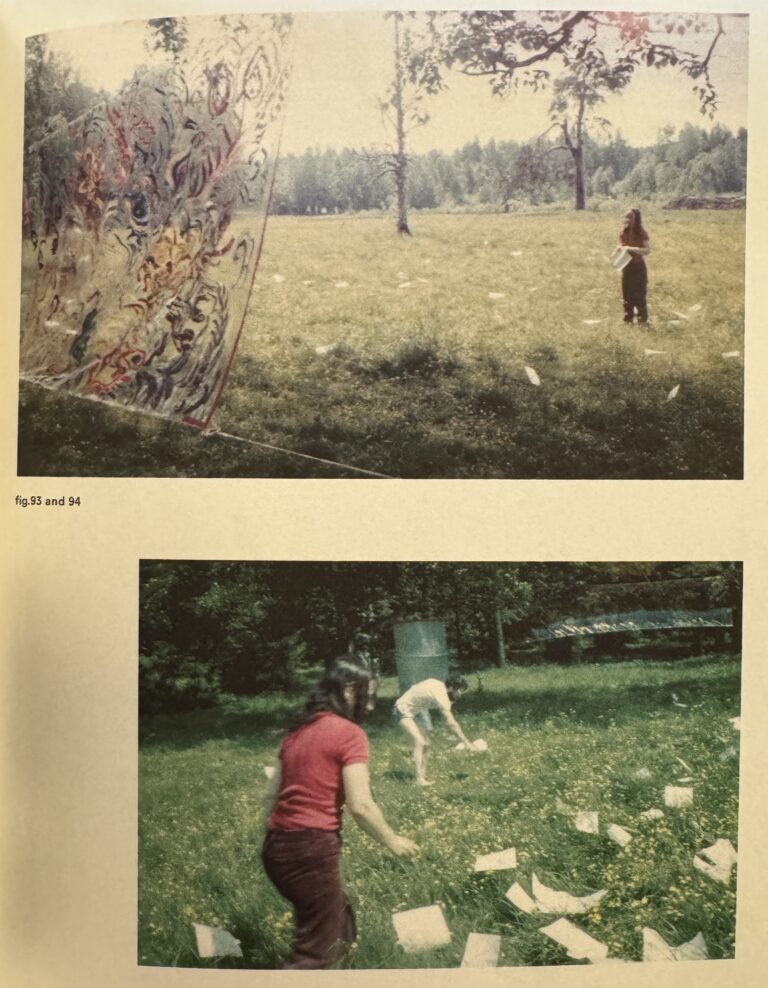
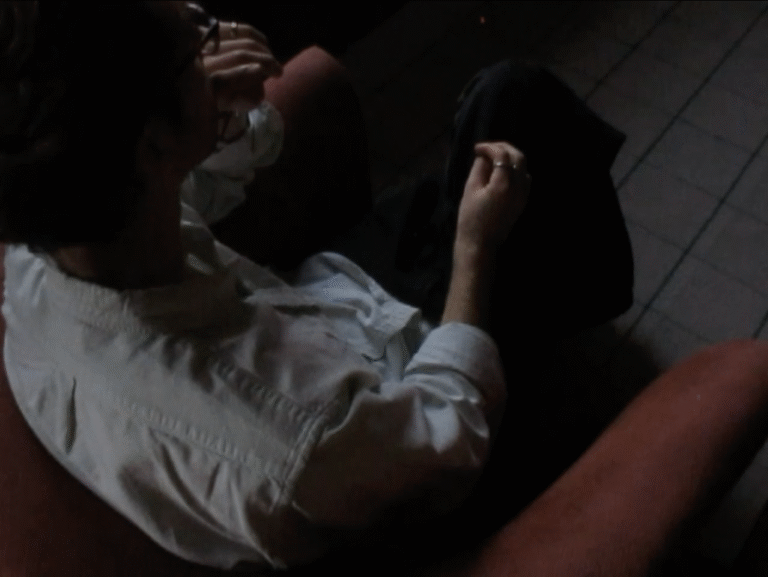
I recently came across artist Ane Hjort Guttu’s work Time Passes, a film produced for eating or opening a window or just walking dully along, a solo show of Guttu’s at the Bergen Kunsthalle. Commissioned for the exhibition, this work responds to a proposed ban on street begging in Norway. This work highlights the role of commissions to connect to local and contemporary issues, sparking dialogues between artistic practice and members of the local community.


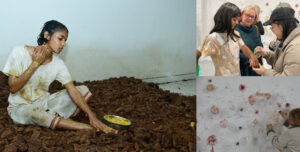
Recent anti-immigration rallies in Edinburgh demonstrate the need for intercultural dialogues that recognize the richness of culture that diversity brings to local communities, and Nidhi Bodana’s commissioned site specific work and performance will be crucial to offer a “site of healing, visibility, and reclamation, inviting audiences to move from passive viewing to active witnessing, from silence to solidarity” (Nidhi Bodana, artist statement). Having spent time with these artists’ practices, I am beginning to feel confident that the dialogues between these works invite audiences to reflect upon their own identity, and inspire publics to consider how community is strengthened through being accepting, understanding, and inclusive of diverse cultures and populations.


References


Bodana, Nidhi, quote from Artist Statement. Accessed via: https://bodananidhi.co.uk/ 

Formafantasma, “On Exhibition Design” in Mousse Magazine, 2nd March 2026, accessed via: https://www.moussemagazine.it/magazine/on-exhibition-design-formafantasma-2026 

Guttu, Anna Hjort, “Time Passes” in Cervetto, Renata, On Boycott, Censorship and Educational Practices The Fellow Reader #1, de Appel, Amsterdam, NL, 2015, pp 136-140.
Week 12: Finding My Title & Tightening Up Public Programming

Finding my title: Mending the Mutilated World

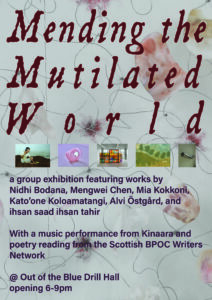
preliminary sketch design of poster

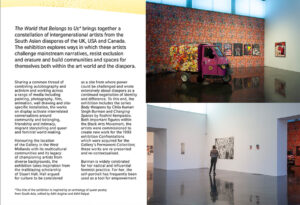
Through my research I came across the exhibition The World that Belongs to Us, co-curated by Aziz Sohail and Deborah Robinson at the New Art Gallery Walsall, which explores similar themes to my own project, though looking at identity and belonging through the lens of activism and community building. Given this, the effective title communicates a sense of agency and action, empowering publics to consider notions of belonging and to break down barriers between diverse communities and groups.


screenshot of The World That Belongs to Us exhibition guide and installation views at The New Art Gallery Walsall. © 2024. Photos by Johnathan Shaw.


This exhibition helped me arrive at the title for my project: Mending the Mutilated World. This title seeks to communicate how the artworks in the exhibition offer opportunities to mend the divided world through intercultural dialogues and negotiations of diasporic identity; the use of “mending” seeking to demonstrate how this process is ongoing and embodied through these artists’ practices. While Zagajewski’s original poem sought to offer resilience through recognizing beauty in a fraught world, this title reflects the need to move one step forward, to enact action in our day to day lives to mend the divisive and fragmented contemporary world.


While The World that Belongs to Us was a well-conceived exhibition exploring these themes in a nuanced way, the primary public programming being a symposium undermines the necessity for accessible dialogues for wider publics, re-invigorating my focus on publics who often feel excluded from institutional spaces.


Updated Programme & Publication

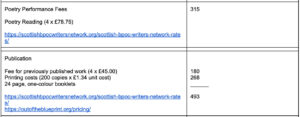
Updated budget for Publication & Poetry Reading Performance Fees

This week I realized I had forgotten to include rates for the partnership I am proposing with Scottish BPOC Writers Network for a poetry reading and to support work for the publication. As such, I have re-envisaged my budget based and publication based on their suggested network rates:


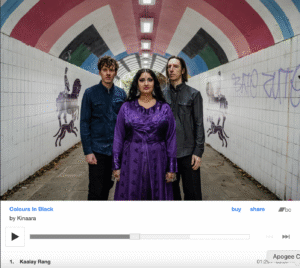
As such, the closing night performance will include a reading from 4 authors/poets from the network who will also be invited to submit previously published work for the publication. The closing night performance will include an open mic for poets/authors from the local community to share their own works related to the exhibition theme, followed by Kinaara’s music performance.


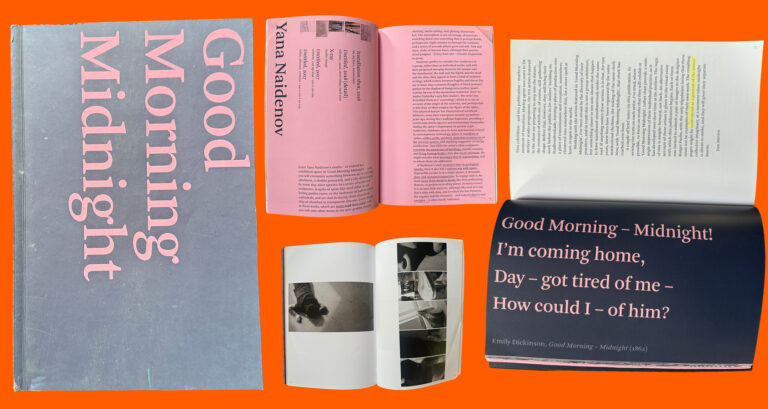
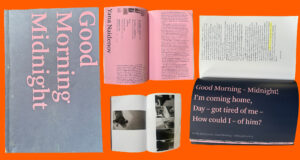
The publication will include writers’ contributions alongside exhibition texts and ephemera/contributions from the artists’ practices and works. I have been highly influenced by the publication for De Ateliers’ Offspring 2018 exhibition Good Morning Midnight, curated by Tom Morton, which fuses artworks, writing by artists, and texts about the exhibition in a book form which is accessible, though more akin to an artist’s book than the often-discursive and strictly supplemental exhibition catalogues.


Collage of spreads & cover of Good Morning Midnight exhibition publication. Morton, Tom and Boogerd, Dominic van den, Good Morning Midnight / Offspring 2018, Amsterdam, NL, 2018

References

The World that Belongs to Us, co-curated by Aziz Sohail and Deborah Robinson, New Art Gallery Walsall, Walsall, UK, 24 November 2023 – 9 June 2024


Offspring 2018 Good Morning Midnight, curated by Tom Morton, De Ateliers, Amsterdam, NL, May 16–27, 2018.


Zagajewski, Adam. “Try to Praise the Mutilated World”, trans. Clare Cavanagh, from Without End: New and Selected Poems (Farrar, Straus and Giroux, 2002)


Week 11: Jí Jū Exhibition, Ethics, and Site Visits

Jí Jū Collective: ‘Our Shell’

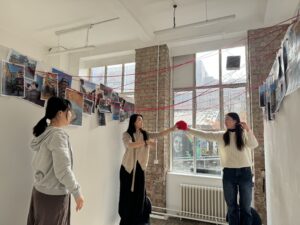
Last week the Collective installed an exhibition entitled ‘Our Shell’, where we exhibited artworks from members of the collective alongside an installation we collectively created including pairings of images from our adopted home (Edinburgh) and our hometowns, exploring how we seek belonging and create a ‘shell’ in unfamiliar environments. This was a celebratory moment for the collective, as we put into practice theoretical skills we have been developing: more on this in the reflection text.

Photo of exhibition install, image courtesy author.

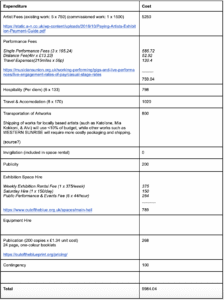
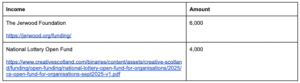
Preliminary Budget

**This budget also does not reflect fees for participants in the closing night reading, which I will indeed add.

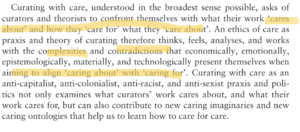
This week I continued fleshing out a preliminary budget for my ISCP, which can be viewed above. A major concern I have is in regards to the ethics of commissioning just one artist (Nidhi Bodana) to create a new work, and include previously existing works by all others. Returning to week 3’s readings on ethics & care has helped me navigate this issue: as I “attempt to make reasonable decisions while taking the positions of others into account” (Chen 2023), I am equally as constantly aware of my own positionality in regards to the themes explored in the exhibition, to which these texts provide guidance into how I navigate aligning “’caring about’ with ‘caring for’”(Krasny & Perry, 8) within my work. 


Highlighted text from Krasny, Elke and Perry, Lara. eds. Curating with Care. Routledge, 2023, pp 8.

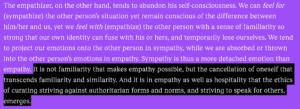
Highlighted text from Chen, Meng-Shi. ‘Ethics of Curating.’ Curatography. The Study of Curatorial Culture 5 (2021). https://curatography.org/5-3-en/


Out of Blue Drill Hall Site Visit


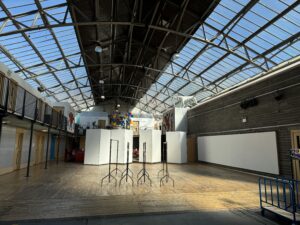
Photo of main hall, image courtesy author.

Visiting the site this week highlighted how suitable the space is for the exhibition — publics flowing in and out of the main hall & cafe, studio-holders traversing the space, the tall ceilings and skylights imbuing an openness and almost replicating the feeling of being outside… 

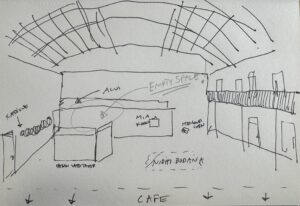
Preliminary sketch of exhibition plan.

After visiting, the inclusion of a reading room in the front supplementary space seems crucial — being the first space visitors engage with, it would exist as a casual, accessible, and stimulating space that offers reading materials, research, and the exhibition publication as a way to ease publics into the theme of the exhibition, or serve as a space of contemplation before leaving.


Sketch of reading room


Programming

My approach to programming and how it intersects with the exhibition has slightly shifted, detailed in this brief schedule/outline of the programming:


Opening night: Performance from Alvi Ostgard & newly commissioned performance from Nidhi Bodana.

Closing night: Music performance from Kinaara, partnership with Scottish BPOC Writers Network to present a reading from poets & authors.

Publication & partnership with Out of the Blueprint: 24page publication printed onsite, including contributions from participating artists (& written works from members of the Scottish BPOC Writers Network. The publication will be freely disseminated at the exhibition and at sites around Edinburgh, including libraries and cultural centers.


Photo of supplementary exhibition space at the entrance of Out of the Blue Drill Hall, image courtesy author.

References

Chen, Meng-Shi. ‘Ethics of Curating.’ Curatography. The Study of Curatorial Culture 5 (2021). https://curatography.org/5-3-en/


Krasny, Elke and Perry, Lara. eds. Curating with Care. Routledge, 2023


Week 10: a trimmed tree is no place for song birds

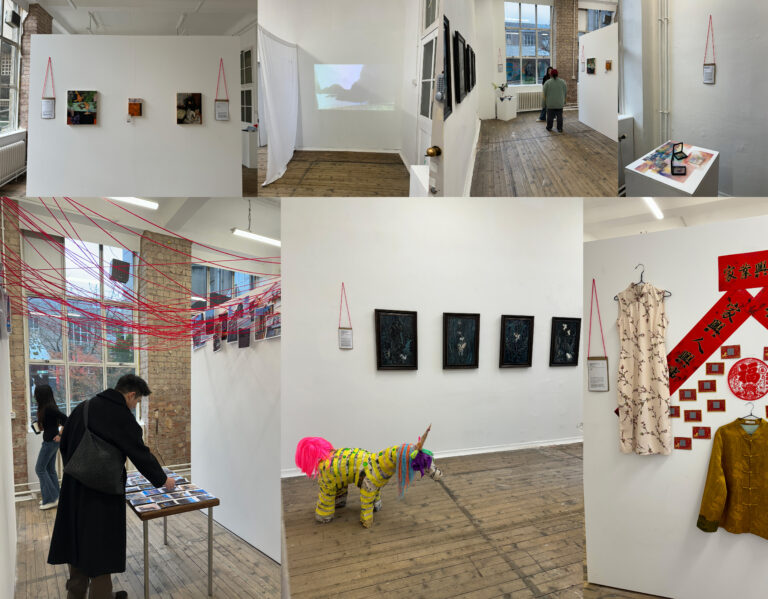
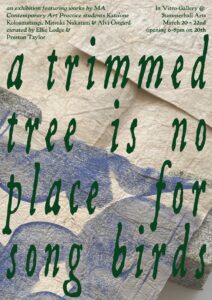
This past weekend we installed and opened the exhibition a trimmed tree is no place for song birds, featuring works by MA CAP artists/students Kato’one Koloamatangi, Mitsuki Nakatani, and Alvi Östgård. This pivotal moment of curating the show alongside Ellie Lodge was highly informative as to how I approach my ISCP, which I will discuss in depth in the critical reflection text.


a trimmed tree is no place for song birds installation views. Images courtesy author.


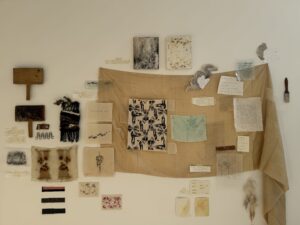
Image of ephemera wall.

Ephemera Installation

In the exhibition, Ellie and I wanted to include an installation that brought together all 3 of the artists’ research, notes, material studies, and studio ephemera in one place to put their practices directly in dialogue with each other. The exceedingly positive response to this installation reflects a desire in audiences for deeper insight into the working practices of these artists and demonstrates the immense power of making artists’ research/archives public in a de-authored, heterogenous manner. In many ways, this installation points to the archive “as found yet constructed, factual yet fictive, public yet private”(Foster 5).


Grammel’s essay in this week’s reading also resonates with my personal ethos inspiring my approach to the curation of this exhibition; that “curatorial practice should deliberately create unstable constellations contradicting the notion of truth as something accomplished” (Grammel 34).


Public Programming & ISCP

This week’s theme on Publics & Programming is perfectly fitting given the public program is a crucial aspect of my project. I highly resonate with Alistair Hudson’s goal to “rescue the ideology of art from itself” in his work at the Middlesbrough Institute of Modern Art (MIMA) (Hudson, 2017). Aspects of MIMA’s civic programming could apply to my project — inviting local schools to participate in a workshop with Out of the Blueprint or an accessible open day featuring free lunch, inspired by MIMA’s ‘community days’.

Highlighted text from Hudson, A. (2017) ‘Building a user-generated museum: a conversation with Alistair Hudson’, OpenDemocracy, 5 May. Available at: https://www.opendemocracy.net/en/building-user-generated-museum-conversation-with-alistair-hudson


Initial sketch of floor plan, demonstrating shifting plans in what works to be included.

Changes in Selected Works

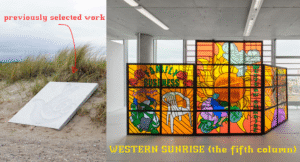
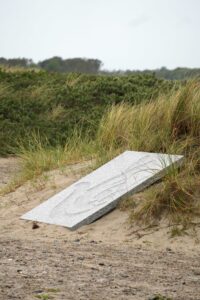
As the space has shifted from my initial concept of Dalmeny Street Park to Out of the Blue Drill Hall, the included works have changed due to the project existing indoors and a re-consideration of how certain works will exist in the space. Whilst ihsan saad ihsan tahir’s  outdoor marble slab installation is not suitable for the exhibition given this shift, his stained glass work WESTERN SUNRISE (the fifth column) explores similar themes & will be much more effective in the indoor space.


Another notable shift is that I have chosen to commission a new performance and installation from Nidhi Bodana rather than a previously made work. This performance would take place on the opening night of the exhibition and the installative remnants will remain throughout the duration. Below are details of new works selected for the project.


Images of Nidhi Bodana’s works You Make Up Me (right image) and Until When (left). These images are of the artist’s previous performances & installations, and serve as precedents for the newly commissioned work. Images courtesy Nidhi Bodana, https://bodananidhi.co.uk/#gallery

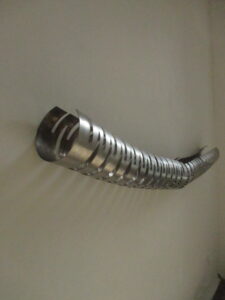
Installation view of Kato’one Koloamatangi’s sculpture Blueprint, 2026. Image courtesy author.


Collage of previously chosen work by ihsan saad ihsan tahir from WESTERN SUNRISE and new work for the ISCP, WESTERN SUNRISE (the fifth column). Images courtesy ihsan saad ihsan tahir, https://ihsansaadihsantahir.com/


References

Foster, Hal. “An Archival Impulse.” October (238 Main St., Suite 500, Cambridge, MA 02142-1046, USA) 110, no. 110 (October 2004): 3–22. https://doi.org/10.1162/0162287042379847


Grammel, S. (2011) ‘A Series of Acts and Spaces’, in Richter, D. and Wolfs, R. (eds.) ‘Institution as Medium. Curating as Institutional Critique? Part 1’, On Curating, 8, pp.33-38. Available at: https://drive.google.com/drive/folders/1QlprJ8Zu7SGn9TJex3Y4uJQ6z8Aq-YUA


Hudson, A. (2017) ‘Building a user-generated museum: a conversation with Alistair Hudson’, OpenDemocracy, 5 May. Available at: https://www.opendemocracy.net/en/building-user-generated-museum-conversation-with-alistair-hudson


Week 9: Workshops & Access Practice


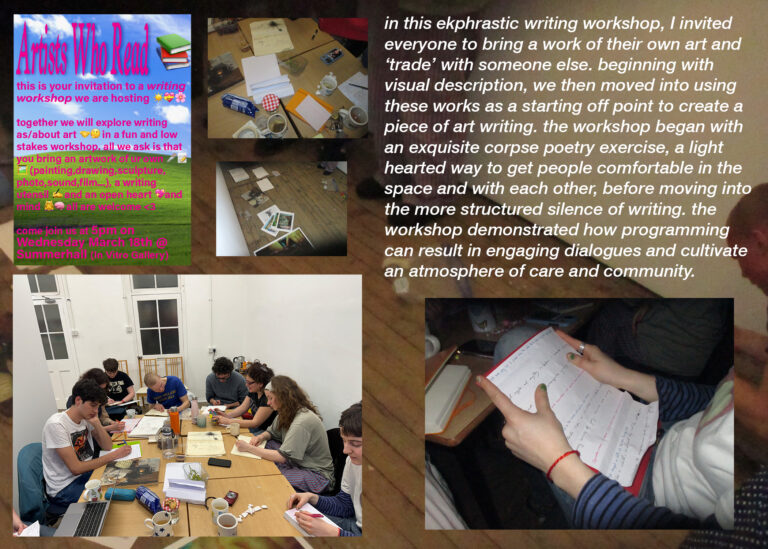
artists who read Workshop in Summerhall

This week I led an art writing workshop for the artists who read club in the collective space, extending my own personal practice through leading a workshop while also exploring the role of workshops as part of the programming for my ISCP. Whilst the workshop was focused on ekphrastic writing and its participants were primarily artists, I began reflecting upon this aspect of programming as making a way to make exhibitions more accessible for non-art audiences and young people. As the fostering of inter- & cross-cultural dialogues is central to my exhibition, programming opportunities such as writing workshops or reading groups can bring literal dialogues into the exhibition space.

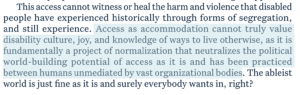
Screenshot of Taraneh Fazeli and Cannach MacBride, pp 136.

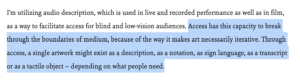
Screenshot of Lazard, Carolyn. “Carolyn Lazard on Illness, Intimacy and the Aesthetics of Access”


Access practice

dis_place gallery demonstrates how the exhibition can change forms to avoid access practice as “a project of normalization”, and function as a generative practice that avoids ableist tendencies and centers disabled people’s experiences and needs(Fazeli & MacBride, 136). As such, I intend to explore digital and alternative formats as more than facsimile of the exhibition, but as iterative and generative responses that are tailored for the audience’s needs, including easy-read documents, audio description, and exploring different digital mediums and layouts for presenting the exhibition.


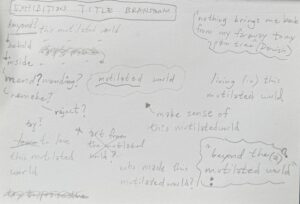
Photograph of notebook, exhibition title brainstorming

Title workshopping

Workshopping the title has proven to be a difficult process, and I have yet to arrive at a title that successfully incorporates Adam Zagajewski’s expressive notion of the “mutilated world” from his poem “Try to Praise the Mutilated World.” I enjoy the evocative nature of the phrase, though I struggle with whether it provides a necessary clarity in what the exhibition seeks to communicate. That being said, I do not want to employ the colon for fear of explication or the title becoming didactic; after all, as writer/curator Tom Morton humorously states, the colon “is not intellectual super-glue” (Morton 2026).


Jí Jū Collective

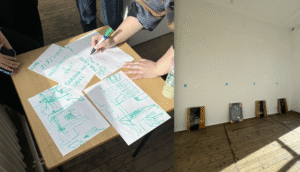
Collage of photos of Jí Jū Collective exhibition planning


Whilst our collective’s plans for how to use the space have oscillated over the past few weeks, we have arrived at an event in which certain members of the collective will bring in personal artworks that reflect/are about home, and install this exhibition as an adopted ‘shell’ alongside a mini pamphlet and installation including pairs of images of our home towns and adopted homes (in Edinburgh). 


Reflecting upon my participation in the collective over the past two weeks, I have taken less of a leadership role as I have been quite busy with the CAP exhibition planning & artists who read workshop, and needed to take a step back. Whilst there have been instances of miscommunication and bumps in the road whilst planning this activity, members of the collective have begun to be more vocal and engaged, a great reminder that my communication style and personality have the potential to deter participation and not foster openness for people with varying communication styles.


References:

Taraneh Fazeli, and Cannach MacBride. “MEANS WITHOUT ENDS: LEARNING HOW TO LIVE OTHERWISE THROUGH ACCESS-CENTERED PRACTICE.” In As for Protocols, edited by Re’al Christian, Carin Kuoni, and Eriola Pira, pp. 120-145. Amherst College Press, 2025. https://doi.org/10.3998/mpub.14526504.12

Lazard, Carolyn. “Carolyn Lazard on Illness, Intimacy and the Aesthetics of Access”, interview by Edna Bonhomme, Frieze 225 (March 2022), https://www.frieze.com/article/carolyn-lazard-edna-bonhomme-interview-2022

Morton, Tom. “[Insert Title Here].” Frieze 139 (May 2011), https://www.frieze.com/article/insert-title-here

Zagajewski, Adam. “Try to Praise the Mutilated World”, trans. Clare Cavanagh, from Without End: New and Selected Poems (Farrar, Straus and Giroux, 2002)


Week 8: Summerhall CAP Exhibition Planning & the Archive

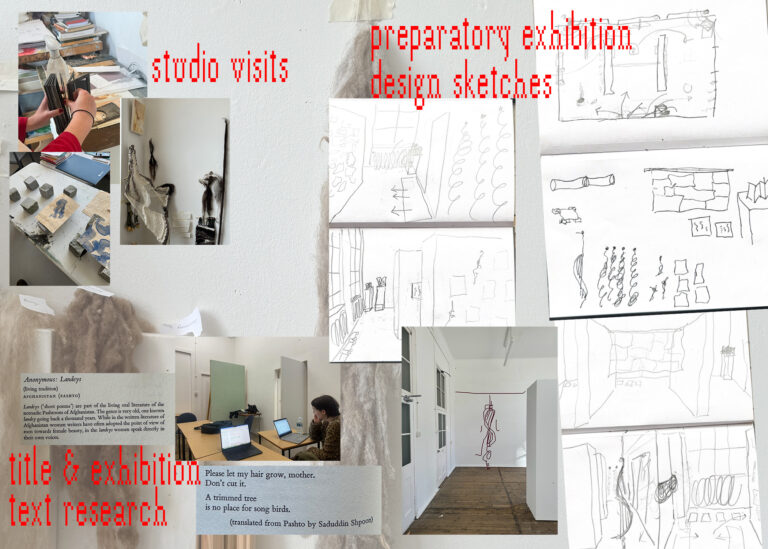
Collage of preparation research & sketches for the CAP exhibition @ Summerhall. Also featuring photos of Cosman, Carol, Joan Keefe, and Kathleen Weaver, eds. The Penguin Book of Women Poets. Harmondsworth: Penguin, 1978, pp 291-292.

a trimmed tree is no place for song birds

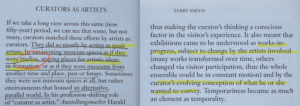
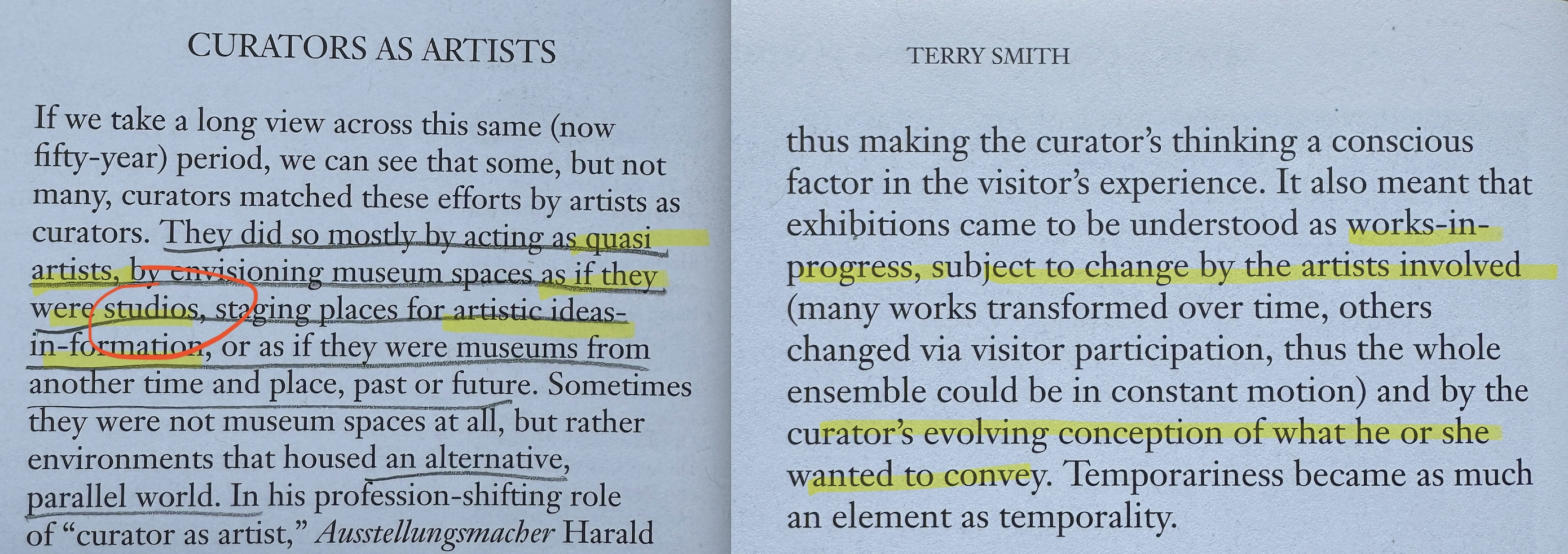
Much of my time this week has been spent preparing the exhibition of CAP students Ellie and I are curating. As such, I have been reflecting on the urge/decision to include ephemera from these artists’ practices. The making visible of this artistic research (including sketches, material studies, drawings) in many ways reflects upon my own situatedness as an artist/curator and a subliminal instinct to “[stage] places for ideas-in-formation”(Terry Smith, 131).

Image of Smith, Terry, and Independent Curators International. Thinking Contemporary Curating. New York: Independent Curators International, 2013, pp 131-132.

CAP Exhibition flyer, designed by author. Featuring personal image from studio visit in Kato’one Koloamatangi’s studio.

In many ways this ephemera could be viewed as the creation of a living archive, akin to the self archiving practice of the Woman’s Art Library. Rather than select specific objects/artefacts, our approach also reflects this non-hierarchical and ‘uncurated’ method of developing a living archive; we communicated a desire to exhibit ephemera from their practices but prompted artistic self-selection, hopefully (I will reflect on this after the exhibition in week 10) manifesting in the cultivation of dialogues surrounding this living archive in the exhibition.


This line of thought was bolstered by Siobhan McLaughlin’s notion of the artist-as-gardener (from this week’s readings) at it relates to my own situatedness as an artist curating the practices of others: given the areas of overlap between my ISCP themes and the exhibition, the process has felt akin to “sowing seeds of ideas from [my] own personal practice, growing them in collaboration with [the] invited artists, so that the exhibition is both presentation of artworks and a grown stem of artistic research”(Siobhan). 


On the Archive

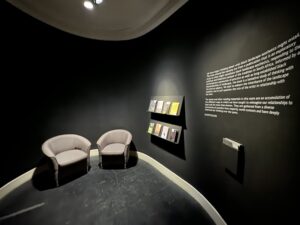
While I am unsure the place that an archive could take in my speculative curatorial project, I found that the reading room at the Talbot Rice exhibition “the dead don’t go until we do” functions in a similar manner to the archive: it “[creates] an open space for discussion to reevaluate critical issues, such as identity, trauma, testimony, collective memory… by pushing people into questioning and thinking”(Durukan & Akmehmet, 133). 


Photograph of the reading room that is a part of MADEYOULOOK’s installation Mafolofolo, 2022 – ongoing, at the Talbot Rice Gallery’s exhibition The dead don’t go until we do. Image courtesy author.


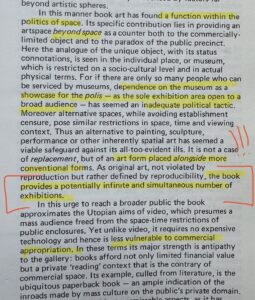
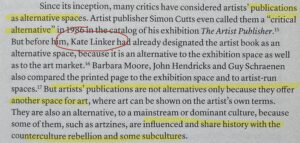
Annotated image of Linker, Kate.” The Artist’s Book as an Alternative Space.” Studio International 195, no. 990 (1980): 77.

Publication as Alternate Space

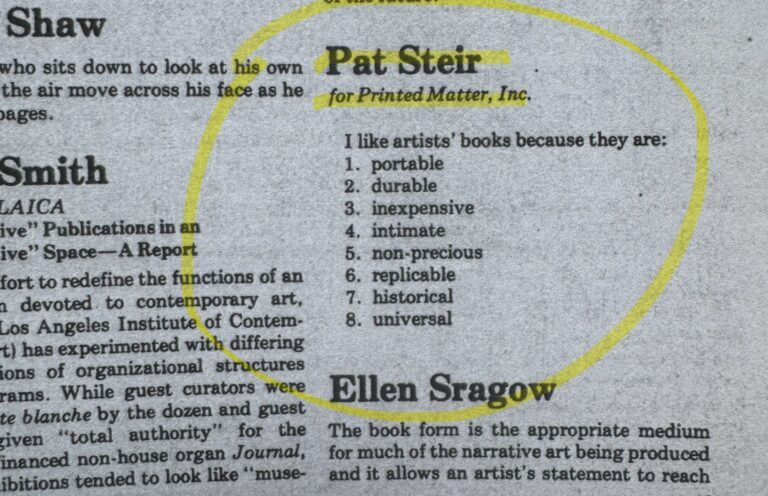
The role of the reading room in offering dialogues and dissemination brings me back to the publication as curatorial form: the art critic Kate Linker’s essay “The artist’s book as an alternative space” demonstrates the role that publications can play: “the book provides a potentially infinite and simultaneous number of exhibitions”(Linker, 77).


Admittedly, this reflects my own biases towards physical exhibition making. The temporality of exhibitions results in their fading from memory in a way that the artworks themselves (books, films, visual art, music) do not (at least for me). The living-with (books on the shelf, the soundtrack to a season of life, print-out of a painting taped on the studio wall) that art objects traditionally enable offer a prolonged and complicated experience that the physical temporality of an exhibition does not, at least without its documentation or re-shaping into a more portable, and extended form: the book. Rather than view the publication as facsimile, I am interested in it offering an extension of the themes and dialogues presented in the exhibition, further democratizing the exhibition to audiences farther afield.


Moving into next week, I am re-workshopping my title, tightening in on included artists and beginning to look at a budget, while also developing (and installing) the CAP exhibition in Summerhall.


References

Linker, Kate.” The Artist’s Book as an Alternative Space.” Studio International 195, no. 990 (1980): 75-79.

McLaughlin, Siobhan, “Artist-as-Gardener: Thoughts on artist-run spaces”, April 29, 2022, https://www.siobhanmclaughlin.co.uk/artist-as-gardener 

Smith, Terry, and Independent Curators International. Thinking Contemporary Curating. New York: Independent Curators International, 2013, pp 131-132.

Nesli Gül Durukan & Kadriye Tezcan Akmehmet (2021) Uses of the archive in exhibition practices of contemporary art institutions, Archives and Records, 42:2, 131-148. Accessed via: https://www.tandfonline.com/doi/full/10.1080/23257962.2020.1770709 


from collage of Summerhall exhibition preparation/research:

Cosman, Carol, Joan Keefe, and Kathleen Weaver, eds. The Penguin Book of Women Poets. Harmondsworth: Penguin, 1978, pp 291-292.


Week 7: Building a Village & Workshops

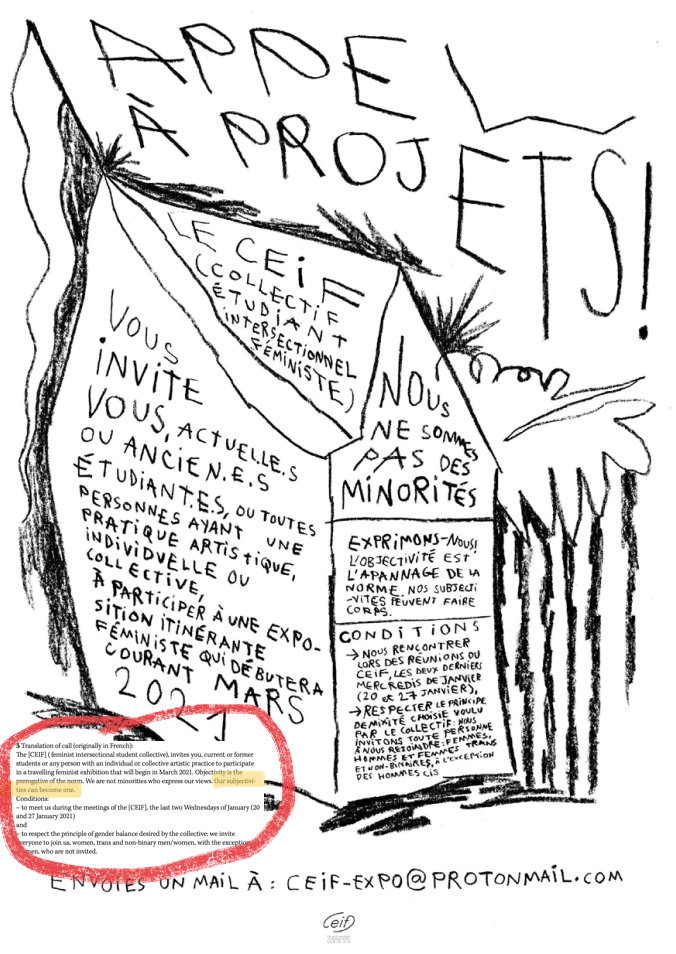
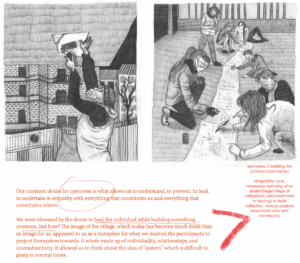
Screenshot of Bernard, Romane, et. al. “Now Imagine That We Are a Village” in Reckitt, Helena and Richter, Dorothee. eds. ‘Instituting Feminism.’ On Curating 52 (2021), pp 143. Drawing by Rose Moreau.

Call drawing by Marie Béney, from Bernard, Romane, et. al. “Now Imagine That We Are a Village” in Reckitt, Helena and Richter, Dorothee. eds. ‘Instituting Feminism.’ On Curating 52 (2021), pp 141-145.


This week, I have been thinking about the emphasis on dialogue and community that is so central to the project — and how to intertwine this in all facets of the project, before/after the exhibition itself.

Building a ‘village’

I have been greatly inspired by the text written by members of the “collectif étudiant intersectionnel féministe” (CEIF), a feminist intersectional travelling exhibition, in “On Curating 52”. They utilize the village as a metaphor and framework to underscore the necessity of collective action and community central to the project. 

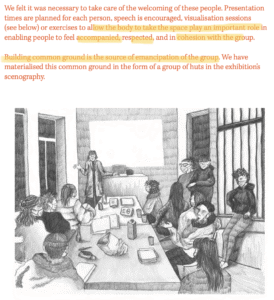
Incorporating workshops in the development of the exhibitions, CEIF leads with care: ensuring the empowerment and connection of participants in the exhibition. 

Screenshot of Bernard, Romane, et. al. “Now Imagine That We Are a Village” in Reckitt, Helena and Richter, Dorothee. eds. ‘Instituting Feminism.’ On Curating 52 (2021), pp 144. Drawing by Rose Moreau.


I am currently participating as an artist in off-page 26, a workshop/development programme in Glasgow, and have been thinking about this model of workshops/crits/dialogues leading to exhibition. Whilst the curators/organizers select artists involved, the curatorial project becomes expanded and guided by the diverse interests/practices of the collective and the (actual) dialogues of the artists.

Given the nature of my project, incorporating an artist workshop prior to the exhibition is essential. Perhaps I have been too focused on dialogues amongst publics/project, but a programme for participating artists would foster empowering dialogues and collective gathering. 

Screenshot of Bernard, Romane, et. al. “Now Imagine That We Are a Village” in Reckitt, Helena and Richter, Dorothee. eds. ‘Instituting Feminism.’ On Curating 52 (2021), pp 145.


Myvillages & Situated Practice

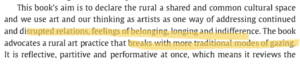
MyVillages, “Introduction” in MyVillages (eds.), The Rural (Whitechapel Gallery, 2019), pp. 12.

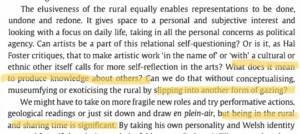
The discussion of the ‘village’ goes hand in hand with this week’s focus onsituated practices and reading on the rural; revisiting this text cemented key tenets underpinning community and access in my project, and the resonances with my own upbringing in the rural.

MyVillages, “Introduction” in MyVillages (eds.), The Rural (Whitechapel Gallery, 2019), pp. 17.

I recognize (and am critical of) my own situatedness in relation to the project themes, and as such this emphasis on “[breaking] with more traditional modes of gazing” is crucial for the success of the project. I am not seeking to “produce knowledge about others”, rather, I am devoted to the project offering opportunities for “sharing time” and dialogue, crucial for building an understanding and empathetic public/community.


Extending Dialogues

In conducting further research for the project publication, I came across Out of the Blueprint, an eco print studio actually located within Out of the Blue Drill Hall, the proposed site for the exhibition. They focus on supporting young people within the community through residencies, workshops, and training opportunities, and their printing services support these efforts. As such, they are a perfect partner to work with to print the publication, flyers, and other project ephemera. 


I would be very interested in proposing workshops through Out of the Blueprint as part of the programming to involve young artists from the local community, and will investigate this further in the coming weeks.


References

Bernard, Romane, et. al. “Now Imagine That We Are a Village” in Reckitt, Helena and Richter, Dorothee. eds. ‘Instituting Feminism.’ On Curating 52 (2021), pp 141-145. https://www.on-curating.org/files/oc/dateiverwaltung/issue52/PDF_to_Download/OnCurating_Issue52_WEB.pdf


MyVillages, “Introduction” in MyVillages (eds.), The Rural (Whitechapel Gallery, 2019), pp. 12-19


Week 6: Publication as Practice, Site Re-Thinking, and Summerhall

Publication as Practice

Photo of Chiara Figone, Paolo Caffoni, “Notes Toward a Publishing Practice” in Pichler, Michalis, ed. Publishing Manifestos : An International Anthology from Artists and Writers. Cambridge, Massachusetts: The MIT Press, 2023, pp. 310.
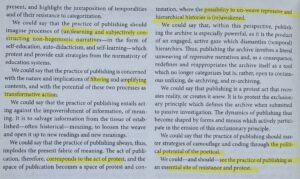
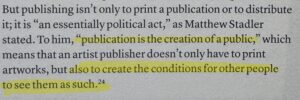
Intersecting with this week’s lecture theme, a key focus of mine is to flesh out the publication as a curated object to temporally extend and conceptually expand upon the physical project. An initial concept is to publish conversations held between the artists in small zines that are highly distributable and to employ a guerrilla distribution strategy of dispersion around the city, alongside freely accessed digital pdf’s. 
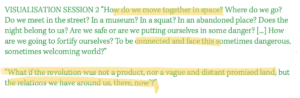
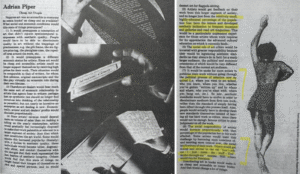
Photo of Lefebvre, Antoine. “Portrait of the Artist as a Publisher” in Bajohr, Hannes. Publishing as Artistic Practice. Second edition. Edited by Annette Gilbert. Berlin: Sternberg Press, 2017,  pp. 59.


Collage of Pichler, Michalis, ed. Publishing Manifestos : An International Anthology from Artists and Writers. Cambridge, Massachusetts: The MIT Press, 2023, pp. 61-62.

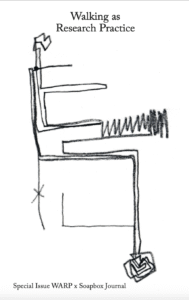
Cover of Gommes, Lynn, author Walking as Research Practice Conference, and Soapbox. “Walking as Research Practice : A Special Issue Resulting from the WARP Conference (September 2022) /.” Fourth edition. Edited by Lynn Gommes. Amsterdam: Roma Publications, 2025.


I am also inspired by how the ‘Walking as Research Practice’ publication widens the dissemination of a research conference through a publication that incorporates new material whilst functioning as an art object.


Further Site Research

Dalmeny Street Park has hosted guerrilla Go Skateboarding Day events over the past few years, some of which resulted in negative community feedback and locals reaching out to the council, forcing a temporary removal of the skate ramps. I discovered a community Facebook group I could coordinate with, but these responses do not set a positive precedent for the project.


As an alternative, Out of the Blue Drill Hall seems like a space well suited for the project — located a mere half block down the street, it maintains a more casual and approachable atmosphere than a traditional white cube space, due to the cafe and various studios on site. The space is also very affordable (375/week), which could allow the exhibition a longer duration whilst also still hosting performances and programming. Given the proximity, these events could still exist in Dalmeny to expand the project out-of-doors in a less-invasive and lower-risk manner.


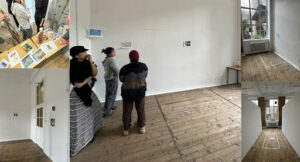
Collage of personal photos, Jí Jū Collective analyzing & installing mock-hang in Summerhall

Jí Jū in Summerhall

This week, the collective all brought printed photos of artworks and we installed a mock exhibition, a fun exercise to grapple with issues of how to curate an exhibition of incredibly diverse works while considering spatial dynamics at play and how to “hold the space.”


We discussed a possible curatorial project where we all bring non-art objects that remind us of home, curating these objects in what is our adopted ‘shell’ — Summerhall, which could be followed by a zine in which photographs of these objects function as a portrait of our collective, the publication becoming the next iteration of our occupied ‘shell.’ 


References

Photo of Lefebvre, Antoine. “Portrait of the Artist as a Publisher” in Bajohr, Hannes. Publishing as Artistic Practice. Second edition. Edited by Annette Gilbert. Berlin: Sternberg Press, 2017, pp. 61.

Lefebvre, Antoine. “Portrait of the Artist as a Publisher” in Bajohr, Hannes. Publishing as Artistic Practice. Second edition. Edited by Annette Gilbert. Berlin: Sternberg Press, 2017, pp. 52-61.

Pichler, Michalis, ed. Publishing Manifestos : An International Anthology from Artists and Writers. Cambridge, Massachusetts: The MIT Press, 2023.

Gommes, Lynn, author Walking as Research Practice  Conference, and Soapbox. “Walking as Research Practice : A Special Issue Resulting from the WARP Conference (September 2022) /.” Fourth edition. Edited by Lynn Gommes. Amsterdam: Roma Publications, 2025.


Week 6: Curatorial Pitch

Try to praise the mutilated world (wip title)


My proposed curatorial project will involve an outdoor public art exhibition alongside programming including music performances, a panel discussion, a reading group, and publication. The project offers cross-cultural dialogues to explore the ways in which identity and culture in diasporic experience is enmeshed in the folklore, religion, and wider culture of their adopted locales. At its core, the project is rooted in encouraging participation and bringing necessary dialogues into the public sphere(literally, in this case); cross-cultural conversations exploring diasporic experience and identity are foundational to building more accepting, understanding, and inclusive cultures and populations.


The proposed title for the project is try to praise the mutilated world. The title is inspired by a poem of the same title by Adam Zagajewski, a Polish poet whose work explores migration and the refugee experience. Whilst recognizing the fraught state of a world that remains divided by borders and conflicted immigration policies, Zagajewski’s work offers a rallying cry of hope, a necessary revolt to ever-present political atrocities.


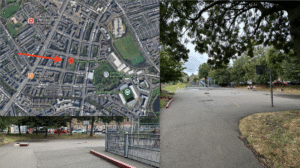
Dalmeny Street Park, collage of images and Google Maps screenshot


I am tentatively planning on the exhibition taking place in Dalmeny Street Park, off of Leith Walk in Edinburgh, for many reasons: for one, the park is situated in one of the more diverse neighborhoods in the city, in which many diasporas interact and exist together. There is a near-constant flow of people walking by the site, whether to the tram on Leith Walk, walking their dogs in the dog-park, skateboarding/playing football in Dalmeny, or kids going to the playground.


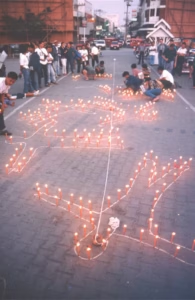
Sunthorn Meesri, bot bat sommut (role play), 1993, performance at Tha Pae Gate, Chiang Mai. Image courtesy Uthit Atimana and Gridthiya Gaweewong


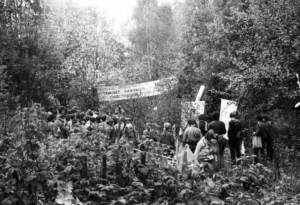
View of ‘APTART Behind the Fence’, 1983. Image via: https://www.afterall.org/articles/introduction-anti-shows-david-morris/

My inspiration for the exhibition taking place outside in the landscape came from both the Chiang Mai Social Installation festivals throughout the ‘90s and the APTART ‘anti-shows’ that existed in the natural landscape (whereas CMSI existed in urban fabric). Given the themes I am exploring in the project, a more traditional white cube or exhibition space could of course be at risk of becoming didactic, but crucially it opposes the project’s goal of encouraging dialogue and discourse. Bringing it out into the urban fabric further offers opportunities for passers-by to casually encounter the work, kids playing in the adjacent playground to bring their parents in, and the assemblage of forces at play around the site to inform and affect the work. 


ARTISTS

ihsan saad ihsan tahir – WESTERN SUNRISE


The exhibition will include a number of artists practicing in the UK who explore themes that expand upon my project theme, from diasporic identity, crosscultural dialogues, to drawing transnational kinship between folklore and the landscape. These artists work in a variety of media, though installative and sculptural works will be best suited for the space and ethos of the project.


Mengwei Chen – Ghost in the Shell

Nidhi Bodana – Nomadic Life


Mia Kokkoni – Travellers (2025)

Kato’one Koloamatangi – ‘To Pa’


Alvi Östgård – Savn 


http://www.kinaara.co.uk/


Alvi Östgård’s ‘Death in a Nutshell’ project incorporates endangered Scottish sheep wool and cast hazelnuts, and is inspired by a Scottish/Nordic folktale in which death is trapped in a nutshell.

Kato’one Koloamatangi’s practice explores cultural identity as a Tongan w/ sculpture & sound installations, inspired by a sculptural work which she describes as a ‘doorway to memory’, exploring family, history, and memory.

Mia Kokkoni’s paintings depict imagined landscapes equally inspired by the flora and landscapes of Greece alongside adopted landscape of Scotland, fusing Celtic and Greek folklore and culture.

Nidhi Bodana, an artist from India (state o/Madhya Pradesh) is a performance/installation artist whose “work seeks to heal, empower, and bring visibility to what has been silenced, overlooked, or rendered invisible”… “the work becomes a site of healing, visibility, and reclamation, inviting audiences to move from passive viewing to active witnessing, from silence to solidarity”(source: artist’s website). 

Mengwei Chen’s work Visitant reflects Chen’s practice which explores East Asian traditional art and folkloric themes as they intersect with contemporary narratives in literature, comics, and social media.

ihsan saad ihsan tahir explores notions of class, cross-cultural exchange, displacement and masculinity in sculpture and installation works, such as WESTERN SUNRISE which includes an installation in the landscape.

The band Kinaara fuses Punjabi and Celtic folk music to explore the richness of these musical traditions, that which on the surface may seem to be highly dissimilar, but the band exposes the intersections of these genres.


The exhibition would only exist over a weekend given the nature of the show existing outdoors, but a chapbook-style DIY publication would extend the longevity of the project. I intend on inviting participating artists to contribute writings about other artists’ works, interviews between artists, as well as including works of writing related to the themes of the project.

Questions:


  • Concerns about exhibition taking place outside? (weather, accessibility, ‘security’ of works?)
  • Perspectives on asking artists to create site-specific works?


References

Try To Praise the Mutilated World – Adam Zagajewski


Week 5: “Anti-shows,” the Public Park as Exhibition, and Site Research

APTART

In further research into curatorial practices this week I came across the APTART “anti-shows” that were put on in the early 80s in Moscow.1
While these were in direct response to a political and art ecosystem that only provided exhibition opportunities for Social Realist works, this self-organizing group reflects the power of alternative exhibition formats and spaces to build community and spaces for dialogue (central to the ethos underpinning my curatorial practice):

Image of text from Anti-Shows : APTART 1982-84, pp. 


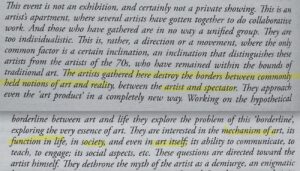
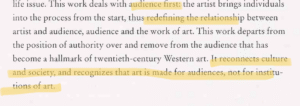
In particular, the ‘APTART en plein air’ and ‘APTART Behind the Fence’ shows in May and September ‘83, respectively, are highly influential as they use the natural landscape to situate their show. Engaging with installations, paintings, performances, and participatory works while traversing public grassy fields or wooded trees is a much different experience than the sterile white cube. As Mary Jane Jacob so aptly states when discussing the “new public art”, “for the meaning of this art to be conveyed, its presence in public is essential. It is not art for public spaces but art addressing public issues.”2


Screenshot of Mary Jane Jacob, “Mapping the Terrain: New Genre Public Art”, pp. 54.


Superflex/Public Park as Exhibition Site

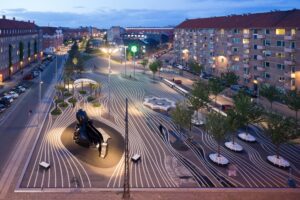
My mind immediately goes to SUPERFLEX’s involvement in the Superkilen Park in Copenhagen, DK, in which the collective invited groups from the 50+ nationalities living in the immediate vicinity of the park to nominate objects relevant to their culture or national origins to be permanently installed in the park.3 This decision to open the curation of these installations unto publics to integrate their diaspora into the built environment reflects a positive participatory project relevant to my curatorial themes, though I question the project’s goal of an “urban version of a universal garden.”4 Does this conveniently instrumentalize the diversity of a neighborhood to publicly oppose the negative wide perception of a homogenous Denmark that wants to remain so?5 Regardless, the work emphasises the need of public programming to foster discourse and bring diverse publics into fruitful dialogues; while this cultural assemblage is visually striking, workshops, readings, performances, screenings, and other sites of gathering are needed to foster meaningful dialogue.

The black square. Superkilen, 2012. Photo: Iwan Baan


Collage of google maps screenshot and personal photos of Dalmeny Street Park

Ultimately, I have come to the conclusion that my project should exist in a public park. An initial public site that comes to mind is Dalmeny Street Park off of Leith Walk, for a few primary reasons:

  • Diverse surrounding community
  • Variety of users/uses (DIY skateboarding spot, football/basketball courts/kids playground/dog park adjacent)
  • Well trafficked


Our workshop with the CAP students in our weekly planning session cemented my project themes — when discussing her practice, Alvi aptly summed up a key aspect of my interests in exploring diaspora’s relationship to adopted cultures — you “[learn] more about your own culture by engaging with others.” Both her and Kato’s practices seem perfectly suited for the project, and I intend on including their works in my speculative project. 


Questions/research inquiries going into next week:

  • While leaving the white cube increases social and physical accessibility, where does it limit access? 
  • How to display non-installative or sculptural work in public? (ie: film, painting…)
  • What permissions are needed for public sites?


References

  1. See Tupitsyn, Margarita, Viktor Agamov-Tupit͡syn, David Morris, and sponsoring body Bard College. Center for Curatorial Studies. Anti-Shows : APTART 1982-84. Edited by Margarita Tupitsyn, Viktor Agamov-Tupit͡syn, and David Morris. London: Afterall, 2017.
  2. See Mary Jane Jacob, “Mapping the Terrain: New Genre Public Art, in Lacy, Suzanne. Mapping the Terrain : New Genre Public Art. Seattle, Wash: Bay Press, 1995, pp. 54.
  3. See BIG, Topotek 1, & Superflex. (2012). Superkilen [Park]. Copenhagen, Denmark.
  4. See Frearson, Amy. “Superkilen by Big, Topotek1 and Superflex.” Dezeen, September 9, 2014. https://www.dezeen.com/2012/10/24/superkilen-park-by-big-topotek1-and-superflex/.
  5. For more information regarding the Danish government’s contested classification and treatment of immigrant communities, particularly in Norrebrø (where Superkilen is located), see https://www.lowyinstitute.org/the-interpreter/eu-court-sets-back-denmark-s-ghetto-laws.


Week 4: Contributing to the Collective & Kicking Off Artist Research

Ji Jū Collective

Screenshot of text from MyVillages, “Introduction” in MyVillages (eds.), The Rural (Whitechapel Gallery, 2019), pp. 12-19.

This week we met to draft a mission statement and outline our curatorial ethics manifesto, a practice that highlighted the rich opportunities and difficulties of working in a collective. When faced with differing opinions, such as how we feel about AI usage or artists’ pay, it was at times difficult to reach a consensus without certain voices silencing themselves given their opinion being in the minority. Whilst we arrived at a solid foundation for both tasks, next week I want to discuss with the collective ways of decision making that could be more democratic while encouraging dissenting opinions (splitting into smaller groups to deliberate vs. open forum).


One of our biggest issues is varying levels of participation, often resulting in my being the most vocal leader and decision maker, which innately introduces concerns over bias and the collective not functioning entirely democratically. How can I take a step back, while ensuring we still meet, discuss, and move our collective forward? 


Independent Curatorial Project

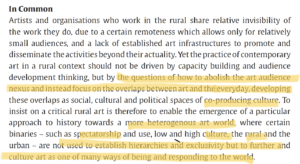
The highlighted text from this week’s reading above (The Rural)1 reflects and expands upon my curatorial mission (stemming from my formative years in the rural), to break art out of the echochamber of art audiences and integrate art into the everyday, to “co-produc[e] culture.”2 That is not to say that I seek to instrumentalize the artworks — something I seek to remain conscious of. On this topic, I attended a reading group at Embassy Gallery this week in which we discussed two essays: Rubenstein’s “Provisional Painting” and Chris Sharp’s “Theory of the Minor.”3,4 Notably, Sharp discusses the idiosyncratic nature of “minor” painting as a rejection of the “major”’s usage of representation, allegory, and language (which all allow, if not encourage, instrumentalization or co-opting of the work). In my own curatorial work, I intend to pair the mission of the rural with the project5 of the minor.


Screenshot from Chris Sharp, “Theory of the Minor” in Mousse 57 (February 2017), pp. 224-231.


As J.L. offered a much-needed reminder in this week’s collective planning meeting to not over-conceptualize before researching artists, these texts (and conversation) have encouraged me to begin deeper research into artists who I would want to include in my ‘exhibition’ and wider programming, to ensure I do not treat artists like puzzle pieces to allegorize or instrumentalize the wider project. ihsan saad ihsan tahir’s WESTERN SUNRISE and Mengwei Chen’s Visitant have already begun shifting the wider project and I certainly hope to include these works in the curatorial project (more on these works & context in subsequent blogs).


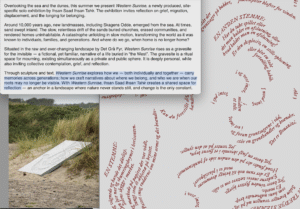
Collage of exhibition text and works, ihsan saad ihsan tahir, WESTERN SUNRISE, SKAL Contemporary, Skagen, Denmark, 2025

Attending an opening of the show “Band Members Wanted” at Whitespace this week emphasized the importance of performance/live events and cemented my decision to include public programming throughout my ‘exhibition’. As such, I have begun researching writers, musicians, and performance artists to include in an ongoing programme. An incredible discovery was the Leeds-based band Kinaara, who blend Celtic and Punjabi folk music, reflecting the lead singer Satnam Galsian’s Punjabi heritage and UK upbringing; their music serves as a dialogue between these two distinctly rich cultures.

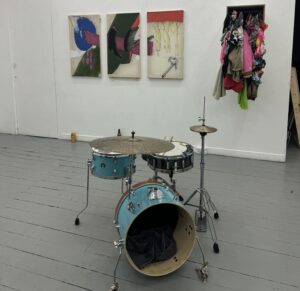
Image courtesy author, photo of Band Members Wanted, exhibition at Whitespace Gallery, Edinburgh, UK, 2025


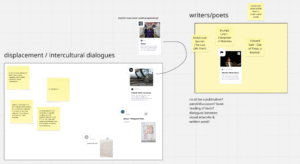
Going into next week, I intend to explore sites in which my curatorial project could take place, continue researching artists, and work through texts on the subject of diaspora and displacement I have gathered (see Miro Board). 


Screenshot of personal Miro Board, 2025


References

  1. Central to my curatorial ethics and vision for my independent project aligns with this prospect set forth in the text; to create a “more heterogenous art world” where “binaries… further and culture art as one of many ways of being and responding to the world.” Whilst I am keenly aware of my particular situatedness in the (art)world (ie: pursuing a Postgrad in Contemporary Art Theory, having levels of education, access, and privilege), I find myself actively critical of institutions, exhibitions, and artworks that do little to speak beyond the confines of an art world, dividing what “is” art from what “isn’t”… In that art is uniquely situated to offer perspective, dialogue, and context, it carries immense power to connect audiences across their ‘differences’: to offer spaces of dialogue and cultural intersection to inspire empathy and understanding. See MyVillages, “Introduction” in MyVillages (eds.), The Rural (Whitechapel Gallery, 2019), pp. 12-19.
  2. Idib.
  3. See Raphael Rubenstein, “Provisional Painting”, in Art in America, May 1, 2009.
  4. See Chris Sharp, “Theory of the Minor” in Mousse 57 (February 2017), pp. 224-231.
  5. Project here is meant to imply the wider mission of the minor, if one were to exist. This is not meant to be confused with an artist’s wider project guiding their practice and works. For more info, see Barry Schwabsky, “Object or Project? A Critic’s Reflections on the Ontology of Painting” in Petersen, Anne Ring, et al., editors. Contemporary Painting in Context. Museum Tusculanum Press, 2010.


Week 3: Curatorial Ethics

Following this week’s seminar, I have begun considering how I would define my curatorial ethics. I was really struck by Dr. Meng Shi-Chen’s conclusion in his essay “Ethics of Curating”, that the goal of an ethics of curating may be “to empathetically uncover the hidden knowledge swept under the carpet, making the invisible visible, without sacrificing the poetic potential of art.”1 In relation to Pratt’s notion of “contact zones”2, and particularly in a contemporary context defined by continually restricted immigration policies and political division spurring an ‘othering’ of any group that carries different social, political, or religious values than one’s own, my interest in alternative formats to the white cube reflects the need (and unique opportunity) for ‘art’ spaces to foster intercultural, intersocioeconomic, international, and translocal3 dialogues. Art has the incredible opportunity to spark dialogue and inspire empathy4, and as such, I seek to bring these dialogues ‘out’ into the community — physically and ephemerally.


I discovered an interesting intersection in the discussion of aesthetics in Reilly and Martinon’s texts, where the former defines the “Eurocentric standards of “taste” and “quality”” to be “ the code words of sexual/racial indifference and exclusion”5 and the latter prescribing aesthetics to be an “institutional narrative” of the “old-school curator”6. As Martinon discusses the widened scope of curating beyond art worlds, aesthetic taste has invariably been democratized through social media and the internet, yet auction houses, galleries, and major institutions continue to reflect Eurocentric standards of taste that need to be questioned and challenged. It is a reminder to actively question my own ‘tastes’ as I approach my own curatorial practice.


Ultimately, my curatorial ethics is defined by a few key pillars: to (1) continually question my own personal biases and interests, (2) defend and protect artists’ voices, practices, and work (and ensure they are not anesthetized by institutional concerns), (3) never speak for others, rather, to use curation to amplify or spark dialogue between voices, (4) not “renounce [my] responsibility… because of structural flaws”7, and (5) to continually return to these pillars, as an ethics of curating (as with anything in life) must be actively reconsidered and adapted.

Screenshot of personal Miro Board.


Following James Clegg’s workshop, I was inspired to start my own Miro board to consolidate and organize my ideas for ‘exhibitions’ and begin building connections between curatorial concepts and artistic practices. A seemingly simple statement James made in the workshop really struck me: that an exhibition must always be able to visually and spatially “hold a room”. Must it?

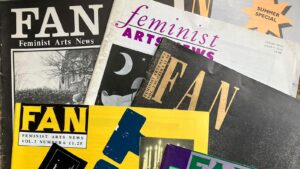
FAN Covers, Flyer for Victoria Horne’s lecture on “Feminist Arts News and the UK Women’s Art Press”, as part of the History of Art Research Seminar Series at the University of Edinburgh.


Attending Dr. Victoria Horne’s talk this week on FAN (Feminist Arts News) magazine has inspired research and a line of thought that will lead into next week; in particular, I found the structuring of the publishing collective as well as the notion that “feminine subjectivity emerg[ed] through work”8 to be highly influential. For each issue, a new editorial team volunteered to curate, produce, and organize the contents of that issue, which would be collated and distributed by a central ‘business collective.’ As a result, the overall curatorial mission was guided and sculpted by its participating members and publics; the publication serving not to make definitive statements about Feminist art & culture from a centralized group, rather to serve as a platform for the decentralized dissemination of the movement’s interests. How could a publication ‘extend’ an exhibition and bring it forward, being continually molded and reshaped by its involved members? 


Notes

  1. See Chen, Meng-Shi. ‘Ethics of Curating.’ Curatography. The Study of Curatorial Culture 5 (2021). https://curatography.org/5-3-en/ 
  2. Pratt defines contact zones as “social spaces where cultures meet, clash, and grapple with each other, often in contexts of highly asymmetrical relations of power, such as colonialism, slavery, or their aftermaths as they are lived out in many parts of the world today.” See Mary Louise Pratt, “Arts of the Contact Zone,” in Ways of Reading, 5th edition, ed. David Bartholomae and Anthony Petroksky (Bedford/St. Martin’s, 1999). Accessed via: https://gato-docs.its.txst.edu/jcr:c0d3cfcd-961c-4c96-b759-93007e68e1f0/Arts+of+the+Contact+Zone.pdf
  3. “The artists’ gatherings may have been transnational but their guiding ethos was translocal, an affirmative localism that did not limit their broader, international outlook, but on the contrary was an important footing of their cosmopolitanism” See CHIANG MAI. (44).
  4. I find Chismar’s discussion of empathy critical in relation to curating and curatorial care, particularly when engaging with subject matter/themes that fall outside of a curator’s direct lived experience. This also reflects the need for dialogue to spark empathy amidst widening social, political, & economic division: “In the case of empathy, familiarity with the recipient and his situation is the chief parameter, whereas for sympathy, agreement with the recipient, liking him and what he stands for—appear to be the important variables.” See Douglas Chismar, “Empathy and Sympathy: The Important Difference” in Journal of Value Inquiry 22(1988): 261-2. 
  5. See Reilly, Maura. Curatorial Activism: Towards an Ethics of Curating. London: Thames & Hudson, 2018, pp.214-225.
  6. See Martinon, Jean-Paul. Curating as Ethics. Minneapolis and London: University of Minnesota Press, 2020, pp. vii.
  7. See Schuppert, M. (2021) ‘Learning to Say No, the Ethics of Artist-Curator Relationships’, Philosophies, 6(16), pp. 1.


Week 2: Breaking out of the White Cube

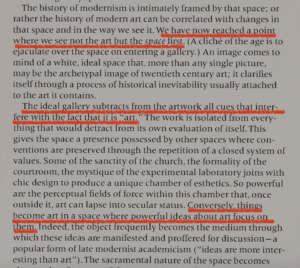
This week I want to start getting the ball rolling on developing curatorial themes beyond just methods of engagement & curation — in that vein, a first idea is an exhibition in which all work has to be made within the ‘gallery space’ throughout the duration of the show, shifting the gallery into a shared studio space of sorts. I put gallery space in quotes as this can encapsulate off-site public art or installations that are developed concurrently, inhabiting the broader conceptual ‘gallery space’. In this way, the exhibition can be used in a bespoke way by participating artists: as a residency, a site for duration-based performance works, a fabrication shop, a hub for ongoing participatory artworks… I have often had friends who come into my own studio in the past comment on how ‘inviting’, ‘warm’, or ‘inspiring’ the space is. Why, then, are many (if not most) art-viewing venues designed to be sterile, boring, and lifeless? (see highlighted quotes in figure 1).


Figure 1: O’Doherty, Brian. “Inside the White Cube”, The Lapis Press, 1986. p.14


I am continually (negatively) struck by the ways in which art institutions plaster over and sterilise the incredibly unique architectures of the historic spaces they inhabit, evident when I recently visited the National Museum of Scotland Modern One (on the contrary, Anselm Kiefer’s installation at the Palazzo Ducale during the 2022 Venice Biennale notably left the building’s Venetian Gothic architecture and grand frescoes on display; more befitting than the sparse warehouses or grand white walls his work is typically shown in). In my curatorial work, I am more interested in getting non-art publics excited about and interested in art than presenting work to an art audience that, for the most part, will go out of their way to attend a gallery opening. In an ongoing, constantly developing ‘exhibition’, publics are inspired to engage in or consider how they can engage with the themes being actively developed and explored in each artist’s practice. 

Of this week’s arts organizations I researched I was most inspired by Arts Catalyst and Taipei Biennial’s curatorial missions and executions. Arts Catalyst’s community-driven focus on social action and art as a means of opening up learning to publics highlights the opportunities of bringing art out into the world, from a community gardening project to an English language book created by and for the refugees and asylum seekers of Sheffield. How does this level of participation and engagement alter publics’ perspectives on the role art can play in their lives – and the world? 

The inclusion of a music room at the Taipei Biennial is another inspiring curatorial format as it innately invites a different intersection of publics into the space; people crave third spaces and community, while paradoxically digital fatigue makes the planning and execution of social events (like going to visit a gallery) difficult. Bringing publics in with concerts, artist talks, workshops, or community engagement events can be an effective way to engage publics by ‘meeting them where they are’ in a way. 

In Maria Lind’s e-flux article “Situating the Curatorial”, when discussing an interview with Irit Rogoff on curation, she explains that “curated events contain epistemological processes and are presentational rather than representational, a distinction that Rogoff credits to the visitors to an exhibition”(see Lind). Lind goes on to state that “the curatorial goes beyond “roles” and takes the shape of a function and a method, even a methodology”(see Lind). This is clearly evidenced by organizations like Grizedale and Arts Catalyst, and I am curious to explore how I can move beyond my presupposed notions of curating into approaching it as a methodology.

Over the next week, I plan on researching further into Lind’s notion of “contact zones” as developed by Mary Louise Pratt and James Clifford to deepen my knowledge and develop methodologies of creating zones of meaningful conversation, interaction, and knowledge sharing between publics&art, art&art, and publics&publics.


Notes


Lind, Maria. “Situating the Curator”, e-flux Journal #116, https://www.e-flux.com/journal/116/378689/situating-the-curatorial 

Rogoff, Irit and Bismarck, Beatrice von, “Curating/Curatorial: A Conversation Between Irit Rogoff and Beatrice Von Bismarck,” in Cultures of the Curatorial, ed. Beatrice von Bismarck, Jörn Schafaff, and Thomas Weski (Berlin: Sternberg Press, 2012), 23

https://artscatalyst.org/?NoSplash 

https://www.taipeibiennial.org/2023/list/musicroom 

https://palazzoducale.visitmuve.it/en/exhibition/exhibition-anselm-kiefer/ 

https://www.rollingstone.com/music/music-features/speedrunning-hip-hop-1234968918/


Week 1: from Chiang Mai Social Installation to Maintenance Art


This has been a fun week of jumping right into the world of curating. 


One of the highlights of the readings for this week was Ana Bilbao’s essay on micro-curating and SVAOs. I have always had a bias towards the DIY and the freedom that being independent permits; while they admittedly appeal to my own tastes and prejudices, I firmly believe that SVAOs are much more powerful than storied institutions or blue chip galleries at engaging publics and supporting artists.


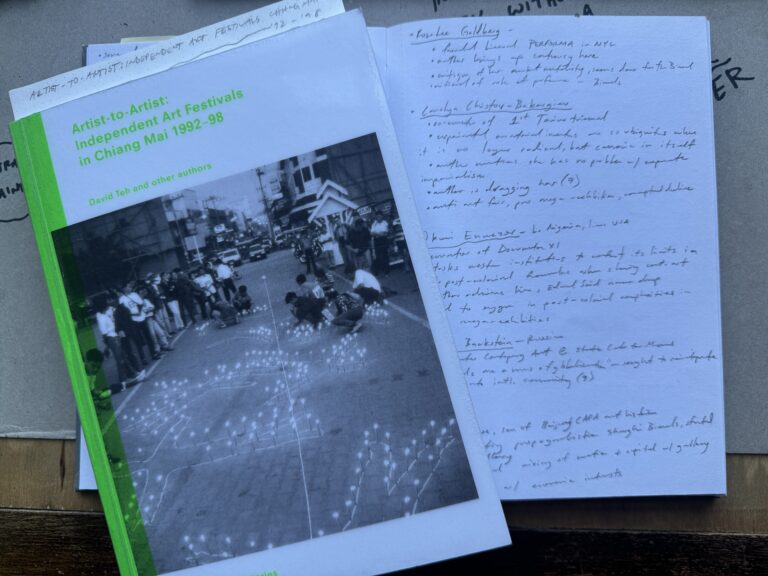
As it is referenced in Bilbao’s essay, I was inspired to pick up a copy of David Teh’s book on the Chiang Mai Social Installation (CMSI) festivals of the 90s to extend my interest in activating publics outside of the walls of the gallery. Teh states that “‘installative’ practices do not merely expand the framework of ‘exhibition’ but decenter and recenter it”, further asking the question “what is the encounter that really matters when artists share their work? Is it not the social more than any material exchange?” (Teh 10). Funny enough, this reflects my interests in the role of curation, while also challenging my background as an artist that primarily makes objects that do not inherently involve publics in the way that installation, conceptual, or participatory art practices do. 


This raises a critical question I want to explore in my own curatorial practice: how can curation build authentic relationships between publics and artworks that do not innately foster participation or engagement? Performance invites participation through the relationship of performer/audience and performer/site… a painting on a white wall or film projection in a quiet back room of a gallery do not share that same sense of invitation and participation. What happens when you put paintings on free-standing walls in a public square? Or disseminate a film via USB – or airdrop?


On engaging publics, I also researched Mierle Ladermen Ukeles’ practice as I had somehow never heard of her. Her Maintenance Manifesto is incredibly inspiring, particularly the relationship between development and maintenance she proposes. In an interview, Ukules mentions that after becoming a mother she “fell out of a certain class and moved into another. And when I looked around, I saw that most of the people in the world were also in that class, that they were workers too”(Afterall Interview). Becoming a mother extradited her from the art world, and into the maintenance world. While much has changed since the ‘70s, Broken Globalization, the Capitalocene, and centre/periphery discourses highlight how the division between oppressor/oppressed and insider/outsider has only widened. 


Curation can make visible these divisions — and potentially — work to collapse these gaps by bringing the periphery in, pushing the centre out, and seeking to build community, connections, and understanding rather than propagate division. 


Notes

Afterall. n.d. “Mierle Laderman Ukeles in Conversation with Alexandra Schwartz.” Afterall. https://www.afterall.org/articles/mierle-laderman-ukeles-in-conversation-with-alexandra-schwartz/

Bilbao, Ana. “Micro-Curating: The Role of SVAOs (Small Visual Arts Organisations) in the History of Exhibition-Making”, Notebook for Art, Theory and Related Zones, issue 25, 2018, pp. 118-138

Teh, David. Artist-to-Artist : Independent Art Festivals in Chiang Mai 1992-98. London: Afterall Books, 2018.

The Brooklyn Rail. “MIERLE LADERMAN UKELES with Maya Harakawa | the Brooklyn Rail.” Brooklynrail.org. The Brooklyn Rail. August 19, 2024. https://brooklynrail.org/2016/10/art/mierle-laderman-ukeles-with-maya-harakawa/

Ukules, Mierle Laderman, “Maintenance Art Manifesto”, 1969, accessed via: https://queensmuseum.org/wp-content/uploads/2016/04/Ukeles-Manifesto-for-Maintenance-Art-1969.pdf