Speculative Independent Curatorial Project Proposal
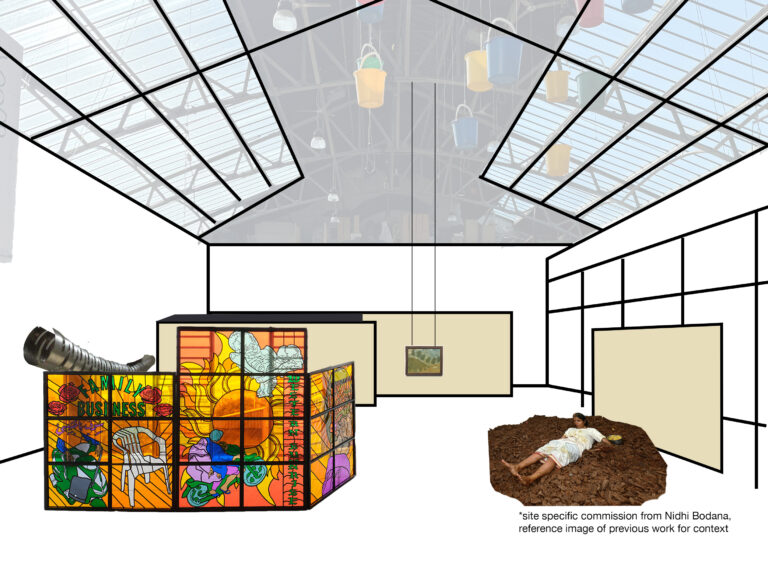
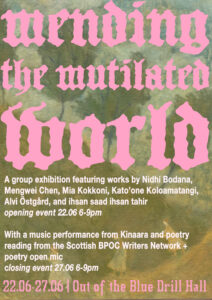
Mending the Mutilated World
Out of the Blue Drill Hall, Edinburgh, UK
June 22-27th, 2026
Curatorial Narrative Text
Mending the Mutilated World is a group exhibition that explores the intersection of diasporic identity and the adopted landscape, folklore, and culture of the UK. Amidst tightening restrictions on global mobility and rising anti-immigration sentiments across the country, intercultural dialogues are crucial to building more understanding and inclusive communities. This exhibition brings together the works of artists practicing in the UK who treat the complicated relationship between diasporic identity and belonging as material, revealing intricate connections across borders and between diverse cultural traditions.
Through installation, performance, film, sculpture, and painting, these artists transform cultural symbols, texts, and iconography into works that resist narratives of division. From ihsan saad ihsan tahir’s exploration of Arab representation and Kato’one Koloamatangi’s exploring the in-between as a Tongan woman in the UK to Nidhi Bodana’s reclaiming of silenced voices, each artist explores the unique ways in which identity is enmeshed within their adopted culture. Where Mia Kokkoni and Alvi Östgård’s practices explore the natural environments of ancestral and adopted landscapes, Mengwei Chen reinterprets East Asian folklore through contemporary mass media. Kinaara’s fusion of Punjabi and Celtic folk music, meanwhile, demonstrates the ability of intercultural collaboration to offer new creative possibilities.
The title for this exhibition is inspired by Polish poet Adam Zagajewski’s “Try to Praise the Mutilated World.” Inspired by living much of his life in exile, he paradoxically implores readers to recognize both the sheer beauty of the natural world and the destruction of human violence and cruelty. He writes:
“[…]Remember June’s long days,
and wild strawberries, drops of rosé wine.
The nettles that methodically overgrow
the abandoned homesteads of exiles.
You must praise the mutilated world[…]”
Amidst a contemporary world that often feels mutilated beyond repair and unworthy of praise, intercultural dialogues are a tool against division. The artists in this exhibition invite us to mend the mutilated world, one conversation at a time.
Artists & Participants
ihsan saad ihsan tahir is an artist based in London and Copenhagen whose work explores cross-cultural exchange, migration, masculinity, and displacement. Through sculpture, painting, drawing, and writing, tahir uses classic sculptural forms to transform contemporary and cultural symbols, texts, and icons into new connotations and representations. His work WESTERN SUNRISE (the fifth column) draws on gothic and hip hop aesthetics, using the form of stained glass common in London to explore and challenge the systems of representation of Arab bodies in the west.
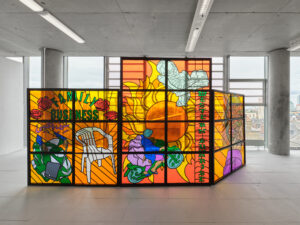
ihsan saad ihsan tahir, WESTERN SUNRISE (the fifth column), 2026. acetate, cardboard, hot glue, tape and wood
Nidhi Bodana is a multidisciplinary visual artist originally from Bagh (Dhar), Madhya Pradesh, India, now based in Glasgow. Bodana’s socially engaged practice includes sculpture, performance, participatory art, installation, and activism, reclaiming spaces to heal, empower, and bring visibility to voices and bodies silenced by systemic neglect. Her work creates spaces where suppressed narratives are not passively viewed by audiences, but are felt, shared, and transformed. For the exhibition I am commissioning a new performance and installation work from Bodana; her works You Make Up Me and Until When serve as precedents for this work, demonstrating how her socially-engaged practice centers marginalized bodies to offer sites of healing and intercultural dialogues.
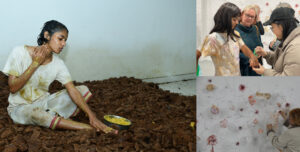
Collage of performance and installation works that serve as precedent for commissioned site-specific work. Images of works You Make Up Me and Until When.
Mengwei Chen is an artist based in London whose practice reinterprets East Asian folklore, sorcery, and ceremonial traditions through a contemporary lens. Chen uses painting, installation, and traditional papercutting to reinterpret aspects of the past through popular culture, such as anime and manga. Fading cultural influences intersect with contemporary iconography, resulting in work that often revolves around ghosts, rituals, and illusions. Ghost in the Shell pairs a manga figure on a hologram fan within a 3D printed shell, presenting a hybrid of traditional and contemporary iconography.
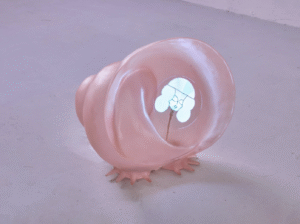
Mengwei Chen, Ghost in the Shell, 2026. 3D print and hologram fan
Kinaara is a three-piece band based in Leeds whose music combines Punjabi and Celtic folk music, exploring the relationship between these rich musical cultures. Formed in 2018, singer Satnam Galsian sought to create a sound that reflected her identity, bringing together her Punjabi heritage and UK upbringing. Their music demonstrates the rich creative opportunities exposed through intercultural dialogues. The band will play during the closing night of the exhibition, offering a celebratory conclusion to the exhibition. You can listen on the band’s website: http://www.kinaara.co.uk/.
Mia Kokkoni is a Glasgow-based Greek painter whose work depicts hybrid landscapes that fuse Celtish folklore and a nostalgic, remembered landscape. These imaginary landscape paintings fuse the environment of her adopted Scottish home with Mediterranean flora and fauna from Kokkoni’s past, finding cross-cultural resonances in folklore and tradition through an attention to the natural environment.
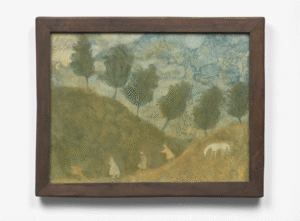
Mia Kokkoni, Travellers, 2025. oil on canvas mounted on board in artist’s frame, 56 x 71 cm
Kato’one Koloamatangi is an artist of Tongan (Nuku’alofa, Tonga) descent, born and raised in Tāmaki Makaurau (Auckland, New Zealand). In her practice she explores cultural identity and her place within the Tongan diaspora, drawing on memory, nostalgia, and her lived experience navigating life as a brown woman outside of her culture. Koloamatangi maintains a distinct focus on and sensitivity towards materiality and material culture, employing steel, ink, stone, and ngatu, a traditional Tongan cloth in her work. In Blueprint (2026), Kolomatangi explores the in-between space of diasporic experience through cultural patterning, working to materialise a pattern of identity through steel sculpture.
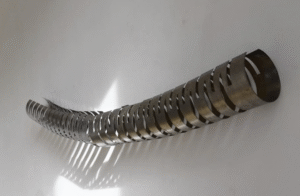
Kato’one Koloamatangi, Blueprint, 2026. Steel sculpture
Alvi Östgård is a multi-disciplinary artist from Norway and Sweden whose practice explores the relationship between Nordic and Scottish folklore and the landscape. Östgård employs Nordic folk traditions such as weaving, felting, knitting, painting and copper embossing in her work, exploring the relationship between the self and the cultural and spiritual histories, myths, and folklore of the landscape. In the performance work Savn (Longing), she continuously braids her hair whilst singing a Nordic lullaby, seated in front of a projection of a film of her sisters throwing paint at each other in a snowy landscape. In this poetic work, Östgård explores the experience of longing for family and cultural traditions of youth whilst living away from one’s home country.
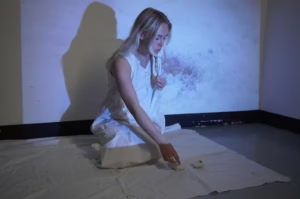
Alvi Östgård, Savn (Longing), 2024.
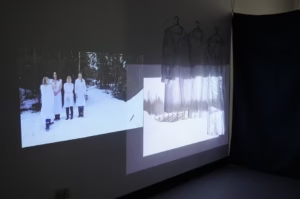
Alvi Östgård, Savn (Longing), 2024
Floor Plan + Renderings of Exhibition
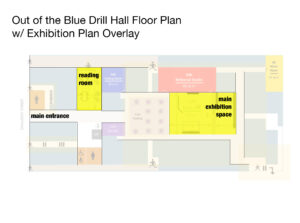
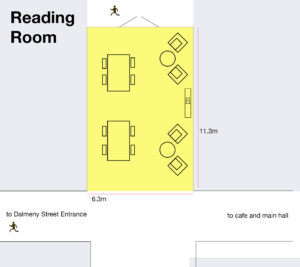
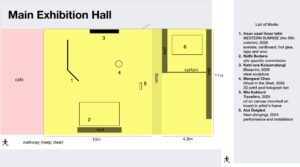
Layout of exhibition, including list of works.
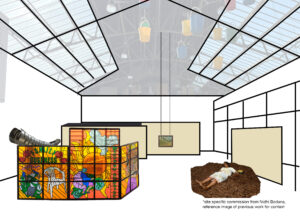
Rendering of Main Hall exhibition space, view from cafe.
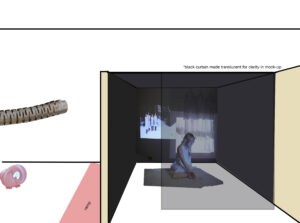
Rendering of Main Hall exhibition space, looking towards Alvi Östgård’s work Savn (Longing).
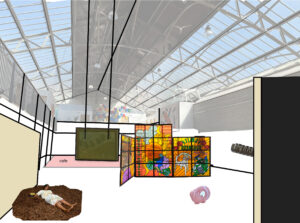
Rendering of Main Hall exhibition space, looking back towards cafe.
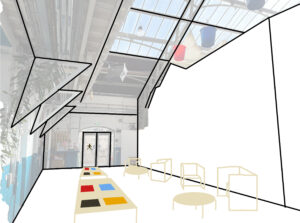
Rendering of reading room
Public Programme
The structure of the public programme supports different levels of engagement targeting diverse publics, including a reading room and both opening and closing night events. The reading room will include copies of the exhibition publication alongside texts chosen by the participating artists, as well as texts that informed the show’s curation: Jhumpa Lahiri’s Interpreter of Maladies, Etel Adnan’s The Arab apocalypse, Edward Said’s Out of Place, and the poetry of Adam Zagajewski. Given its location at the front of the building, the reading room will provide a space for contemplation, reflection, and respite at the beginning or end of the public’s engagement with the exhibition.
The opening night will include performances from Alvi Östgård and Nidhi Bodana, the remnants and ephemera from these performances remaining throughout the exhibition. The exhibition will also include a closing night performance on June 27th, featuring an open mic poetry reading and music performance from the band Kinaara. I will partner with Scottish BPOC Writers Network to put out an open call in their network for four writers whose work will be published in the publication and will participate in the poetry reading, which will also include an open mic in which members of the community can share poetry and spoken word performances. Culminating with the band Kinaara’s performance, this programme is aimed towards writers, musicians, and the wider local community, offering a more accessible environment for socialization amongst publics less likely to attend an exhibition opening.
Curatorial Rationale
At the core of Mending the Mutilated World is a desire to foster connection and understanding through accessible intercultural dialogues. Throughout curation I was critical of my positionality and actively sought to ensure I was not instrumentalizing artists’ practices and identities for the sake of the exhibition’s themes, rather, my approach when selecting artists was to bring together varied perspectives towards diasporic identity and negotiations with adopted culture while avoiding a didactic tone.
Amidst widening division and the growing inability for dissenting publics to communicate openly, I was careful to not alienate particular audiences when discussing divisive issues. Rather than softening a position staunchly in support of global mobility and immigrant rights, the project centers upon shared humanity, finding common ground through an exploration of the interpersonal, familial, ancestral, and emotional negotiations that lie at the heart of diasporic identity and belonging.
Given the focus on accessibility and community engagement, the location at Out of the Blue Drill Hall in Edinburgh’s Leith neighborhood is crucial to the project’s success in sparking accessible intercultural dialogues. Given the building houses artist & creative studios, workshops, rehearsal spaces, and a cafe, it invites a much wider range of publics beyond a traditional white cube, with a focus on providing accessible spaces, classes, resources, and opportunities to the local community.
The approach to public programming reflects the importance of meaningful and diverse audience engagement: incorporating live music and a poetry reading naturally invite different publics than a traditional exhibition, while also providing a platform for their voices to be heard. The publication serves as an extension of this dialogue, allowing the ephemerality of performance and installation to live on beyond the exhibition, the partnership with Out of the Blueprint supporting their social enterprise that provides opportunities to young artists and those with barriers to employment.
Budget
| Expenditure | Cost |
| Artist Fees (existing work: 5 x £750) (commissioned work: 1 x £1500)
Artist Performance Fees (6 x £29.30) https://static.a-n.co.uk/wp-content/uploads/2016/10/Paying-Artists-Exhibition-Payment-Guide.pdf |
£5250
£175.80 _____ £5425.8 |
| Music Performance Fees
Single Performance Fees (3 x £195.24) Distance Fee(4hr x £13.23) Travel Expenses(215miles x 56p) |
£585.72
£52.92 £120.4 _____ £759.04 |
| Poetry Performance Fees
Poetry Reading (4 x £78.75) https://scottishbpocwritersnetwork.org/scottish-bpoc-writers-network-rates/ |
£315 |
| Hospitality (Per diem) (6 x £50) | £300 |
| Travel & Accomodation (6 x £160) | £960 |
| Transportation of Artworks
Shipping of most works for locally based artists will use <10% of budget, while other works such as WESTERN SUNRISE (fifth column) will require more costly packaging and shipping. |
£700 |
| Install (construction of walls + contingency for paint, curtain, etc…) | £100 |
| Publicity | £100 |
| Exhibition Space Hire
Weekly Exhibition Rental Fee (1 x £375/week) Saturday Hire (1 x £150/day) Public Performance & Events Fee (6 x £44/hour) |
£375
£150 £264 ______ £789 |
| Equipment Hire
PA Hire with 2 mics (1 x 53) Table (2 x 2) Chairs (4 x 1) Projector & other equipment free through ECA Bookit |
£53
£4 £4 ___ £61 |
| Publication
Fee for previously published work (4 x £45.00) Printing costs (200 copies x £1.34 unit cost) 24 page, one-colour booklets https://scottishbpocwritersnetwork.org/scottish-bpoc-writers-network-rates/ |
£180
£268 ______ £493 |
| Total | £10,002.84 |
| Income | Amount |
| The Jerwood Foundation
Supports organizations with a focus on making art available for public benefit, and has a precedent of supporting exhibitions, residencies, and fellowships geared towards emerging artists. |
£6,002.84 |
| National Lottery Community Fund | £4,000 |
Publication
Mock-up of publication cover
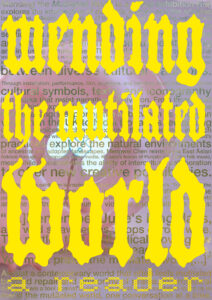
The project includes a publication containing poetry, artwork, and writing related to the exhibition themes. It will be distributed freely on site throughout the exhibition, at local libraries including Leith Public Library, and will be donated to public archives including the National Library of Scotland. Rather than serve as an exhibition catalogue, the form will be closer to that of an art & literature magazine, presenting the voices and works of artists included in the project.
The publication will include contributions from the four writers from the Scottish BPOC Writers Network participating in the closing night reading, images of works in the exhibition and a curatorial narrative text. It will be printed by Out of the Blueprint, a social enterprise eco print studio based out of Out of the Blue Drill Hall that trains young people and supports the local community through workshops, residencies, and subsidies for young artists.