Week6-From the Individual to the Collective: Reconstructing Curatorial Approaches at Summerhall
During this week’s group discussion at Summerhall, my project underwent a structural adjustment. Previously, I had used the narrative framework of “maiden—mother—crone” to explore the social issues women face at different stages of life. However, group members pointed out that while the structural logic was clear, there was a lack of continuity between the issues, and the connection to “witches” was not strong enough. This feedback prompted me to reflect on how to make the theme more focused and how to transform the three-stage structure into a critical curatorial tool.
After reading Curating as Feminist Organizing, edited by Krasny and Perry (2023, p. 4), I realized that feminist curating does not simply revolve around “women’s themes,” but rather expresses political stances through forms of collaboration and collective action . They(2023, p. 223) emphasize that curating as feminist organizing implies that the process of knowledge production itself is inherently negotiated and relational . This made me realize that collective feedback is an integral part of the feminist approach: curatorial structures should emerge through dialogue rather than being unilaterally determined by the curator ( Krasny and Perry, 2023, p. 238).
I have begun to rethink my current narrative framework. The three sections of my previous curatorial project were more symbolic correspondences than a progression centered on a continuous theme. I should shift the project’s focus to a more cohesive central issue: how social language has consistently disciplined and oppressed female identity. Consequently, the three sections of the art exhibition are no longer thematically compartmentalized, but rather analyze how language operates at different stages of women’s lives.
This response also shifted the discussion toward intersectional feminism. Intersectional theory emphasizes that mechanisms of oppression manifest differently across various social positions; therefore, “women” cannot be represented by a single experience (Cho, Crenshaw and McCall, 2013, pp. 787–791). Through discussions within the collective, I realized that if the three-stage framework remained solely at the symbolic level, it would overlook the diversity among women and the complexity of social structures. By focusing on a single theme, I can more carefully consider differences stemming from diverse sociocultural backgrounds when selecting artists, rather than categorizing them solely by age group.
By incorporating collective feedback into my curatorial approach, this project has shifted from a personal concept to a more collaborative and critical framework. This shift has brought my art exhibition closer to the relational and structural thinking emphasized in feminist curation.
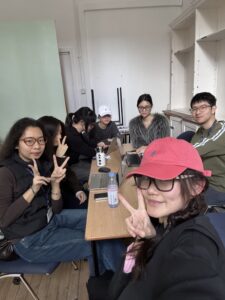
Group photo at Summerhall
Bibliography:
Cho, S. et al. (2013) Toward a Field of Intersectionality Studies: Theory, Applications, and Praxis. Signs: Journal of Women in Culture and Society. [Online] 38 (4), 785–810.
Krasny, E. & Perry, L. (eds.) (2024) Curating as feminist organizing. Abingdon, Oxon ; Routledge, Taylor & Francis Group. [online]. Available from: https://www.taylorfrancis.com/start-session?idp=https%3A%2F%2Fidp.ed.ac.uk%2Fshibboleth&redirectUri=https%3A%2F%2Fwww.taylorfrancis.com%2Fbooks%2F9781003204930.