Critical Reflection Text

Introduction

She Was Called a Witch takes the witch as a starting point to examine how language defines witches and disciplines women through works by contemporary women artists. The exhibition is an in-person group show developed through a feminist curatorial methodology. I first discuss the concept and structure of the SICP, then the conceptual and practical shifts after the Curatorial Pitch, and finally curatorial ethics, collective collaboration and peer review at Summerhall.


Developing the Concept and Structure of the SICP

The Origin of the Concept

The exhibition’s theme took shape through a series of revisions. Initially, my focus on witches stemmed from my interest in magic, the mysterious, and supernatural forces. As my reading and research deepened, I realized that “witches” should not be understood merely as cultural figures shrouded in mystery. Rather, they are a social symbol produced by power structures, systems of labor, and gender discipline. Marxist feminist theorist Silvia Federici (2022) interprets the witch hunts as part of capitalism’s primitive accumulation. In this process, the symbol of the “witch” underwent a transformation in my mind, and my focus shifted from an interest in mystical culture to an examination of “how women are defined as witches.”

Adjustments to the Exhibition Structure

Because “witches” was a broad theme, I initially used the Triple Goddess as the exhibition’s narrative framework. This mythological framework, developed by the British poet Robert Graves in the mid-20th century, links the phases of the moon with the three stages of a woman’s life: maiden, mother, and crone (Pérez, 1987, p. 139). It gave the exhibition a clear spatial structure and connected the witch to feminine divinity and resistance (Hutton, 2017).

However, the framework also reduced women’s lives to three fixed stages. My first plan divided the exhibition into “maiden,” “mother,” and “crone,” with one artwork for each. Yet one work could not represent an entire life stage. Religious and feminist scholar Cynthia Eller (2000, pp. 7–8) points out that while matriarchal myths can provide spiritual strength for some women, they may also reinforce gender stereotypes and undermine the diversity of women’s experiences. This helped me see that my structure risked assuming a universal female life path, such as motherhood. Consequently, I no longer treat the Triple Goddess as the exhibition’s central thesis, but as a supplementary analytical tool. The main theme has shifted to how language defines witches and disciplines women.

Defining the Scope of Language

When selecting artworks, I found that “language” is a broad concept. I needed clearer limits for selecting works.

The witch is not a natural identity, but rather a construct shaped through naming and discipline (Bovenschen, 1978, pp. 85–86). This process places women in a position of accusation and discipline. Feminist gender studies philosopher Judith Butler (2021, p. 5) argues that humans are shaped by language; only when a person is named and acknowledged can they enter into social existence. Thus, the term “witch” carries a long history of power, influencing how these women are understood and treated by society.

However, Butler (2021, p. 14) also notes that the power of language is not static, as it depends on repetition and context; it can also be reappropriated, rewritten, and reclaimed. Therefore, my exhibition defines “language” as a process: how women were defined as witches, and what accusations and disciplinary measures they endured. It explores how this label has been reclaimed in the contemporary era, becoming a form of resistant expression.


Turning Points from the Curatorial Pitch

Women’s Persecution and Witch-Hunting

For the Week 6 Curatorial Pitch, I selected three artworks that depict various forms of pain experienced by women. However, after discussing this with the collective members, I realized that this approach focused more on “women’s pain” in a general sense and had little connection to the theme of “witches.”

In my initial curatorial concept, I interpreted “witch hunts” as another term for “persecution of women.” However, through my research, I discovered that this is not the case. “Persecution of women” constitutes a broader structural framework, while “witch hunts” represent a specific manifestation within that framework. Witch hunts are not historical relics; they are a form of ongoing gender-based violence linked to feminist issues such as stigmatization and sexuality (Chaudhuri & Ward, 2026, p. 2). Furthermore, German feminist literary critic Silvia Bovenschen (1978, pp. 96–104) argues that historical witch hunts were linked to the conquest of nature, the reconstruction of social order, and the control of women. Therefore, research on “witch hunts” must be situated within the framework of patriarchal society’s discipline and exclusion of women. In other words, it must be analyzed within the broader framework of “persecution of women.”

This made me realize that if I only discuss women’s experiences of oppression, I remain confined to the concept of “persecution of women.” To truly address the theme of “witches,” I need to further examine the language that defines women as witches. Witch-hunting therefore became a paradigm for analysing why women are cast as pursued figures and why accusations continue to be fabricated through fear of their resistance (Chaudhuri & Ward, 2026, p. 3).

The Contemporary Reappropriation of the Witch Symbol

The contemporary reappropriation of the witch figure must be approached with caution. Religious studies scholar Laurel Zwissler (2018, pp. 13–18) notes that many feminists reclaim the “witch” as a symbol of resistance to patriarchy, associated with female anger, sexual awareness, and defiance. Yet Zwissler (2018, pp. 18, 23) also argues that this symbolic use cannot replace the historical meaning of the witch, since the figure remains tied to stigma and violence. As Zwissler (2018, p. 24) asks, if a woman turns to the identity of a “witch” only when no other option remains, can it still be read simply as a feminist choice? It has also influenced my curatorial practice; I cannot limit myself to selecting works that present the “witch” solely as a symbol of female power. I therefore needed works that show both the violent and the resistant dimensions of this figure.

Adjustments to the Selection of Artworks

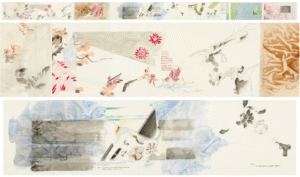
Therefore, I hope to create a dialogue among the different artworks. I selected Evelyn Taocheng Wang’s Witches are Flower Sis. Wang’s work has long focused on how language, customs, and culture shape identity (Lambo, 2025), which connects her treatment of “witches” to my exhibition’s theme, “The Discipline of Language on Women.” Witches are Flower Sis responds to the reimagining of “witches” within contemporary feminist and queer culture. Inspired by Witches, Witch Hunting, and Women (Federici, 2019), Wang transforms the feminine allure historically associated with fear and stigma into flowers. Through fragmented, abstract visual imagery, she presents the book’s accounts of violence against women. Thus, the witches depicted in this work are not the historically persecuted female figures, but rather contemporary representations that have been reimagined and rewritten.

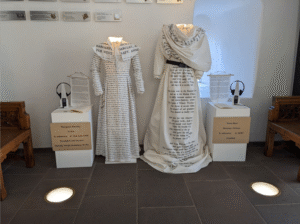
However, without historical and structural context, this reinterpretation risks romanticizing “witches” while overlooking the stigma and violence originally associated with them. Therefore, I have included two additional works. Witches in Word, Not Deed uses archival texts, costumes, and mannequins to visually present the accusations and confessions from historical witch trials. This work demonstrates that language is part of the mechanisms of persecution against women. Magic Kills Industry, meanwhile, further illustrates how these discourses are linked to capitalist development, the division of labor, and control over women’s bodies. Through this combination, I hope the exhibition not only explores the figure of the witch as reclaimed by feminism but also reveals how the witch was originally constructed.

The “witch” serves more as a node where different generations of feminism intersect, offering an intergenerational perspective (Brandl, 2023, p. 160). These three works help viewers see how the “witch” has been continuously rewritten across different times and spaces, thereby unfolding a feminist narrative.


Ethics, Collaboration, and Peer Review

Curatorial Ethics

The feedback on my curatorial pitch changed my judgment regarding artist selection. Initially, I chose Sarah Lucas’s WINTER SONG partly because the work aligned with the “Crone” phase of my three-phase lunar framework at the time; I also recognized Lucas’s high profile and hoped that her name would draw more attention to the exhibition.

But is it too simplistic to rely partly on an artist’s fame to determine an exhibition’s value? Art sociologists Laura Braden and Thomas Teekens (2019, p. 1) note that while an artist’s reputation can indeed attract audiences, it may also redirect viewers’ attention, marginalizing other works in a group exhibition.

Through feedback from my tutor, I realized that, as an emerging curator and given the project’s actual budget, it would be difficult for me to establish a collaboration with an established artist like Lucas. Curator and writer Karen Love (2010, p. 23) argues that emerging curators should fully consider the practical scale and feasibility of a project before finalizing artist selections or developing a proposal.

Consequently, I adjusted my criteria for selecting artists. I no longer prioritized “high visibility” but shifted my focus to mid-career or emerging artists. This shift was not merely a response to practical constraints but also a repositioning of my curatorial ethics. As curator Mirjami Schuppert (2021, pp. 7–10) points out, a “dialogical relationship” is necessary between curators and artists, emphasizing equal collaboration. Therefore, I needed to consider the feasibility of collaboration and the equality of voice. This fosters a more equitable negotiation process and prevents a single star artist from dominating a group exhibition.

Reflections Inspired by Intersectional Feminism

Intersectional feminism prompted me to reexamine my selection of works. At first, my choices mainly responded to Scotland’s witch-hunting history because the project began from this local context. However, if the exhibition remained within a single regional narrative, it might present witch persecution as a local event and overlook similar structures of discipline, stigma and oppression across different places. Critical race theory scholar Kimberlé W. Crenshaw (2021) argues that intersectional feminism emphasizes that gender oppression is not a singular, homogeneous experience, but is always interwoven with geographical, cultural, class, ethnic, and historical conditions. This changed my approach to artwork selection. I no longer sought only direct responses to Scottish history, but began to consider how similar problems appear in different cultural contexts. This is why I chose Evelyn Taocheng Wang, an artist born in China and currently based in the Netherlands. Her inclusion broadens the exhibition beyond Scotland and places the figure of the witch within a wider cross-cultural context. The works therefore no longer revolve around one location, but build an intersectional argument through difference and resonance.

Feminist curating also led me to rethink the role of the curator. Curators are not entirely neutral; rather, they assume a stance and responsibility when selecting and organizing works (Mohamadi, 2023, pp. 1–4). Therefore, I needed to examine my curatorial practice through a critical lens, constantly asking: which women’s experiences does my exhibition make visible, and which does it overlook?

Collective Collaboration

We held several group meetings online and in person. At first, communication was difficult, especially when discussing our collective ethical manifesto. Later, we used voting to move decisions forward, which improved efficiency. I also applied this method to my personal project and realised that collaboration needs both open discussion and clear decision-making rules. Feminist scholar Jo Freeman (2013, pp. 232–233) argues that the absence of rules does not necessarily mean a collective is flat and equitable. Power may be hidden within informal relationships and concentrated in the hands of a few. Therefore, establishing clear and transparent rules can support more equitable participation.

However, collective work did not always generate strong criticism. In Week 10, we completed a research project on the suitability of the Summerhall venue for the artworks. By this point, more stable relationships had been established among the members. Yet written comments were often mild and supportive rather than critical, and I was no exception. In-person feedback was usually more direct. This showed me that written formats can protect feelings but weaken critique. In future collaborations, I would clarify that identifying problems is not personal rejection, but a way to develop collective thinking.

Reflections on Peer Review

While reviewing Yuwei’s blog according to the course requirements, I noticed similar problems in my own blog. Because authors know their own ideas too well, they can overestimate the clarity of their writing. What seemed clear to me was not always clear to readers, especially when images, examples or context were missing. I therefore shared my blog with group members and asked for feedback from a reader’s perspective. They pointed out that some sections lacked logical clarity and that several ideas needed further development. After revision, the structure and expression of my blog became clearer.

Yuwei’s blog also gave me a new curatorial direction. She mentioned a curatorial approach that “leans toward the educational and process-oriented.” Although she did not explain this fully, it led me to research related examples. Through ICI’s do it (in school) (2019), I realised that education and process can operate as curatorial forms. This helped me rethink my own public programme: how can interactive activities help participants develop understanding through the process itself?


Conclusion

This project has three main strengths. First, it develops a clear research question by moving beyond “witch” or women’s themes to examine language, power and mechanisms of oppression. Second, it connects research and curatorial practice through reading, case studies and artwork selection. Third, it builds a coherent curatorial structure, with clear relationships between the works. However, it also has limitations. The project covers many issues, including history, language and geography, which may blur my central focus on linguistic oppression. I also learned that I often leave too many assumptions unstated, so readers and audiences may not always follow the logic that seems clear to me.

In the future, I hope to continue developing feminist curatorial practice through research-led exhibitions, public programmes and collaborative work. This project has helped me learn how to narrow a broad theme into a clearer question, connect artworks through a shared argument, and situate them within historical, social and cultural contexts. These skills will continue to shape my future exhibition-making, research writing and collaborative practice.


Reference List:

Bovenschen, S. (1978) ‘The contemporary witch, the historical witch and the witch myth: the witch, subject of the appropriation of nature and object of the domination of nature’, New German Critique, 15, pp. 83–119. Available at: https://doi.org/10.2307/487908.

Brandl, K. (2023) ‘Summoning the witches of the past: curatorial research on witchcraft in art and activism’, in Krasny, E. and Perry, L. (eds.) Curating as feminist organizing. London: Routledge, pp. 155–167. Available at: https://doi.org/10.4324/9781003204930-14.

Braden, L. E. A. and Teekens, T. (2019) ‘Reputation, status networks, and the art market’, Arts, 8(3), article 81. Available at: https://doi.org/10.3390/arts8030081.

Butler, J. (2021) Excitable speech: a politics of the performative. New edn. London: Routledge. Available at: https://doi.org/10.4324/9781003146759.

Chaudhuri, S. and Ward, J. (2026) ‘Witch hunts everywhere: a feminist re-mapping of misogyny and contemporary anti-witch violence’, Journal of Gender Studies, ahead-of-print. Available at: https://doi.org/10.1080/09589236.2026.2637531.

Crenshaw, K. W. (2021) ‘Demarginalizing the intersection of race and sex: a Black feminist critique of antidiscrimination doctrine, feminist theory and antiracist politics’, Droit et société, 108(2), pp. 465–487. Available at: https://doi.org/10.3917/drs1.108.0465.

Eller, C. (2000) The myth of matriarchal prehistory: why an invented past wont give women a future. Boston: Beacon Press. Available at: https://archive.org/details/mythofmatriarcha0000elle(Accessed: 26 April 2026).

Federici, S. (2019) Witches, witch-hunting, and women. Oakland, CA: PM Press. Available at: https://www.pmpress.org/index.php?l=product_detail&p=960(Accessed: 26 April 2026).

Federici, S. (2022) Caliban and the witch: women, the body and primitive accumulation. London: Penguin Books. Available at: https://www.penguin.co.uk/books/321857/caliban-and-the-witch-by-federici-silvia/9780241532539(Accessed: 26 April 2026).

Freeman, J. (2013) ‘The tyranny of structurelessness, WSQ: Womens Studies Quarterly, 41(3/4), pp. 231–246. Available at: https://doi.org/10.1353/wsq.2013.0072.

Hutton, R. (2017) The triumph of the moon: a history of modern pagan witchcraft. 2nd edn. Oxford: Oxford University Press. Available at: https://global.oup.com/academic/product/the-triumph-of-the-moon-9780198827368 (Accessed: 26 April 2026)

Independent Curators International (2019) do it (in school). Available at: https://curatorsintl.org/records/3586-do-it-in-school (Accessed: 26 April 2026).

Lambo, A. (2025) ‘Evelyn Taocheng Wang doesn’t play by tradition’, Frieze, 18 November. Available at: https://www.frieze.com/evelyn-taocheng-wang-profile (Accessed: 26 April 2026).

Love, K. (2010) Curatorial toolkit: a practical guide for curators. Vancouver: 2010 Legacies Now. Available at: Curatorial Toolkit: A Practical Guide For Curators | PDF | Curator | Art Museum.pdf (Accessed: 25 April 2026).

Mohamadi, N. (2023) ‘Hannah Arendt’s action theory, aesthetics and feminist curatorial praxis’, Arts, 12(2), article 47. Available at: https://doi.org/10.3390/arts12020047.

Pérez, J. (1987) ‘Aspects of the triple lunar goddess in Fuentes’ short fiction’, Studies in Short Fiction, 24(2), pp. 139–147. Available at: https://www.enotes.com/topics/carlos-fuentes/criticism/fuentes-carlos/janet-perez-essay-date-1987 (Accessed: 26 April 2026).

Schuppert, M. (2021) ‘Learning to say no, the ethics of artist-curator relationships’, Philosophies, 6(1), article 16. Available at: https://doi.org/10.3390/philosophies6010016

Zwissler, L. (2018) ‘I am that very witch’: on The Witch, feminism, and not surviving patriarchy’, Journal of Religion & Film, 22(3), article 6. Available at: https://doi.org/10.32873/uno.dc.jrf.22.03.06
Speculative Independent Curatorial Project Proposal

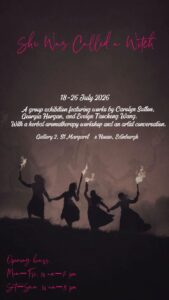
She Was Called a Witch

18–26 July 2026

Opening hours:

Mon–Fri: 10 am–7 pm

Sat–Sun: 10 am–8 pm

curatorial narrative text

A mysterious woman with supernatural power?

A seductive, dangerous, and fascinating figure?

A “sinner” judged by history and burned at the stake?

Or a feminist symbol of resistance?

The “witch” has never been a fixed identity. It is a word that has been repeatedly given new meanings. She is both a projection of fear and the result of being named1. This exhibition therefore asks: what defines a witch?

She Was Called a Witch invites viewers to rethink how language participates in the discipline and oppression of women. It focuses on the shifting meaning of the word “witch”: how it was historically used to identify, exclude, and punish women, and how it has been reclaimed in contemporary culture as a symbol of resistance2.

The exhibition does not simply look back at the history of witch-hunting. Instead, it places this history in a contemporary context. It asks how women artists respond to this past, and how they use different media to rethink the power of language.

The exhibition brings together Carolyn Sutton’s installation Witches in Word, Not Deed, Georgia Horgan’s short film Magic Kills Industry, and Evelyn Taocheng Wang’s painting Witches are Flower Sis. Together, these works lead viewers through a path shaped by the act of “naming.”

Taking place in the gallery at St Margaret’s House, She Was Called a Witch unfolds like an open text. The works form connected “paragraphs” rather than one single story. As viewers move through the space, they read and compare different meanings of the witch.

The exhibition does not offer a final definition of the “witch.” Instead, it asks: if language can name and discipline women, can women also reclaim and transform these words? Through this process of resistance and rewriting, the artists show how women can become subjects who define themselves.

Artists & Participants

Carolyn Sutton is a designer and textile artist based in Edinburgh. She has a strong background in archival research. Her work focuses on social justice, critical heritage, and folklore.

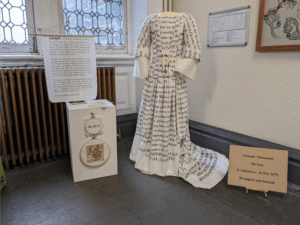
Her work Witches in Word, Not Deed is a commemorative textile installation. It uses a series of individual dresses to remember women in Scottish history who were accused and persecuted as witches. The dresses are printed with words once used to accuse, judge, and stigmatise these women. Through these dresses, Sutton aims to give voice back to women whose voices were taken away. The full work includes 13 dresses. This exhibition will present 4 of them.


Carolyn Sutton, Witches in Word, Not Deed, installation/project documentation. Image source: Carolyn Sutton, available at: https://carolynasutton.crevado.com/witches-in-word-not-deed


Georgia Horgan is an artist based in Glasgow. She mainly works with moving image and text. Horgan’s practice explores the relationships between women’s labour, history, language, witchcraft, and capitalism.

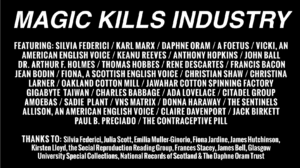
For this exhibition, I have selected Horgan’s Magic Kills Industry. It is a 34-minute essay film. Its key reference is Silvia Federici’s Caliban and the Witch. The film explores witchcraft, women, textiles, and technology. It understands the “witch” through industry, women’s labour, and capitalist accumulation. It also asks what kinds of women’s knowledge were named as dangerous or illegitimate in history, such as knowledge of birth, healing, and the use of herbs3.


Georgia Horgan, Magic Kills Industry, essay film, 34 min. Image source: Waking the Witch, available at: https://wakingthewitch.uk/magic.html


Evelyn Taocheng Wang was born in China and is now a Dutch artist. Her practice includes painting, performance, writing, and clothing. Her work explores how language, culture, and social norms shape identity4. It often focuses on gender, class, and belonging.Wang often combines personal experience with fictional narratives. Through hand-drawing, writing, and layered images, she examines how identity is constructed and distorted across different cultural and linguistic systems.

Her work Witches are Flowers Sis places scenes of violence against women together with abstract plant patterns. In this work, the “witch” becomes a form of re-expression. Wang connects it with the bodily autonomy of women and gender-queer communities5.


Evelyn Taocheng Wang, Witches are Flower Sis, 2020, ink, watercolor, acrylic and pencil on ripe rice paper, 48.7 × 800 cm. Image source: Antenna Space, available at: http://antenna-space.com/zh/artworks/wangyifulingtaochengwitches-are-flower-sis2020/


Exhibition Space

Venue: Gallery 2, St Margaret’s House, Edinburgh

Address: 151 London Road, Edinburgh, EH7 6AE


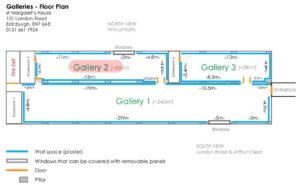
Overall Floor Plan of the Gallery Spaces at St Margaret’s House

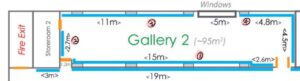
Floor Plan of the Gallery 2


Floor Plan of the Gallery 2

Viewing Route: 1–4

  1. Carolyn Sutton’s Witches in Word, Not Deed
  2. Georgia Horgan‘s Kills Industry
  3. Evelyn Taocheng Wang‘s Witches are Flowers Sis
  4. Photographs of herbal books made by participants in the public programme.


Public Programme Layout:

The central area of Gallery 2 can be temporarily adjusted outside exhibition hours for the workshop and public conversation.

The workshop will take place during a specific time after the gallery closes. Movable tables and chairs will be placed in the centre of Gallery 2. After the activity, the furniture will be removed and the exhibition route will be restored.

The public conversation will take place on the last day of the exhibition. It will use the central area of Gallery 2. Chairs will be temporarily arranged facing the video wall.

Accessibility:

The layout will create a clear one-way viewing route6. Enough space will be left between the works to support wheelchair access.

Seats will be provided in the video area at Position 2, so viewers can stay and watch the film comfortably.

The public programme will use movable tables and chairs. After each event, the space will be restored to ensure smooth circulation for visitors.

Disabled parking is available in the area. Visitors with specific access needs should contact the venue in advance to confirm support.

Exhibition labels will use clear bilingual text in Chinese and English. Audio guides will also be provided.

Public Programme

The public programme allows viewers to bring their own experiences into the exhibition7. It also encourages deeper reflection on how language disciplines women. The programme includes a hands-on workshop and a public conversation.

The hands-on workshop will be led by me and will last about 90 minutes. Participants will use plants such as lavender and basil to make scented objects. They will also use kraft paper, thread, and paint to create their own herbal book. The aim is not to produce a “mysterious” or entertaining image of the witch. Instead, the workshop asks participants to notice the everyday nature of these actions. Women in history carried out similar practices, but they were named as witches. Through making, participants can understand the relationship between naming, knowledge, and women’s bodies in a more practical way.At the end of the workshop, participants can take their works home. With their consent, photographs of the works will be shown on the final wall of the exhibition. They will become contemporary responses to the history of witch-hunting.

The public conversation will take place on the last day of the exhibition. It will summarise and deepen the project. I will host the event and invite the three exhibiting artists to take part. The discussion will focus on the artists’ positions within feminist expression, their approaches to making, and how they understand the figure of the “witch.” Due to distance, Evelyn Taocheng Wang will join online. The event will last about 2 hours and will include a guest conversation and audience Q&A.

Curatorial Rationale

This project takes “how the witch is produced through language” as its central question. It looks back at historical witch-hunting and asks how language has been used to name, stigmatise and discipline women. The exhibition does not simply present the witch as a symbol of female power. It also does not reduce witch-hunting to a general story of women’s suffering. Instead, it considers how the word “witch” has been used, translated and rewritten across different contexts.

The project will take the form of an offline thematic group exhibition. It uses thematic, archival and feminist curatorial methods. Since the subject involves historical violence, bodily experience, language and contemporary feminist responses, it cannot be fully addressed through one artist alone. I have selected three artists who approach the topic through text, moving image and embodied experience. Their works create dialogue and contrast. The creative aim is to treat the exhibition space as a readable field of language. Viewers move between artworks, texts, images and discussion, and gradually understand how language produces power.

The exhibition will be organised into three connected sections. The first section begins with historical naming and accusation. It shows how the witch was produced through language. The second section turns to contemporary artistic responses and explores the female body, memory and resistance. The third section extends the project through a public programme, such as a workshop or talk. This invites audiences to reflect on gendered naming and shaming in everyday life.

The exhibition is aimed at general gallery visitors, art students, feminist audiences, and people interested in witch-hunting history, women’s knowledge, language, and gender politics.

I have chosen Gallery 2 at St Margaret’s House because its scale suits a small to medium-sized group exhibition and allows a clear viewing route. The exhibition will last for one week, which is realistic for the budget and organisation. Ethically, it will avoid romanticising the witch or turning trauma into visual consumption. Accessibility will be supported through a clear route, seating, bilingual texts and an audio guide.

Budget

Expenditure Cost
Artist Fees (3 × £700) £2,100
Paying-Artists-Exhibition-Payment-Guide.pdf
Artist Talk Fees £300
Recommended Rates of Pay (RRoP) | Scottish Artist Union
Artist Travel Expenses £500
Evelyn Taocheng Wang will participate online
Public Programme Materials £200
Artwork Transport £1,000
Installation: wall construction, paint, curtains and contingency costs £400
Marketing and Publicity £300
Cleaning Fee £300
Exhibition Space Rental
Weekly Gallery Hire Fee (1 week × £100) £100
Guide to Galleries – Scot-ART
Equipment £300
Projector
Chairs × 4
Tables × 2
Total £5,500
Income
Open Fund for Individuals £5500
Open Fund for Individuals | Creative Scotland


Reference List

  1. Bovenschen, S. (1978) ‘The contemporary witch, the historical witch and the witch myth: the witch, subject of the appropriation of nature and object of the domination of nature’, New German Critique, 15, pp. 83– Available at: https://doi.org/10.2307/487908.
  2. Zwissler, L. (2018) ‘I am that very witch: on The Witch, feminism, and not surviving patriarchy’, Journal of Religion & Film, 22(3), article 6. Available at: https://doi.org/10.32873/uno.dc.jrf.22.03.06
  3. Federici, S. (2022) Caliban and the witch: women, the body and primitive accumulation. London: Penguin Books. Available at: https://www.penguin.co.uk/books/321857/caliban-and-the-witch-by-federici-silvia/9780241532539 (Accessed: 26 April 2026).
  4. Lambo, A. (2025) ‘Evelyn Taocheng Wang doesn’t play by tradition’, Frieze, 18 November. Available at: https://www.frieze.com/evelyn-taocheng-wang-profile (Accessed: 26 April 2026).
  5. Crenshaw, K.W. (2021) ‘Demarginalizing the intersection of race and sex: a Black feminist critique of antidiscrimination doctrine, feminist theory and antiracist politics’, Droit et société, 108(2), pp. 465– Available at: https://doi.org/10.3917/drs1.108.0465.
  6. McMurtrie, R.J. (2022) ‘Observing, recording, visualising and interpreting visitors’ movement patterns in art museums: a mixed method approach’, Multimodality & Society, 2(2), pp. 93–
  7. O’Neill, P. and Wilson, M. (eds.) (2010) Curating and the educational turn. London: Open Editions.


Summative Peer Review of Yuwei Ruan

Most of your blog posts establish a connection to the course content. This effectively demonstrates how you integrate theoretical concepts from the course with practical experience. However, you could analyse more specifically how course ideas shaped your curatorial decisions.

Your Curatorial Pitch has a clear framework, but it would be stronger with specific artists and works.

Suggestions on the Overall Logic

Your blog posts lack coherence. I find it difficult to see how this content helps you make progress on your personal project. I suggest you give each post a title; currently, none of your posts have titles, which makes it hard for readers to quickly grasp the main point of each one.

You can establish deeper connections between your blog posts, which helps readers see the evolution of your thinking. For example, there is a clear contradiction between your Week 3 and Week 4 posts. In Week 3, you mentioned that you did not want to adopt a traditional exhibition model, preferring instead educational and process-oriented formats. However, in your Week 4 blog post, you stated that you hoped to develop the exhibition into a “traditional offline exhibition.” It would be helpful to clarify what “traditional” means here and what led to this shift. This contradiction lends itself well to critical reflection and will also deepen the connections between your blog posts.

ICI’s do it (in school) (2019) could help you understand exhibition formats that prioritise education and process, as it uses artist instructions and audience participation to turn exhibition-making into learning, practice and co-creation.

Currently, your blog is only updated through Week 6. For Weeks 7–13, I suggest focusing more directly on your personal project.

Suggestions on Content

Weeks 1 and 2 cover many topics, so the analysis feels broad. You could focus on one or two points and integrate theory more clearly with your own project. For example, you mentioned “collective work”; you could further reflect on the clashes of ideas that arose during collective discussions, how disagreements were resolved, and what curatorial ethics this involves (Schuppert, 2021). You could also explain what you gained from this collaborative approach and how it has influenced your personal project.

Your references are useful, but they appear only in the final bibliography. Since they are not cited within the text, your argument becomes less persuasive.

Reading Experience

Including some images would make your content even more compelling. For example, since you mentioned that Summerhall’s venue characteristics align well with your exhibition theme, adding photos of the venue or a floor plan would provide a more visual explanation of why you chose this location.

Additional Recommendations

Your topic is valuable and could be supported by further exhibitions and literature. The 2022 exhibition Eternally Yours in London is very similar to your theme, as it explores repair and reuse. I suggest incorporating a public engagement project, as this can help expand the scope of your exhibition (O’Neill and Wilson, 2010, p. 12). Lee Mingwei’s The Mending Project can serve as a reference. Additionally, philosopher Elizabeth V. Spelman’s Repair: The Impulse to Restore in a Fragile World (2003) can help you explore the concept of “repair” from ethical and social perspectives.


Bibliography

Independent Curators International (2019) do it (in school). Available at: https://curatorsintl.org/records/3586-do-it-in-school (Accessed: 26 April 2026).

O’Neill, P. & Wilson, M. (2010) Curating and the educational turn. London: Open Editions.

Schuppert, M. (2021) Learning to Say No, the Ethics of Artist-Curator Relationships. Philosophies (Basel). [Online] 6 (1), 16.

Somerset House (2022) Eternally Yours [exhibition]. Terrace Rooms, South Wing, Somerset House, London, 16 June–25 September. Available at: https://www.somersethouse.org.uk/whats-on/eternally-yours (Accessed: 26 April 2026).

Spelman, E. V. (2003) Repair : the impulse to restore in a fragile world. Boston: Beacon Press.


Week13-Designing the Public Programme in Practice

In my Week 6 blog post, I discussed how public programmes can expand the boundaries of an exhibition, mainly at a theoretical level. Now, I want to integrate them more directly into my solo exhibition and consider how they can be organised in practice.


I plan to organise two public programmes: a herbal book and aromatherapy workshop, and a post-exhibition discussion.


Through engaging hands-on activities, I aim to translate the exhibition’s themes into the real world. The workshop is mainly aimed at women, art students, and audiences interested in feminism, bodily experience and historical narratives. It will last no more than 90 minutes. The group should be limited to around 15 to 20 people, because the activity involves touching, smelling, making and discussion. If the group is too large, it may become only a craft class, and participants may find it hard to enter a quiet, reflective state.


I plan to hold the workshop on Saturday afternoon rather than on a weekday. The audience may include students, part-time workers and the general public, so a weekend afternoon may be easier for them to attend.At the same time, Alistair Hudson (2017), director of Middlesbrough Institute of Modern Art, has prompted me to think further about public programmes. He argues that public programmes should not only be extra activities outside an exhibition. They should allow audiences to use the exhibition and bring their own experiences into its themes.


Based on this, I want to include the workshop outcomes in the exhibition. With participants’ permission, I will photograph their works and place the images on the exhibition wall as the final section. This can create a dialogue between the contemporary and the historical.


I will also invite the three artists in the exhibition to take part in a public talk. It will include a guest discussion and an audience Q&A, lasting no more than two hours. I hope to arrange it near the end of the exhibition, so it can review and deepen the project.

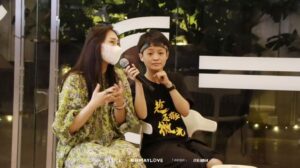
This reminds me of the sex education exhibition that I helped organise in 2022. We included a theatre performance and a public talk. Audience feedback showed that the Q&A and discussion were often the most moving parts. They turned personal experiences into public conversation and brought people closer together. Therefore, I decided to design this section carefully.


Audience interaction session in the public programme I Have Asked Many People About You (2022). Image source: Maylove, a Chinese sex education organisation.


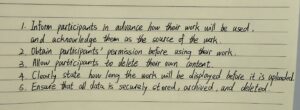
However, incorporating audience-generated content into the exhibition and having participants discuss their personal experiences on-site raise issues of privacy. Drawing on the research of Jenny Kidd, a scholar in digital culture and museum media studies, and digital producer Rosie Cardiff (2017, pp. 48–49), I decided to take the following measures:


My notes on the design of the public programme. Photograph by Anqi Li, 2026.


Bibliography:

Kidd, J. & Cardiff, R. (2017) ‘A space of negotiation’: Visitor Generated Content and Ethics at Tate. Museum and society. [Online] 15 (1), 43–55.

Hudson, A. (2017) ‘Building a user-generated museum: a conversation with Alistair Hudson’, OpenDemocracy, 5 May. Available at: https://www.opendemocracy.net/en/building-user-generated-museum-conversation-with-alistair-hudson


Week12-Feedback as Collective Curatorial Practice

During this week’s group discussion, I offered suggestions for my peers’ curatorial projects. I found that these suggestions not only helped them refine their projects but also helped me improve my own.


My advice to Houde focused on his online exhibition experience. He designed a website, and from a visitor’s perspective, I believe he needs to consider a few additional questions: Is the page visually appealing? Is it easy to navigate? How long does it take for a visitor to view the entire exhibition?

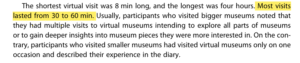
Unlike physical exhibitions, online exhibitions make it difficult for visitors to focus on a webpage for extended periods. Research by museum marketing scholars Tanja Komarac and Đurđana Ozretić Došen (2024, p. 364) shows that most young visitors spend between 30 and 60 minutes on online exhibitions. When visitors cannot find a suitable browsing rhythm, they lose patience (2024, p. 369). Therefore, an online exhibition is not merely about placing works on a webpage; it also requires consideration of viewing rhythm, navigation paths, and the duration of attention.


Screenshot from Komarac and Ozretić Došen’s article, “Understanding virtual museum visits: Generation Z experiences” (2024, p. 364).


Screenshot from Komarac and Ozretić Došen’s article, “Understanding virtual museum visits: Generation Z experiences” (2024, p. 369).


Although my personal project is an online exhibition, this reflection has also made me consider how viewers engage with my exhibition. I need to think about how to quickly immerse viewers in the context of “The Witch.” For example, I could include introductory text, consider the spatial sequence, and carefully position the first artwork. By doing so, I can pique viewers’ interest, help them quickly grasp the exhibition’s message, and prevent them from feeling confused.


My advice to Yuexuan concerns limiting the number of visitors to her exhibition. Her work explores emotion and the body, and she influences viewers’ experiences by placing paintings in unconventional locations, such as on the floor or in corners. I believe this approach is very powerful, but it requires controlling the number of visitors. If the space becomes too crowded, viewers will struggle to notice the relationship between their bodies and the artwork, and it will be difficult for them to develop a quiet, contemplative emotional response.


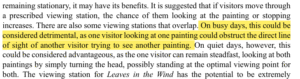
Multimodal and spatial discourse analysis scholar Robert J. McMurtrie (2022, p. 109) points out that, during busy periods, overlapping viewing areas may have a negative effect. One viewer may block another viewer’s direct line of sight. This made me reflect on my own exhibition. I realised that spatial conditions can support the emotional expression of artworks. My exhibition includes moving-image works and darker viewing areas, so I need to control the number of visitors and the speed of movement. Otherwise, the sense of oppression and historical seriousness that I want to create may be weakened by a crowded environment.


Screenshot from McMurtrie’s article, “Observing, recording, visualising and interpreting visitors’ movement patterns in art museums: A mixed method approach” (2022, p. 109).


Bibliography:

Komarac, T. & Ozretić Došen, Đ. (2024) Understanding virtual museum visits: generation Z experiences. Museum management and curatorship (1990). [Online] 39 (3), 357–376.

McMurtrie, R. J. (2022) Observing, recording, visualising and interpreting visitors’ movement patterns in art museums: A mixed method approach. Multimodality & society (Online). [Online] 2 (2), 93–113.


Week 11-Reflecting on the Group Project

Through this week’s group project, I realised that artworks are not simply placed within a space. Their meaning is shaped by the venue’s structure, viewing routes, stopping points, and interpretive texts.


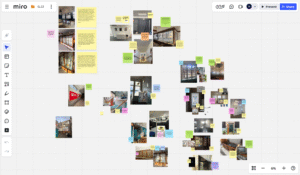
During the exercise, we photographed possible locations and discussed what kinds of artworks they might support. Throughout this process, my own judgments were refined and adjusted based on my peers’ feedback. For example:


Screenshot from our collective project.


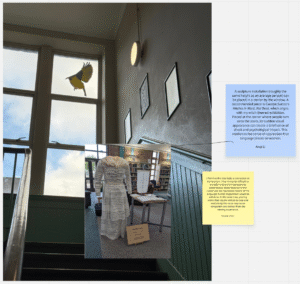
Screenshot taken by me from the collective project webpage, showing Houde’s feedback on my proposed spatial arrangement.


However, Houde’s feedback made me realize that a space’s dramatic quality does not necessarily mean it is effective for displaying artworks.


I realized that placing an artwork in an unexpected location might create a momentary sensory impact for the viewer, but it does not necessarily help the viewer understand the work’s content. Especially when the work requires careful reading and extended viewing, a strong spatial effect might distract the viewer from the work itself.


This issue concerns not only “where to place the artwork,” but also how to guide the audience.


Robert J. McMurtrie (2022, pp. 107–109) similarly argues that curators need to consider viewing stations, visitor movement, congestion, and the placement of labels. This suggests that viewing is not static; curators must consider how pathways, positioning, and interpretive texts influence the audience’s viewing experience.


This is particularly important for my own curatorial project. Witches in Word, Not Deed is not suited for placement in a corner designed primarily for foot traffic. Since the form of the work’s skirt is already sufficiently striking, I do not need to consider how to further enhance its visual impact. Instead, I aim to guide viewers from an initial attraction toward a more careful reading and understanding of the work.


Sutton, C. (2026) Witches in Word, Not Deed. Available at: https://carolynasutton.crevado.com/witches-in-word-not-deed (Accessed: 8 April 2026).


Therefore, I plan to place the work against a wall. This will allow viewers, upon entering the space, to more clearly sense that they are immersed within the spatial environment created by the work. Additionally, explanatory text can be incorporated onto the wall to help viewers transition from visual engagement to a deeper understanding.


This collaboration has changed the way I assess space.


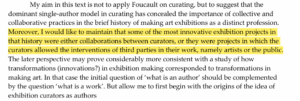
Houde’s response made me realize that my previous judgments regarding spatial placement were almost unquestionable. I tended to prioritize whether a location could evoke a strong emotional impact, rather than first asking whether it could convey the work’s meaning. I assumed I knew which locations would be most effective, but collective collaboration broke this inertia. As contemporary art theorist Eva Fotiadi (2014, p. 3) suggests, many innovative exhibitions arise precisely from collaboration.

In this case, collective work did not simply add opinions, but interrupted my assumptions and showed me that curatorial judgement develops through collaboration and refinement.


Screenshot from page 3 of Fotiadi, E. (2014) ‘The canon of the author. On individual and shared authorship in exhibition curating’, Journal of Art Historiography, 11(11).


Bibliography

Fotiadi, E. (2014) The canon of the author. On individual and shared authorship in exhibition curating. Journal of art historiography. 11 (11), 1.

McMurtrie, R. J. (2022) Observing, recording, visualising and interpreting visitors’ movement patterns in art museums: A mixed method approach. Multimodality & society (Online). [Online] 2 (2), 93–113.


Week10-Beyond the Exhibition Space: Rethinking the Role of Events in Curatorial Practice

During a class discussion, I was advised to incorporate activities into my art exhibition.

This led me to reconsider the boundaries of an exhibition. In Curating and the Educational Turn (2010), O’Neill and Wilson point out that contemporary curating is undergoing an “educational turn,” in which exhibitions are no longer merely displays of finished works but have become processes of knowledge generation. Public programs, lectures, and discussions can extend the temporal and spatial scope of an exhibition, transforming curation into a structure of ongoing dialogue (O’Neill and Wilson, 2010, p. 12). Such events bring art further into the social context. Therefore, the “exhibition + events” format serves as a means of expanding the boundaries of curation.


However, this combination is not without its problems.


Allen and Gutwill (2004) examine interactive design in museums. They argue that when too many interactive elements are added, visitors may focus on secondary aspects. As a result, the core content can be overlooked. They argue that if multiple elements lack a clear hierarchical structure, visitors are likely to become confused, and their understanding may actually be impaired (Allen & Gutwill, 2004, pp. 207–208). This perspective reminds me of the need to clarify the purpose of the event and the logical connection between the event and the art exhibition.


At the same time, events alter the venue’s existing operational structure and create tension between its cultural mission and commercial functions (Antchak & Adams, 2020, pp. 854–857). This reminds me that events are not neutral additions but affect exhibition structure. Therefore, when planning events, I must be vigilant to ensure they do not overshadow the exhibition’s core themes.


Taking all of the above into account, I realize that “exhibition + event” is a structural choice rather than a simple combination. Events should revolve around the core issues of the exhibition.

I plan to design a workshop for my witch exhibition, such as creating herbals and incense (women who engaged in these practices were once labeled as witches). While this format appears playful on the surface, its purpose is not entertainment. I hope that through this hands-on experience, participants will reflect on how the identity of a “witch” has been constructed and misunderstood. At the same time, I will collaborate with artists to facilitate sharing and discussion, encouraging participants to engage in critical dialogue.


To avoid undermining the exhibition, I must ensure:

1. The workshop remains relevant to the exhibition.

2. The exhibition remains the central focus.

3. The workshop does not impose a predefined stance on the audience but rather provides a space for discussion.


Bibliography:

Allen, S. & Gutwill, J. (2004) Designing With Multiple Interactives: Five Common Pitfalls. Curator (New York, N.Y.). [Online] 47 (2), 199–212.

Antchak, V. & Adams, E. (2020) Unusual venues for business events: key quality attributes of museums and art galleries. International journal of tourism cities. [Online] 6 (4), 847–862.

O’Neill, P. & Wilson, M. (2010) Curating and the educational turn. London: Open Editions.


Week9-How Exhibition Atmosphere Shapes Thematic Expression

During the group discussion at Summerhall, a member once again pointed out an issue with my work: even though the exhibits were clearly arranged, the exhibition lacked a strong connection to the theme of “witches.” She suggested that I could deepen the exhibition’s connection to witches by creating a specific atmosphere within the venue. This suggestion made me wonder: Is the atmosphere of an exhibition merely a visual complement, or is it a mechanism capable of generating meaning?


Gadsby (2014, p. 131) notes that an increasing number of contemporary museums are drawing inspiration from theatrical set design. These museums use lighting, sound, and spatial arrangements to enhance visitors’ emotional engagement. Consequently, the atmosphere of a venue is not merely a backdrop but a mechanism that can guide visitors. In thematic exhibitions, spatial design that aligns with the narrative enhances coherence, making it easier for visitors to immerse themselves in the theme (Dong, 2024, p. 598).


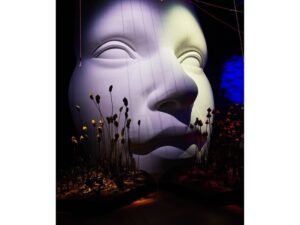
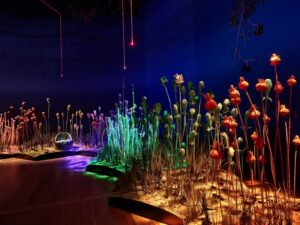
This is evident in the The Viking Sorceress exhibition. The exhibition divides the space into distinct zones, each serving a different narrative function. This aligns with the Triple Goddess framework I employ. The Viking Sorceress employs interactive guidance, audio narration, and scene reenactments to draw visitors “into the story” rather than simply having them observe from the sidelines. This experiential design changes the way visitors go, allowing them not only to read information but also to “experience the worldview.” This approach helps visitors understand the complexity of the sorceress figure throughout history.


The face of a vølve or seer, part of the new “The Viking Sorceress” exhibition at the Danish National Museum. (Roberto Fortuna/Denmark’s National Museum)


The Danish National Museum’s new exhibit features depictions of plants supposedly used to create drugs for psychoactive experiences lead by vølver. (Roberto Fortuna/Denmark’s National Museum)


However, this also made me realize a problem: while atmosphere can enhance understanding, it can also obscure structure.


Unlike theaters, museums risk undermining the transmission of knowledge if their scenography overemphasizes emotional impact (Gadsby, 2014, pp. 136–138). Dong (2024, pp. 598–600) also notes that if thematic spaces lack a clear hierarchy, visual elements can become distracting.


My exhibition explores “historical accusations against witches through language, and contemporary language’s disciplining of women.” This means that the “witch-like atmosphere” I create cannot be limited to mysterious music and dim lighting. I do not wish to merely evoke a sense of mystery; rather, I aim to use the atmosphere to reinforce the theme. For example, I plan to use sound to repeat historical accusations and employ projections to show how text covers the body. This prompts viewers to reflect on how language has become a tool for disciplining women.


As a curator, I need to ensure that the atmosphere of the space serves the message I wish to convey, rather than imposing a predetermined emotional response on the audience. My intention is to create an immersive atmosphere that guides reflection, rather than replacing it.


Bibliography

Gadsby, J. (2014) Scenography in museum design: an examination of its current use, and its impact on visitors value of experience. Birmingham City University.

Rak, J. et al. (2024) ‘Study on the Strategy of Creating the Atmosphere ofThematic Exhibition Space–A Comparative Study of the “Garden” and “V&A Alice inWonderland” Exhibitions, for Example’, in Proceedings of the 3rd International Conference on Culture, Design and Social Development (CDSD 2023). France: Atlantis Press (Zeger Karssen). p.


Week8-Further Confirm The Archival Artworks In The Exhibition.

This week’s course content reminded me of the blog post from Week 4 on “curatorial archives.” It got me thinking: if my project is meant not only to present authentic history but also to translate historical materials into the language of an authentic exhibition, how should I select artworks?

I ultimately chose Carolyn Sutton’s Witches in Word, Not Deed.


Sutton, C. (2026) Witches in Word, Not Deed. Available at: https://carolynasutton.crevado.com/witches-in-word-not-deed (Accessed: 8 April 2026).


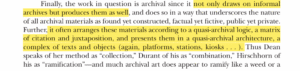
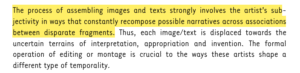
Hal Foster, an American art historian and critic, argues that “the archive” in contemporary art is not simply the presentation of existing documents. Instead, artists collect, reorganise, and recontextualise different materials. Through this process, they produce new historical relationships (Foster, 2004, p. 5).


Screenshot of page 5 from Hal Foster’s article An Archival Impulse (Foster, 2004).


As a result, I realized that archival artworks can use various media to bring oppressive historical language back into the present.


Carolyn Sutton’s work resonates deeply with my theme. She prints the accusations and misconceptions directed at women during witch hunts onto skirts, transforming this violent language—which originally existed only in history—into a visual form. For viewers, this form is easier to grasp, as they see not merely historical documents, but how language has actually been imposed upon women’s bodies.


However, archival artworks still have certain limitations.


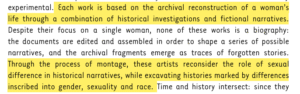
Giovanna Zapperi, a professor of art history (2013, p. 23), argues that while feminist archival art makes suppressed women’s histories visible again, this reconstruction is not an objective presentation of history; rather, it is a rewriting imbued with the artist’s stance and desires (2013, pp. 26–27).


Screenshot of page 23 from Giovanna Zapperi’s article Woman’s Reappearance: Rethinking the Archive in Contemporary Art—Feminist Perspectives (Zapperi, 2013).


Screenshot of page 27 from Giovanna Zapperi’s article Woman’s Reappearance: Rethinking the Archive in Contemporary Art—Feminist Perspectives (Zapperi, 2013).


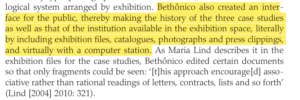
This makes me worry that viewers might focus more on the form of the Witches in Word, Not Deed skirt, thereby diminishing their understanding of the cruelty of history. The text on the skirt has a strong visual impact, but viewers may not necessarily stop to read it. Drawing on the methodology proposed by Reesa Greenberg (2012, p. 166) in her analysis of Telling Histories, I decided to design a way to help the audience gain a deeper understanding of this history. For example, by presenting historical materials through an interactive interface and curating the content so that viewers see the key points first.


Screenshot of page 166 from Reesa Greenberg’s article Archival Remembering Exhibitions (Greenberg, 2012).


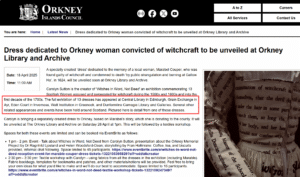
In practical terms, this work has already been on tour and has been exhibited at several venues across Scotland.


Screenshot of the Orkney Islands Council news webpage, ‘Dress dedicated to Orkney woman convicted of witchcraft to be unveiled at Orkney Library and Archive’ (Orkney Islands Council, 2025).


This indicates that the work has a degree of portability and experience with touring exhibitions. It has already been adapted for various spaces, such as libraries and archives, and does not rely solely on large international art museums. Furthermore, since the artist is based in Edinburgh, I believe the logistics of transportation and installation are relatively manageable.


At the same time, Carolyn Sutton’s longstanding engagement with public cultural institutions demonstrates her commitment to education and public discourse, which extends beyond

large institutions. Based on this, I believe a collaboration with her is feasible.


Bibliography

Foster, H. (2004) An Archival Impulse. October. [Online] 110 (110), 3–22.

Zapperi, G. (2013) woman’s reappearance: rethinking the archive in contemporary art—feminist perspectives. Feminist review. [Online] 105 (105), 21–47.

Greenberg, R. (2012) Archival Remembering Exhibitions. Journal of curatorial studies. [Online] 1 (2), 159–177.


Week7-The Triple Goddess as Constructed Framework: From Symbol to Analytical Tool

Based on course feedback, I decided to reexamine my curatorial framework—the Triple Goddess (Maiden–Mother–Crone).


Janet Pérez is a scholar specializing in Spanish literature and mythological symbolism. In her 1987 article, she analyzed how the Triple Goddess operates in literature. She noted that this structure is linked to the three phases of the moon and corresponds to the cycle of birth, maturity, and death. This symbolism emphasizes women’s transformation and temporality rather than a singular identity (Pérez, 1987, pp. 139–141).


Triple Goddess symbol


At the same time, the Triple Goddess is not an ancient symbol of femininity that has survived unchanged to the present day. It is a modern reorganization of mythological sources. This framework largely stems from the British poet and novelist Robert Graves’s reconstruction of mythology (Pérez, 1987, p. 139). In his model, different deities were combined into a single structure (pp. 140–142).


Since the Triple Goddess is not an unquestionable tradition but rather an interpretive framework within a historical context, it must be approached critically. It can be reinterpreted within a contemporary context. In my curatorial practice, I need to decide how to utilize it, rather than allowing it to constrain me.


This leads me to reflect: if I categorize women directly into three distinct phases, am I overlooking the inherent complexity of women’s experiences?


This has led me to explore how the image of the goddess is reinterpreted in contemporary art.


Feminist art critic Gloria Feman Orenstein (1978, p. 72) notes that female artists bring the Great Goddess back into being through the body and ritual. For example, the artist Ana Mendieta imprinted her body onto the earth, merging her body with the land. She (1978, p. 76) experienced the goddess through her own bodily actions We can see that the image of the goddess is not simply replicated, but rather reinterpreted through practice.


It is more like a mode of action—a way of reinterpreting the body and history.


This had a significant impact on my exhibition. I began to reinterpret the Triple Goddess not as “stages of life” but as “spatial structures.” The Maiden, Mother, and Crone no longer represent age, but rather the ways in which women are shaped within different historical contexts. It became an analytical tool rather than a natural law.


Bibliography

Orenstein, G. F. (1988) ‘The Reemergence of the Archetype of the Great Goddess in Art by Contemporary Women’, in Arlene Raven et al. (eds) Feminist Art Criticism. 1st edition [Online]. Routledge. pp. 71–86.

PEREZ, J. (1987) ASPECTS OF THE TRIPLE LUNAR GODDESS IN FUENTES SHORT FICTION. Studies in short fiction. 24 (2), 139–147.