Week13-Designing the Public Programme in Practice
In my Week 6 blog post, I discussed how public programmes can expand the boundaries of an exhibition, mainly at a theoretical level. Now, I want to integrate them more directly into my solo exhibition and consider how they can be organised in practice.
I plan to organise two public programmes: a herbal book and aromatherapy workshop, and a post-exhibition discussion.
Through engaging hands-on activities, I aim to translate the exhibition’s themes into the real world. The workshop is mainly aimed at women, art students, and audiences interested in feminism, bodily experience and historical narratives. It will last no more than 90 minutes. The group should be limited to around 15 to 20 people, because the activity involves touching, smelling, making and discussion. If the group is too large, it may become only a craft class, and participants may find it hard to enter a quiet, reflective state.
I plan to hold the workshop on Saturday afternoon rather than on a weekday. The audience may include students, part-time workers and the general public, so a weekend afternoon may be easier for them to attend.At the same time, Alistair Hudson (2017), director of Middlesbrough Institute of Modern Art, has prompted me to think further about public programmes. He argues that public programmes should not only be extra activities outside an exhibition. They should allow audiences to use the exhibition and bring their own experiences into its themes.
Based on this, I want to include the workshop outcomes in the exhibition. With participants’ permission, I will photograph their works and place the images on the exhibition wall as the final section. This can create a dialogue between the contemporary and the historical.
I will also invite the three artists in the exhibition to take part in a public talk. It will include a guest discussion and an audience Q&A, lasting no more than two hours. I hope to arrange it near the end of the exhibition, so it can review and deepen the project.
This reminds me of the sex education exhibition that I helped organise in 2022. We included a theatre performance and a public talk. Audience feedback showed that the Q&A and discussion were often the most moving parts. They turned personal experiences into public conversation and brought people closer together. Therefore, I decided to design this section carefully.
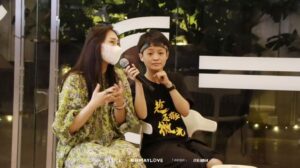
Audience interaction session in the public programme I Have Asked Many People About You (2022). Image source: Maylove, a Chinese sex education organisation.
However, incorporating audience-generated content into the exhibition and having participants discuss their personal experiences on-site raise issues of privacy. Drawing on the research of Jenny Kidd, a scholar in digital culture and museum media studies, and digital producer Rosie Cardiff (2017, pp. 48–49), I decided to take the following measures:
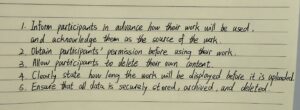
My notes on the design of the public programme. Photograph by Anqi Li, 2026.
Bibliography:
Kidd, J. & Cardiff, R. (2017) ‘A space of negotiation’: Visitor Generated Content and Ethics at Tate. Museum and society. [Online] 15 (1), 43–55.
Hudson, A. (2017) ‘Building a user-generated museum: a conversation with Alistair Hudson’, OpenDemocracy, 5 May. Available at: https://www.opendemocracy.net/en/building-user-generated-museum-conversation-with-alistair-hudson