Week12-Feedback as Collective Curatorial Practice
During this week’s group discussion, I offered suggestions for my peers’ curatorial projects. I found that these suggestions not only helped them refine their projects but also helped me improve my own.
My advice to Houde focused on his online exhibition experience. He designed a website, and from a visitor’s perspective, I believe he needs to consider a few additional questions: Is the page visually appealing? Is it easy to navigate? How long does it take for a visitor to view the entire exhibition?
Unlike physical exhibitions, online exhibitions make it difficult for visitors to focus on a webpage for extended periods. Research by museum marketing scholars Tanja Komarac and Đurđana Ozretić Došen (2024, p. 364) shows that most young visitors spend between 30 and 60 minutes on online exhibitions. When visitors cannot find a suitable browsing rhythm, they lose patience (2024, p. 369). Therefore, an online exhibition is not merely about placing works on a webpage; it also requires consideration of viewing rhythm, navigation paths, and the duration of attention.
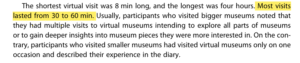
Screenshot from Komarac and Ozretić Došen’s article, “Understanding virtual museum visits: Generation Z experiences” (2024, p. 364).

Screenshot from Komarac and Ozretić Došen’s article, “Understanding virtual museum visits: Generation Z experiences” (2024, p. 369).
Although my personal project is an online exhibition, this reflection has also made me consider how viewers engage with my exhibition. I need to think about how to quickly immerse viewers in the context of “The Witch.” For example, I could include introductory text, consider the spatial sequence, and carefully position the first artwork. By doing so, I can pique viewers’ interest, help them quickly grasp the exhibition’s message, and prevent them from feeling confused.
My advice to Yuexuan concerns limiting the number of visitors to her exhibition. Her work explores emotion and the body, and she influences viewers’ experiences by placing paintings in unconventional locations, such as on the floor or in corners. I believe this approach is very powerful, but it requires controlling the number of visitors. If the space becomes too crowded, viewers will struggle to notice the relationship between their bodies and the artwork, and it will be difficult for them to develop a quiet, contemplative emotional response.
Multimodal and spatial discourse analysis scholar Robert J. McMurtrie (2022, p. 109) points out that, during busy periods, overlapping viewing areas may have a negative effect. One viewer may block another viewer’s direct line of sight. This made me reflect on my own exhibition. I realised that spatial conditions can support the emotional expression of artworks. My exhibition includes moving-image works and darker viewing areas, so I need to control the number of visitors and the speed of movement. Otherwise, the sense of oppression and historical seriousness that I want to create may be weakened by a crowded environment.
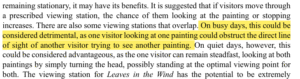
Screenshot from McMurtrie’s article, “Observing, recording, visualising and interpreting visitors’ movement patterns in art museums: A mixed method approach” (2022, p. 109).
Bibliography:
Komarac, T. & Ozretić Došen, Đ. (2024) Understanding virtual museum visits: generation Z experiences. Museum management and curatorship (1990). [Online] 39 (3), 357–376.
McMurtrie, R. J. (2022) Observing, recording, visualising and interpreting visitors’ movement patterns in art museums: A mixed method approach. Multimodality & society (Online). [Online] 2 (2), 93–113.