Speculative Independent Curatorial Project Proposal
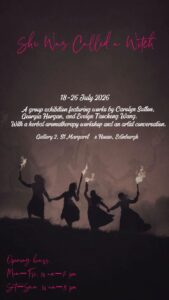
She Was Called a Witch
18–26 July 2026
Opening hours:
Mon–Fri: 10 am–7 pm
Sat–Sun: 10 am–8 pm
curatorial narrative text
A mysterious woman with supernatural power?
A seductive, dangerous, and fascinating figure?
A “sinner” judged by history and burned at the stake?
Or a feminist symbol of resistance?
The “witch” has never been a fixed identity. It is a word that has been repeatedly given new meanings. She is both a projection of fear and the result of being named1. This exhibition therefore asks: what defines a witch?
She Was Called a Witch invites viewers to rethink how language participates in the discipline and oppression of women. It focuses on the shifting meaning of the word “witch”: how it was historically used to identify, exclude, and punish women, and how it has been reclaimed in contemporary culture as a symbol of resistance2.
The exhibition does not simply look back at the history of witch-hunting. Instead, it places this history in a contemporary context. It asks how women artists respond to this past, and how they use different media to rethink the power of language.
The exhibition brings together Carolyn Sutton’s installation Witches in Word, Not Deed, Georgia Horgan’s short film Magic Kills Industry, and Evelyn Taocheng Wang’s painting Witches are Flower Sis. Together, these works lead viewers through a path shaped by the act of “naming.”
Taking place in the gallery at St Margaret’s House, She Was Called a Witch unfolds like an open text. The works form connected “paragraphs” rather than one single story. As viewers move through the space, they read and compare different meanings of the witch.
The exhibition does not offer a final definition of the “witch.” Instead, it asks: if language can name and discipline women, can women also reclaim and transform these words? Through this process of resistance and rewriting, the artists show how women can become subjects who define themselves.
Artists & Participants
Carolyn Sutton is a designer and textile artist based in Edinburgh. She has a strong background in archival research. Her work focuses on social justice, critical heritage, and folklore.
Her work Witches in Word, Not Deed is a commemorative textile installation. It uses a series of individual dresses to remember women in Scottish history who were accused and persecuted as witches. The dresses are printed with words once used to accuse, judge, and stigmatise these women. Through these dresses, Sutton aims to give voice back to women whose voices were taken away. The full work includes 13 dresses. This exhibition will present 4 of them.
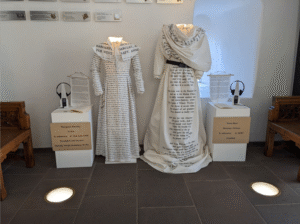
Carolyn Sutton, Witches in Word, Not Deed, installation/project documentation. Image source: Carolyn Sutton, available at: https://carolynasutton.crevado.com/witches-in-word-not-deed
Georgia Horgan is an artist based in Glasgow. She mainly works with moving image and text. Horgan’s practice explores the relationships between women’s labour, history, language, witchcraft, and capitalism.
For this exhibition, I have selected Horgan’s Magic Kills Industry. It is a 34-minute essay film. Its key reference is Silvia Federici’s Caliban and the Witch. The film explores witchcraft, women, textiles, and technology. It understands the “witch” through industry, women’s labour, and capitalist accumulation. It also asks what kinds of women’s knowledge were named as dangerous or illegitimate in history, such as knowledge of birth, healing, and the use of herbs3.
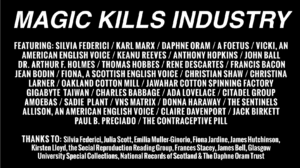
Georgia Horgan, Magic Kills Industry, essay film, 34 min. Image source: Waking the Witch, available at: https://wakingthewitch.uk/magic.html
Evelyn Taocheng Wang was born in China and is now a Dutch artist. Her practice includes painting, performance, writing, and clothing. Her work explores how language, culture, and social norms shape identity4. It often focuses on gender, class, and belonging.Wang often combines personal experience with fictional narratives. Through hand-drawing, writing, and layered images, she examines how identity is constructed and distorted across different cultural and linguistic systems.
Her work Witches are Flowers Sis places scenes of violence against women together with abstract plant patterns. In this work, the “witch” becomes a form of re-expression. Wang connects it with the bodily autonomy of women and gender-queer communities5.
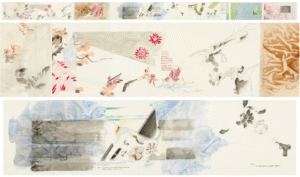
Evelyn Taocheng Wang, Witches are Flower Sis, 2020, ink, watercolor, acrylic and pencil on ripe rice paper, 48.7 × 800 cm. Image source: Antenna Space, available at: http://antenna-space.com/zh/artworks/wangyifulingtaochengwitches-are-flower-sis2020/
Exhibition Space
Venue: Gallery 2, St Margaret’s House, Edinburgh
Address: 151 London Road, Edinburgh, EH7 6AE
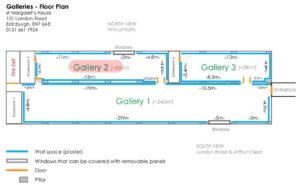
Overall Floor Plan of the Gallery Spaces at St Margaret’s House
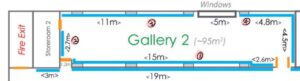
Floor Plan of the Gallery 2
Floor Plan of the Gallery 2
Viewing Route: 1–4
- Carolyn Sutton’s Witches in Word, Not Deed
- Georgia Horgan‘s Kills Industry
- Evelyn Taocheng Wang‘s Witches are Flowers Sis
- Photographs of herbal books made by participants in the public programme.
Public Programme Layout:
The central area of Gallery 2 can be temporarily adjusted outside exhibition hours for the workshop and public conversation.
The workshop will take place during a specific time after the gallery closes. Movable tables and chairs will be placed in the centre of Gallery 2. After the activity, the furniture will be removed and the exhibition route will be restored.
The public conversation will take place on the last day of the exhibition. It will use the central area of Gallery 2. Chairs will be temporarily arranged facing the video wall.
Accessibility:
The layout will create a clear one-way viewing route6. Enough space will be left between the works to support wheelchair access.
Seats will be provided in the video area at Position 2, so viewers can stay and watch the film comfortably.
The public programme will use movable tables and chairs. After each event, the space will be restored to ensure smooth circulation for visitors.
Disabled parking is available in the area. Visitors with specific access needs should contact the venue in advance to confirm support.
Exhibition labels will use clear bilingual text in Chinese and English. Audio guides will also be provided.
Public Programme
The public programme allows viewers to bring their own experiences into the exhibition7. It also encourages deeper reflection on how language disciplines women. The programme includes a hands-on workshop and a public conversation.
The hands-on workshop will be led by me and will last about 90 minutes. Participants will use plants such as lavender and basil to make scented objects. They will also use kraft paper, thread, and paint to create their own herbal book. The aim is not to produce a “mysterious” or entertaining image of the witch. Instead, the workshop asks participants to notice the everyday nature of these actions. Women in history carried out similar practices, but they were named as witches. Through making, participants can understand the relationship between naming, knowledge, and women’s bodies in a more practical way.At the end of the workshop, participants can take their works home. With their consent, photographs of the works will be shown on the final wall of the exhibition. They will become contemporary responses to the history of witch-hunting.
The public conversation will take place on the last day of the exhibition. It will summarise and deepen the project. I will host the event and invite the three exhibiting artists to take part. The discussion will focus on the artists’ positions within feminist expression, their approaches to making, and how they understand the figure of the “witch.” Due to distance, Evelyn Taocheng Wang will join online. The event will last about 2 hours and will include a guest conversation and audience Q&A.
Curatorial Rationale
This project takes “how the witch is produced through language” as its central question. It looks back at historical witch-hunting and asks how language has been used to name, stigmatise and discipline women. The exhibition does not simply present the witch as a symbol of female power. It also does not reduce witch-hunting to a general story of women’s suffering. Instead, it considers how the word “witch” has been used, translated and rewritten across different contexts.
The project will take the form of an offline thematic group exhibition. It uses thematic, archival and feminist curatorial methods. Since the subject involves historical violence, bodily experience, language and contemporary feminist responses, it cannot be fully addressed through one artist alone. I have selected three artists who approach the topic through text, moving image and embodied experience. Their works create dialogue and contrast. The creative aim is to treat the exhibition space as a readable field of language. Viewers move between artworks, texts, images and discussion, and gradually understand how language produces power.
The exhibition will be organised into three connected sections. The first section begins with historical naming and accusation. It shows how the witch was produced through language. The second section turns to contemporary artistic responses and explores the female body, memory and resistance. The third section extends the project through a public programme, such as a workshop or talk. This invites audiences to reflect on gendered naming and shaming in everyday life.
The exhibition is aimed at general gallery visitors, art students, feminist audiences, and people interested in witch-hunting history, women’s knowledge, language, and gender politics.
I have chosen Gallery 2 at St Margaret’s House because its scale suits a small to medium-sized group exhibition and allows a clear viewing route. The exhibition will last for one week, which is realistic for the budget and organisation. Ethically, it will avoid romanticising the witch or turning trauma into visual consumption. Accessibility will be supported through a clear route, seating, bilingual texts and an audio guide.
Budget
| Expenditure | Cost |
| Artist Fees (3 × £700) | £2,100 |
| Paying-Artists-Exhibition-Payment-Guide.pdf | — |
| Artist Talk Fees | £300 |
| Recommended Rates of Pay (RRoP) | Scottish Artist Union | — |
| Artist Travel Expenses | £500 |
| Evelyn Taocheng Wang will participate online | — |
| Public Programme Materials | £200 |
| Artwork Transport | £1,000 |
| Installation: wall construction, paint, curtains and contingency costs | £400 |
| Marketing and Publicity | £300 |
| Cleaning Fee | £300 |
| Exhibition Space Rental | — |
| Weekly Gallery Hire Fee (1 week × £100) | £100 |
| Guide to Galleries – Scot-ART | — |
| Equipment | £300 |
| Projector | — |
| Chairs × 4 | — |
| Tables × 2 | — |
| Total | £5,500 |
| Income | |
| Open Fund for Individuals | £5500 |
| Open Fund for Individuals | Creative Scotland |
Reference List
- Bovenschen, S. (1978) ‘The contemporary witch, the historical witch and the witch myth: the witch, subject of the appropriation of nature and object of the domination of nature’, New German Critique, 15, pp. 83– Available at: https://doi.org/10.2307/487908.
- Zwissler, L. (2018) ‘I am that very witch: on The Witch, feminism, and not surviving patriarchy’, Journal of Religion & Film, 22(3), article 6. Available at: https://doi.org/10.32873/uno.dc.jrf.22.03.06
- Federici, S. (2022) Caliban and the witch: women, the body and primitive accumulation. London: Penguin Books. Available at: https://www.penguin.co.uk/books/321857/caliban-and-the-witch-by-federici-silvia/9780241532539 (Accessed: 26 April 2026).
- Lambo, A. (2025) ‘Evelyn Taocheng Wang doesn’t play by tradition’, Frieze, 18 November. Available at: https://www.frieze.com/evelyn-taocheng-wang-profile (Accessed: 26 April 2026).
- Crenshaw, K.W. (2021) ‘Demarginalizing the intersection of race and sex: a Black feminist critique of antidiscrimination doctrine, feminist theory and antiracist politics’, Droit et société, 108(2), pp. 465– Available at: https://doi.org/10.3917/drs1.108.0465.
- McMurtrie, R.J. (2022) ‘Observing, recording, visualising and interpreting visitors’ movement patterns in art museums: a mixed method approach’, Multimodality & Society, 2(2), pp. 93–
- O’Neill, P. and Wilson, M. (eds.) (2010) Curating and the educational turn. London: Open Editions.