Week9-How Exhibition Atmosphere Shapes Thematic Expression
During the group discussion at Summerhall, a member once again pointed out an issue with my work: even though the exhibits were clearly arranged, the exhibition lacked a strong connection to the theme of “witches.” She suggested that I could deepen the exhibition’s connection to witches by creating a specific atmosphere within the venue. This suggestion made me wonder: Is the atmosphere of an exhibition merely a visual complement, or is it a mechanism capable of generating meaning?
Gadsby (2014, p. 131) notes that an increasing number of contemporary museums are drawing inspiration from theatrical set design. These museums use lighting, sound, and spatial arrangements to enhance visitors’ emotional engagement. Consequently, the atmosphere of a venue is not merely a backdrop but a mechanism that can guide visitors. In thematic exhibitions, spatial design that aligns with the narrative enhances coherence, making it easier for visitors to immerse themselves in the theme (Dong, 2024, p. 598).
This is evident in the The Viking Sorceress exhibition. The exhibition divides the space into distinct zones, each serving a different narrative function. This aligns with the Triple Goddess framework I employ. The Viking Sorceress employs interactive guidance, audio narration, and scene reenactments to draw visitors “into the story” rather than simply having them observe from the sidelines. This experiential design changes the way visitors go, allowing them not only to read information but also to “experience the worldview.” This approach helps visitors understand the complexity of the sorceress figure throughout history.
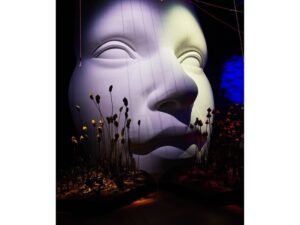
The face of a vølve or seer, part of the new “The Viking Sorceress” exhibition at the Danish National Museum. (Roberto Fortuna/Denmark’s National Museum)
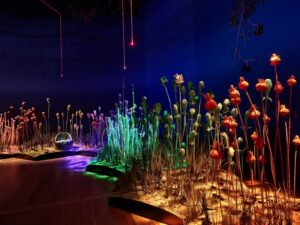
The Danish National Museum’s new exhibit features depictions of plants supposedly used to create drugs for psychoactive experiences lead by vølver. (Roberto Fortuna/Denmark’s National Museum)
However, this also made me realize a problem: while atmosphere can enhance understanding, it can also obscure structure.
Unlike theaters, museums risk undermining the transmission of knowledge if their scenography overemphasizes emotional impact (Gadsby, 2014, pp. 136–138). Dong (2024, pp. 598–600) also notes that if thematic spaces lack a clear hierarchy, visual elements can become distracting.
My exhibition explores “historical accusations against witches through language, and contemporary language’s disciplining of women.” This means that the “witch-like atmosphere” I create cannot be limited to mysterious music and dim lighting. I do not wish to merely evoke a sense of mystery; rather, I aim to use the atmosphere to reinforce the theme. For example, I plan to use sound to repeat historical accusations and employ projections to show how text covers the body. This prompts viewers to reflect on how language has become a tool for disciplining women.
As a curator, I need to ensure that the atmosphere of the space serves the message I wish to convey, rather than imposing a predetermined emotional response on the audience. My intention is to create an immersive atmosphere that guides reflection, rather than replacing it.
Bibliography:
Gadsby, J. (2014) Scenography in museum design : an examination of its current use, and its impact on visitors’ value of experience. Birmingham City University.
Rak, J. et al. (2024) ‘Study on the Strategy of Creating the Atmosphere ofThematic Exhibition Space–A Comparative Study of the “Garden” and “V&A Alice inWonderland” Exhibitions, for Example’, in Proceedings of the 3rd International Conference on Culture, Design and Social Development (CDSD 2023). France: Atlantis Press (Zeger Karssen). p.